May 21, 2026
India's Coal Governance Dilemma: When Public Sector Survival Meets Market Reform
Few policy disputes reveal the structural tensions inside India's energy governance as sharply as the battle over coal block allocation. Across the country, the push toward competitive commercial auctions has reshaped how coal resources are distributed, transferring decision-making power from administrative processes to market mechanisms. Yet for state-linked coal producers with geographically concentrated operations, this shift carries existential weight that purely market-driven frameworks were never designed to resolve.
It is within this context that Telangana Deputy Chief Minister Bhatti Vikramarka's meeting with Union Coal and Mines Minister G. Kishan Reddy in New Delhi carries significance well beyond a routine administrative exchange. The discussions, which covered new coal block allocations, coal gasification opportunities, and the stalled mining lease for Tadicherla Coal Block-II, represent a formal articulation of the fault lines running through India's coal sector governance. Furthermore, Bhatti urges Kishan to allocate new coal blocks for SCCL is a request that signals deeper systemic pressures beneath the surface of this single political exchange.
When big ASX news breaks, our subscribers know first
SCCL's Structural Position: Why Geographic Concentration Changes Everything
Singareni Collieries Company Limited operates as a joint venture between the Telangana state government and the Government of India, functioning as the primary domestic coal supplier for thermal power stations across South India. Its operations are anchored entirely within the Godavari Valley Coal Fields, a historically productive coal-bearing region that stretches through Telangana's eastern districts.
This geographic concentration is the defining factor that makes every block allocation decision disproportionately consequential for SCCL. Unlike Coal India, which draws on reserves spread across multiple states and coalfields, SCCL's operational continuity is tightly bound to a single geological corridor. Consequently, the coal supply challenges SCCL faces are fundamentally different in nature from those confronting nationally distributed operators.
| Dimension | Coal India | SCCL |
|---|---|---|
| Geographic Spread | National (multiple coalfields) | Regional (Godavari Valley, Telangana) |
| Ownership Structure | Central Government | Joint: Telangana State + Centre |
| Block Access | National framework priority | Dependent on state-centre negotiation |
| Gasification Progress | Advanced pilot projects underway | Planning and advocacy stage |
| Workforce Scale | ~250,000+ employees | Tens of thousands (Telangana-concentrated) |
The company employs tens of thousands of workers directly, making it one of Telangana's largest public-sector employers. Any significant contraction in its reserve pipeline does not merely affect corporate production targets; it threatens livelihoods, regional power supply, and the broader industrial ecosystem built around the Godavari Valley coal corridor over more than a century of operations.
Key Insight: SCCL's situation illustrates a systemic risk that applies to any geographically concentrated, state-linked coal producer. As existing reserves mature, the pipeline of replacement blocks becomes existential rather than merely strategic. Each delayed or redirected block allocation has consequences that compound over time.
The Auction vs. Direct Allocation Fault Line
How India's Coal Distribution Framework Operates
India's coal block distribution framework operates through two primary channels. The first is competitive commercial auction, open to both private and public entities, where the highest bid determines allocation. The second is administrative direct allocation, historically reserved for designated public sector undertakings operating in the national or strategic interest.
The 2014 Supreme Court cancellation of hundreds of previously allocated coal blocks, followed by the Coal Mines (Special Provisions) Act 2015, fundamentally restructured how blocks are distributed, tilting the framework strongly toward competitive auctions. While this shift introduced greater transparency and fiscal returns to state governments through auction revenues, it also created a new vulnerability for state-owned coal companies that had previously relied on administrative allocation to maintain operational continuity.
Telangana's position is that applying a uniform auction framework to blocks located within or adjacent to SCCL's existing mining corridor treats a strategic public sector operator the same as a speculative private bidder, which the state argues produces perverse outcomes for regional energy security. In addition, broader coal market pricing dynamics add further complexity to the value calculations underpinning these allocation decisions.
The Koyagudem Block-III Case
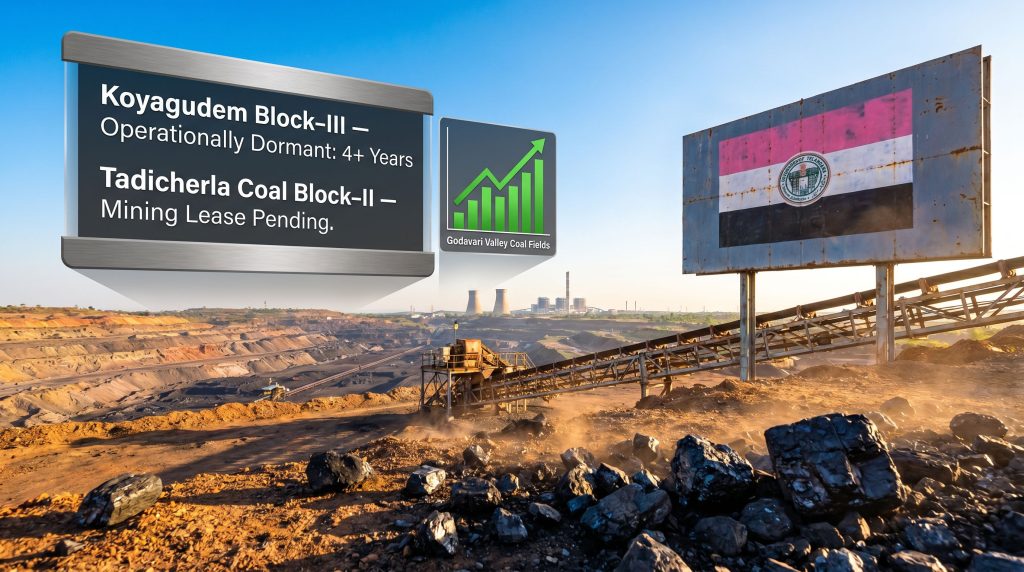
The Koyagudem Block-III situation is cited as the clearest evidence for this argument. Located within the Godavari Valley Coal Fields and identified as critical for meeting Telangana's power generation requirements, the block was allocated through an auction process. Yet more than four years after that allocation, not a single tonne of coal has been extracted. Bhatti Vikramarka formally raised this with G. Kishan Reddy, arguing that the auction outcome has produced no tangible energy benefit for the state and requesting that the block be reassigned to SCCL.
This is not an insignificant observation. A four-year operational void following competitive allocation raises legitimate questions about whether auction winners in geographically complex coalfields consistently possess the operational infrastructure needed to rapidly convert block ownership into production. SCCL, with its existing logistics networks, workforce, and mine development expertise in the Godavari Valley, could theoretically commence operations at adjacent blocks far more rapidly than a new entrant building from zero.
Tadicherla Coal Block-II: The Mining Lease Bottleneck
A separate but related pressure point concerns Tadicherla Coal Block-II, where SCCL has already invested in pre-mining activities and geological exploration work. The block sits in a state of operational readiness without the formal mining lease that would allow extraction to commence.
This scenario illustrates a lesser-discussed friction in India's coal governance: the gap between block identification, exploration investment, and final lease grant. Companies can invest significant capital in geological assessment and site preparation only to find the regulatory process for formalising the mining lease moves on a different timeline entirely. For a public sector company managing long-term reserve replacement, this kind of bottleneck creates planning uncertainty that compounds over multiple blocks simultaneously.
Bhatti's appeal to accelerate the Tadicherla mining lease process was framed specifically around SCCL's future production requirements and Telangana's medium-term energy security. With pre-mining groundwork already completed, the delay represents sunk cost without yield rather than a genuine pending evaluation.
Coal Gasification: SCCL's Modernisation Pathway
What Is Coal Gasification and Why Does It Matter?
Beyond immediate block allocation concerns, the New Delhi discussions opened a longer-horizon conversation about coal gasification as SCCL's most credible pathway toward industrial modernisation and value-addition.
Coal gasification is a thermochemical process that converts coal into synthetic gas, or syngas, through a reaction with oxygen and steam at high temperatures. The resulting syngas — primarily a mixture of hydrogen, carbon monoxide, and carbon dioxide — can be used as a clean-burning fuel, as a feedstock for fertiliser production through ammonia synthesis, or as a building block for methanol and other industrial chemicals. This dramatically expands coal's economic utility beyond its conventional role as a combustion fuel for power generation.
India's Union government has been advancing coal gasification as a national industrial priority, with Coal India already progressing pilot projects. The broader policy goal is to reduce India's import dependency on fertiliser feedstocks and industrial chemicals by developing domestic coal-to-chemicals capacity. However, the coal policy intervention examples emerging internationally also demonstrate how purposeful government support can accelerate these transitions when deployed strategically.
SCCL's interest in participating in this transition is grounded in a multi-dimensional value proposition:
- Energy security: Diversifying coal's end-use reduces exposure to the long-term structural decline in thermal power demand as renewables scale up
- Industrial integration: Syngas as a fertiliser feedstock addresses a genuine import substitution opportunity relevant to South India's agricultural economy
- Employment transition: Gasification plants require a different but substantial technical workforce, providing a potential redeployment pathway as conventional mining evolves
- Technological relevance: Aligning with India's coal gasification framework positions SCCL as a forward-looking entity rather than a legacy operator managing decline
Bhatti specifically requested that the Ministry of Coal extend technical guidance, policy support, and facilitation to link SCCL's gasification initiatives with centrally sponsored schemes, following frameworks already being developed for Coal India's projects.
| Benefit Dimension | Expected Outcome |
|---|---|
| Energy Security | Diversifies coal utility beyond thermal power generation |
| Industrial Value | Syngas as feedstock for fertilisers and industrial chemicals |
| Employment | Technical and operational roles in gasification facilities |
| Import Substitution | Reduces reliance on imported fertiliser feedstocks |
| Long-Term Viability | Positions SCCL within India's coal-to-chemicals industrial strategy |
The Political Geometry of the Standoff
What elevates this beyond a standard state-centre administrative negotiation is the political architecture surrounding it. G. Kishan Reddy is himself a Telangana-origin political leader, which creates an implicit regional solidarity dimension to the appeal. Bhatti's framing carries an unspoken acknowledgment that a minister from Telangana occupies a unique position to advocate for the state's most significant public sector industrial asset.
Separately, the proposed all-party delegation to New Delhi to press the case on the Sravanapalli block — which Telangana's Congress and BRS parties are backing jointly in opposition to its potential auction — reflects an unusual degree of political consensus within the state. SCCL's welfare has effectively become a cross-party issue, a rare alignment that itself signals how deeply embedded the company is in Telangana's collective economic identity.
The Sravanapalli block dispute follows the same logic as the Koyagudem argument: that blocks positioned within SCCL's operational geography should not be subjected to competitive bidding that could transfer them to parties without the existing infrastructure to develop them efficiently. Furthermore, mining industry consolidation trends globally suggest that operational adjacency and infrastructure proximity are increasingly recognised as material factors in determining who can most efficiently develop a given resource.
The next major ASX story will hit our subscribers first
What the Centre's Response Signals for India's Coal Policy
A Constructive but Uncommitted Opening
G. Kishan Reddy's response to the discussions was constructive rather than dismissive. He committed to convening a joint meeting involving Central officials, Telangana state representatives, and SCCL leadership to address three specific agenda items: SCCL's coal gasification roadmap, the Koyagudem Block-III allocation, and the Tadicherla Coal Block-II mining lease.
The significance of this commitment should not be overstated in either direction. It represents openness to a negotiated resolution, not a pre-commitment to any particular outcome. The substantive decisions emerging from that joint meeting will carry the real policy weight.
However, the framing matters. A structured multi-stakeholder forum with a defined agenda suggests the Centre views SCCL's concerns as legitimate governance questions rather than political lobbying. How the Union Ministry of Coal ultimately responds will set a precedent with implications extending well beyond Telangana.
A positive outcome for SCCL could establish that state-linked public sector coal companies with demonstrated operational capacity in specific geographies hold a preferential claim over blocks within those corridors, relative to commercial auction winners who lack equivalent infrastructure. Conversely, maintaining the auction-first framework signals that market-based allocation will not bend to operational convenience arguments, regardless of the public sector claimant.
The Long-Term Energy Security Dimension
South India's thermal power capacity relies heavily on SCCL's output as a geographically proximate, domestically sourced coal supply. The alternative to SCCL's continued production growth is not seamless substitution; it is a combination of increased coal imports, more distant Coal India supply chains with higher logistics costs, and accelerated renewable deployment — the latter still not advanced enough to absorb baseload demand without stability risks.
The decisions made in the coming months regarding Koyagudem Block-III, Tadicherla Coal Block-II, and SCCL's gasification pathway will shape the company's production capacity not just for the next budget cycle but for the next two decades. Block development timelines in coal mining are measured in years; mining leases, environmental clearances, infrastructure construction, and workforce ramp-up create long lead times between allocation and production.
This is why the urgency in Bhatti's New Delhi discussions carries genuine policy weight. Each year of delay in securing replacement blocks is a year closer to a production plateau that SCCL's current reserve base cannot indefinitely sustain. In addition, the India coal trading exchange proposal under discussion nationally adds another layer to how India's coal governance architecture may evolve, potentially affecting price discovery and supply access for state-linked producers like SCCL.
The keyword framing of this debate, captured in the political shorthand that Bhatti urges Kishan to allocate new coal blocks for SCCL, understates what is actually a multi-layered governance question about how India balances market-based resource distribution, regional energy security, and the long-term viability of state-linked industrial anchors in economically significant but geographically bounded coal regions.
Disclaimer: This article is intended for informational purposes only and does not constitute financial, investment, or policy advice. References to future outcomes, timelines, and regulatory decisions involve inherent uncertainty. Readers should consult primary sources and qualified advisors for decisions related to energy policy or investment.
Want to Stay Ahead of Major Mineral Discoveries Before the Broader Market?
Discovery Alert's proprietary Discovery IQ model delivers real-time alerts on significant ASX mineral discoveries, transforming complex geological data into actionable investment insights for both short-term traders and long-term investors — explore historic examples of exceptional discovery returns to understand the opportunity, then begin your 14-day free trial at Discovery Alert to secure your market-leading edge.