May 21, 2026
The Compaction Bottleneck: Why Pressing Is the Hidden Constraint in Titanium Powder Metallurgy Scale-Up
Spend enough time studying advanced manufacturing scale-ups and a consistent pattern emerges: the most capital-intensive equipment rarely defines the production ceiling. More often, it is the intermediate processing step, the one that sits between feedstock generation and final densification, that determines whether a factory actually ships parts or simply accumulates powder. In titanium powder metallurgy, that intermediate constraint is compaction. Getting it right, at volume, with the geometric precision that defense and aerospace customers require, is one of the least-discussed but most consequential engineering challenges in the US titanium supply chain.
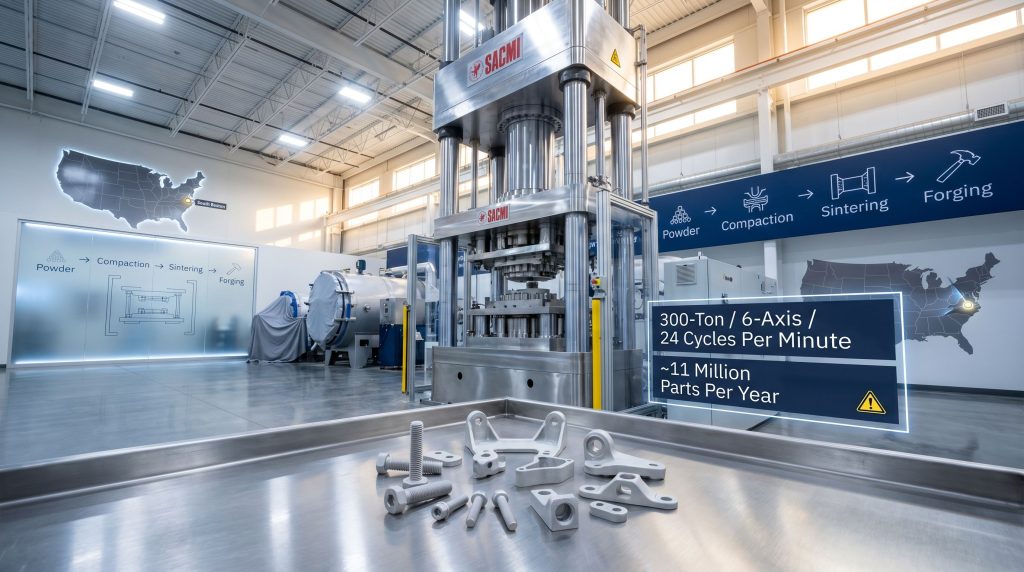
IperionX SACMI press commissioning at the company's South Boston, Virginia campus represents a direct attempt to resolve exactly this constraint. Understanding what the press actually does, how six-axis compaction differs from conventional approaches, and where this equipment sits within the broader production architecture requires moving well beyond the headline capacity figures and into the engineering mechanics.
When big ASX news breaks, our subscribers know first
What Powder Metallurgy Actually Requires Before a Part Becomes a Part
Most discussions of titanium manufacturing begin with the finished component and work backwards. The more instructive starting point is the powder itself, because the entire value chain hinges on transforming a fine metallic powder into a dimensionally accurate, mechanically consistent solid object without the energy penalties and material waste that define conventional processing routes.
In standard titanium manufacturing, the sequence runs from titanium sponge through vacuum arc remelting to produce ingots, which are then worked into billet stock and finally machined into components. Each stage introduces thermal history, microstructural variability, and significant material loss. The buy-to-fly ratio, which measures the weight of raw input material against the weight of the finished part, can reach 10:1 or higher for complex aerospace components machined from billet. That means nine kilograms of expensive titanium becomes chips on the factory floor for every one kilogram of useful output.
Powder metallurgy changes this equation structurally. The process sequence compresses to:
- Powder production via a reduction process (in IperionX's case, HAMR, or Hydrogen Assisted Metallothermic Reduction)
- Compaction of powder into a green preform at near-net-shape dimensions
- Sintering and forging to densify the preform and develop final mechanical properties
- Inspection and qualification before parts enter the customer supply chain
The critical insight that investors and observers often miss is that the green preform produced at the compaction stage is not a finished component. It is a fragile, porous intermediate with limited mechanical strength. Its commercial value is zero until it passes through sintering and forging. However, the dimensional accuracy and density uniformity of the green preform directly determine whether the sintered and forged output will meet the tight tolerances that aerospace and defense metal applications demand.
Process Engineering Insight: In powder metallurgy, defects introduced at the compaction stage propagate through sintering. A poorly compacted preform with density gradients will produce a sintered part with inconsistent microstructure, regardless of how well the furnace is controlled. Pressing quality is a prerequisite, not a secondary concern.
How the SACMI Six-Axis Press Differs From Conventional Uniaxial Compaction
Conventional powder presses apply force from a single axis, typically from above and below the die cavity simultaneously. This uniaxial approach works well for simple, symmetrical geometries like flat discs or short cylinders. For anything more complex, including the fasteners, brackets, gears, and actuator components that defense supply chains require in volume, uniaxial pressing creates density gradients across the part because powder cannot redistribute laterally under single-direction loading.
The SACMI press installation addresses this through simultaneous multi-directional force application across six independent axes. The engineering implications are substantial:
- Uniform green density distribution across complex three-dimensional geometries, reducing the sintered dimensional variation that disqualifies parts from tight-tolerance applications
- Broader geometric capability, enabling part families that would otherwise require additive manufacturing (with its throughput limitations) or extensive machining from billet (with its material waste penalties)
- Improved repeatability across high-cycle production runs, because multi-axis compaction reduces the sensitivity of green density to minor variations in powder fill
- Higher compaction force rating at 300 metric tons, enabling the pressing of larger cross-section parts that lower-tonnage equipment cannot consolidate to adequate green density
The cycle rate capability of up to 24 cycles per minute under single-cavity tooling conditions translates mathematically to approximately 11 million parts per year on a continuous operation basis. This figure has attracted significant attention, but it warrants careful interpretation.
Critical Distinction: The 11 million parts per year figure is an engineering ceiling derived from maximum cycle rate and idealised continuous operation. Defence and aerospace-qualified component production incorporates qualification hold periods, tooling changeovers, scheduled maintenance, and process verification sampling that materially reduce effective annual output. Treating this number as a production forecast would misrepresent the operational reality of certified component manufacturing.
Furthermore, multi-cavity tooling configurations can push throughput higher for simpler geometries like fasteners, where identical cavities can be pressed simultaneously. For complex structural components requiring individual die configurations, single-cavity operation and longer qualification cycles reduce throughput accordingly.
The Five-Step Process: From Powder to Qualified Green Preform
The compaction sequence on the SACMI press follows a defined process flow that determines downstream quality outcomes at each stage:
- Powder dosing – HAMR-derived titanium powder is precisely metered into the die cavity. Fill weight consistency directly affects green density uniformity across production lots.
- Multi-axis compaction – Six independent punches apply simultaneous force vectors, consolidating the powder into a coherent preform with near-net-shape external dimensions.
- Controlled ejection – The green preform is released from the die using controlled ejection sequences that minimise stress cracking in the fragile pre-sintered structure.
- Green stage inspection – Dimensional checks and density measurements confirm that each preform meets the specification window before advancing to the furnace queue.
- Furnace transfer – Qualified preforms are staged for HSPT sintering and forging, the downstream densification and mechanical property development stages.
Virginia Campus Architecture: How the SACMI Press Fits the Full Production Chain
The South Boston campus is being constructed as an integrated powder-to-component platform, with each production stage co-located on a single site. This architectural decision carries engineering and commercial significance that distributed supply chains cannot replicate.
The three primary stages on campus map as follows:
| Production Stage | Technology | Status |
|---|---|---|
| Powder generation | HAMR (Hydrogen Assisted Metallothermic Reduction) | Operational and scaling |
| Component forming | SACMI 300-ton six-axis press | Commissioned |
| Densification | HSPT sintering and forging furnaces | Scheduled arrival, June 2026 quarter |
The upstream context matters here. HAMR powder output at the Virginia facility reportedly climbed from approximately 0.8 metric tons per month in late 2025 to approximately 4.3 metric tons per month by the March 2026 quarter. That is roughly a fivefold increase in feedstock availability over the preceding quarters. The IperionX SACMI press commissioning is the logical downstream response to this upstream volume growth: without forming capability, accumulated powder has no route to commercial output.
Co-locating all three stages on a single campus reduces handling risk for the fragile green preform stage, enables tighter feedback loops between compaction parameters and sintered outcomes, and accelerates qualification cycling by eliminating the transportation and chain-of-custody complexity that plagues distributed titanium supply chains. In addition, this integrated model aligns with the broader Titan Project milestone objectives that IperionX has been working towards.
Operational Reality Check: The press removes the compaction bottleneck. However, manufacturing throughput is determined by the slowest constraint in the entire sequence. Until the HSPT sintering and forging furnaces arrive and are commissioned, headline pressing capacity cannot translate into finished component output. The full production loop closes in mid-2026.
The Qualification Gap: Why Press Commissioning Is a Starting Line, Not a Finish Line
One of the least-understood aspects of defence and aerospace component supply chains is that equipment commissioning and customer qualification operate on entirely different timelines. Commissioning confirms that a piece of equipment can produce parts to a geometric specification. Qualification confirms that a manufacturing process consistently produces parts that meet a customer's mechanical, metallurgical, and dimensional requirements across extended production lots.
The distinction has direct implications for how the IperionX SACMI press commissioning should be interpreted:
| Qualification Stage | Primary Activity | Typical Duration | Output |
|---|---|---|---|
| Prototype pressing | Initial geometry validation runs | 4–8 weeks | Sample parts for customer review |
| Customer mechanical testing | Dimensional, fatigue, and metallurgical testing | 8–16 weeks | Test report and specification feedback |
| Process refinement | Tooling and parameter adjustment cycles | 4–8 weeks | Revised sample lots |
| Low-Rate Initial Production qualification | Extended runs with statistical process sampling | 12–20 weeks | Formal qualification package |
| Production contract | Customer procurement decision | Variable | Repeat purchase orders at volume |
In aerospace and defence supply chains, the interval between a prototype purchase order and a volume production contract typically spans 12 to 24 months of process validation, depending on component criticality and the customer's qualification protocols. Early-stage customer engagements at the prototype level validate part geometry and material properties but do not establish the process repeatability data that production contracts require.
The press commissioning enables qualification cycling to begin in earnest. It does not, however, complete the qualification process. This distinction is critical for accurately framing what the press commissioning milestone actually represents in the context of the Virginia platform's commercial development trajectory. For further context, understanding the role of a definitive feasibility study in resource projects illustrates how milestone completion and commercial readiness operate on separate timelines.
The next major ASX story will hit our subscribers first
Reshoring Titanium Forming Capacity: The Structural Manufacturing Argument
Why Conventional Routes Create Supply Chain Vulnerability
Conventional titanium processing requires large-scale infrastructure. Vacuum arc remelting furnaces, electron beam cold hearth melters, and the sponge production facilities that feed them represent enormous fixed capital investments that are geographically concentrated in a small number of countries. This concentration creates supply chain vulnerability for defence procurement systems that depend on multi-stage offshore processing before titanium reaches component form.
Powder metallurgy routes structurally decouple component manufacturing from smelting infrastructure. A pressing and sintering facility does not require co-location with a sponge production plant or a melting operation. This decoupling enables a smaller-footprint domestic manufacturing model that is economically viable at moderate production volumes and does not depend on the scale economics that historically justified offshore concentration.
The comparative manufacturing economics across three primary titanium processing routes illustrate the structural position powder metallurgy occupies:
| Attribute | Conventional Wrought | Powder Metallurgy | Additive Manufacturing |
|---|---|---|---|
| Supply chain stages | 5–6 | 3–4 | 2–3 |
| Buy-to-fly ratio | High (up to 10:1 for complex parts) | Low (near-net-shape) | Very low |
| Domestic facility footprint | Large (smelting infrastructure required) | Moderate (press and furnaces) | Small (printer and powder) |
| Volume throughput capability | High | High (with multi-cavity tooling) | Low to moderate |
| Part complexity ceiling | Moderate | High (with multi-axis pressing) | Very high |
| Qualification pathway maturity | Established | Developing | Early-stage for structural parts |
How Near-Net-Shape Economics Change the Domestic Viability Equation
The near-net-shape characteristic of powder metallurgy is particularly significant in higher-cost domestic manufacturing environments. When buy-to-fly ratios of 10:1 are eliminated and replaced with ratios approaching 1.1:1 or 1.2:1, the material cost reduction partially offsets the labour cost differential between domestic and offshore production. Understanding mining economics basics helps contextualise why input cost efficiency at each processing stage is so consequential for overall project viability. At scale, this dynamic makes domestic powder metallurgy economically competitive in ways that conventional machining-intensive routes are not.
The Three-Stage Validation Framework for 2026
The Virginia platform's maturity can be assessed against three sequential validation stages, each of which must be completed before the next unlocks meaningful commercial output.
Stage 1: Equipment Commissioning (Current Phase)
- SACMI press operational and producing qualified green preforms
- Process parameters established for initial targeted part families
- Green density and dimensional repeatability confirmed across initial production runs
Stage 2: Full Process Loop Closure (Target: Mid-2026)
- HSPT sintering and forging furnaces installed and commissioned at the Virginia campus
- Press-sinter-forge sequence validated end-to-end for at least one customer-relevant part family
- First qualification lots produced through the complete process chain for customer submission
Stage 3: Customer Contract Conversion (Target: H2 2026 and Beyond)
- Prototype-stage customer engagements advancing through qualification packages toward Low-Rate Initial Production contracts
- Repeat purchase orders received at volumes sufficient to demonstrate repeatable process economics
- Revenue contribution from the Virginia platform becoming commercially material
The pace at which Stage 2 transitions to Stage 3 will be shaped by factors outside the direct control of any single facility: customer qualification cycles, defence procurement timelines, and the statistical process control data accumulated across extended production runs. Consequently, the SACMI press commissioning advances Stage 1 to completion and creates the preconditions for Stage 2, but it cannot accelerate the customer-side qualification timelines that govern Stage 3.
Frequently Asked Questions: IperionX SACMI Press Commissioning
What does the SACMI press do at IperionX's Virginia facility?
The SACMI press is a 300-ton, six-axis powder metallurgy compaction machine that compresses HAMR-derived titanium powder into shaped green preforms. These preforms subsequently undergo HSPT sintering and forging to become finished titanium components.
Why does six-axis compaction matter for defence and aerospace components?
Multi-axis pressing produces more uniform green density distribution across complex geometries compared to conventional uniaxial pressing. This translates directly to more consistent sintered dimensions and mechanical properties, which are prerequisites for components that must meet tight aerospace and defence tolerances.
What does the 11 million parts per year figure actually represent?
It represents the theoretical engineering ceiling based on the press's maximum cycle rate of 24 cycles per minute under single-cavity tooling and continuous operation. Real-world throughput for defence-grade qualified components will be materially lower once qualification holds, tooling changeovers, and maintenance schedules are factored in.
When will the full production loop from powder to finished component be operational?
IperionX has indicated that HSPT sintering and forging furnaces are scheduled to arrive during the June 2026 quarter. Once commissioned, these furnaces complete the end-to-end powder-to-component pathway on the Virginia campus. The company's latest presentation outlines the full roadmap for this transition.
What is the difference between pressing capacity and production output?
Pressing capacity refers to the throughput capability at the compaction stage only. Total production output is governed by the lowest-throughput stage in the full press-sinter-forge sequence. Until sintering furnace capacity matches pressing capacity, the headline pressing numbers will not translate into equivalent finished component volumes.
How long does defence component qualification typically take after pressing begins?
In aerospace and defence supply chains, the path from a prototype purchase order to a volume production contract typically spans 12 to 24 months, depending on component criticality, customer qualification protocols, and the number of process refinement cycles required.
What the Press Commissioning Confirms and What It Does Not
The IperionX SACMI press commissioning marks a genuine advancement in the Virginia platform's manufacturing readiness level. Three production stages — powder generation, component forming, and densification — are now either operational or in near-term commissioning. The integrated single-campus architecture positions the facility as a functionally complete powder-to-component platform once the sintering and forging furnaces arrive.
The variables that will ultimately determine platform performance extend beyond equipment commissioning milestones:
- Sintering and forging furnace throughput alignment with the pressing capacity now in place
- The duration of customer qualification cycling across targeted defence and aerospace part families
- The rate at which prototype-stage customer engagements convert to repeat volume production contracts
- Process yield rates across the full press-sinter-forge sequence under sustained production conditions
For observers tracking the Virginia ramp, the most meaningful near-term signal will not be the pressing capacity number. It will be whether the first customer qualification packages, submitted through a complete press-sinter-forge process chain, result in Low-Rate Initial Production contracts within the 2026 calendar year. That conversion — from prototype validation to repeatable production — is the metric that distinguishes a manufacturing platform from a demonstration facility.
This article is intended for informational purposes only and does not constitute financial advice. Past performance is not indicative of future results. Readers should conduct their own independent research and consult a licensed financial adviser before making any investment decisions. Forward-looking statements and production figures discussed in this article involve assumptions and uncertainties that may cause actual outcomes to differ materially from those described.
Want to Track the Next Major ASX Mineral Discovery Before the Broader Market Does?
Discovery Alert's proprietary Discovery IQ model delivers real-time alerts the moment significant mineral discoveries are announced on the ASX, turning complex data across more than 30 commodities into clear, actionable insights for both short-term traders and long-term investors — start your 14-day free trial today and see why historic discoveries have generated extraordinary returns by exploring Discovery Alert's dedicated discoveries page.