May 21, 2026

The DRC's Mining Cadastre as a Sovereignty Tool: What the Revocation of Rights Linked to Acacia and Kwango Mines Reveals
Africa's mining jurisdictions are undergoing a quiet but consequential transformation. Across the continent, governments are moving away from passive permit administration toward active enforcement of compliance obligations, treating their mineral estates not as resources to be distributed, but as sovereign assets to be managed. Nowhere is this shift more visible than in the Democratic Republic of Congo, where the state's Mining Cadastre Office has spent three years systematically dismantling a backlog of non-compliant title holdings. The DRC revokes mining rights linked to Acacia and Kwango Mines in May 2026, representing the most publicly prominent output of that campaign to date, and the scale of territory involved makes it impossible to dismiss as routine regulatory housekeeping.
When big ASX news breaks, our subscribers know first
Understanding the DRC's Mining Rights Framework Before the Revocations
What Is CAMI and How Does It Govern Mining Titles in the DRC?
The Mining Cadastre Office, known by its French acronym CAMI, sits at the centre of the DRC's mineral title system. It is responsible for issuing exploration and exploitation permits, maintaining the national title register, monitoring compliance with permit conditions, and executing revocation procedures where those conditions are breached.
The DRC's Mining Code establishes annual surface fees as a binding financial obligation attached to every active permit. These are not optional levies or administrative suggestions. They are structural conditions of title retention, and failure to pay them triggers a formal enforcement sequence. That sequence is tiered:
- Financial tracing by CAMI's internal services to confirm non-payment
- Issuance of a formal alert notice identifying the non-compliant operator
- A 45-day cure period during which the permit holder can provide proof of payment
- Formal revocation if satisfactory evidence is not supplied within the cure window
This architecture matters because it means revocation is not arbitrary. The process is documented, structured, and tied to a specific legal obligation. When CAMI published its alert notice on April 16, 2026, identifying unpaid 2026 annual surface fees as of April 10, it was following a procedure already applied to hundreds of operators across the country. The 45-day window that followed gave affected title holders until mid-May to respond before enforcement action was taken.
The Scale of the DRC's Mining Estate: A Jurisdiction of Global Consequence
The DRC is not a peripheral mining jurisdiction. The country's DRC natural resources include roughly 70% of the world's known cobalt reserves, significant copper deposits across the Copperbelt, and extensive gold, diamond, and bauxite endowments spread across its vast interior provinces.
The challenge of governing this estate is compounded by the country's geography: the DRC covers more than 2.3 million square kilometres, with provincial mining territories often separated by hundreds of kilometres of difficult terrain. Under previous administrations, permit issuance outpaced compliance monitoring.
Title proliferation created a situation where large areas of the mining estate were nominally licensed but practically inactive, generating no royalties, attracting no investment, and blocking access by operators who might actually develop the resources. The economic cost of this idle inventory is significant: foregone tax revenues, suppressed exploration activity, and reduced incentive for legitimate operators to compete for new ground.
CAMI's 2023-initiated cadastre audit campaign was designed to address this directly. The aim is not punitive enforcement for its own sake but the practical recovery of productive territory for re-allocation to compliant, investment-ready operators.
What Did the DRC Actually Revoke and Why Does the Scale Matter?
Breaking Down the 90 Revoked Mining Titles Across Five Provinces
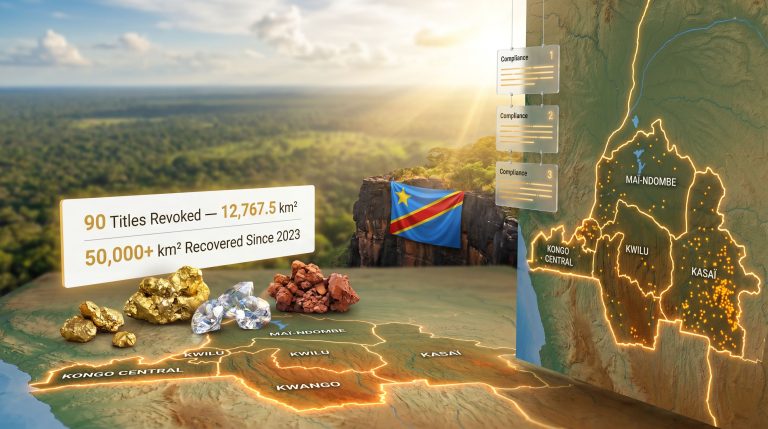
The May 2026 revocation action stripped two companies of their mining rights across a combined 12,767.5 square kilometres of territory in five provinces. As reported by Bankable Africa, the DRC revokes mining rights linked to Acacia and Kwango Mines across the following breakdown:
| Company | Titles Revoked | Area Affected | Key Minerals |
|---|---|---|---|
| Acacia | 43 titles | 7,485 sq km | Gold, diamonds, bauxite |
| Kwango Mines | 47 titles | 5,282.5 sq km | Gold, diamonds, bauxite |
| Combined Total | 90 titles | 12,767.5 sq km | Multi-commodity |
The two companies jointly held 15,029 individual mining blocks across Kwango, Kwilu, Maï-Ndombe, Kongo Central, and Kasaï provinces. To put the spatial dimension in context, the combined revoked area exceeds the administrative footprint of Kinshasa province-city, one of the most densely administered territories in the country.
The geographic layout of the revoked blocks is particularly notable. Rather than representing scattered, disconnected parcels, the titles form a contiguous mining corridor stretching from Kongo Central toward Kasaï, passing through the territories of Kahemba, Popokabaka, and Kasongo-Lunda in Kwango province. This corridor structure suggests the original permit assembly was strategically conceived to control access across a broad geological trend, which in turn amplifies the significance of its recovery for future exploration investment.
What Minerals Were at Stake and What Re-Entry Opportunities Now Exist?
The commodity mix covered by these permits reflects the geological diversity of the western DRC's sedimentary and metamorphic terrains:
-
Gold: The Kongo Central and Kwango belt has seen limited systematic modern exploration. With gold prices sustaining elevated levels through 2025–2026, recovered ground in this corridor carries immediate appeal for junior explorers capable of tolerating the DRC's operating risk profile.
-
Diamonds: The Kwango basin is historically significant for alluvial diamond production and has a strong artisanal mining presence. Industrial-scale re-entry requires careful management of the artisanal sector, which has legal recognition under the DRC Mining Code and cannot simply be displaced.
-
Bauxite: Perhaps the least-discussed component of this revocation, bauxite is gaining strategic attention globally as aluminium producers look to secure upstream supply outside of Guinea, which currently dominates the global bauxite export market. Identified bauxite occurrences in the western DRC represent an underexplored opportunity in a mineral that rarely attracts the same media attention as cobalt or copper.
Investment Scenario: A mid-tier gold explorer acquiring reclaimed titles in the Kahemba to Kasongo-Lunda corridor would gain access to underexplored terrain within a structurally prospective geological setting. However, community engagement protocols, environmental baseline studies, and rigorous political risk assessment would need to be completed before any bankable feasibility pathway could be established.
Is This an Isolated Action or a Systemic Policy Shift?
The 2023–2026 Cadastre Clean-Up Campaign: Scope, Methodology, and Outcomes
The revocations linked to Acacia and Kwango Mines did not occur in isolation. They are the latest output of a structured compliance audit campaign that CAMI launched in 2023. The methodology applied across the campaign has been consistent:
- Cross-referencing the national title register against financial payment records
- Identifying titles where annual surface fees are unconfirmed or absent
- Issuing formal alert notices to affected operators
- Applying the 45-day cure period before proceeding to revocation
- Returning recovered titles to the CAMI register for potential re-tendering
The cumulative outcome as of mid-2026 is striking. CAMI has recovered more than 50,000 square kilometres of mining territory since the campaign began, representing one of the most consequential cadastre reform exercises in sub-Saharan Africa's recent regulatory history. To frame that figure differently, 50,000 square kilometres is roughly equivalent to the combined land area of Denmark and Switzerland.
Comparative Enforcement: How the DRC's Approach Stacks Up Against Regional Peers
The DRC is not acting in a regional vacuum. Furthermore, several African mining jurisdictions have undertaken comparable cadastre reform processes in recent years:
- Tanzania pursued aggressive mining title audits after 2017, renegotiating royalty structures and asserting greater state control over large-scale projects
- Guinea has conducted compliance reviews across its dominant bauxite sector, targeting underperforming concessions and restructuring permit portfolios
- Zambia has used periods of copper price volatility to reclaim idle Copperbelt concessions and re-tender them under revised fiscal terms
Policy Insight: The DRC's cadastre campaign signals a broader continental consensus taking shape: African governments increasingly treat mining title compliance as an active sovereign resource management tool rather than a passive administrative formality. The era of accumulated, inactive permit portfolios operating outside regulatory accountability is contracting.
The Political Dimension: Why These Specific Revocations Carry Broader Significance
Political Economy of Mining Rights in Post-Kabila DRC
The shift in DRC political leadership that followed the 2018 elections created conditions under which regulatory institutions could exercise greater independence in enforcement actions that might previously have encountered political friction. CAMI's willingness to pursue revocations at this scale reflects an institutional confidence that would have been harder to demonstrate in earlier governance contexts.
The political sensitivity surrounding Acacia and Kwango Mines is well-documented in investigative reporting. A 2017 investigation by the Groupe d'Étude sur le Congo (GEC) examined business interests attributed to the network surrounding former President Joseph Kabila and identified links between certain mining entities and Jaynet Kabila, the former president's twin sister. Deutsche Welle and other international media subsequently reported on similar connections involving Acacia and Kwango Mines.
A critical caveat is essential here: the current ownership structures of both companies have not been publicly established through official documentation. Investigative reporting provides important context, but it does not constitute legal confirmation of beneficial ownership. For any investor considering engagement with reclaimed territory formerly associated with politically sensitive permit holders, this distinction carries real due diligence weight.
Governance Risk Implications for Foreign Investors in the DRC Mining Sector
The intersection of permit compliance enforcement and political economy creates a specific risk profile that foreign investors in the DRC need to navigate carefully. Key considerations include:
-
Beneficial ownership verification: Titles that previously sat within politically connected portfolios require enhanced scrutiny when they re-enter the market. International transparency frameworks such as the Extractive Industries Transparency Initiative (EITI) and the OECD Due Diligence Guidance for Responsible Mineral Supply Chains provide a useful baseline.
-
Reputational exposure: Acquiring assets linked to operators under regulatory scrutiny can generate reputational risk even where the legal pathway to acquisition is technically clean.
-
Title history documentation: CAMI's revocation records become part of the title history. Incoming operators should review the full compliance audit trail before committing capital.
-
Community relations baseline: In territories where permit holders were inactive for extended periods, local communities may have developed informal land use arrangements that create additional engagement obligations for new operators.
Broader Enforcement Trends: Beyond Acacia and Kwango
The AVZ Minerals Precedent: Foreign Operators Are Not Exempt
A separate 2026 enforcement action by CAMI involved the cancellation of a lithium exploration permit held by ASX-listed AVZ Minerals, also over non-payment of surface rights obligations. The AVZ Congo lithium dispute is significant for several reasons, demonstrating that the compliance campaign is being applied consistently across both locally affiliated and foreign-linked operators.
It also signals that the DRC's enforcement posture extends into the battery minerals sector, where international investor interest has been running at elevated levels. Lithium is central to electric vehicle battery chemistry, and the DRC's emerging lithium endowment, particularly the Manono deposit that AVZ had been pursuing, sits within a global demand narrative that makes enforcement actions in this space geopolitically as well as commercially notable.
Human Rights and Environmental Governance: The Parallel Regulatory Pressure
Permit compliance enforcement does not operate in isolation from broader ESG accountability pressures. In May 2026, civil society organisation IBGDH raised concerns about environmental and health impacts affecting communities near the Ruashi Mining site in Kolwezi, highlighting the ongoing tension between industrial mining operations and adjacent residential populations in the DRC's mining provinces.
These parallel pressures are shaping investor behaviour. Global battery supply chain scrutiny, driven partly by European Union battery regulation requirements and partly by ESG-focused institutional capital, is forcing mining companies operating in the DRC to demonstrate genuine community and environmental accountability. For operators seeking to acquire reclaimed territory, this means ESG due diligence is no longer a box-ticking exercise but a genuine commercial prerequisite.
The next major ASX story will hit our subscribers first
What Happens to Reclaimed Territory? The Re-Investment Pipeline
How CAMI Re-Allocates Revoked Mining Titles
Once a title is revoked, it re-enters the CAMI register as available ground. The reallocation process follows the DRC Mining Code's standard framework:
- The revoked title is officially recorded in the cadastre system as unencumbered
- CAMI assesses eligibility criteria for new applicants under the Mining Code
- The title may be subject to competitive tender or direct application depending on its classification and commodity type
- New applicants must demonstrate financial and technical capacity as part of the eligibility assessment
- Approved applications trigger a new compliance cycle, including annual surface fee obligations from the outset
The timeline between revocation and effective re-tendering can vary significantly. Complex political or legal challenges from former holders can extend the limbo period, which is a material consideration for investors monitoring the pipeline of newly available ground.
Which Mineral Categories Are Most Likely to Attract New Investment?
The reclaimed corridor spanning Kongo Central through Kwango to Kasaï presents differentiated investment appeal across its commodity spectrum:
-
Gold commands the most immediate re-entry interest given sustained price strength. Junior explorers with high risk tolerance and lean operating structures are best positioned to move quickly on recovered gold-bearing ground.
-
Bauxite presents a longer-dated but potentially higher-value opportunity as aluminium supply chains seek diversification away from Guinea. The strategic dimension of this commodity is underappreciated relative to cobalt and lithium peers.
-
Diamonds present more complex re-entry dynamics. The Kimberley Process certification requirements, the strong artisanal mining presence in the Kwango basin, and the structural challenges facing the rough diamond market all weigh on the investability of recovered diamond ground in the near term.
Frequently Asked Questions: DRC Mining Rights Revocation
What legal grounds does the DRC use to revoke mining permits?
Under the DRC Mining Code, annual surface fees are a mandatory financial condition of permit retention. Non-payment, confirmed through CAMI's financial tracing process, constitutes grounds for revocation following a formal alert and 45-day cure period. Notably, the DRC cobalt export ban demonstrates how the government applies similarly structured regulatory mechanisms across multiple commodity sectors.
How large is the territory affected by the Acacia and Kwango Mines revocations?
The combined revoked area totals 12,767.5 square kilometres across 90 mining titles, a footprint larger than the administrative area of Kinshasa province-city.
How much mining territory has the DRC reclaimed since 2023?
CAMI has recovered more than 50,000 square kilometres of mining area since launching its compliance audit campaign in 2023. In addition, the DRC cobalt export suspension has further reinforced how broadly the DRC is deploying regulatory tools to reassert control over its mineral estate.
Are foreign mining companies also subject to these enforcement actions?
Yes. The 2026 cancellation of a lithium permit held by AVZ Minerals confirms that enforcement extends to foreign-affiliated operators, not only domestically connected entities. Furthermore, the Congolese cobalt rivalry between global superpowers adds a geopolitical layer to how enforcement decisions are perceived internationally.
What minerals are covered by the revoked permits?
The 90 revoked titles covered gold, diamond, and bauxite assets across five provinces: Kwango, Kwilu, Maï-Ndombe, Kongo Central, and Kasaï.
Can revoked mining titles be reacquired?
Revoked titles re-enter the CAMI register and become eligible for re-tendering under the DRC Mining Code's standard reallocation procedures. New applicants are subject to eligibility assessments and standard compliance obligations from the point of new title issuance. However, as Pinsent Masons outlines, significant legal and commercial risks arise from engaging with titles that carry complex regulatory histories.
Key Takeaways: What the DRC's Enforcement Campaign Signals for African Mining Governance
The significance of the DRC revokes mining rights linked to Acacia and Kwango Mines extends well beyond the two companies and the 12,767.5 square kilometres of recovered territory. Taken in full context, this action is a data point in a much larger governance transformation:
- The recovery of more than 50,000 sq km since 2023 establishes the DRC as one of Africa's most active jurisdictions in permit compliance enforcement
- CAMI's structured, legally grounded enforcement methodology reduces the scope for legal challenge and strengthens institutional credibility
- The political dimensions of these specific revocations add a governance transparency signal that extends beyond administrative compliance alone
- For investors, recovered territory represents both a commercial opportunity and a due diligence imperative, particularly regarding beneficial ownership transparency and historical title compliance records
- The extension of enforcement to foreign operators like AVZ Minerals confirms that the campaign is applied on a non-discriminatory basis, strengthening its legitimacy in the eyes of international capital markets
- The DRC's approach is consistent with a continental shift toward resource sovereignty through active regulatory management, a trend that investors in African mining assets need to factor into their country risk frameworks going forward
This article is intended for informational purposes only and does not constitute financial or investment advice. Forecasts, scenarios, and projections discussed herein involve inherent uncertainty and should not be relied upon as the basis for investment decisions. Readers should conduct their own independent due diligence before engaging with any mining jurisdiction or asset referenced in this article.
Want to Track the Next Major Mineral Discovery Before the Broader Market Does?
Discovery Alert's proprietary Discovery IQ model delivers real-time alerts on significant ASX mineral discoveries, turning complex geological and commodity data into actionable investment insights the moment they hit the exchange — explore Discovery Alert's dedicated discoveries page to understand how historic mineral finds have generated substantial returns, and begin your 14-day free trial today to position yourself ahead of the market.