May 20, 2026
How a Shifting Global Trade Architecture Is Rewriting the Rules of Strategic Diplomacy
When geopolitical fragmentation accelerates, nations rarely wait for multilateral systems to catch up. Instead, they build bilateral scaffolding, forging targeted partnerships designed to deliver economic resilience, technology access, and strategic depth faster than any international institution can move. This dynamic is precisely what has unfolded across the India-Europe trade corridor over the past several years, and nowhere is it more visible than in the newly elevated relationship between New Delhi and Rome.
The India Italy special strategic partnership, formalised in May 2026, is far more than a diplomatic gesture. It represents a carefully constructed architecture for economic interdependence, technological co-development, and supply chain resilience, built between two nations whose industrial strengths are strikingly complementary and whose strategic positions within the evolving global order have grown increasingly aligned.
When big ASX news breaks, our subscribers know first
Why the India–Italy Relationship Upgrade Matters for Global Trade Architecture
From Strategic to Special Strategic: Understanding What the Tier Shift Actually Means
Not all diplomatic partnerships are created equal. Within the structured vocabulary of international relations, the movement from a standard strategic partnership to a Special Strategic Partnership carries meaningful institutional implications. It typically signals the establishment of dedicated implementation mechanisms, time-bound sectoral targets, and high-level oversight structures that move cooperation from declaratory intent to operational accountability.
India has deployed this elevated designation selectively across its bilateral portfolio. Comparable frameworks exist with the United States, Japan, and Australia, each calibrated to address specific industrial, defence, and technology complementarities. The elevation of India-Italy ties to this tier reflects a deliberate decision by both governments to institutionalise their relationship in a way that creates measurable outcomes rather than aspirational language.
The geopolitical timing of this upgrade matters enormously. The period spanning 2025 and 2026 represents a pivotal window in which India's European engagement strategy has accelerated alongside the conclusion of India-EU Free Trade Agreement negotiations. This broader multilateral backdrop, shaped in part by the wider geopolitical mining landscape, creates a complementary framework within which bilateral mechanisms can address specific priorities with greater precision and speed than EU-wide structures typically allow.
Italy's weight in this equation should not be underestimated. As a G7 member with a sophisticated industrial base and a strategic Mediterranean geography, Italy occupies a unique position within India's European calculus. It is simultaneously an EU insider, a G7 voice, and a potential Mediterranean gateway for the India-Middle East-Europe Economic Corridor, making it a uniquely valuable partner across multiple strategic dimensions at once.
The Macro Context: India's European Pivot Meets Italy's Indo-Pacific Ambitions
India's bilateral engagement across EU member states has expanded rapidly, driven by the recognition that differentiated partnerships with individual European powers can deliver strategic depth that collective EU frameworks alone cannot. Germany anchors industrial and engineering cooperation; France provides defence and nuclear collaboration; and Italy is now being positioned as the nexus for Mediterranean connectivity, precision manufacturing, and technology co-development.
For Italy, the logic runs in a parallel direction. Italian governments in recent years have placed growing emphasis on diversifying economic partnerships beyond the European continent, seeking to reduce overreliance on traditional markets and supply chains that have proven vulnerable to geopolitical disruption. India's rapid economic expansion, its large and increasingly sophisticated workforce, and its strategic position as a gateway to South Asia and the broader Indo-Pacific region represent a compelling destination for Italian businesses seeking new markets and industrial partnerships.
Both nations have also developed increasingly aligned positions on core questions of global governance, including support for a free and open Indo-Pacific, UN Security Council reform, and the importance of rules-based multilateral frameworks. These shared positions on structural global issues provide political ballast for an economic relationship that is still maturing, embedding the partnership within a broader framework of shared strategic interests that transcend transactional trade considerations.
What Does the €20 Billion Trade Target Actually Mean?
Breaking Down the Bilateral Trade Goal
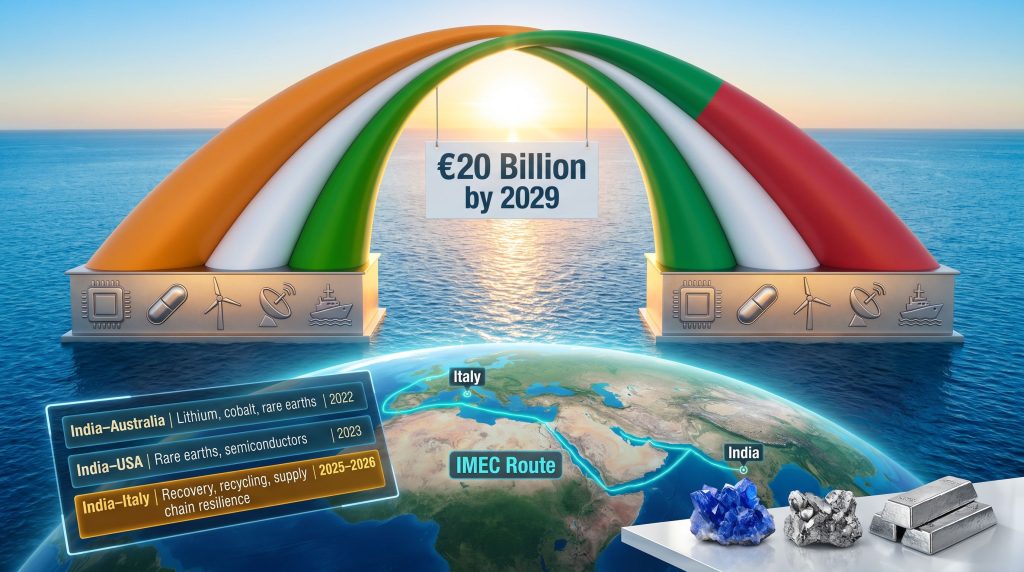
The centrepiece of the India Italy special strategic partnership's economic agenda is an ambitious bilateral trade target of €20 billion annually by 2029, agreed upon during Prime Minister Narendra Modi's visit to Italy in May 2026. Achieving this figure will require sustained compound growth across multiple sectors and meaningful progress on trade facilitation measures that reduce friction for both goods and services.
| Metric | Detail |
|---|---|
| Target Trade Volume | €20 billion annually |
| Target Year | 2029 |
| Framework Document | Italy-India Joint Strategic Action Plan 2025-2029 |
| Priority Sectors | Automotive, semiconductors, clean tech, pharma, digital, infrastructure, critical minerals |
| Key Agreements Signed | Critical minerals, agriculture, maritime transport and ports |
This target creates something that aspirational diplomatic language rarely delivers: accountability. Both governments have attached a specific number to a specific year, meaning progress can be measured, shortfalls identified, and policy adjustments made accordingly. This shift toward quantified economic diplomacy reflects a broader trend among major partners who recognise that declaratory frameworks without performance benchmarks rarely translate into durable change. Furthermore, the pressure created by trade wars and supply chains disruption globally has added urgency to these bilateral commitments.
Sector-by-Sector Growth Potential
The priority sectors identified within the partnership framework reveal a sophisticated understanding of where industrial complementarities are strongest and where trade growth is most achievable within the four-year window.
- Automotive and Mobility: Italian expertise in vehicle design, powertrain engineering, and EV platform development aligns with India's ambitions to scale domestic electric vehicle manufacturing. Co-development opportunities in this space are substantial given Italy's heritage in precision automotive engineering.
- Semiconductors: India's push to establish domestic chip manufacturing capabilities intersects with Italy's strengths in precision engineering and specialist manufacturing processes, creating potential for supply chain integration and co-investment.
- Clean Technology: Both nations share interests in advancing renewable energy supply chains. Italian industrial capabilities in solar components, wind systems, and green hydrogen infrastructure complement India's scale manufacturing potential.
- Pharmaceuticals: India's position as the world's largest producer of generic medicines by volume provides a natural supply relationship with Italy's biotech and specialty pharma sector, which demands reliable, cost-competitive active pharmaceutical ingredient supply.
- Digital Technologies and Fintech: The INNOVIT India innovation hub provides an institutional backbone for startup collaboration, research exchange, and technology commercialisation in digital financial services and platform technologies.
- Critical Minerals: Supply chain resilience agreements and cooperation on mineral recovery and recycling address one of the most strategically sensitive dimensions of modern industrial policy.
What Is the Italy–India Joint Strategic Action Plan 2025–2029?
A Five-Year Operational Roadmap
The Joint Strategic Action Plan 2025-2029, published by India's Ministry of External Affairs, represents the operational backbone of the Special Strategic Partnership. It translates the diplomatic elevation into six concrete cooperation pillars, each with sector-specific deliverables that provide a structured pathway for implementation.
The shift from declaratory partnership language to a structured five-year action plan with six defined pillars represents a meaningful maturation in how India and Italy approach bilateral cooperation, moving from intent to implementation architecture.
The Six Core Pillars of the 2025-2029 Action Plan:
- Political Dialogue – High-level engagement mechanisms including ministerial consultations and structured diplomatic exchanges
- Economic Cooperation – Trade facilitation, investment promotion, and industrial partnerships across priority sectors
- Connectivity – IMEC advancement, maritime transport cooperation, and port infrastructure agreements
- Defence and Security – Defence Industrial Roadmap, co-development frameworks, and the newly launched maritime security dialogue
- Science, Technology and Innovation – AI, quantum computing, supercomputing, and space cooperation
- Culture, Education and People-to-People Ties – Mobility pathways, student exchanges, and skilled worker movement
How the IMEC Corridor Fits Into the Strategic Vision
The India-Middle East-Europe Economic Corridor represents one of the most geopolitically significant infrastructure initiatives of the current decade, designed to provide an alternative trade route linking India through the Arabian Peninsula to Europe. Italy's geographic position at the heart of the Mediterranean gives it a natural role as a potential European terminus for IMEC, making deeper India-Italy cooperation on connectivity a strategically logical extension of both nations' broader interests.
Both governments reaffirmed their support for IMEC through the partnership framework and committed to a ministerial-level meeting in 2026 specifically focused on advancing the corridor from declaration to concrete implementation. This commitment reflects a shared understanding that IMEC's strategic value lies not merely in its conceptual appeal but in the development of actual port agreements, rail linkages, and logistics infrastructure that can deliver measurable trade diversification benefits.
For India, IMEC reduces dependency on traditional single-route trade architectures that have proven vulnerable to disruption. For Italy, the corridor represents an opportunity to position its ports and logistics infrastructure as critical nodes in a new Eurasian connectivity framework, strengthening its economic relevance within both the EU and the broader global trade system.
How Deep Does the Defence and Technology Cooperation Go?
The Defence Industrial Roadmap: Beyond Arms Trade
The adoption of a jointly agreed Defence Industrial Roadmap marks a significant deepening of India-Italy security cooperation that moves well beyond traditional arms procurement relationships. The roadmap commits both nations to frameworks for co-development and co-production, meaning industrial capabilities and intellectual property flow in both directions rather than one nation simply purchasing finished systems from the other.
Priority defence technology domains identified within this framework include helicopters, naval systems, and electronic warfare, each reflecting areas where Italian defence industrial capabilities align with India's strategic requirements and domestic production ambitions. The joint declaration of intent for defence technology partnerships provides the political foundation for subsequent detailed technical cooperation agreements.
Both governments also agreed to examine the feasibility of an annual high-level military dialogue mechanism, a structural addition that would provide sustained senior-level engagement beyond episodic summit interactions. The launch of a maritime security dialogue is particularly significant given shared interests in Indian Ocean and Mediterranean security architecture, where both nations have growing strategic stakes.
INNOVIT India: Building a Bilateral Innovation Ecosystem
INNOVIT India represents one of the most structurally significant institutional mechanisms within the partnership framework. Rather than functioning as a symbolic gesture, it is designed as an operational platform for sustained technology exchange, startup collaboration, and university research partnerships.
INNOVIT India is positioned as a structural platform for startup collaboration, research partnerships, and university cooperation, functioning as an institutional mechanism for sustained technology exchange rather than a one-off diplomatic initiative.
Technology Domains Under the INNOVIT India Framework:
- Artificial Intelligence (with specific emphasis on human-centric and secure development approaches)
- Semiconductor research and development
- Quantum computing
- Healthcare innovation and medical technology
- Logistics technology and supply chain digitalisation
- Fintech and digital financial infrastructure
Both governments also committed to deepening cooperation in supercomputing and scientific research, reflecting an understanding that computational infrastructure increasingly underpins competitive advantage across defence, pharmaceutical, climate modelling, and advanced manufacturing domains. The explicit reaffirmation of a human-centric and secure approach to AI development signals alignment on governance principles that have become increasingly contested across different geopolitical frameworks.
Space Cooperation: ISRO and the Italian Space Agency
The commitment to expand cooperation between India's ISRO and the Italian Space Agency covers Earth observation, heliophysics, and broader space exploration, building on existing scientific relationships between the two agencies. Italy's dual role as both a member of the European Space Agency and a bilateral partner with its own space agency capabilities provides India with multiple complementary channels for European space cooperation. The strategic value of this partnership extends beyond scientific exchange to encompass satellite manufacturing, launch services, and the development of space-based infrastructure with both commercial and defence applications.
Critical Minerals: Why This Agreement Is More Than a Handshake
The Strategic Logic Behind the Critical Minerals Framework
The formal signing of a critical minerals agreement between India and Italy reflects a global strategic trend that has rapidly elevated mineral security from a technical supply chain concern to a central pillar of national economic and defence planning. The surge in critical minerals demand driven by the energy transition has concentrated global supply chains in ways that create acute strategic vulnerabilities for technology-dependent economies.
The India-Italy agreement specifically focuses on supply chain resilience, mineral recovery, and recycling cooperation, a distinct emphasis that reflects Italy's position within the EU Critical Raw Materials Act framework and India's growing interest in developing domestic processing and circular economy capabilities. This focus on recovery and recycling is particularly significant because it addresses a dimension of mineral security that is often overlooked in standard procurement-focused agreements. In addition, the critical raw materials transition agenda has accelerated both governments' recognition of the need for diversified sourcing strategies.
| Partnership | Critical Mineral Focus | Year Established |
|---|---|---|
| India-Australia | Lithium, cobalt, rare earths | 2022 |
| India-USA | Rare earths, semiconductors | 2023 |
| India-Italy | Recovery, recycling, supply chain resilience | 2025-2026 |
| India-EU (broader) | Critical Raw Materials Act alignment | Ongoing |
Supply Chain Resilience as a Structural Priority
The circular economy dimension of the India-Italy critical minerals agreement addresses a less commonly understood but increasingly important aspect of mineral security strategy. Mineral recovery from industrial waste streams, end-of-life product recycling, and the development of secondary processing capabilities can meaningfully reduce the primary demand for mined critical minerals, lowering exposure to supply disruptions.
Italy's industrial expertise in precision manufacturing and advanced materials processing provides relevant capabilities for developing recovery and recycling technologies that India could deploy at scale given its large and rapidly growing consumer electronics and electric vehicle markets. This creates an asymmetric but mutually beneficial technology transfer dynamic where Italian process expertise meets Indian manufacturing scale. Consequently, Europe's critical minerals supply chain strategy increasingly views partnerships with India as a structural asset rather than a contingency measure.
The next major ASX story will hit our subscribers first
What Does the India–Italy Partnership Mean for Counter-Terrorism and Global Security?
Shared Security Positions and the Pahalgam Declaration
The joint declaration issued during PM Modi's May 2026 visit to Italy included a strong and explicit condemnation of the April 2025 Pahalgam terror attack, in which 26 people were killed in Indian-administered Kashmir. Italy's formal alignment with India's characterisation of this attack and the subsequent pledges of closer cooperation against terror financing and extremist network disruption carry meaningful diplomatic weight, signalling a convergence of security perspectives that reinforces the substance of the Special Strategic Partnership designation.
Both governments committed to expanding cooperation mechanisms against terrorism and violent extremism, with specific attention to disrupting financial networks and extremist communication channels. This security dimension of the partnership reflects a shared recognition that contemporary terrorism increasingly operates across borders through decentralised financial and digital infrastructure that requires multilateral responses.
Multilateral Alignment on Global Governance
Both nations expressed concern over ongoing conflicts in West Asia and Ukraine, aligning on the importance of diplomatic solutions and dialogue over escalation. This shared position on managing major power conflicts through diplomacy rather than confrontation reflects a pragmatic internationalism that both countries have developed as a function of their respective economic dependencies and strategic interests.
Support for UN Security Council reform figures prominently in the partnership's multilateral agenda, with both governments reiterating backing for institutional changes that would better reflect contemporary global power realities. India's long-standing candidacy for a permanent Security Council seat finds a supportive voice in Italy's willingness to back reform processes, even as the specific modalities of such reform remain contested within the UN system. Both nations also reaffirmed their commitment to a free, open, and rules-based Indo-Pacific, a shared positioning that aligns with broader democratic partner consensus on maritime freedom.
People-to-People Ties: The Mobility and Education Dimension
Expanding Human Capital Flows
The people-to-people dimension of the India Italy special strategic partnership addresses practical mobility pathways that have long-term implications for the depth and durability of bilateral relations. The agreement includes structured mechanisms for expanding mobility pathways for students, researchers, and skilled workers, particularly in STEM sectors, creating institutional channels for human capital exchange that complement the technology and industrial cooperation frameworks.
A particularly concrete element of the mobility agenda involves facilitating the movement of Indian nurses to Italy, addressing a genuine structural need within Italy's healthcare workforce while creating professional opportunities for Indian skilled workers in a regulated and supported environment. Italy, like many European nations, faces demographic pressures that create persistent shortfalls in healthcare staffing, and structured bilateral mobility agreements provide a more sustainable and ethical alternative to ad hoc labour migration.
University cooperation under the INNOVIT India framework extends the people-to-people dimension into academic and research communities, creating institutional relationships between Indian and Italian universities that can generate joint research outputs, collaborative postgraduate programmes, and sustained academic exchange. These relationships tend to build long-term bilateral understanding at a societal level that outlasts individual political administrations and creates constituencies for continued cooperation across electoral cycles. For a detailed overview of the bilateral political context, the Indian Embassy in Rome provides authoritative background on the evolution of diplomatic ties.
What Analysts and Policymakers Should Watch
The India Italy special strategic partnership establishes an ambitious framework, but its ultimate strategic significance will be determined by implementation quality rather than declaratory breadth. Several specific indicators deserve close monitoring in the coming years.
Key Progress Benchmarks:
- Annual bilateral trade trajectory against the €20 billion target, with sector-level breakdowns revealing where growth is accelerating and where structural barriers persist
- INNOVIT India's operational launch timeline, its initial cohort of partner institutions, and the first concrete research collaboration announcements
- Defence Industrial Roadmap implementation milestones, particularly the first co-production agreements in helicopter and naval systems domains
- IMEC ministerial meeting outcomes in 2026, specifically whether concrete port agreements and logistics infrastructure commitments emerge from diplomatic declaration
- Critical minerals cooperation deliverables, including joint recovery and recycling pilot programmes that demonstrate operational progress beyond agreement signing
Those seeking broader context on how this partnership fits within India's wider European strategy may find the India-Italy Indo-Mediterranean vision analysis from Open The Magazine a valuable reference point for understanding the longer-term strategic framing behind these bilateral developments.
This article is intended for informational and analytical purposes only. It does not constitute financial or investment advice. Readers should conduct independent research and seek professional guidance before making any decisions based on the geopolitical or economic analysis presented here.
Want to Stay Ahead of the Next Major Mineral Discovery on the ASX?
Whilst geopolitical partnerships reshape global critical minerals supply chains, Discovery Alert's proprietary Discovery IQ model delivers real-time alerts on significant ASX mineral discoveries — transforming complex data into actionable insights for investors at every level. Explore historic examples of extraordinary discovery returns and begin your 14-day free trial to position yourself ahead of the market.