June 30, 2026
Six Decades of Iron Ore: Understanding the Economics Behind the World's Most Productive Mining Corridor
Few industrial relationships in modern history have proven as enduring or as economically consequential as the exchange of raw materials between Australia's northwest and the blast furnaces of East Asia. The Pilbara region of Western Australia sits at the centre of that exchange, and the Rio Tinto eight-billionth tonne of Pilbara iron ore milestone is not merely a corporate achievement measured in tonnage. It is a window into how the world's most capital-intensive commodity system actually functions, and where it is heading next.
When big ASX news breaks, our subscribers know first
Why the Pilbara Remains the Backbone of Global Iron Ore Supply
The Strategic Weight of Western Australia's Iron Ore Province
The Pilbara's geological endowment is, in strict technical terms, exceptional. The region hosts some of the world's largest known concentrations of high-grade hematite iron ore, a mineral form of iron oxide that typically assays above 60% iron content. This grade threshold matters enormously in steelmaking economics. Higher-grade ores reduce the volume of slag produced per tonne of steel, lower coke consumption in blast furnaces, and directly reduce carbon emissions intensity per unit of output.
These are not marginal efficiency gains. At the scale of Asian integrated steelmakers processing tens of millions of tonnes annually, the difference between a 58% iron feedstock and a 62% iron feedstock translates into billions of dollars in operating cost differentials. Furthermore, Australia's iron ore advantages in grade, infrastructure, and proximity to Asian markets reinforce this competitive position considerably.
East Asian steelmakers have understood this calculus for decades. Japan, South Korea, and China collectively account for the vast majority of Pilbara ore exports, and the concentration of that demand is structurally anchored in the capital equipment those countries have deployed. Blast furnace infrastructure built to operate on Pilbara-grade ore is not easily reconfigured for lower-grade alternatives without significant capital reinvestment.
How Eight Billion Tonnes Translates Into Real-World Scale
To grasp what eight billion tonnes of iron ore actually means in physical terms, it helps to think beyond tonnage and into finished product. Iron ore is not consumed directly; it is processed through blast furnaces or direct reduction plants to yield pig iron, which is then converted into steel. The steel produced from Rio Tinto's cumulative Pilbara exports is sufficient, by the company's own calculations, to construct a staggering array of global landmarks at industrial scale.
Scale in Context:
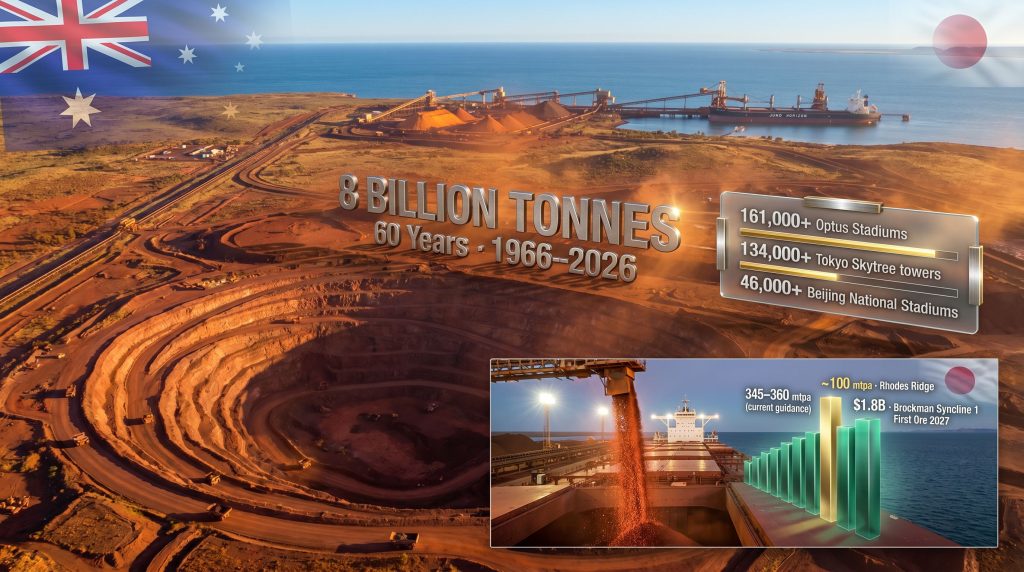
Rio Tinto's cumulative eight-billion-tonne Pilbara output represents enough steel-grade ore to theoretically supply:
- More than 161,000 Optus Stadiums (Perth, Western Australia)
- More than 134,000 Tokyo Skytree towers (Japan)
- More than 46,000 Beijing National Stadiums (China)
These comparisons are deliberately chosen to resonate with the three primary destination markets for Pilbara ore. They illustrate something that a raw tonnage figure cannot: the tangible civilisational infrastructure built on the back of a single regional export corridor operating continuously for six decades.
What Does the Eight-Billionth Tonne Milestone Actually Represent?
The Shipment That Marked the Record: Cape Lambert to Nippon Steel
On 19 May 2026, the bulk carrier Juno Horizon departed Cape Lambert port in Western Australia loaded with the cargo that pushed Rio Tinto's cumulative Pilbara export tally to eight billion tonnes. The destination was Nippon Steel Corporation in Japan, a detail that carries considerable symbolic weight. Nippon Steel received Rio Tinto's inaugural Pilbara shipment in August 1966, making the recipient of the eight-billionth tonne the same partner that received the very first.
Cape Lambert serves as one of Rio Tinto's primary export terminals in the Pilbara, capable of accommodating very large ore carriers (VLOCs) that have progressively grown in size over the decades. The evolution in vessel size alone tells a story about how the trade has matured. Where early shipments in the 1960s departed on comparatively modest bulk carriers, modern ore shipments utilise vessels exceeding 300,000 deadweight tonnes, fundamentally transforming the unit economics of the trade and the engineering requirements of port facilities.
The cumulative tonnage figure also incorporates production from the Robe River Joint Venture, a partnership arrangement that has contributed meaningfully to overall Pilbara output and reflects the collaborative ownership structures common in large-scale Australian iron ore development.
Sixty Years of Continuous Iron Ore Trade: The Australia-Japan Supply Corridor
The 60-year span between the 1966 inaugural shipment and the 2026 milestone encompasses extraordinary turbulence in global commodity markets. The 1970s oil crises reshaped global energy economics, the 1997 Asian financial crisis contracted steel demand abruptly, and the commodity supercycle of the 2000s followed by the subsequent price collapse each tested the resilience of long-term supply arrangements. However, the Australia-Japan iron ore relationship survived all of these disruptions.
Long-term offtake agreements, typically structured over periods of five to twenty years with periodic price renegotiation mechanisms, provided both parties with volume certainty and price predictability that short-term spot market arrangements could not deliver. For Rio Tinto, these contracts justified successive rounds of capital investment in Pilbara mining, rail, and port infrastructure. For Japanese steelmakers, they secured a reliable feedstock supply stream independent of spot market volatility.
Rio Tinto's iron ore chief executive Matthew Holcz described the milestone as a testament to the generations of workers, engineers, and community members who built and sustained operations across six decades. He noted that Japan remains a cornerstone trading partner, and committed to continued investment in Pilbara operations and regional communities as global steel demand continues to grow.
How Has Rio Tinto Built One of the World's Largest Iron Ore Systems?
Infrastructure at Scale: Ports, Rail, and Regional Communities
The visible output of the Pilbara operation is iron ore loaded onto ships. The less visible foundation, however, is one of the most extensive private infrastructure networks on Earth. Rio Tinto operates approximately 1,700 kilometres of heavy-haul rail across the Pilbara, connecting mine sites to port facilities at Dampier and Cape Lambert. The ore passes through crushing, screening, and blending circuits designed to produce consistent product specifications that meet the metallurgical requirements of individual steel mill customers.
Six regional towns exist in their current form largely because of Rio Tinto's sustained operational presence:
- Dampier – primary port community adjacent to the Dampier Port terminal
- Karratha – the largest regional centre in the Pilbara, servicing multiple mining operations
- Pannawonica – a company-established town servicing the Robe Valley operations
- Paraburdoo – a purpose-built mining community in the southern Pilbara ranges
- Tom Price – one of Australia's highest-elevation towns, established to service the Hamersley Iron operations
- Wickham – a coastal community supporting Cape Lambert port operations
Beyond these six towns, an additional five communities across the broader region from the Kimberley to the Great Southern benefit from fly-in fly-out (FIFO) workforce arrangements. The socioeconomic multiplier effect of sustained large-scale mining extends well beyond direct employment, encompassing local procurement, contractor networks, education infrastructure, and healthcare services.
The Role of Traditional Owner Partnerships in Long-Term Operational Continuity
The Pilbara is the traditional country of numerous Aboriginal groups, including the Yinhawangka, Banyjima, Nyiyaparli, and Kuruma Marthudunera peoples among others. The legal and social framework governing the relationship between mining operators and Traditional Owners has undergone fundamental transformation over the six decades of Pilbara iron ore production, and particularly since the destruction of Juukan Gorge rockshelters in 2020.
That event, which resulted in the irreversible loss of a 46,000-year-old heritage site of profound cultural significance, reshaped the entire Australian resources sector's approach to Indigenous heritage management. The subsequent parliamentary inquiry and legislative reforms raised the threshold for heritage clearance approvals and embedded greater Traditional Owner authority into consultation processes.
The current framework reflects an understanding that social licence to operate is not a one-time approval but an ongoing negotiated relationship. Matthew Holcz explicitly acknowledged the Traditional Owner groups across the Pilbara for their partnership, knowledge, guidance, and stewardship in the context of the Rio Tinto eight-billionth tonne of Pilbara iron ore milestone.
What Comes Next? Rio Tinto's Pilbara Growth Pipeline
Rhodes Ridge: The Undeveloped Giant in Rio Tinto's Portfolio
Perhaps the most consequential element of Rio Tinto's medium-term Pilbara strategy is a deposit that has produced nothing yet. Rhodes Ridge, in which Rio Tinto holds a 50% interest, is regarded by the company and independent analysts as one of the largest undeveloped iron ore deposits anywhere in the world. At full development, Rio Tinto indicates the project could support production of approximately 100 million tonnes per annum of higher-grade ore.
The emphasis on higher-grade output is strategically significant. As decarbonisation pressure intensifies across the global steel industry, steelmakers are increasingly prioritising ore quality as a lever to reduce per-tonne carbon emissions. Furthermore, higher-iron-content ores are better suited to the direct reduction iron (DRI) processes that green iron production routes depend upon, positioning Rhodes Ridge directly in line with this structural demand shift.
Production Guidance and Medium-Term Output Targets
| Metric | Detail |
|---|---|
| Current Pilbara Output Range | ~345-360 million tonnes per annum (medium-term guidance) |
| Rhodes Ridge Potential Capacity | ~100 mtpa (higher-grade ore at full development) |
| Brockman Syncline 1 Investment | $1.8 billion; first ore targeted by 2027 |
| Rio-BHP Collaboration Scope | Up to 200 million tonnes across neighbouring operations (subject to approvals) |
Brockman Syncline 1: The Near-Term Capacity Addition
While Rhodes Ridge represents a long-horizon opportunity, the Brockman Syncline 1 project addresses Rio Tinto's near-term sustaining capital requirements. The company has committed $1.8 billion to develop this deposit, with first ore production targeted for 2027. Brockman Syncline 1 is designed to replace depletion from existing operations and maintain the overall production profile within the 345-360 mtpa guidance range rather than representing an expansion above that band.
The distinction between sustaining capital and growth capital is important for understanding Rio Tinto's Pilbara investment thesis. Sustaining projects like Brockman Syncline 1 defend existing production volumes against natural mine depletion, while growth projects like Rhodes Ridge are intended to expand the absolute production base over time.
Rio Tinto and BHP: Exploring Collaborative Mining Across Shared Boundaries
One of the most structurally novel developments in the Pilbara's recent history is the announced exploration of potential cooperation between Rio Tinto and BHP. In January 2026, the two companies confirmed they were jointly examining options to extract up to 200 million tonnes of iron ore from adjacent tenement areas where their respective lease boundaries converge.
The commercial logic is straightforward. Where two operations share geological continuity across an administrative boundary, the duplication of separate infrastructure represents significant capital inefficiency. Any such arrangement remains contingent on regulatory approvals, competition authority clearance, and the completion of Traditional Owner consultation processes. Investors should treat the 200 million tonne figure as an indicative upper bound subject to significant feasibility work rather than a confirmed production forecast.
Why Does This Milestone Matter for Global Steel Markets?
Asia's Structural Dependence on Pilbara Iron Ore
The Pilbara's dominance as a feedstock source for East Asian steelmaking reflects decades of deliberate investment in matching the metallurgical specifications of Pilbara ore blends to the operational parameters of specific blast furnaces across Japan, South Korea, and China. Consequently, this process of technical integration creates switching costs that extend far beyond simple price comparisons. A steel mill optimised for a particular blend of Pilbara hematite fines and lump cannot simply substitute Brazilian pellet feed without incurring operational disruptions, productivity penalties, and in some cases, refractory damage to furnace linings.
In addition, China iron ore demand continues to play a defining role in shaping global iron ore trade flows, further cementing the strategic importance of the Pilbara supply corridor across the region.
Iron Ore Grade Dynamics and the Shift Toward Higher-Quality Feedstocks
The iron ore market is not a single homogeneous commodity. It is a spectrum of products differentiated by iron content, silica and alumina impurity levels, phosphorus content, and physical form including lump, fines, and pellets. These distinctions carry real price implications, and the benchmark iron ore price typically references 62% iron fines.
The price premium for high-grade iron ore (65%+ iron content) over the 62% benchmark has historically ranged from $10 to $40 per tonne depending on steel market conditions and environmental regulatory pressure on Chinese steelmakers. During periods of tightened emissions controls, this premium can spike substantially as mills prioritise quality over quantity.
The decarbonisation trajectory of the global steel industry reinforces this grade premium trend structurally. Innovations in hydrogen iron ore reduction require higher-grade ore feedstocks, typically above 67% iron content, making the higher-grade focus of projects like Rhodes Ridge particularly well-positioned for the steel industry's long-term transition.
The Geopolitical Dimension: Trade Relationships and Supply Chain Resilience
The six-decade continuity of the Australia-Japan iron ore corridor has been tested by geopolitical stresses that would have disrupted less structurally embedded trade relationships. Trade tensions, currency volatility, and periodic diplomatic friction have come and gone, while the ore shipments have continued without interruption. This resilience reflects the fundamental reality that neither side can easily substitute the other without incurring severe economic costs.
The comparative position of other major iron ore supply regions is instructive. Brazil's Carajás system represents the only other resource base comparable in scale to the Pilbara, but Brazilian ore is geographically disadvantaged for Asian supply given transit times roughly three times longer than Australian shipments. Furthermore, China steel and iron ore market dynamics continue to evolve in ways that reinforce the structural importance of reliable, high-grade supply from established corridors like the Pilbara. West African emerging producers have been in various stages of development for decades without achieving consistent large-scale production, leaving the Pilbara's competitive position essentially unreplicated.
The next major ASX story will hit our subscribers first
Frequently Asked Questions: Rio Tinto's Pilbara Iron Ore Operations
What is the significance of Rio Tinto's eight-billionth tonne of Pilbara iron ore?
The milestone represents 60 years of continuous iron ore exports from Western Australia's Pilbara region, beginning with the first shipment to Japan in August 1966 and reaching the Rio Tinto eight-billionth tonne of Pilbara iron ore mark with the 19 May 2026 cargo aboard the Juno Horizon bound for Nippon Steel.
Where did the eight-billionth tonne shipment depart from?
The shipment left from Cape Lambert port in Western Australia's Pilbara region. You can learn more about Rio Tinto's Pilbara operations directly from the company's official operational overview.
What is Rhodes Ridge and why is it important to Rio Tinto?
Rhodes Ridge is considered one of the world's largest undeveloped iron ore deposits, in which Rio Tinto holds a 50% interest. At full development, it could produce approximately 100 million tonnes per annum of higher-grade ore, playing a critical role in sustaining long-term Pilbara output.
What is Rio Tinto's current Pilbara production guidance?
Rio Tinto targets a medium-term Pilbara output range of approximately 345-360 million tonnes per annum.
Are Rio Tinto and BHP collaborating in the Pilbara?
As of January 2026, both companies announced they are exploring a potential collaboration to mine up to 200 million tonnes of iron ore across neighbouring Pilbara operations, pending regulatory and Traditional Owner approvals. This remains an exploratory discussion rather than a confirmed operational arrangement.
How many communities does Rio Tinto's Pilbara operation support?
Six regional towns including Dampier, Karratha, Pannawonica, Paraburdoo, Tom Price, and Wickham are directly supported, along with five additional communities through FIFO arrangements spanning from the Kimberley to the Great Southern region.
What is the significance of ore grade in the iron ore market?
Iron ore grade directly affects steelmaking efficiency, energy consumption, and carbon emissions intensity. Higher-grade ores above 62% iron content command price premiums and are increasingly preferred by steelmakers under decarbonisation pressure. Projects targeting higher-grade output are therefore strategically aligned with the steel industry's long-term transition toward lower-emission production methods.
Key Takeaways: Six Decades of Pilbara Iron Ore in Numbers
| Milestone | Data Point |
|---|---|
| Cumulative Pilbara exports (as of May 2026) | 8 billion tonnes |
| Years of continuous operation | 60 years (1966-2026) |
| Milestone vessel | Juno Horizon |
| Milestone departure port | Cape Lambert, WA |
| Milestone cargo recipient | Nippon Steel Corporation, Japan |
| Regional towns directly supported | 6 (plus 5 FIFO communities) |
| Medium-term production guidance | 345-360 mtpa |
| Rhodes Ridge potential output | ~100 mtpa |
| Brockman Syncline 1 investment | $1.8 billion |
| Rio-BHP collaboration scope (indicative) | Up to 200 mtpa (subject to approvals) |
Disclaimer: This article contains forward-looking statements and production guidance figures sourced from company announcements. These figures are subject to change based on regulatory approvals, market conditions, geological findings, and other factors beyond the company's control. This article does not constitute financial advice. Readers should conduct their own research and consult qualified financial advisers before making investment decisions.
Want to Capitalise on the Next Major ASX Mineral Discovery Before the Broader Market?
Discovery Alert's proprietary Discovery IQ model delivers real-time alerts on significant ASX mineral discoveries, transforming complex geological and market data into actionable investment insights for both short-term traders and long-term investors — explore historic examples of exceptional discovery returns to understand the scale of opportunity, then begin your 14-day free trial at Discovery Alert to position yourself ahead of the market.