August 25, 2026
The Four-Layer Technology Stack Redefining How Mines Operate
Every major industrial transformation in history has followed a similar pattern: a convergence of enabling technologies reaches a threshold where the cost of not adopting them exceeds the cost of change. The global mining industry is at precisely that inflection point today. The question facing operators is no longer whether to embrace digital mining solutions, but how quickly they can deploy them before competitive disadvantages compound.
Understanding this transformation requires moving beyond the headlines about autonomous trucks and AI algorithms. The real story is architectural. Modern digital mining solutions are built across four interdependent layers: a sensing and connectivity layer (IoT sensors, GPS, edge nodes), a data and analytics layer (cloud-native platforms and real-time dashboards), an intelligence layer (machine learning models and predictive algorithms), and an operational layer (autonomous equipment, digital twins, and remote control centres). When these layers function as an integrated system rather than isolated deployments, the productivity and safety outcomes are categorically different from anything legacy operations can achieve.
When big ASX news breaks, our subscribers know first
From Static Geology to Dynamic Intelligence: AI in Mine Planning and Ore Processing
Traditional mine planning is, at its core, a slow-moving process. Geological surveys are conducted periodically, extraction sequences are fixed well in advance, and adjustments to ore processing parameters happen reactively. This model was adequate when commodity prices were stable and labour was inexpensive. Neither condition reliably holds today.
Data-driven mining operations are replacing this static approach with continuously updated decision frameworks. These models ingest geological data, real-time commodity price signals, and live equipment availability metrics to generate extraction sequences optimised for profitability at any given moment. The practical result is a mine plan that adapts dynamically rather than one that becomes outdated within weeks of being written.
In ore processing, the gains are equally measurable. AI in mining operations analyses the characteristics of ore feed in real time and adjusts grinding, flotation, and leaching circuit parameters before suboptimal material reaches the processing plant. This pre-emptive adjustment capability reduces reagent consumption, lowers energy use, and cuts tailings volume.
Research consistently indicates that AI-driven optimisation of ore processing circuits can deliver recovery rate improvements of several percentage points. At the scale of a major copper or gold operation processing tens of thousands of tonnes per day, even a single percentage point improvement in recovery translates into tens of millions of dollars annually.
Why Is Geometallurgical Integration Still Underutilised?
A less commonly discussed application involves the integration of geometallurgical data into AI planning models. Geometallurgy maps the variability of ore hardness, mineralogy, and processing behaviour across a deposit at a granular level. When this data is fed into AI planning systems, operators can sequence extraction to present the processing plant with a more predictable and favourable ore blend, reducing energy spikes and improving throughput consistency. This capability remains underutilised at many operations but represents a significant untapped efficiency lever.
Digital Twins and Predictive Maintenance: The End of Breakdown Economics
The financial logic behind digital twin technology is straightforward once the maintenance cost structure of a typical mining operation is understood. Unplanned equipment breakdowns are extraordinarily expensive, not merely because of repair costs, but because of cascading production losses across the entire value chain. A single haul truck breakdown can idle a loading unit and reduce crusher throughput simultaneously.
A digital twin addresses this by creating a continuously updated virtual replica of a physical asset, fed by live sensor data streams measuring vibration, temperature, hydraulic pressure, and fluid condition. Anomaly detection algorithms compare real-time readings against baseline performance profiles and flag deviation patterns that historically precede failures. Furthermore, predictive maintenance in mining enables targeted intervention before breakdown occurs, dramatically reducing unplanned downtime.
The contrast with alternative maintenance philosophies is stark:
| Maintenance Approach | Downtime Risk | Cost Efficiency | Equipment Lifespan |
|---|---|---|---|
| Reactive (breakdown) | High | Low | Shortened |
| Scheduled (time-based) | Moderate | Moderate | Moderate |
| Predictive (condition-based) | Low | High | Extended |
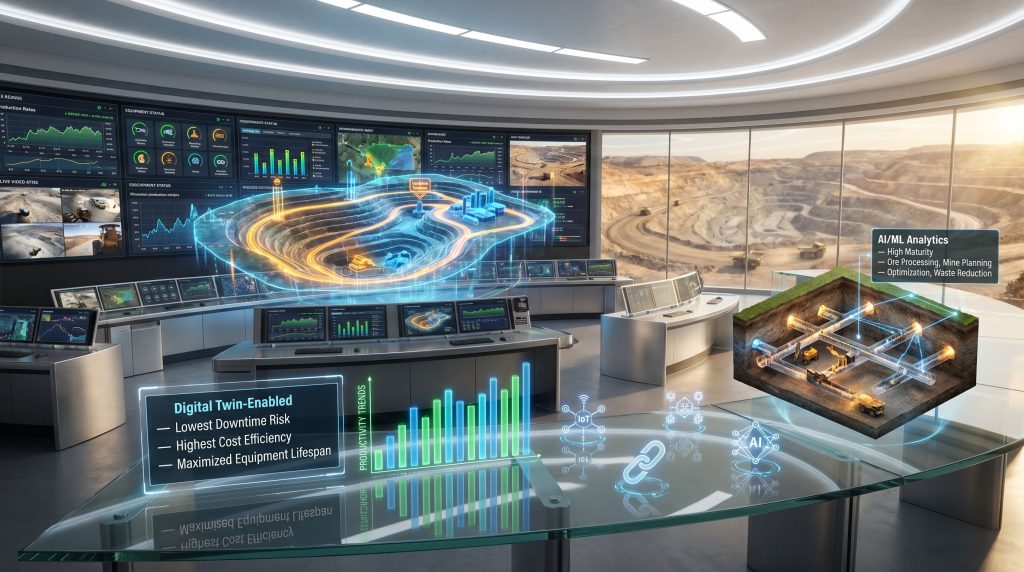
| Digital twin-enabled | Lowest | Highest | Maximised |
How Do Digital Twins Extend Beyond Individual Assets?
Beyond individual asset management, digital twins are increasingly being deployed at the mine-site level, creating a full simulation environment where operators can test changes to extraction sequences, blasting patterns, or processing configurations virtually before committing resources. This capability significantly reduces the risk and cost of operational experimentation.
Integration with enterprise resource planning systems adds another dimension: when a digital twin identifies an impending component failure, it can automatically trigger a purchase order for the required spare part, ensuring it arrives at the site before the maintenance window opens. This closed-loop supply chain integration remains one of the more underappreciated aspects of mature digital twin deployments.
Autonomous Equipment and Fleet Optimisation: Rewriting the Productivity Equation
The commercial deployment of autonomous haul trucks at scale represents one of the most thoroughly validated applications within the broader digital mining solutions landscape. Major operations globally have demonstrated consistent results: fuel consumption reductions through AI-managed speed and load profiles, near-elimination of fatigue-related incidents, and utilisation rates that manual operations cannot match.
These systems rely on multi-sensor arrays combining LiDAR, radar, GPS, and computer vision to navigate complex terrain without human intervention. In addition, the operational advantages extend well beyond safety:
- Continuous 24-hour operation eliminates shift change delays and fatigue-related productivity loss
- Optimised haul profiles reduce fuel consumption through algorithmically calculated speed, payload, and routing decisions
- Elimination of human error in high-cycle repetitive tasks improves consistency and reduces wear-related maintenance costs
- Hazard zone clearance removes personnel from blast areas, unstable ground, and high-dust environments during active operations
Real-time fleet management systems layer additional optimisation on top of autonomous capability. Dispatch algorithms dynamically assign trucks based on load point availability, road conditions, fuel efficiency targets, and processing plant feed requirements. The reduction in idle time achieved through dynamic dispatch is often cited as one of the most immediate and measurable financial benefits of fleet digitalisation.
How Does Fleet Integration Transform Mine Planning?
What is less widely recognised is the interaction between autonomous fleet systems and mine planning software. When these systems share data continuously, extraction sequences and haulage scheduling are co-optimised in a closed loop. Changes in geological conditions at the face are automatically propagated into fleet routing decisions. Consequently, this integration eliminates the lag between geological discovery and operational response that characterises manually managed operations. Mining automation technology is therefore central to achieving this level of operational coherence.
Connected Mine Infrastructure: IoT Networks and Remote Operations Centres
A fully connected mine site deploys thousands of sensors across equipment, infrastructure, environmental monitoring points, and personnel tracking systems. Data from these endpoints is transmitted via industrial wireless networks, including private LTE and increasingly private 5G infrastructure, to edge computing nodes that perform initial processing before forwarding aggregated data to centralised cloud platforms.
Remote operations centres (ROCs) represent the human interface layer of this architecture. Experienced operators supervise multiple sites simultaneously from a centralised and safe environment, monitoring unified dashboards that display equipment health, production rates, environmental conditions, and safety alerts in real time. The safety and efficiency outcomes from ROC adoption have encouraged large mining companies to consolidate operational oversight of geographically dispersed assets into single facilities.
Environmental monitoring has become a core function of connected mine infrastructure rather than a compliance afterthought. Sensor networks and drone-based systems track air quality, water quality, dust dispersion, and emissions continuously. Automated alert systems trigger compliance responses when environmental thresholds are approached, enabling corrective action before a breach occurs. This capability reduces regulatory risk while generating the auditable data streams that ESG reporting frameworks increasingly demand.
Blockchain Traceability: Building Trust Across Critical Mineral Supply Chains
The provenance question surrounding critical minerals has moved from a niche ethical concern to a mainstream regulatory and commercial issue. Cobalt, lithium, nickel, and rare earth elements each carry complex, multi-jurisdiction supply chains where fraudulent origin claims and conflict mineral exposure represent genuine legal and reputational risks.
Blockchain technology addresses this through distributed ledger architecture that creates tamper-proof, chronological records of mineral origin, custody transfers, processing steps, and certifications. Each transaction is recorded as an immutable block visible to all permissioned participants in the chain.
The EU Battery Regulation creates binding obligations for battery manufacturers to disclose the sourcing and carbon footprint of key raw materials. Blockchain-enabled traceability infrastructure in mining supply chains is emerging as one of the most practical compliance pathways for meeting these requirements.
The minerals most directly affected by blockchain traceability requirements include:
- Cobalt from the Democratic Republic of Congo, where artisanal and small-scale mining creates significant supply chain opacity
- Lithium from South American brine operations, where water usage and indigenous land rights face increasing scrutiny
- Nickel across Indonesian and Philippine operations, where deforestation and laterite processing emissions are under regulatory examination
- Rare earth elements, where processing chemistry and tailings management create environmental disclosure obligations
Integration with digital product passports (DPPs), which are increasingly mandated under EU regulatory frameworks, extends traceability from extraction through to end-of-life material recovery. This creates the foundational infrastructure for genuine circular economy models in critical mineral supply chains.
The next major ASX story will hit our subscribers first
Digital Tools and ESG Performance: From Compliance to Competitive Advantage
Institutional capital flows in mining are increasingly conditioned on measurable, auditable ESG performance. Manual reporting systems cannot deliver the granularity or verification standards that investors, regulators, and offtake partners now expect. Digital platforms are becoming the standard infrastructure for ESG compliance, and mining's digital transformation is accelerating this shift across the sector.
AI-driven energy management systems optimise power consumption across processing plants, ventilation circuits, and pumping infrastructure in real time. These systems identify opportunities for renewable energy integration and demand-side flexibility that manual energy management cannot capture. Real-time emissions tracking enables Scope 1, 2, and 3 carbon footprint measurement with the precision required for credible net-zero pathway commitments.
In tailings management, advanced process control systems reduce tailings generation by maximising recovery rates in processing circuits, while drone-based structural monitoring detects seepage risks and embankment anomalies before they escalate. Digital water balance models track consumption, recycling rates, and discharge quality continuously.
Integrated ESG reporting platforms aggregate environmental, social, and governance data into structured frameworks aligned with GRI, TCFD, ISSB, and ICMM reporting standards. Automation of this alignment is reducing the compliance burden while improving the credibility of disclosed data. For instance, organisations such as Wipro's digital mining practice have developed purpose-built platforms to support these reporting requirements across global mining operations.
Key Digital Mining Technologies: A Comparative Overview
| Technology | Primary Application | Key Benefit | Maturity Level |
|---|---|---|---|
| Autonomous Equipment | Haulage, drilling, loading | Safety, continuous operation | High (commercial scale) |
| Digital Twins | Asset management, simulation | Predictive maintenance, planning | Moderate to High |
| AI/ML Analytics | Ore processing, mine planning | Optimisation, waste reduction | High |
| IoT and Real-Time Monitoring | Equipment health, environment | Visibility, rapid response | High |
| Blockchain | Supply chain traceability | Compliance, fraud prevention | Moderate |
| Cloud-Native Platforms | Data integration, reporting | Scalability, accessibility | High |
| Remote Operations Centres | Multi-site management | Safety, efficiency | High |
| ESG Digital Platforms | Sustainability reporting | Regulatory compliance | Moderate to High |
Implementation Challenges: The Gaps That Determine Digital Transformation Outcomes
The technology itself is rarely the primary obstacle to successful digital mining implementation. The more persistent challenges are organisational and architectural.
IT/OT integration is consistently cited as the most technically complex barrier. Legacy operational technology systems including PLCs, SCADA platforms, and proprietary equipment protocols were designed for reliability in isolated environments, not connectivity. Bridging these systems with modern IT infrastructure requires significant middleware investment, cybersecurity hardening specific to industrial control environments, and change management programmes that address operator scepticism.
Data governance presents a parallel challenge. Digital transformation generates enormous data volumes, but value is only realised when that data is clean, consistently structured, and connected to decision-making workflows. Many mining organisations lack the internal data science capability and governance frameworks needed to convert raw sensor output into actionable operational intelligence.
Capital allocation creates the third tension. Digital initiatives compete with sustaining capital and brownfield expansion projects for budget approval. ROI timelines for foundational infrastructure investments such as connectivity platforms are harder to quantify than production expansion capital, creating institutional resistance even when the long-term case is compelling.
A phased implementation approach addresses this by prioritising high-impact, rapidly measurable use cases first. Predictive maintenance and fleet optimisation typically deliver demonstrable returns within six to eighteen months, building the internal business case for broader platform investment. Resources such as Reactore's analysis of digital mining ROI provide useful frameworks for prioritising these entry points effectively.
Frequently Asked Questions About Digital Mining Solutions
What Distinguishes a Digital Twin From a Conventional Simulation Model?
A simulation model is a static, scenario-based analytical tool used for planning. A digital twin is a live, continuously updated replica of a physical asset or process, fed by real-time sensor data, enabling ongoing operational monitoring and intervention rather than one-time planning exercises.
How Do Autonomous Trucks Specifically Reduce Safety Incidents?
By removing operators from active blast zones, areas of unstable ground, and high-dust environments during hazardous operations. Fatigue-related incidents, which account for a disproportionate share of heavy equipment accidents in mining, are eliminated entirely in autonomous configurations.
Can Smaller Mining Operators Access Digital Mining Technology?
Cloud-native, subscription-based deployment models are making digital mining solutions accessible to mid-tier and junior operators without the capital outlays required for on-premise enterprise systems. Modular entry points around equipment monitoring allow smaller operations to capture value before scaling to broader platform adoption.
How Does Predictive Maintenance Reduce Total Maintenance Costs?
By replacing time-based servicing schedules with condition-based interventions, it eliminates unnecessary preventive work while avoiding the far higher costs of unplanned breakdowns. Extended equipment lifespan and reduced spare parts inventory requirements generate additional cost reductions beyond direct maintenance expenditure.
The Road Ahead: 5G, Edge Computing, and the Autonomous Connected Mine
The next capability frontier lies at the intersection of private 5G networks, edge computing, and AI inference at the point of data generation. Current wireless infrastructure constraints limit real-time data transmission in deep underground and remote open-cut environments. Private 5G removes this bottleneck, enabling the kind of latency-sensitive autonomous decision-making that current network architectures cannot support.
Edge computing complements this by processing AI inference locally rather than routing data to centralised cloud environments, reducing response times and enabling faster autonomous reactions to changing conditions at the mine face.
The longer-term trajectory points toward what the industry increasingly describes as the fully autonomous connected mine: an integrated operational environment where extraction, haulage, processing, and environmental management are orchestrated by a unified digital platform. Human roles in this model shift decisively from direct operation toward supervisory oversight, data interpretation, and strategic decision-making.
The mining companies most likely to lead the next decade of production are not necessarily those sitting on the largest or highest-grade reserves. They are those building the most sophisticated digital operating models, capable of extracting maximum value from their resource base at minimum cost and minimum environmental impact. The competitive gap between operators who have made this transition and those still managing on legacy systems is already measurable. Over the next five to ten years, it will likely become decisive.
Readers interested in ongoing analysis of digital transformation, equipment innovation, and sustainability trends across the global mining sector can consult industry coverage from Metals Mining Review Europe at metalsminingrevieweurope.com.
Want To Identify the Next Major ASX Mineral Discovery Before the Market Does?
Discovery Alert's proprietary Discovery IQ model delivers real-time alerts on significant ASX mineral discoveries, instantly transforming complex geological data into actionable investment insights for both short-term traders and long-term investors. Explore how historic mineral discoveries have generated substantial returns and begin your 14-day free trial today to position yourself ahead of the market.