June 11, 2026
The Infrastructure Logic Driving bp's Upstream Expansion in Southeast Asia
Across the global LNG industry, the most capital-efficient exploration strategies rarely involve blank-slate frontier drilling. The assets that consistently generate the strongest risk-adjusted returns are those developed in proximity to existing processing and export infrastructure, where the heavy capital expenditure has already been committed and the market pathways are already established. This principle sits at the heart of how major operators allocate upstream exploration budgets in mature LNG provinces, and it explains precisely why bp Indonesia exploration blocks tied to Tangguh LNG represent far more than a routine acreage acquisition.
By signing three new production sharing contracts (PSCs) during Indonesia's second 2025 petroleum bidding round, bp has executed a deliberate infrastructure-anchored positioning move designed to protect and extend the commercial utilisation of one of Asia's most significant LNG export systems. Understanding why these blocks matter requires looking beyond the exploration narrative and examining the structural logic of what bp is actually protecting.
When big ASX news breaks, our subscribers know first
How Tangguh LNG Functions as bp's Strategic Anchor in Indonesia
The Tangguh System: Scale, Output, and Operational Architecture
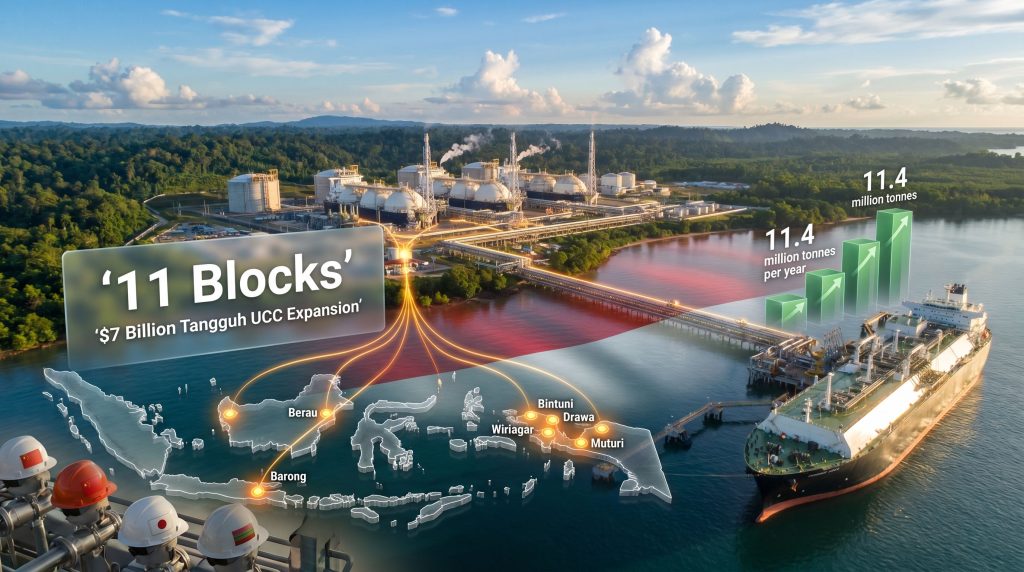
The Tangguh LNG facility, situated in Bintuni Bay in Papua Barat (West Papua), is built around three liquefaction trains with a combined nameplate output of approximately 11.4 million tonnes of LNG per year. At that scale, Tangguh ranks among the larger individual LNG production systems operating across the Asia-Pacific basin, competing in the same capacity tier as major Australian and Malaysian facilities.
The facility operates as a unitised LNG system, meaning its liquefaction trains are not tied to a single upstream reservoir but instead draw feedstock gas from multiple contributing blocks through a shared gathering and processing network. This architecture is critically important when evaluating the strategic significance of new adjacent acreage, because any new gas discovery within pipeline reach of the facility can potentially be commercialised by routing production into an already-operating system rather than constructing standalone infrastructure.
The three foundation blocks underpinning Tangguh's current production profile are:
| Block Name | Role in Tangguh System | Operational Status |
|---|---|---|
| Berau Block | Primary gas supply source | Producing |
| Wiriagar Block | Unitised feed block | Producing |
| Muturi Block | Unitised feed block | Producing |
Crucially, the PSCs governing these core producing blocks extend to December 31, 2055, providing a nearly three-decade operational runway from mid-2026. This long-dated contract structure gives bp the commercial certainty needed to justify large capital commitments to both upstream feedstock development and facility-level expansion projects.
The unitised structure of Tangguh means that new gas discoveries adjacent to the facility are not standalone exploration prospects. They are potential additions to an already-functioning supply chain with processing capacity, export infrastructure, and long-term offtake agreements already in place.
What Are the Three New Exploration Blocks bp Has Added to Its Indonesian Portfolio?
Block-by-Block Breakdown: Bintuni, Drawa, and Barong
The three PSCs were executed with the Government of Indonesia through upstream regulator SKK Migas (Satuan Kerja Khusus Pelaksana Kegiatan Usaha Hulu Minyak dan Gas Bumi) and witnessed by Indonesia's Minister of Energy and Mineral Resources, Bahlil Lahadalia, at the Indonesian Petroleum Association (IPA) Convention and Exhibition 2026.
Bintuni Exploration Block
- Located in Papua Barat, in geographic proximity to the operating Tangguh LNG facility in Bintuni Bay
- Held under a newly signed PSC with the Government of Indonesia via SKK Migas
- Consortium partners include CNOOC Southeast Asia, MI Berau B.V. (a joint venture between INPEX Corporation and Mitsubishi Corporation), and Indonesia Natural Gas Resources Muturi, Inc. (a subsidiary of LNG Japan Corporation)
- Proximity to existing Tangguh infrastructure creates potential for shorter-cycle development pathways if exploration confirms commercial resources
Drawa Exploration Block
- Also situated near the Tangguh LNG operational footprint in Papua Barat
- Shares the same consortium structure as the Bintuni block
- Positioned as a complementary exploration asset that could leverage shared infrastructure and processing capacity at Tangguh if gas is discovered
Barong Exploration Block (East Java)
- Located in East Java, representing a geographic diversification from bp's Papua Barat concentration
- Operated by INPEX, which holds a 51% participating interest
- bp participates as non-operating partner with a 49% interest
- Expands bp's Indonesian upstream exposure into a distinct geological basin
bp's Expanded Indonesian Block Portfolio
| Block | Location | bp Role | Key Partners |
|---|---|---|---|
| Bintuni | Papua Barat | Operator (via Tangguh consortium) | CNOOC, MI Berau B.V., LNG Japan subsidiary |
| Drawa | Papua Barat | Operator (via Tangguh consortium) | CNOOC, MI Berau B.V., LNG Japan subsidiary |
| Barong | East Java | Non-operator (49%) | INPEX (51%, operator) |
| Berau | Papua Barat | Operator | Existing Tangguh consortium |
| Wiriagar | Papua Barat | Operator | Existing Tangguh consortium |
| Muturi | Papua Barat | Operator | Existing Tangguh consortium |
The three new PSC agreements bring bp's total participating interests in Indonesian oil and gas blocks to 11, further consolidating its position as one of the country's most active upstream operators. Furthermore, these bp's deepwater exploration wins demonstrate a consistent pattern of expanding its Indonesian upstream footprint through strategically sequenced acreage additions.
Following the signings, bp's executive vice president for gas and low carbon energy confirmed that these agreements reflect the company's continued commitment to Indonesia's energy security and economic growth, framing the deals as long-term investment decisions rather than speculative near-term exploration bets.
The Strategic Rationale: Why Tie New Exploration to Existing LNG Infrastructure?
The Brownfield Adjacency Model Explained
The conceptual framework underpinning bp's block acquisition strategy is what the industry increasingly refers to as brownfield adjacency exploration, a model that prioritises acreage near existing processing infrastructure over frontier prospects that would require standalone development. This approach differs fundamentally from traditional upstream exploration in several key ways:
-
Capital efficiency: New gas discoveries near Tangguh would not require construction of new pipelines, compression facilities, or liquefaction trains. The gathering network, processing plant, and export terminal already exist, meaning development capital requirements are materially lower than for equivalent standalone projects.
-
Compressed development timelines: Infrastructure proximity reduces the time between exploration success and first production, improving project economics under commodity price uncertainty by shortening the period of pre-revenue capital deployment.
-
Feedstock security: From a facility management perspective, new upstream blocks provide optionality to replace declining production from maturing foundation reservoirs, sustaining utilisation rates on existing infrastructure without new facility construction.
-
Risk-adjusted returns: The combination of lower capital requirements and shorter timelines mathematically improves the risk-adjusted economics of exploration, even at discovery sizes that would be sub-commercial in a greenfield context.
The Tangguh UCC Expansion: A $7 Billion Multiplier Effect
The strategic logic of the new blocks is further amplified by bp's commitment to the Tangguh Ubadari, CCUS, and Compression (UCC) project, a capital program representing approximately $7 billion in investment designed to unlock incremental gas volumes, compress reservoir pressure to extend field life, and integrate carbon capture, utilisation, and storage (CCUS) technology into the facility's operational footprint. Notably, bp sanctions this carbon capture commitment as a cornerstone of the facility's long-term competitiveness strategy.
The UCC project creates what might be described as a multiplier effect on the value of new upstream acreage. When a $7 billion facility expansion is underway, the marginal value of securing additional feedstock supply becomes substantially higher. Each new tonne of gas per day that can be routed through the expanded Tangguh system generates returns against an infrastructure investment that is already committed and largely sunk.
bp's block acquisition strategy is not purely exploratory in nature. It is a feedstock security play designed to protect the long-term utilisation rate of a multi-billion dollar infrastructure investment, while simultaneously future-proofing Tangguh's commercial competitiveness in an increasingly carbon-conscious Asian LNG market.
How These Agreements Fit Within Indonesia's Upstream Regulatory Framework
SKK Migas and the 2025 Petroleum Bidding Round
Indonesia's upstream oil and gas sector operates under the regulatory oversight of SKK Migas, the specialised government body responsible for supervising PSC agreements between the Government of Indonesia and international upstream operators. The three new bp PSCs were executed as part of Indonesia's second 2025 petroleum bidding round, a structured competitive process through which the Indonesian government awards exploration acreage to international operators seeking entry or expansion in the country's upstream sector.
The ministerial presence at the signing ceremony, with Energy and Mineral Resources Minister Bahlil Lahadalia witnessing the agreements at the IPA Convention, reflects Indonesia's practice of elevating high-value upstream deals to a level of political and commercial visibility that signals institutional alignment with the investment.
Key Characteristics of Indonesia's PSC Framework
The PSC model used in Indonesia differs from the concession-based licensing systems common in the North Sea or Gulf of Mexico. Under the Indonesian PSC structure:
- The state retains ownership of the petroleum resource, with contractors recovering costs and receiving a profit-split share of production
- Cost recovery provisions allow operators to recoup exploration and development expenditures from gross production before profit is split
- The framework includes domestic market obligation (DMO) requirements, under which a portion of production must be sold to the Indonesian domestic market at regulated prices
- Recent reforms have introduced more favourable fiscal terms for projects incorporating CCUS technology, reflecting the government's interest in attracting lower-carbon upstream investment
These structural features make Indonesia's PSC environment meaningfully different from other Southeast Asian upstream jurisdictions, and understanding them is essential for evaluating the commercial proposition that bp and its partners have accepted under the new agreements. In addition, policy shifts in resource markets globally are reshaping how international operators assess long-term contractual frameworks across Asia-Pacific.
What bp's Indonesia Strategy Signals for Asian LNG Supply Security
Tangguh's Role in the Regional Energy Architecture
At 11.4 million tonnes per year, Tangguh occupies a structurally important position in the Northeast and Southeast Asian LNG supply chain. The facility's long-term offtake agreements cover buyers across China, Japan, South Korea, and other regional markets, with the PSC's extension to 2055 providing a supply commitment horizon that exceeds the operational lifespan of many competing projects currently in development.
Asia's LNG demand dynamics have shifted considerably since 2022. As European buyers restructured their supply portfolios in response to reduced Russian gas availability, the global LNG supply outlook has experienced significant rebalancing. Asian buyers, particularly in Japan and South Korea, maintained and in some cases extended their long-term contract commitments with established producers as a risk management response to supply volatility, reinforcing the commercial value of Tangguh's existing offtake base.
The CCUS Premium and Carbon-Conscious Procurement
The integration of CCUS technology into the Tangguh UCC expansion introduces a commercially meaningful differentiation factor. Japanese and South Korean utility buyers have increasingly incorporated carbon intensity metrics into their LNG procurement criteria, driven by domestic decarbonisation commitments and emerging carbon pricing frameworks.
LNG produced at facilities with verified carbon abatement measures commands preferential positioning in procurement decisions, and in some cases explicit price premiums under negotiated contract structures. Consequently, energy transition demand trends are accelerating the pace at which carbon-conscious procurement criteria become embedded in long-term Asian LNG supply agreements.
By building CCUS into the Tangguh expansion, bp is not simply meeting regulatory requirements or ESG reporting obligations. It is actively enhancing the long-term commercial competitiveness of the facility in markets where decarbonised supply is moving from a preference to a procurement criterion.
The next major ASX story will hit our subscribers first
Who the Key Consortium Partners Are and What They Contribute
Mapping the Multinational Stakeholder Structure
The partnership structure across bp's Indonesian blocks reflects deliberate alignment between upstream equity holders and downstream demand markets, a design philosophy common in large-scale LNG projects where supply security and market access are mutually reinforcing objectives.
CNOOC Southeast Asia
- Brings Chinese state-backed capital and connectivity to Chinese LNG demand markets
- Long-standing participation in the Tangguh consortium reflects China's strategic focus on securing upstream gas equity in Southeast Asia as part of its national energy security framework
- China remains one of Tangguh's significant LNG offtake markets, creating an alignment of interest between CNOOC's upstream position and downstream demand
MI Berau B.V. (INPEX Corporation + Mitsubishi Corporation Joint Venture)
- Represents the convergence of two distinct Japanese strategic interests: INPEX as Japan's national upstream champion and Mitsubishi as one of the country's largest LNG trading and infrastructure conglomerates
- Japanese participation in Tangguh dates back to the project's development phase, reflecting Japan's decades-long policy of securing equity LNG positions to underpin domestic energy supply chains
- Mitsubishi's commercial infrastructure connects upstream production to downstream Japanese utility and industrial buyers
Indonesia Natural Gas Resources Muturi, Inc. (LNG Japan Corporation subsidiary)
- Further reinforces Japanese commercial interest in Tangguh feedstock security
- The subsidiary structure links the upstream exploration blocks directly to the LNG Japan Corporation's downstream supply portfolio in Japan
INPEX (Barong Block Operator)
- Operates the Barong block in East Java with a 51% interest, acting as technical operator
- INPEX's dual role across both the Tangguh consortium and the Barong block illustrates the depth of Japanese-Indonesian upstream integration and INPEX's growing operational footprint beyond its flagship Ichthys LNG project in Australia
Exploration and Development Risks bp Must Navigate
Subsurface and Technical Risk Factors
Despite the strategic clarity of the brownfield adjacency rationale, the new blocks carry genuine exploration-stage risk that investors and analysts should weigh carefully:
-
Exploration success probability: The geological setting of the Bintuni and Drawa blocks benefits from proximity to the proven Tangguh gas system, but new PSC acreage requires independent drilling programs to confirm commercial resource volumes. Proximity to a producing system does not guarantee equivalent reservoir quality in adjacent structures.
-
Infrastructure integration complexity: Routing new gas streams into existing Tangguh processing trains requires detailed technical compatibility assessment, including pressure matching, gas composition analysis, and pipeline capacity evaluation. Near-capacity utilisation rates at existing facilities can complicate incremental gas integration.
-
Reservoir quality uncertainty: Both the Bintuni and Drawa blocks are exploration-stage assets. Commercial viability depends entirely on well results that cannot be predetermined at the PSC signing stage, regardless of the geological analogues provided by the adjacent Tangguh system.
Operational and Geopolitical Considerations
-
Papua Barat presents a historically complex stakeholder environment for resource operators, with extensive indigenous community consultation requirements and a track record of community relations challenges that have affected operational timelines for prior projects in the province
-
ESG and environmental governance requirements are increasingly embedded in both PSC terms and international investor expectations, particularly for projects that form part of a CCUS-integrated facility system where carbon accounting protocols must be applied consistently across the value chain
-
The long duration of the PSC commitment to 2055 exposes bp and its partners to multiple cycles of Indonesian regulatory change, fiscal policy reform, and political transition, requiring robust contractual protections and ongoing government relationship management
-
However, oil and gas price volatility over a 30-year operational horizon introduces forecast uncertainty that materially affects the net present value calculations underlying the investment decision
-
Moreover, regional energy export challenges across the broader Asia-Pacific basin serve as a useful reference point for the regulatory and logistical complexities that long-duration upstream commitments in this geography can entail
Frequently Asked Questions: bp Indonesia Exploration Blocks and Tangguh LNG
What are the bp Indonesia exploration blocks tied to Tangguh LNG?
The newly added blocks are Bintuni and Drawa, both located in Papua Barat in close proximity to the Tangguh LNG facility, and Barong in East Java. These complement the existing Berau, Wiriagar, and Muturi blocks that form the upstream foundation of the Tangguh system.
How many Indonesian blocks does bp now hold?
Following the signing of three new PSCs, bp holds participating interests in 11 oil and gas blocks across Indonesia.
What is the Tangguh UCC project?
The Tangguh Ubadari, CCUS, and Compression project is a $7 billion expansion designed to unlock additional gas volumes, extend field life through compression, and integrate carbon capture technology into the Tangguh LNG system's operational footprint.
Who regulates upstream oil and gas contracts in Indonesia?
SKK Migas is Indonesia's upstream oil and gas regulatory body, responsible for overseeing PSC agreements and supervising the activities of international upstream operators across the country's petroleum sector.
Why are the Bintuni and Drawa blocks considered strategically valuable?
Their proximity to the operating Tangguh LNG facility means that commercial gas discoveries could be developed using existing gathering, processing, and export infrastructure, substantially reducing both capital expenditure requirements and time-to-production compared to standalone greenfield developments in the same basin.
How long do the Tangguh PSCs run?
The production-sharing contracts covering the core Tangguh blocks extend to December 31, 2055.
Key Takeaways: bp's Infrastructure-Anchored Exploration Model in Indonesia
-
bp's three new PSC agreements bring its total Indonesian upstream portfolio to 11 blocks, with the majority clustered around the Tangguh LNG system in Papua Barat
-
The Bintuni and Drawa blocks represent a brownfield adjacency strategy built on the premise that existing Tangguh infrastructure dramatically reduces the development cost and timeline for any future commercial gas discoveries in the surrounding area
-
The $7 billion Tangguh UCC expansion, incorporating CCUS technology, amplifies the strategic value of securing upstream feedstock acreage by raising the marginal return on each additional tonne of gas that can be routed through the expanded facility
-
A multinational consortium spanning Chinese and Japanese corporate interests reflects Tangguh's function as a regionally significant LNG supply asset serving multiple national energy security objectives simultaneously
-
The integration of CCUS into the Tangguh system positions bp to pursue carbon-intensity differentiated pricing in Japanese and South Korean procurement markets, where decarbonised LNG supply is becoming a commercial differentiator rather than simply a compliance exercise
-
bp's Indonesian strategy is fundamentally oriented around maximising long-term utilisation and commercial competitiveness of one of Asia's most strategically important LNG facilities, rather than speculative resource discovery for its own sake
This article is intended for informational and analytical purposes only and does not constitute financial, investment, or legal advice. Statements regarding exploration potential, development timelines, and commercial outcomes involve inherent uncertainty and should not be interpreted as guarantees of future performance. Readers should conduct independent due diligence before making any investment decisions related to the companies or projects discussed.
Want To Stay Ahead Of The Next Major Resource Discovery On The ASX?
While bp's infrastructure-anchored strategy in Indonesia illustrates how proximity to existing assets can dramatically improve exploration economics, similar value-creation moments occur regularly on the ASX when significant mineral discoveries are announced. Discovery Alert's proprietary Discovery IQ model delivers real-time alerts on significant ASX mineral discoveries, transforming complex geological data into actionable investment insights — explore the historic returns major discoveries have generated and begin your 14-day free trial to position yourself ahead of the broader market.