
May 21, 2026
The Methane Accounting Problem at the Heart of Australia's Coal Approval Crisis
Coal mine approvals in Australia have entered a fundamentally different era. What was once a largely administrative process, governed by technical assessments and economic impact studies, has evolved into a multi-front legal battleground where climate science, Indigenous heritage law, shareholder activism, and ecological protection converge simultaneously. Australian activists challenge Glencore coal expansion at Hail Creek in Queensland — and this is not an isolated campaign by a local environmental group.
It is, furthermore, the visible expression of a structural shift in how Australia evaluates fossil fuel expansion, and the legal tools available to those who oppose it. Understanding what is actually being contested at Hail Creek requires moving beyond the headline figures and examining the underlying technical and regulatory vulnerabilities that make this project genuinely exposed.
When big ASX news breaks, our subscribers know first
What the Hail Creek Expansion Actually Involves
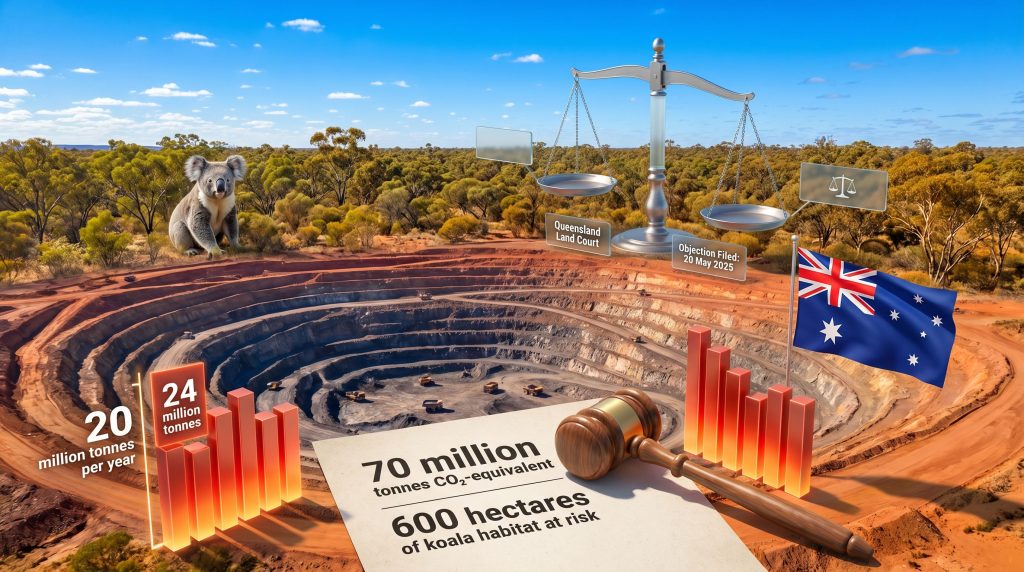
The Hail Creek mine, located in Queensland's Bowen Basin, is one of Australia's larger open-cut operations producing both thermal and coking coal. Its current approved production capacity sits at 20 million tonnes of run-of-mine (ROM) coal per year. The proposed Eastern Margin Extension would add approximately 24 million tonnes of total additional ROM coal output, extending the mine's operational life by roughly three years to 2038.
The scale of the proposal, combined with its emissions profile, is central to understanding why Australian activists challenge Glencore coal expansion plans with such legal specificity. In addition, the broader context of government intervention in mining adds another layer of complexity to how these disputes are likely to be resolved.
| Parameter | Detail |
|---|---|
| Mine Location | Bowen Basin, Queensland |
| Mine Type | Open-cut thermal and coking coal |
| Current Approved Capacity | 20 million tonnes/year (ROM coal) |
| Proposed Additional Output | 24 million tonnes (total extension volume) |
| Extended Mine Life | To 2038 (approx. 3 additional years) |
| Estimated Lifetime GHG Emissions | Over 70 million tonnes CO₂-equivalent |
| Koala Habitat at Risk | Approximately 600 hectares |
| Legal Venue | Queensland Land Court |
| Objection Filed | 20 May 2025, by Mackay Conservation Group |
The Mackay Conservation Group (MCG) lodged a formal statutory objection in the Queensland Land Court on 20 May 2025. This is the prescribed legal mechanism under Queensland mining and environmental legislation for third parties to formally contest approval decisions. The MCG's challenge rests on three core arguments: the project's structural incompatibility with Australia's domestic and international climate commitments, a projected release of over 70 million tonnes of greenhouse gas emissions across the project's lifetime, and the clearing of approximately 600 hectares of high-quality native bushland supporting koala populations.
The Methane Discrepancy: The Technical Fault Line
Of all the vulnerabilities embedded in the Hail Creek proposal, the methane accounting question is arguably the most technically significant, and the least widely understood by general observers.
Previous academic research has indicated that actual methane emissions from the Hail Creek mine may be four to five times higher than the figures officially reported. This is not a marginal rounding error. It is a discrepancy of a magnitude that, if substantiated in a legal setting, would fundamentally undermine the credibility of any greenhouse gas abatement plan built on those baseline figures.
Methane is a particularly potent greenhouse gas. Over a 20-year timeframe, methane is estimated to have a global warming potential approximately 80 times greater than carbon dioxide, according to the Intergovernmental Panel on Climate Change (IPCC). Open-cut coal mining releases fugitive methane from exposed coal seams and surrounding strata during the excavation process.
Unlike underground mining, where methane drainage infrastructure is standard, open-cut operations have historically had limited commercial incentive to capture these emissions, and their measurement has relied on modelling approaches that critics argue are systematically conservative.
Glencore has acknowledged this gap by proposing methane pre-drainage technology as part of its emissions management strategy. Pre-drainage involves extracting fugitive methane from coal seams before the overburden is removed and mining commences, reducing the volume of gas vented to the atmosphere during operations. The concept is technically sound and has established precedent in underground coal mining contexts. However, the company has confirmed that feasibility studies for pre-drainage at Hail Creek would only be completed within two years of any project approval being granted.
This sequencing represents a critical weakness in the approval case. Committing to study the viability of the primary emissions mitigation technology after approval is secured, rather than before it is sought, leaves the abatement plan structurally unverified at the point when regulators and courts must assess its credibility.
How Australia's Safeguard Mechanism Applies, and Where It Falls Short
Glencore's regulatory defence rests substantially on the Safeguard Mechanism, Australia's legislated framework for managing emissions at large industrial facilities. The mechanism applies to any facility emitting above 100,000 tonnes of CO₂-equivalent per year, requiring covered operators to keep net emissions at or below a declining baseline trajectory.
Hail Creek already operates within this framework, and Glencore has confirmed that the proposed expansion would be accompanied by a formal greenhouse gas emissions abatement plan. On its face, this satisfies the procedural requirements of the current regulatory system.
However, activists and independent researchers have drawn a critical distinction between regulatory compliance and genuine climate alignment. Consequently, this distinction is becoming the central battleground in Australian coal approvals:
- Compliance with the Safeguard Mechanism's current baselines does not equal alignment with Australia's Paris Agreement commitments or its stated net-zero trajectory.
- The Safeguard Mechanism's declining baseline structure was designed to reduce emissions intensity over time, but does not prohibit absolute emissions growth if new capacity is brought online.
- An abatement plan built on methane figures that may be four to five times lower than actual emissions is not a credible mitigation instrument, regardless of its formal compliance status.
This distinction between technical compliance and substantive climate alignment is increasingly the terrain on which Australian coal challenges are being fought. Furthermore, the ongoing mining sustainability transformation across the sector is raising the evidentiary bar that projects like Hail Creek must meet.
Beyond Climate: Ecology, Heritage, and the Expanding Legal Toolkit
The Hail Creek challenge operates across multiple legal dimensions simultaneously, reflecting a broader maturation in the strategies deployed by those opposing coal expansion in Australia.
Ecological Impact
The proposed clearing of approximately 600 hectares of native bushland raises concerns that extend beyond koala habitat. The Bowen Basin sits within catchments that drain toward the Great Barrier Reef, and long-term disruption to vegetation cover and hydrology in this region carries downstream ecological risk. Koalas are listed as endangered under Australia's federal environmental legislation, a designation that triggers specific assessment obligations under the Environment Protection and Biodiversity Conservation (EPBC) Act.
Considerations around natural capital in mining are increasingly being incorporated into legal challenges, as courts are asked to quantify the ecological value of habitats that would be permanently destroyed. In addition, mining waste management practices at open-cut operations like Hail Creek are facing greater scrutiny as part of the broader environmental assessment process.
Indigenous Cultural Heritage as a Veto Mechanism
A parallel and instructive precedent emerged from New South Wales, where planning authorities rejected Glencore's proposed Glendell coal mine expansion on the grounds of irreversible heritage impacts to the Wonnarua people and the Ravensworth Homestead site. Indigenous representatives formally opposed the project, and that opposition proved decisive in the planning outcome.
The Glendell rejection is significant for several reasons that are not widely appreciated:
- It demonstrated that Indigenous cultural heritage arguments can independently defeat a coal expansion proposal, without requiring climate grounds to succeed.
- It established a documented precedent within the same company's project portfolio, creating a reference point that legal challengers to Hail Creek can cite.
- It signals that planning authorities are now willing to prioritise irreversible cultural and ecological impacts over economic arguments in coal approval decisions.
The Shareholder Activism Dimension: Compounding Risk from Above
The Australasian Centre for Corporate Responsibility (ACCR) has maintained sustained engagement with Glencore on its coal expansion strategy since 2022, including formal interventions at annual general meetings. Shareholder activists challenging Glencore have secured support from a meaningful minority of institutional investors, signalling that discomfort with the company's coal growth trajectory is not confined to activist circles.
The ACCR has pointed to two outcomes it regards as partial indicators of progress: Glencore's withdrawal of a proposed greenfield coal mine, and the rejection of the Glendell expansion on heritage grounds by New South Wales planning authorities. Whether these outcomes reflect genuine strategic recalibration or opportunistic retreat from projects that had become legally untenable is a question investors should examine carefully.
When shareholder activism and regulatory challenge align on the same project simultaneously, the combined risk exposure for a coal expansion proposal escalates well beyond what either pressure stream would generate independently.
The next major ASX story will hit our subscribers first
A Pattern Across Multiple Cases
Hail Creek does not exist in isolation. Viewed alongside other recent Australian coal approval outcomes, it forms part of a discernible pattern of escalating legal and regulatory resistance. Furthermore, broader coal policy intervention at the international level is shaping the context in which these domestic disputes are unfolding.
| Case | Location | Status / Outcome |
|---|---|---|
| Hail Creek Eastern Margin Extension | Queensland | Under legal challenge, Queensland Land Court |
| Glendell Coal Mine Expansion | New South Wales | Rejected on Indigenous heritage grounds |
| Glencore Greenfield Coal Proposal | Undisclosed | Withdrawn by Glencore |
Each of these cases has advanced through different legal and regulatory mechanisms, suggesting that opposition to coal expansion in Australia is not dependent on any single pathway succeeding. The multiplication of available legal tools — from Land Court objections to EPBC federal assessments to heritage law — means that coal expansion proposals now face layered exposure that is difficult to fully anticipate during project design.
Scenario Analysis: Three Trajectories for the Hail Creek Decision
The following scenarios are speculative projections based on available information and should not be treated as predictions or investment advice.
Scenario A: Conditional Approval
Queensland Land Court proceedings conclude in Glencore's favour, with approval granted subject to enhanced methane monitoring requirements, expanded habitat offset obligations, and binding timelines for pre-drainage feasibility. Mine life extends to 2038. Activist groups escalate to federal EPBC review.
Scenario B: Delayed Partial Approval
Legal proceedings extend over 12 to 24 months. Capital commitment and operational planning are disrupted. Compounding pressure from shareholder resolutions and potential federal intervention forces a project redesign, with significantly strengthened conditions attached to any eventual approval.
Scenario C: Rejection or Withdrawal
Legal proceedings expose material deficiencies in methane reporting and the abatement plan's credibility. The federal environment minister exercises EPBC powers to reject the project on biodiversity or climate grounds. Glencore withdraws the proposal, consistent with the precedent set by its earlier greenfield withdrawal. This outcome would materially raise the approval bar for future coal expansion projects across Australia.
What This Means for the Industry's Compliance-First Strategy
Glencore's approach to the Hail Creek challenge illustrates a compliance-first strategy that has served the coal industry adequately in the past but is now facing a credibility stress test. Demonstrating that a project operates within the Safeguard Mechanism's legislated framework, and that a formal abatement plan exists, was previously sufficient to satisfy regulatory expectations. That threshold is no longer adequate in the current approval environment.
Several structural shifts explain why:
- Methane reporting scrutiny is intensifying. The gap between modelled and independently measured fugitive emissions at coal operations is attracting increasing attention from courts, regulators, and researchers. Projects where this discrepancy is material — and Hail Creek is clearly in that category — face a specific and growing legal vulnerability.
- Technology commitments require upfront credibility. Proposing to study the viability of an emissions mitigation technology after project approval is granted reflects a planning sequencing that courts are likely to scrutinise closely, particularly when the technology's feasibility determines the credibility of the entire abatement case.
- Heritage law is a structurally independent veto. The Glendell outcome confirmed that cultural heritage grounds can defeat a coal expansion independently of any climate argument. This expands the legal surface area that project proponents must defend.
- Regulatory compliance and climate alignment are not equivalent. The distinction between meeting legislated baselines and genuinely aligning with national and international climate commitments is now explicitly available as a legal argument, and courts are beginning to engage with it.
For investors monitoring Australian coal assets, the Hail Creek proceedings represent more than a single project dispute. They are a real-time test of whether existing compliance frameworks can survive legal challenge in an environment where the tools available to opponents are multiplying, and where the evidentiary bar for abatement credibility is rising.
This article is intended for informational purposes only and does not constitute financial, legal, or investment advice. Scenario projections are speculative and based on publicly available information. Readers should conduct independent research and seek professional advice before making any investment decisions related to companies or projects discussed.
Want to Track the Mining Projects Shaping ASX Markets in Real Time?
Discovery Alert's proprietary Discovery IQ model instantly identifies significant ASX mineral discoveries and delivers actionable alerts to subscribers — cutting through complex data across more than 30 commodities so investors can act ahead of the broader market. Start your 14-day free trial today, or explore Discovery Alert's discoveries page to understand how historic mineral discoveries have generated substantial returns.