June 12, 2026
The Engineering Gap Between What We Know and What We Build
Every structural discipline has its equivalent of a known flaw that gets repeated anyway. In civil engineering, the tailings storage facility represents precisely that contradiction. The geotechnical principles governing embankment stability have been well understood for generations. The failure modes are catalogued, the warning signals are detectable, and the safer construction alternatives exist. Yet the global inventory of tailings dam failures continues to grow, and the consequences continue to escalate in scale and severity.
This is not a knowledge problem. It is a governance, incentive, and institutional problem, and fixing tailings failures will require confronting all three simultaneously.
When big ASX news breaks, our subscribers know first
What Tailings Storage Facilities Actually Are, and Why They Fail
The Engineered Structure Most People Have Never Heard Of
Tailings storage facilities are among the largest engineered structures on earth. They store the fine-grained, chemically active residue left after ore processing, a material that can contain heavy metals, process reagents, and acid-generating sulphides in concentrations that make uncontrolled release a serious environmental catastrophe. Unlike conventional water dams, TSFs are typically raised incrementally over the life of a mine, meaning their structural configuration evolves continuously and their failure risk changes accordingly.
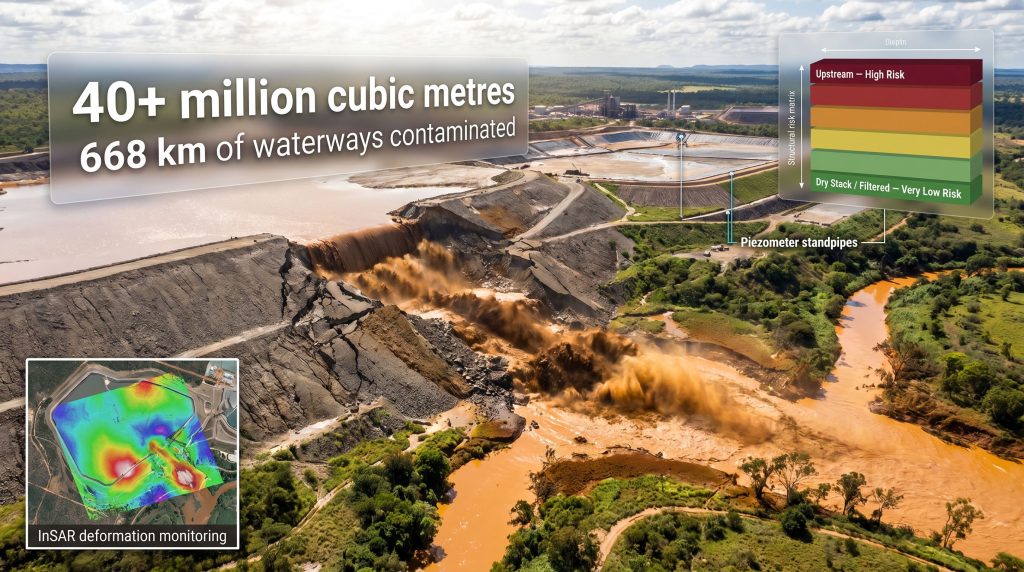
The scale of potential consequences is not hypothetical. The 2015 collapse of the Fundão dam in Brazil released more than 40 million cubic metres of iron ore tailings, killing 19 people and contaminating approximately 668 kilometres of downstream waterways. The Doce River ecosystem is still recovering, and legal proceedings against the operator have extended across multiple continents.
"Scale of consequence: A single upstream embankment failure can release a volume of material equivalent to tens of thousands of Olympic swimming pools in a matter of hours, with contamination plumes that persist for decades in riverbed sediments and floodplain soils."
The Cumulative Failure Rate the Industry Rarely Publicises
Research compiled through the World Mine Tailings Failures database suggests a cumulative failure rate for constructed TSFs of between 1.5% and 4.4% through to the end of 2020. That figure deserves to sit with readers for a moment. Applied across the thousands of active and legacy tailings facilities worldwide, it means dam failure is not an outlier event. It is a statistically predictable outcome of the current system.
| Metric | Figure |
|---|---|
| Cumulative TSF failure rate (to end-2020) | 1.5% to 4.4% |
| Tailings released at Fundão (Brazil, 2015) | 40+ million cubic metres |
| Waterway contamination, Fundão event | 668 km |
| Lives lost, Fundão collapse | 19 |
The Five Failure Mechanisms Engineers Have Been Tracking for Decades
Ranked by Frequency and Consequence
Understanding how tailings dams fail is foundational to fixing tailings failures at scale. Five dominant mechanisms account for the vast majority of recorded events:
-
Overtopping occurs when the water level within the facility rises to or above the dam crest, typically during extreme rainfall events or periods of insufficient water management. The eroding action of water spilling over an embankment that was never designed as a spillway can undermine the structure rapidly.
-
Slope instability encompasses a range of geotechnical failure modes in which the embankment face loses its capacity to resist shear stresses, leading to slumping, sliding, or progressive collapse.
-
Seismic liquefaction is a particularly dangerous mechanism in which earthquake-induced cyclic loading causes saturated, loosely deposited tailings to temporarily behave as a fluid. Once liquefaction initiates, containment is effectively lost.
-
Internal erosion, or piping, develops when water migrating through the embankment body gradually transports fine particles, creating a channel that widens until structural failure occurs. This mechanism is insidious because it progresses invisibly until collapse is imminent.
-
Foundation failure results from inadequate or poorly characterised sub-surface conditions beneath the dam, including weak or compressible soils that were not adequately assessed during design.
The Compounding Effect of Climate Change on Embankment Risk
Climate scientists have documented a clear intensification of precipitation extremes across most global mining regions, and this trend has direct engineering consequences for tailings storage. Freeboard margins, which represent the vertical distance between the water surface and the dam crest, are being eroded by more frequent and more intense rainfall events. Design storm assumptions built on historical hydrology are becoming structurally inadequate as non-stationary climate conditions push flood magnitudes beyond historical norms.
Less discussed but equally significant is the drought-flood cycle dynamic. Extended dry periods cause desiccation cracking in embankment materials, reducing their cohesive strength. When intense rainfall follows, water infiltrates these cracks rapidly, producing sudden saturation in a structure that was previously dried out. This sequential stress loading has been identified as a contributing factor in several embankment failures in semi-arid mining regions.
The Invisible Risk: Inactive and Abandoned Facilities
One of the least reported dimensions of global tailings risk is the proportion of failures that involve facilities no longer in active production. When a mine closes, TSF monitoring budgets are typically the first expenditure to be reduced. Drainage infrastructure deteriorates. Vegetation encroachment blocks spillways. Settlement and cracking go unrecorded.
Furthermore, satellite-based deformation monitoring programmes have identified measurable surface movement at inactive tailings facilities with no active monitoring programmes, sometimes detecting precursor signals years before any visible structural distress becomes apparent. This capability exists, is technically mature, and remains dramatically underutilised at legacy sites worldwide. The broader topic of mine reclamation evolution highlights just how much ground the industry still needs to cover in this space.
Why Upstream Construction Remains the Industry's Most Persistent Liability
The Cost Trap That Has Cost Lives
The upstream embankment raise method, in which each successive construction lift is placed over previously deposited tailings rather than on competent fill, is the cheapest way to increase a tailings facility's capacity. It is also the construction method associated with the majority of the most catastrophic failures in recent decades, including Fundão and the 2019 Brumadinho disaster in Brazil, which killed 270 people.
The structural vulnerability of upstream-raised embankments stems from their reliance on the deposited tailings themselves as a foundation for subsequent raises. When those tailings are saturated and loosely deposited, as is common in conventional slurry operations, they present a high liquefaction hazard under seismic loading. The economic attractiveness of the upstream method has consistently outweighed the geotechnical arguments against it in cost-pressured operating environments.
Comparing Construction Methods on Risk and Cost
| Construction Method | Structural Risk | Seismic Performance | Relative Cost |
|---|---|---|---|
| Upstream | High | Poor | Low |
| Centreline | Moderate | Moderate | Moderate |
| Downstream | Low | Good | High |
| Paste Tailings | Low | Good | High |
| Dry Stack / Filtered | Very Low | Excellent | Very High |
Engineering consensus has been moving against upstream construction for more than two decades, but the economic incentive to use it remains strong, particularly for operations with high tonnage throughput and constrained capital budgets. Understanding how project economics are structured at the planning stage — including the role of definitive feasibility studies — reveals why lower-risk construction methods are so often deferred in favour of cheaper alternatives.
Fixing Tailings Failures: A Five-Pillar Framework for Structural Reform
Pillar 1: Transitioning to Lower-Risk Tailings Technologies
The clearest technical pathway toward fixing tailings failures lies in reducing or eliminating the water pond that drives most catastrophic failure modes. Three technologies represent the current frontier of practice:
- Filtered tailings use vacuum or pressure filtration to remove the majority of process water before deposition, producing a near-dry, stackable material. The resulting stack does not require a water-retaining embankment and is far less susceptible to liquefaction.
- Paste tailings reduce water content relative to conventional slurry while retaining sufficient fluidity for pumped transport. They represent an intermediate step between slurry and fully filtered approaches.
- Dry stack tailings represent the most conservative option from a safety standpoint, eliminating the large free-water pond entirely and enabling compacted placement that achieves structural stability comparable to engineered fill.
The trade-off is cost. Filtered and dry stack systems carry substantially higher capital expenditure requirements and are operationally more complex, particularly at high throughput rates or in remote locations with limited power infrastructure. However, as the insurance and liability costs associated with conventional TSFs become more accurately priced into project financing, the economic case for lower-risk alternatives is strengthening.
Pillar 2: Engineering for Extreme Events, Not Historical Averages
Design standards across most jurisdictions have historically used probabilistic return periods, such as the one-in-100 or one-in-1,000-year storm, as the basis for spillway capacity and freeboard design. In a stationary climate, this approach has defensible statistical grounding. In a non-stationary climate, it systematically underestimates the design event.
Current best practice calls for sizing critical spillway infrastructure against the Probable Maximum Flood (PMF), a deterministic estimate of the largest flood that could reasonably be expected at a given site. Similarly, seismic design should reference the Maximum Credible Earthquake (MCE) rather than probabilistic hazard estimates that may underweight rare but high-consequence events.
Closure design is a particular blind spot. In many jurisdictions, detailed closure planning is not required until late in the mine life, by which point the facility configuration is largely fixed. Integrating closure design at the feasibility stage, when construction choices are still open, would substantially reduce the long-term liability embedded in TSF design.
Pillar 3: Continuous Monitoring as a Non-Negotiable Operational Standard
The monitoring technology available to TSF operators today is qualitatively different from what existed even a decade ago:
- Satellite InSAR (Interferometric Synthetic Aperture Radar) can detect millimetre-scale surface deformation across an entire TSF footprint, providing early identification of embankment movement that precedes visible failure by weeks or months.
- SAR (Synthetic Aperture Radar) monitoring operates independent of cloud cover and daylight, providing continuous surveillance capability regardless of site access or weather conditions.
- Piezometer networks provide real-time data on pore water pressure within the embankment, the single most critical variable in assessing liquefaction risk.
- Inclinometers track lateral movement within the embankment body, detecting developing instability before surface expression is visible.
- Drone photogrammetry enables periodic volumetric surveys and crest condition assessment at a fraction of the cost of traditional survey methods.
"Monitoring Technology Performance Summary: InSAR/SAR provides millimetre-resolution deformation mapping across full TSF footprint with all-weather capability; piezometers deliver real-time pore pressure data critical to liquefaction susceptibility assessment; inclinometers detect sub-surface lateral movement within the embankment body; drone photogrammetry enables periodic volumetric and crest condition surveys."
The integration of these data streams into unified monitoring platforms, with automated alert thresholds and structured escalation protocols, is rapidly becoming the industry benchmark. What remains inadequate is the rate of adoption, particularly among smaller operators and at inactive facilities where monitoring budgets have been cut.
Pillar 4: Governance, Regulation, and Enforceable Accountability
The Global Industry Standard on Tailings Management (GISTM), developed following the Brumadinho disaster through a collaboration between the International Council on Mining and Metals, the United Nations Environment Programme, and the Principles for Responsible Investment, represents the most comprehensive performance framework currently available. It establishes requirements across the full TSF lifecycle, from siting and design through to post-closure stewardship.
Its critical limitation is voluntary adoption. In most mining jurisdictions, it carries no regulatory force. Compliance is increasingly demanded by institutional investors and major stock exchanges, creating a de facto capital markets standard that is more stringent than the legal baseline in many countries. This gap between investor expectations and regulatory requirements creates uneven enforcement, particularly for smaller operators without access to institutional capital markets.
Independent Tailings Review Boards (ITRBs), comprising independent geotechnical engineers who conduct periodic reviews of TSF design, operations, and monitoring, are increasingly specified in GISTM-aligned commitments and major mining codes. Their effectiveness depends on genuine independence, access to complete operational data, and the authority to require corrective action. As noted in discussions around mining sustainability transformation, voluntary frameworks only go so far without enforceable accountability behind them.
Pillar 5: Post-Closure Stewardship as a Permanent Obligation
The conceptual framing of tailings facilities as problems that end at mine closure is one of the most dangerous misconceptions in the industry. TSFs remain physically present and potentially hazardous for decades or centuries after the last ore is processed. Long-term stewardship obligations include:
- Ongoing structural monitoring and periodic geotechnical assessment
- Maintenance of drainage infrastructure, including spillways and underdrains
- Management of vegetation encroachment and erosion
- Regulatory inspection by adequately resourced authorities
- Financially bonded closure plans sized to actual long-term liability, not discounted estimates
"Critical structural gap: In many jurisdictions, financial assurance requirements for TSF closure are set at levels far below the actual cost of long-term stewardship, effectively transferring long-term liability to future governments and affected communities."
Where Reform Is Advancing, and Where It Is Not
Measurable Progress Since Brumadinho
Several structural shifts in industry practice have occurred since 2019:
- Institutional investors including major pension funds and sovereign wealth funds have begun incorporating GISTM compliance into capital allocation criteria
- Brazil has introduced stricter dam safety legislation that restricts upstream construction above certain hazard classifications
- Canada has strengthened provincial dam safety regulations following domestic incidents
- Satellite monitoring service providers have significantly reduced per-facility costs, expanding accessibility to mid-tier operators
- Engineering firms are increasingly incorporating climate scenario modelling into standard TSF design packages
The Structural Gaps That Persist
Despite this progress, significant systemic risks remain unaddressed:
- Thousands of legacy TSFs in developing economies operate under design standards from the 1970s and 1980s, with inadequate monitoring and no formal closure plans
- Small and mid-tier operators frequently lack the technical capacity and financial resources to implement best-practice monitoring or construction methods
- The global inventory of tailings facilities, particularly historical and abandoned sites, remains incomplete and largely outside public reporting frameworks
- ESG disclosures by mining companies rarely capture the full liability represented by legacy TSFs, making accurate risk assessment by investors extremely difficult
Consequently, these gaps intersect directly with how the industry approaches natural capital in mining, where inadequate accounting for long-term environmental liabilities remains a persistent blind spot.
The next major ASX story will hit our subscribers first
Operational Checklists for Tailings Safety
For Operating Facilities
- Annual independent geotechnical review by a qualified person
- Real-time piezometer network installed and actively reviewed against alert thresholds
- Satellite deformation monitoring programme in operation
- Freeboard and spillway capacity assessed against current Probable Maximum Flood estimates
- Seismic hazard assessment updated to current Maximum Credible Earthquake methodology
- Emergency Action Plan current, tested, and communicated to downstream communities
For Inactive and Closed Facilities
- Post-closure monitoring programme formally documented and funded
- Vegetation and drainage condition inspected on a defined schedule
- Financial assurance maintained at full estimated long-term closure cost
- Regulatory notification procedures established for material changes in condition
- Long-term stewardship responsibility legally assigned and enforceable
Frequently Asked Questions: Tailings Dam Safety
What is the most common cause of tailings dam failure?
Overtopping and slope instability are historically the most frequent failure mechanisms, accounting for a substantial share of recorded events. Seismic liquefaction and internal erosion are comparatively less frequent but tend to produce the most severe and rapid consequences when they occur, particularly in upstream-raised embankments.
What is the difference between filtered tailings and conventional slurry tailings?
Conventional slurry tailings are pumped as a high-water-content liquid into storage facilities contained by embankment dams. Filtered tailings are mechanically dewatered before placement, producing a material with a moisture content close to its optimum compaction point. The absence of a large free-water pond in filtered systems eliminates the primary driver of embankment overtopping and dramatically reduces seepage-related risks.
Is the Global Industry Standard on Tailings Management legally binding?
The GISTM is a voluntary performance standard. It has no direct legal force in most jurisdictions. However, it is increasingly incorporated into institutional investor requirements, major stock exchange listing conditions, and financing covenants, making it effectively mandatory for operators seeking access to mainstream capital markets.
How does satellite InSAR monitoring improve tailings dam safety?
InSAR technology measures surface deformation across a facility with millimetre-scale precision by comparing successive radar images of the same area. Changes in the electromagnetic return between acquisition dates reveal ground movement that may indicate embankment settlement, seepage-driven deformation, or the early stages of slope instability. Detection at this resolution, over an entire TSF footprint, and independent of site access, provides an early warning capability that ground-based instrumentation alone cannot replicate.
What are the long-term obligations after a tailings dam is closed?
Post-closure tailings facilities require indefinite monitoring, periodic geotechnical assessment, drainage maintenance, and erosion management. These are not temporary obligations. Depending on the chemistry of the stored material, particularly where acid-generating sulphides are present, active water treatment may be required for a century or longer. Financial provisioning for these obligations must be legally secured before operations begin, not estimated at closure when the mine's revenue stream has ended.
The Path Forward: Three Strategic Priorities
Fixing tailings failures at a systemic level requires prioritising three actions above all others over the next decade. Moreover, as discussions around mining for dummies: grade is king but permitting wins wars make clear, the broader regulatory and social licence environment in which TSFs operate is just as important as the engineering choices made on site.
-
Mandatory GISTM adoption as a regulatory baseline across all major mining jurisdictions, with independent verification and public reporting requirements that close the gap between voluntary commitment and enforceable practice.
-
A comprehensive global TSF inventory, publicly accessible, recording the design method, age, hazard classification, and monitoring status of every active, inactive, and abandoned tailings facility. Without this foundational dataset, risk management is operating in partial blindness.
-
Financial assurance reform that requires closure bonds and perpetual care funds to be sized against realistic long-term liability estimates, independently validated, and maintained at full value throughout the facility's operational and post-closure life.
"The core challenge in fixing tailings failures is not the absence of technical solutions. The engineering knowledge, monitoring technology, and construction alternatives all exist. What is missing is the institutional architecture that makes safety the structural default rather than a cost-benefit calculation made under competitive pressure."
Further Resources
Readers seeking to build deeper understanding of tailings dam safety, failure data, and policy developments may find the following resources valuable:
- Mining Magazine covers ongoing tailings management and ESG developments across the global industry: miningmagazine.com
- World Mine Tailings Failures maintains a publicly accessible database of TSF failure events globally: worldminetailingsfailures.org
- Earthworks publishes independent analysis of tailings disaster protection for communities worldwide
- U.S. National Park Service provides technical overviews of long-term tailings dam failure risk: nps.gov
This article contains forward-looking assessments, regulatory projections, and scenario-based analysis. These represent informed perspectives based on publicly available data and engineering literature, not guarantees of future outcomes. Readers with operational or investment exposure to tailings storage facilities should seek qualified geotechnical and legal advice specific to their circumstances.
Want to Stay Ahead of Significant ASX Mineral Discoveries Before the Broader Market Does?
Discovery Alert's proprietary Discovery IQ model delivers real-time alerts on significant ASX mineral discoveries, instantly translating complex geological data into actionable investment insights for both short-term traders and long-term investors. Explore how major mineral discoveries have historically generated substantial returns on Discovery Alert's dedicated discoveries page, and begin your 14-day free trial today to secure a market-leading advantage.