
July 20, 2026
The Hidden Architecture of Critical Minerals Risk: Why Congo's Regulatory Shift Matters Globally
Battery metals investors often focus on commodity price cycles, exploration results, and project economics when building their conviction. What receives far less analytical attention is the institutional architecture that governs resource extraction in the jurisdictions where the most critical deposits actually exist. When that architecture starts shifting, the downstream consequences reach far beyond Kinshasa.
The Democratic Republic of Congo sits at the intersection of two defining forces of the 21st century: the accelerating global demand for battery metals and the geopolitical contest to control their supply. No other single country concentrates this much structural importance across so many critical minerals simultaneously. That is precisely why a proposed package of legislative amendments to the DRC's 2018 Mining Code, currently moving through government review, has triggered an emergency mobilisation from the country's leading industry body and raised material questions about Congo mining reform investor confidence.
When big ASX news breaks, our subscribers know first
Why the DRC Occupies an Irreplaceable Position in the Global Battery Metals Supply Chain
The DRC's natural resources endowment is not simply large — it is strategically irreplaceable in several critical commodity categories. The country holds the world's top position in cobalt production and ranks as the second-largest supplier of copper globally. Beyond those headline figures, the DRC also contributes meaningful volumes of gold, tantalum, and germanium, the latter being a semiconductor-critical material that sits at the intersection of defence technology and advanced electronics manufacturing.
This concentration of strategically significant outputs has attracted capital from across the geopolitical spectrum. The major operator landscape reflects this clearly:
| Operator | Country of Origin | Primary Commodity Focus |
|---|---|---|
| CMOC | China | Copper, Cobalt |
| Huayou Cobalt | China | Cobalt |
| Zijin Mining | China | Copper, Gold |
| Glencore | Switzerland | Copper, Cobalt |
| Barrick Gold | Canada | Gold |
Chinese operators have established the deepest operational footprint, a reflection of Beijing's long-term critical minerals acquisition strategy. However, Western capital remains significant, and the presence of both creates a complex stakeholder dynamic whenever regulatory conditions change. Any shift in the DRC's mining governance framework is not a localised African mining story — it propagates through battery manufacturing supply chains in Asia, Europe, and North America.
Furthermore, the US-China rivalry over the DRC's mineral wealth adds a geopolitical dimension that makes regulatory developments even more consequential for global investors.
Dissecting the Proposed Amendments: What the 40-Article Bill Actually Contains
The legislative trigger for the current industry alarm is a bill submitted by Congolese lawmaker Serge Chembo N'Konde, which was referred to the government for comment in June 2026. The scope of the proposed amendments is substantial, covering more than 40 articles of the existing 2018 Mining Code.
The proposed changes cluster into several distinct categories:
Expanded State Control Over Strategic Resources
- Broadened government authority over minerals classified as strategic or reserved
- A proposed national mineral stockpile mechanism that would give the state a buffer capacity over mineral flows
- Creation of specialised regulatory agencies with enhanced oversight mandates
Elevated Enforcement and Penalty Powers
- New authority for authorities to suspend or revoke mining permits under expanded trigger conditions
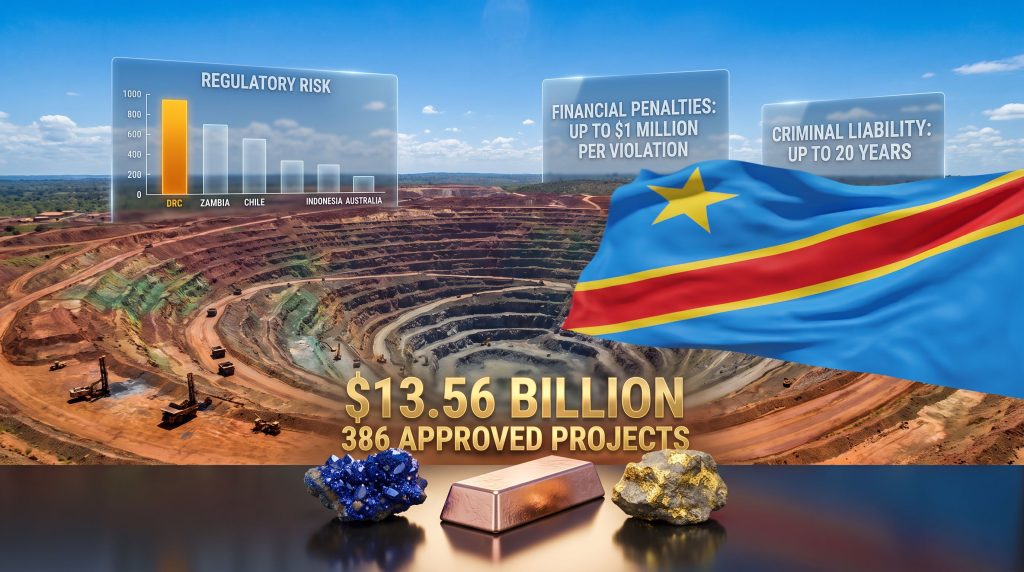
- Financial penalties reaching up to $1 million per violation
- Criminal liability provisions carrying prison terms of up to 20 years for certain offences
"The combination of permit revocation powers and personal criminal liability represents a qualitative escalation in sovereign risk. It shifts the risk profile from financial exposure to direct personal jeopardy for executives and project sponsors, a factor that can profoundly alter capital allocation behaviour."
One dimension of this proposal that receives insufficient attention in standard analysis is the germanium angle. The DRC is one of a small number of jurisdictions producing meaningful germanium volumes. Given that germanium has emerged as a chokepoint material in semiconductor and fibre optic manufacturing, any expansion of state stockpile authority over strategic minerals could have implications well beyond battery chemistry.
Industry warnings about Congo mining reform investor confidence have consequently drawn significant international attention, with analysts noting the broader ramifications for global supply chains.
The Chamber of Mines Response: Emergency Forum and the Consultation Deficit Argument
The DRC Chamber of Mines has called an emergency industry forum scheduled for July 15 to 17, 2026, with the stated goal of developing a unified industry position before the legislative process advances further. Internal documentation from the Chamber identified the pace of the reform process as a significant procedural concern, specifically flagging the risk that operators would be effectively excluded from shaping legislation that directly governs their capital commitments.
This consultation deficit argument deserves serious analytical weight. When major capital allocators are bypassed in the design of regulatory frameworks, the result is not simply political friction. It creates a specific class of governance risk where the rules governing billions of dollars in existing and prospective investment are determined without input from the entities most exposed to them.
Where the Industry Says the Real Problem Lies
The mining industry's core analytical position is that the existing 2018 Mining Code is not fundamentally defective. The dysfunction, operators argue, is concentrated at the implementation layer — where overlapping institutional mandates, unauthorised interventions at the operational level, and inconsistent enforcement practices already generate legal uncertainty on a daily basis.
This is a critically important distinction for investors to understand:
- Legislative reform addresses the written rules governing the sector
- Implementation reform addresses how those rules are actually applied by multiple, sometimes competing, government agencies and officials
- The industry's argument is that rewriting the code without fixing implementation will not solve the underlying investor confidence problem, and could compound it by adding new legislative uncertainty on top of existing enforcement unpredictability
This diagnosis aligns with broader observations about resource governance in sub-Saharan Africa, where the gap between formal regulatory frameworks and their practical application is often wider than the gap between different countries' formal codes. In addition, the DRC's cobalt export suspension has already demonstrated how abrupt policy shifts can reverberate through global supply chains.
Macro Confidence Signals: The Counterbalancing Data
Despite the legislative alarm signals, the DRC's macro trajectory contains genuine positive indicators that sophisticated investors should weigh carefully.
| Indicator | Detail |
|---|---|
| S&P Credit Outlook | Upgraded to Positive in January 2026 |
| Basis for Upgrade | Fiscal reform progress and mining sector performance |
| Approved Investment Projects (2019 to 2023) | 386 projects totalling $13.56 billion in planned investment |
| Government Strategic Objective | Improved access to international debt capital markets |
The S&P outlook revision is not trivial. It signals that fiscal consolidation is producing measurable results and that the DRC's creditworthiness trajectory is moving in a positive direction. The $13.56 billion in approved investment projects across a four-year period demonstrates that capital continues to flow into the DRC at scale, even against a backdrop of governance complexity.
The ongoing review of the Sicomines resource-for-infrastructure contracts adds another layer of complexity. The government has indicated it is reviewing these arrangements for equity and fairness, while simultaneously issuing assurances that existing legal agreements will be honoured. Navigating the tension between resource nationalism and foreign direct investment retention is a governance tightrope, and the market will be watching how it is walked. The DRC's efforts to seek new investors and reduce Chinese dominance further illustrates this delicate balancing act.
Three Regulatory Scenarios and Their Portfolio Implications
For investors with DRC exposure, the outcome of the current reform cycle is not binary. Three plausible scenarios carry materially different implications:
Scenario A: Accelerated Reform With Limited Consultation
Legislation advances rapidly with minimal operator input. Marginal projects face capital flight as sponsors reprice sovereign risk upward. Major operators adopt a defensive posture, pausing new capital commitments while monitoring enforcement patterns. Cobalt and copper supply chain disruption becomes a realistic medium-term scenario.
Scenario B: Negotiated Reform With Structured Industry Input
The Chamber of Mines forum produces a credible consolidated position. The government incorporates meaningful operator feedback into revised bill language. Consequently, investor confidence stabilises and the reform is absorbed as manageable regulatory evolution rather than a hostile escalation.
Scenario C: Reform Stalls or Is Withdrawn
Legislative momentum collapses under industry and diplomatic pressure. Short-term confidence recovers, but the underlying implementation failures that operators identify as the real problem remain unresolved. Structural governance weaknesses persist, creating the conditions for a future reform cycle under potentially less favourable political circumstances.
"Investors should note that Scenario C is not straightforwardly positive. A reform withdrawal that leaves implementation dysfunction unaddressed simply defers rather than resolves the risk, potentially concentrating it into a future episode where political conditions may be less amenable to industry negotiation."
The next major ASX story will hit our subscribers first
How the DRC Compares to Peer Jurisdictions on Regulatory Risk
Contextualising DRC regulatory risk requires comparison against the full spectrum of critical mineral jurisdictions:
| Jurisdiction | Primary Commodity | Regulatory Stability | Recent Reform Trend |
|---|---|---|---|
| DRC | Cobalt, Copper | Moderate to High Risk | Proposed tightening |
| Zambia | Copper | Moderate Risk | Gradual liberalisation |
| Chile | Copper, Lithium | Low to Moderate Risk | Lithium nationalisation debate |
| Indonesia | Nickel | Moderate Risk | Export ban enforcement |
| Australia | Lithium, Copper | Low Risk | Stable, investor-friendly |
The DRC's current reform trajectory diverges meaningfully from Zambia's more gradual liberalisation path and sits at a significant distance from Australia's stable, predictable permitting environment. Its closest analogue in terms of interventionist impulse is Indonesia's nickel governance model, though the DRC operates with considerably weaker institutional capacity to implement complex regulatory frameworks consistently.
However, understanding the full picture of cobalt production globally makes clear just how difficult it would be to replace DRC output — no peer jurisdiction comes close in scale or concentration.
Portfolio Strategy: Managing DRC Concentration Risk
For institutional investors and project financiers with DRC exposure, several risk management considerations deserve active attention:
- Political risk insurance mechanisms should be reviewed for adequacy against the new liability provisions being proposed, particularly the criminal exposure elements
- Offtake agreement structures that embed governance-linked price adjustment clauses provide partial hedging against regulatory deterioration
- Bilateral investment treaty arbitration pathways under applicable treaties remain available to foreign investors facing expropriation or permit interference, though treaty arbitration is costly and slow
- Jurisdictional diversification into alternative cobalt sources, including emerging production from Australia, Canada, and the Philippines, can reduce concentration risk without fully exiting the DRC's scale advantages
- Implementation monitoring at the operational level, rather than solely tracking legislative developments, provides earlier warning signals of enforcement deterioration
The near-term signal to watch is the output of the Chamber of Mines forum and whether the DRC government engages substantively with the industry position that emerges from it. A responsive government engagement would indicate that Scenario B remains viable. Silence or dismissal, however, would point toward Scenario A and a meaningful repricing of Congo mining reform investor confidence across the investment community.
Furthermore, the cobalt export ban extension already in place adds another layer of urgency to how quickly the government resolves the consultation deficit with industry stakeholders.
Frequently Asked Questions: Congo Mining Reform and What It Means for Investors
What specific changes does the proposed DRC mining bill introduce?
The bill proposes amendments to more than 40 articles of the 2018 Mining Code. Core provisions include expanded state control over minerals classified as strategic, the creation of national mineral stockpile mechanisms, new specialised regulatory agencies, expanded permit suspension and revocation powers, financial penalties of up to $1 million per violation, and criminal liability provisions carrying prison terms of up to 20 years.
Why is investor confidence particularly sensitive to DRC regulatory changes?
The DRC's position as the world's leading cobalt producer and second-largest copper supplier means its regulatory conditions directly affect global battery metal supply chains. Disruption in the DRC cannot easily be substituted from alternative sources at comparable scale or cost.
Has the DRC changed its mining code before, and what was the outcome?
The 2018 Mining Code revision introduced increased royalty rates and revised the classification of strategic minerals. Its reception from the industry was mixed at the time, and the current reform debate in part reflects persistent implementation failures from that revision that were never fully resolved.
What is the difference between mining code reform and mining code implementation?
Mining code reform changes the written legislative framework governing extraction, permitting, taxation, and state control. Implementation refers to how multiple government agencies, ministries, and officials actually apply those rules in practice. Industry operators broadly argue that inconsistent, overlapping, and sometimes unauthorised interventions at the implementation level are currently causing more investor uncertainty than any specific legislative gap.
How are major mining companies likely to respond if the bill passes as proposed?
Capital allocation decisions on new projects are likely to be paused. Existing operations will continue given the sunk cost base, but expansion commitments and new exploration spend may be deferred. Companies with access to bilateral investment treaty protections may initiate formal dispute processes if permit actions are taken under the new provisions. Congo mining reform investor confidence, in that scenario, could deteriorate materially across both junior and major operator cohorts.
This article is intended for informational and analytical purposes only and does not constitute financial or investment advice. The scenarios, projections, and regulatory interpretations presented involve inherent uncertainty. Readers should conduct independent due diligence and consult qualified advisers before making investment decisions related to jurisdictions or commodities discussed.
Want to Stay Ahead of Critical Mineral Discoveries Before the Broader Market?
Discovery Alert's proprietary Discovery IQ model delivers real-time alerts on significant ASX mineral discoveries — instantly translating complex mineral data into actionable insights for investors navigating volatile commodity sectors like cobalt and copper. Explore historic returns from major mineral discoveries and begin your 14-day free trial at Discovery Alert to position yourself ahead of the market.