July 20, 2026
When Energy Security Becomes the Deciding Factor in Aluminium Smelting
The global aluminium industry operates at the intersection of two brutal realities: the commodity price cycle and the energy cost curve. For smelters consuming enormous volumes of electricity around the clock, the margin between viability and shutdown can narrow rapidly when either of these forces turns unfavourable. Understanding how energy dependency shapes operational outcomes is not merely an academic exercise — it is the central lens through which South32's FY26 aluminium portfolio performance must be assessed.
South32 FY26 Brazil aluminium output rises Mozal pauses captures only part of a more complex and strategically significant picture. Behind the numbers lies a portfolio in deliberate transition, with Brazil emerging as the growth engine and Mozambique marking the limits of what energy insecurity can ultimately sustain. The headline result for investors tracking this story involves five distinct operations, each shaped by geography, energy infrastructure, commodity pricing, and ownership structure.
When big ASX news breaks, our subscribers know first
FY26 Portfolio at a Glance: Five Operations, Five Outcomes
South32's aluminium value chain in FY26 spanned two alumina refineries and three primary aluminium smelters across four countries. The performance divergence across these assets was stark, and the alumina market pressures experienced globally were clearly reflected across multiple operations.
| Operation | Ownership | FY26 Production | FY25 Production | Y-o-Y Change | FY27 Guidance |
|---|---|---|---|---|---|
| Worsley Alumina | 86% | 3.72 Mt | 3.73 Mt | -0.3% | 3.9 Mt |
| Brazil Alumina | 36% | 1.41 Mt | 1.34 Mt | +5% (record) | 1.36 Mt |
| Brazil Aluminium | 40% | 144 kt | 138 kt | +4% | 140 kt |
| Hillside Aluminium | 100% | 717 kt | 718 kt | Flat | 720 kt |
| Mozal Aluminium | 63.7% | 248 kt | 355 kt | -30% | Care & Maintenance |
The broadest insight from this table is not any single operation's result, but the divergence itself. Record output in Brazil coexisted with a complete production halt in Mozambique — two extremes that illustrate the range of outcomes possible within a single corporate portfolio operating in different energy and commodity environments.
Brazil Aluminium: Potline Stabilisation Delivers 4% Annual Growth
How the Alumar Ramp-Up Unfolded
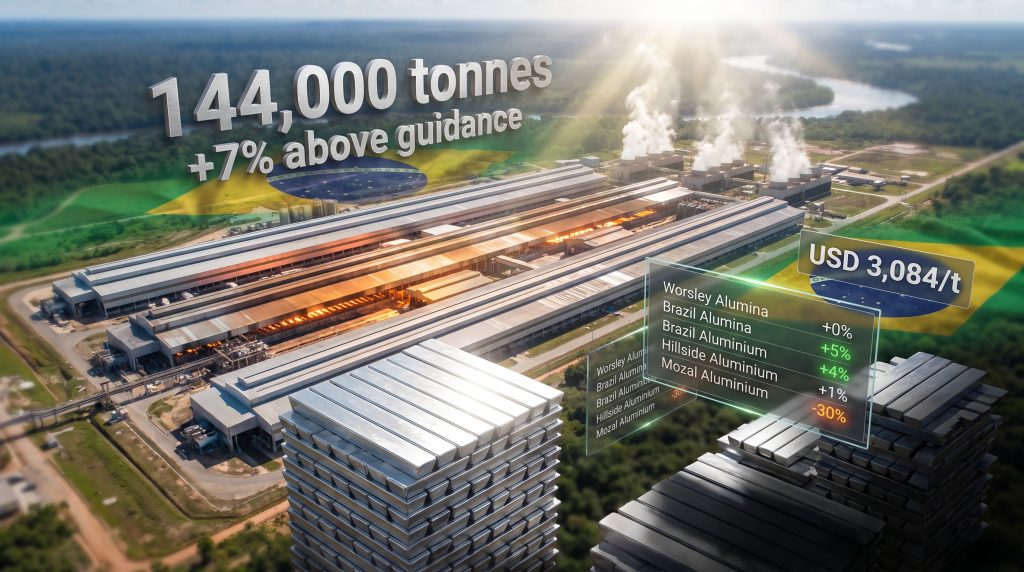
The Brazil Aluminium operation, a non-operated joint venture in which South32 holds a 40% interest alongside Alcoa at the Alumar smelter complex in São Luís, produced 144,000 tonnes in FY26 — a 4% increase from 138,000 tonnes in FY25. The improvement was not sudden; it was the product of progressive process stabilisation across all three potlines throughout the year.
A potline is the core production unit of a primary aluminium smelter. Each potline contains a series of electrolytic cells through which electrical current passes to reduce alumina into molten aluminium via the Hall-Héroult process. When a potline is disrupted or restarted, achieving consistent current efficiency across hundreds of individual pots is a technically demanding task that can take months to stabilise.
The fact that Alumar's three potlines were all improving simultaneously in FY26 explains both the mid-year guidance revision downward and the subsequent recovery. Furthermore, the broader aluminium market impact of shifting trade conditions added complexity to operational planning throughout the period.
Guidance Revision and Recovery: Reading Between the Numbers
| Metric | Value |
|---|---|
| FY26 Original Guidance | 160,000 tonnes |
| FY26 Revised Guidance | 135,000 tonnes |
| FY26 Actual Production | 144,000 tonnes |
| Performance vs. Revised Guidance | +7% above guidance |
| FY27 Production Guidance | 140,000 tonnes |
The guidance reduction from 160 kt to 135 kt mid-cycle was a signal that ramp-up challenges were more persistent than initially modelled. Exceeding the revised target by 7% demonstrated that the operational team achieved stabilisation ahead of schedule — a meaningful operational recovery. Q4 FY26 production reached 37,000 tonnes, up 12% quarter-on-quarter from 33,000 tonnes in Q3, confirming the upward momentum entering FY27.
The Price Tailwind That Amplified Results
The production improvement was significantly amplified by a favourable aluminium price environment. Brazil Aluminium's average realised price rose from USD 2,572 per tonne in FY25 to USD 3,084 per tonne in FY26, a 20% year-on-year uplift. Annual sales reached 143,000 tonnes, up 4% from the prior year.
A notable feature of Q4 FY26 was a 56% quarter-on-quarter spike in sales to 42,000 tonnes — driven by the timing of export shipments rather than a step-change in underlying demand.
Brazil Alumina: Record Output, But a 36% Price Collapse Complicates the Story
Above Nameplate: What Drives Refinery Outperformance
Brazil Alumina, a 36% non-operated interest within the same Alumar complex, delivered record annual production of 1.41 million tonnes in FY26 — 5% above FY25's 1.34 Mt and approximately 4% above its own FY26 guidance. The driver was consistently high plant availability throughout the year, enabling operations to run above nameplate capacity.
In alumina refining, nameplate capacity represents the design output of a facility under standard operating conditions. Running above nameplate requires both mechanical reliability and optimised process chemistry — specifically, maintaining the correct bauxite-to-caustic soda ratios in the Bayer process and managing digestion temperatures. Achieving this consistently across a full financial year reflects genuine operational discipline.
The Volume-Price Divergence Problem
| Metric | FY26 | FY25 | Change |
|---|---|---|---|
| Annual Production | 1.41 Mt | 1.34 Mt | +5% |
| Annual Sales | 1.409 Mt | 1.349 Mt | +4% |
| Avg. Realised Alumina Price | USD 356/t | USD 555/t | -36% |
| FY27 Guidance | 1.36 Mt | — | Stable |
Despite the record production achievement, Brazil Alumina's average realised alumina price fell 36% year-on-year from USD 555 per tonne to USD 356 per tonne. This price collapse substantially eroded the revenue benefit of higher volumes, illustrating a core tension in commodity manufacturing: operational excellence cannot fully compensate for adverse market pricing.
The alumina price weakness in FY26 reflected a global market condition characterised by supply growth outpacing demand. Alumina pricing often moves independently of aluminium, and the two commodities can diverge significantly during certain phases of the industrial cycle. An investor focusing purely on volume metrics without tracking the alumina-to-aluminium price ratio would have materially overestimated the financial benefit of Brazil Alumina's record year.
Worsley Alumina: Steady Production Masks a 30% Price Decline
Near-Perfect Operational Delivery
South32's 86%-owned Worsley Alumina refinery in Western Australia produced 3.72 million tonnes in FY26, essentially matching the 3.73 Mt achieved in FY25 and reaching 99% of its FY26 guidance — operationally, a near-flawless year. Improved bauxite availability underpinned throughput throughout most of the year, though a weather-related disruption to third-party gas supply during Q3 FY26 created a temporary production setback.
The Q3 disruption was external in origin, caused by a third-party gas pipeline operator rather than any internal plant failure. Q4 FY26 production recovered strongly to 943,000 tonnes, up 6% quarter-on-quarter from 886,000 tonnes in Q3, with sales also recovering to 931,000 tonnes — an 11% quarterly improvement.
Worsley Alumina: FY26 vs FY25 Financial and Operational Comparison
| Metric | FY26 | FY25 | Change |
|---|---|---|---|
| Annual Production | 3.72 Mt | 3.73 Mt | -0.3% |
| Annual Sales | 3.63 Mt | 3.70 Mt | -2% |
| Avg. Realised Price | USD 363/t | USD 518/t | -30% |
| FY27 Guidance | 3.9 Mt | — | Maintained |
Worsley's FY27 guidance of 3.9 Mt represents a meaningful planned step-up from FY26 actuals, implying either throughput expansion, debottlenecking investment, or improved process efficiency. The 30% alumina price decline mirrored Brazil Alumina's experience, confirming that this was a market-wide phenomenon rather than an asset-specific issue.
Mozal Aluminium: When Energy Insecurity Ends 25 Years of Production
The Root Cause of the March 2026 Suspension
Mozal Aluminium, South32's 63.7%-owned smelter in Mozambique, entered care and maintenance on 15 March 2026, ending 25 years of continuous primary aluminium production. The proximate cause was a failure to reach a commercially viable long-term electricity supply agreement. Compounding this was a regional drought that reduced hydroelectric power generation capacity, tightening available supply and pushing electricity costs to levels that made continued smelter operation economically indefensible.
This combination of factors highlights a structural vulnerability that affects energy-intensive industries in sub-Saharan Africa. Aluminium smelting typically consumes between 13,000 and 15,000 kilowatt-hours per tonne of aluminium produced — one of the highest energy intensities of any industrial process. When a smelter is located in a region where power supply depends significantly on hydroelectric generation, drought-driven output reductions create a direct and potentially existential threat to operational continuity.
Financial Impact of the Shutdown
| Cost Category | Estimated Amount |
|---|---|
| One-off shutdown and transition costs | USD 60 million |
| Ongoing annual care and maintenance costs | USD 5 million per year |
FY26 Production and Sales Impact
| Metric | FY26 | FY25 | Change |
|---|---|---|---|
| Annual Production | 248 kt | 355 kt | -30% |
| Annual Sales | 275 kt | 351 kt | -22% |
| Avg. Realised Aluminium Price | USD 3,237/t | USD 2,789/t | +16% |
| Q4 FY26 Production | 0 kt | — | Full suspension |
| Q4 FY26 Sales | 46 kt | 105 kt | -56% Y-o-Y |
Despite a 30% production decline, Mozal achieved 103% of its FY26 guidance — because the guidance had already incorporated the planned care and maintenance transition. Q4 FY26 sales of 46,000 tonnes represented the drawdown of finished goods inventory accumulated prior to the shutdown, not ongoing production.
The Mozal case is particularly instructive for investors evaluating mining companies with African smelting exposure. Even at a 16% higher realised aluminium price, the operation could not sustain economic viability in the face of electricity cost escalation. This underscores the degree to which energy pricing risk can override commodity price tailwinds in capital-intensive smelting operations.
The next major ASX story will hit our subscribers first
Hillside Aluminium: Consistency Under Load-Shedding Pressure
South Africa's Grid Challenges and Hillside's Response
Hillside Aluminium, South32's 100%-owned smelter in Richards Bay, South Africa, produced 717,000 tonnes in FY26 — virtually flat against 718,000 tonnes in FY25 — while continuing to operate near maximum technical capacity. That this was achieved despite periodic electricity load-shedding events in South Africa's national grid reflects both the smelter's priority power agreements and its operational resilience. In addition, this result stands in sharp contrast to the experience at Mozal, further demonstrating how an aluminium power strategy can be the difference between sustained output and closure.
| Metric | FY26 | FY25 | Change |
|---|---|---|---|
| Annual Production | 717 kt | 718 kt | Flat |
| Annual Sales | 688 kt | 732 kt | -6% |
| Avg. Realised Price | USD 3,250/t | USD 2,717/t | +20% |
| FY27 Guidance | 720 kt | — | Unchanged |
The 6% decline in annual sales was attributed to shipment timing rather than any deterioration in demand fundamentals, and the 20% uplift in realised aluminium prices meaningfully supported revenue outcomes despite flat volumes. Hillside achieved 100% of its FY26 production guidance.
The Aluminium-Alumina Price Divergence: A Critical FY26 Dynamic
Perhaps the most analytically significant feature of South32 FY26 Brazil aluminium output rises Mozal pauses results is the directional split between aluminium and alumina pricing. While all three smelting operations benefited from 16-20% higher realised aluminium prices, both alumina refineries experienced price declines of 30-36%.
| Operation | Commodity | FY26 Avg. Price | FY25 Avg. Price | Y-o-Y Change |
|---|---|---|---|---|
| Brazil Aluminium | Aluminium | USD 3,084/t | USD 2,572/t | +20% |
| Hillside Aluminium | Aluminium | USD 3,250/t | USD 2,717/t | +20% |
| Mozal Aluminium | Aluminium | USD 3,237/t | USD 2,789/t | +16% |
| Worsley Alumina | Alumina | USD 363/t | USD 518/t | -30% |
| Brazil Alumina | Alumina | USD 356/t | USD 555/t | -36% |
This divergence is not unusual in the aluminium value chain but is often misunderstood by generalist investors. Alumina trades on its own supply-demand dynamics, influenced by Chinese refinery output, bauxite access, and refinery capacity additions globally. Aluminium smelting margins are affected when alumina costs rise but smelter revenues also increase — in FY26, the reverse occurred, benefiting integrated producers differently depending on their position in the value chain.
The Alcoa Transaction: Redefining South32's Corporate Identity
A Strategic Exit from Energy-Intensive Commodity Processing
The announced sale of South32's entire aluminium value chain represents one of the most consequential portfolio decisions in the company's history. This Alcoa joint venture relationship, already established through the Alumar complex in Brazil, forms part of a broader transaction encompassing all operations reviewed in this report: Worsley Alumina, Brazil Alumina, Brazil Aluminium, Hillside Aluminium, and the care-and-maintenance Mozal asset. Post-transaction, South32 exits bauxite mining, alumina refining, and primary aluminium smelting entirely.
South32's stated strategic direction centres on repositioning as an upstream base metals company focused on commodities with stronger structural growth characteristics — particularly copper, zinc, and manganese. The rationale is commercially coherent: aluminium smelting assets are among the most capital-intensive and energy-dependent in mining, with limited ability to generate differentiated margins in a competitive commodity environment.
What Alcoa Gains From the Transaction
For Alcoa, the transaction deepens an existing operational relationship, since the two companies already share the Alumar complex in Brazil as joint venture partners. Absorbing South32's interests adds significant alumina refining capacity — Worsley's planned 3.9 Mt FY27 output plus Brazil Alumina's 1.36 Mt guidance — and meaningful smelting tonnage across two continents.
The acquisition consolidates Alcoa's position as a vertically integrated primary aluminium producer at a moment of relatively strong aluminium price performance. Consequently, the deal reshapes the competitive landscape among major aluminium producers globally.
FY27 Outlook and What the Portfolio Transition Means for Investors
FY26 is effectively the final full operational year in which South32 managed this aluminium portfolio in its current form. The FY27 guidance figures below reflect the post-Mozal landscape:
- Worsley Alumina: 3.9 Mt (step-up from 3.72 Mt in FY26)
- Brazil Alumina: 1.36 Mt (below FY26 record, reverting toward nameplate)
- Brazil Aluminium: 140 kt (stable, reflecting consolidated potline performance)
- Hillside Aluminium: 720 kt (marginal increase from 717 kt FY26)
- Mozal Aluminium: Care and maintenance, no production guidance
The broader lesson from South32 FY26 Brazil aluminium output rises Mozal pauses results is one that extends well beyond a single company's annual report. According to recent production reporting, energy access, pricing reliability, and infrastructure quality are not secondary considerations in primary aluminium production — they are primary determinants of operational survival.
Mozal's suspension, Hillside's resilience, and Brazil's record output together form a case study in how geography and energy security shape the long-term viability of one of the world's most energy-intensive industrial processes. However, the direction of travel is now clear: South32 exits a sector defined by these challenges, while Alcoa absorbs a portfolio that will require sustained energy discipline to optimise.
Disclaimer: This article contains forward-looking statements and production guidance figures sourced from South32's FY26 operational reports. These figures are subject to commodity price movements, operational developments, regulatory changes, and transaction completion timelines. Readers should not rely on guidance figures as guarantees of future performance. This article does not constitute financial advice.
Want to Catch the Next Major ASX Mining Discovery Before the Market Does?
Discovery Alert's proprietary Discovery IQ model scans ASX announcements in real time, instantly identifying significant mineral discoveries across aluminium, copper, zinc, and more than 30 other commodities — turning complex data into actionable investment insights for both short-term traders and long-term investors. Explore how historic discoveries have generated substantial returns and begin your 14-day free trial today to position yourself ahead of the broader market.