August 13, 2026
The Hidden Radioactive Contaminant Moving Through the World's Battery Supply Chain
Supply chains carrying the minerals powering the electric vehicle revolution have long faced scrutiny over labour conditions and geopolitical concentration risk. Yet a less visible threat has been accumulating quietly within one of those supply chains for more than two decades: Congo uranium contamination in cobalt exports. Radioactive material has been moving through international shipping routes embedded inside a commodity classified as an industrial product, not a nuclear one. The revelation that natural uranium may have been co-exported alongside cobalt hydroxide from the Democratic Republic of Congo (DRC) for roughly twenty-four years exposes a structural blind spot in how the world monitors the materials underpinning its clean energy transition.
Understanding why this happened, and what it means for battery manufacturers, automakers, regulators, and workers, requires looking closely at the geology, the chemistry, and the commercial incentives that allowed a monitoring gap of this magnitude to persist. Furthermore, the DRC natural resources context makes this issue especially complex, given the country's extraordinary mineral wealth and the regulatory challenges that come with it.
When big ASX news breaks, our subscribers know first
The Geology That Makes Contamination Inevitable Without Intervention
The DRC's Central African Copperbelt is one of the most mineralogically complex ore systems on the planet. Copper, cobalt, and uranium do not occur here by coincidence; they are products of the same ancient sedimentary and hydrothermal geological processes that deposited metals across the Katanga province over hundreds of millions of years. Uranium mineralisation is particularly common within the carbonate-hosted and sandstone-hosted ore bodies that also carry economic concentrations of copper and cobalt.
What makes this geologically significant from a processing standpoint is that uranium shares certain chemical behaviours with cobalt and copper during hydrometallurgical extraction. In heap leaching and agitated leach operations, dilute sulphuric acid dissolves the target metals from crushed ore. Under specific pH conditions and oxidation states, uranium dissolves into the leach solution alongside cobalt and copper. When operators then precipitate cobalt hydroxide by raising the pH of the pregnant leach solution, uranium can co-precipitate into the solid product.
This is not an operational failure unique to any single processing facility. It is a predictable consequence of processing uranium-bearing ore without a dedicated uranium removal step. Adding such a step, typically a uranium-selective ion exchange circuit, requires capital investment and generates a uranium-bearing waste stream that then requires licensed disposal, a regulatory complication in a country where uranium production is currently prohibited.
The contamination dynamic in DRC cobalt hydroxide is not about intentional nuclear material trafficking. It is the result of processing ore chemistry that includes uranium, within a regulatory framework that was never designed to account for it.
Quantifying the Scale: What Peer-Reviewed Research Found
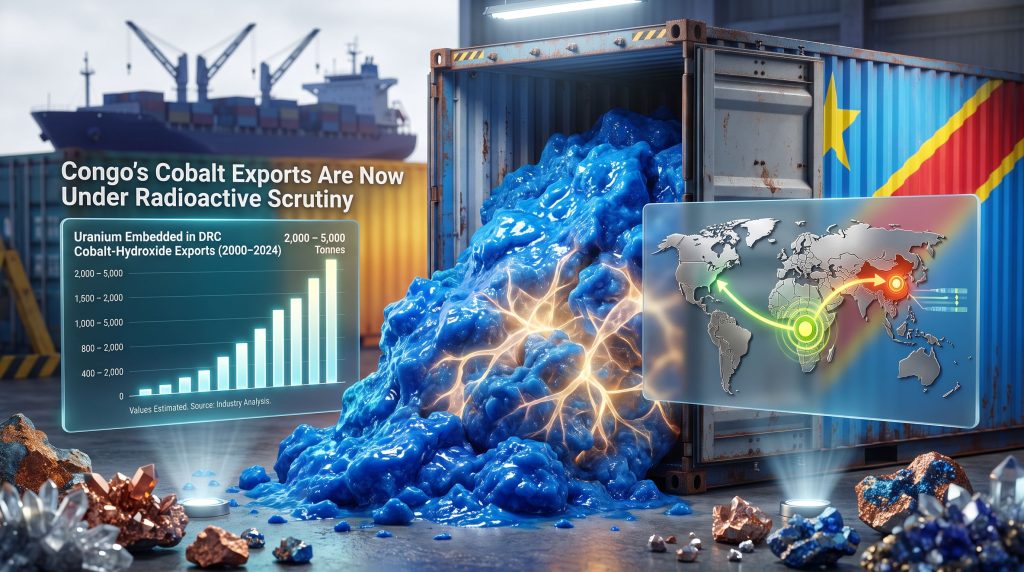
Research published in Nature Communications applied uranium concentration modelling against documented cobalt production and export volumes across a twenty-four-year window from 2000 to 2024. The resulting estimates are significant in their scale.
| Metric | Estimated Range |
|---|---|
| Natural uranium embedded in DRC cobalt hydroxide exports (2000–2024) | 2,000 to 5,000 tonnes |
| Primary export destination | China |
| Methodology basis | Production volume modelling combined with concentration sampling data |
| DRC share of global mined cobalt production | Approximately 70% |
Several important caveats apply to these figures. The methodology relies on representative concentration sampling and documented production volumes rather than direct testing of every individual shipment. Concentration levels vary across different ore bodies within the Copperbelt, and between different processing facilities, meaning the actual cumulative figure could sit anywhere within a wide range. Congolese authorities formally disputed the methodology on precisely these grounds, arguing that modelled estimates cannot substitute for direct shipment-level measurement.
That methodological dispute is scientifically legitimate. However, it does not invalidate the core regulatory concern. Even if the true cumulative figure is at the lower bound of modelled estimates, thousands of tonnes of natural uranium transiting international shipping routes embedded within an industrial commodity that is not subject to nuclear materials handling protocols represents a materials accounting gap of genuine significance. An investigation by Lighthouse Reports has further documented how these shipments moved largely undetected through global trade channels.
A Compound Problem: Processing Chemistry Meets Regulatory Architecture
One of the less widely understood dimensions of this issue is how the commodity classification of cobalt hydroxide created the monitoring gap in the first place. Cobalt hydroxide is an intermediate processing product carrying approximately 30 to 40 percent cobalt by mass. It is classified and traded as a base metals commodity, not a nuclear material, and export protocols have historically focused on cobalt content, not radioactivity screening.
Under international nuclear materials frameworks, including those administered by the International Atomic Energy Agency (IAEA), regulatory obligations attach to materials defined as nuclear or radioactive. Natural uranium embedded at low concentrations within an industrial product occupies a grey zone, particularly when the exporting country's own uranium production is prohibited and its nuclear regulatory infrastructure is not calibrated to monitor cobalt hydroxide shipments.
The IAEA operates nuclear safeguarding frameworks designed to track fissile and radioactive material flows across borders. Reporting on the investigation indicates that an IAEA expert noted the agency had no current indication that the DRC was failing its safeguarding obligations. This is a critical distinction: the issue appears to be an unaddressed monitoring gap rather than deliberate regulatory non-compliance.
How Did This Go Unnoticed for So Long?
The DRC cobalt export ban and related trade policy interventions have focused predominantly on cobalt volumes and pricing rather than contaminant screening. Consequently, the absence of a mandatory radioactivity testing framework for cobalt hydroxide meant uranium co-export proceeded without systematic detection. A formal IAEA technical support mission, if deployed following consultation with the DRC government, would provide independent verification capacity and help establish tracking and reporting systems suited to the actual material flows involved.
Tenke Fungurume and the Copperbelt's Broader Exposure
The Tenke Fungurume Mining operation, one of the DRC's largest copper-cobalt complexes, was specifically referenced in the joint investigation by the Financial Times and Lighthouse Reports as a site where internal documents and testing records suggested uranium levels in certain shipments exceeded applicable limits. The operation is majority-owned by CMOC Group, formerly China Molybdenum Co., adding a geopolitical dimension to the controversy given the scale of Chinese mining investment across the DRC's Katanga province.
Critically, the uranium co-occurrence issue is not confined to a single operation. It reflects a geological characteristic shared across multiple copper-cobalt operations processing ore from uranium-bearing zones within the Copperbelt. Any facility processing ore from these geological formations without a dedicated uranium removal step faces potential exposure to the same dynamic. Given that the DRC accounts for roughly 70% of global cobalt production, the systemic implications for battery supply chains are substantial.
The Multi-Stakeholder Dispute: Conflicting Evidence Streams
The evidentiary landscape around Congo uranium contamination in cobalt exports involves four distinct and partially contradictory evidence streams.
| Evidence Source | Methodology | Key Finding | Limitation |
|---|---|---|---|
| Nature Communications study | Production volume modelling with concentration data | 2,000 to 5,000 tonnes uranium in exports over 24 years | Not based on direct sampling of all shipments |
| Joint investigative journalism (FT/Lighthouse Reports) | Document review and site-level testing records | Elevated uranium detected in some shipments above applicable limits | Sample of operations, not a sector-wide audit |
| Chinese industry association self-review | Member company internal testing | No excessive uranium found in member company exports | Self-reported; methodology not independently verified |
| DRC national nuclear authority routine screening | Radioactivity testing of consignments | Elevated radioactivity identified in certain cobalt hydroxide shipments | Scope and frequency of testing not fully disclosed |
Industry associations representing Chinese mining interests in the DRC, including USMCC, have publicly stated that member company reviews found uranium concentrations within permissible export thresholds. These groups have also argued, with some validity, that there is no economic incentive to recover uranium from cobalt processing streams. Uranium recovery would require additional capital expenditure, generate a regulated waste stream, and operate within a legal framework where uranium production is prohibited domestically.
This economic argument is worth unpacking. If uranium recovery is economically unattractive and legally complicated, operators have no financial motivation to deliberately concentrate uranium in their product. The contamination, where it exists, is genuinely incidental. That does not, however, remove the obligation to measure and report it.
The next major ASX story will hit our subscribers first
Downstream Consequences: From Worker Safety to ESG Disclosure
The implications of Congo uranium contamination in cobalt exports extend across several risk categories simultaneously.
Worker Safety: Workers involved in cobalt hydroxide processing, bagging, loading, and transport face potential chronic low-level radiation exposure if uranium concentrations in processed material are not monitored or disclosed. This risk is particularly acute for artisanal and small-scale miners (ASM), who account for a meaningful share of DRC cobalt production and operate with minimal radiation monitoring infrastructure. The absence of systematic occupational radiation exposure data across the sector is a significant knowledge gap.
Trade and Logistics Risk: The commercial consequences of mandatory screening programmes could be significant if elevated uranium concentrations trigger cargo rejection at destination ports.
| Risk Category | Potential Impact |
|---|---|
| Shipment rejection at destination ports | Immediate supply disruption to battery material processors |
| Regulatory reclassification of cobalt hydroxide | Increased compliance costs and shipping restrictions |
| Insurance and liability exposure | Higher logistics costs for cobalt traders and offtake holders |
| Reputational risk for EV battery supply chains | Downstream pressure on automakers' ESG and battery regulation disclosures |
Battery Regulation Compliance: Supply chain due diligence frameworks under the EU Battery Regulation and critical minerals traceability provisions in other major markets increasingly require mine-level accountability. The broader battery metals landscape is already under pressure from competing regulatory demands, and uranium contamination disclosures would add a further compliance layer. Automakers and battery cell manufacturers sourcing DRC cobalt should be evaluating whether their supply chain audit frameworks include radiation monitoring as a verification parameter.
Non-Proliferation Considerations: Natural uranium is not enriched and is not directly weapons-usable in the form present in cobalt hydroxide. However, thousands of tonnes of radioactive material transiting international shipping routes embedded within an unmonitored commodity stream still raises materials accounting questions under international non-proliferation frameworks, independent of any weaponisation risk.
The DRC Government's Formal Response
The DRC government has announced a structured response framework following the publication of academic research and investigative journalism on this topic. Key elements include:
- Mandatory screening of cobalt hydroxide shipments destined for China for uranium content
- Establishment of a multi-agency working group incorporating two national nuclear bodies and accredited external laboratories
- A two-month assessment programme covering health risks, environmental exposure, and border-level enforcement capacity
- Planned deployment of radiation detection infrastructure at key border crossings
- Consultation with the IAEA regarding a formal technical support mission
The government's acknowledgment that it has taken careful note of the research findings, while simultaneously disputing the methodology of the Nature Communications study, reflects a pragmatic political position. Disputing the scale of the estimates preserves regulatory flexibility; committing to an investigation acknowledges that existing monitoring was insufficient. The cobalt export ban impacts already reshaping market dynamics add further urgency to resolving this contamination question quickly.
Forward Scenarios: Three Possible Outcomes
The trajectory of this issue depends heavily on the findings of the DRC's two-month review and any subsequent IAEA involvement.
Scenario 1: Investigation Validates Contamination at Scale
If systematic direct sampling confirms uranium concentrations consistent with or above modelled estimates, mandatory uranium content limits for cobalt hydroxide exports become likely, alongside enhanced border screening infrastructure and potential renegotiation of existing offtake agreements between DRC producers and Chinese refiners.
Scenario 2: Investigation Finds Levels Within Acceptable Limits
If direct sampling produces lower concentration estimates than modelled projections, the regulatory response would likely focus on formalising uranium monitoring requirements without triggering trade disruption. The academic methodology would face peer review challenge, and industry self-regulation mechanisms would be strengthened.
Scenario 3: IAEA Technical Mission Triggers Broader Safeguarding Review
If an IAEA mission identifies systemic safeguarding failures rather than isolated monitoring gaps, cobalt hydroxide could face reclassification under nuclear materials handling protocols. This would significantly increase compliance costs across the entire supply chain and accelerate commercial investment in cobalt-reduced battery chemistries.
What This Means for the Cobalt Market and Battery Industry
Cobalt remains a critical cathode material in NMC and NCA battery chemistries used in premium electric vehicles globally. While high-nickel cathode formulations and lithium iron phosphate (LFP) chemistry are reducing cobalt intensity in some market segments, cobalt has not been eliminated from premium EV battery design at commercial scale. The DRC's dominant position in global cobalt supply means there is no near-term alternative sourcing geography capable of absorbing a significant DRC supply disruption.
Furthermore, reporting by Radio France Internationale has highlighted growing alarm among trade partners and regulators regarding the scale of unmonitored uranium flows within cobalt shipments destined for China's battery material refining sector.
For battery manufacturers and automakers, the Congo uranium contamination in cobalt exports question is not simply a geopolitical risk to monitor. It is an active supply chain compliance exposure that intersects with occupational health obligations, battery regulation requirements, and ESG disclosure frameworks simultaneously.
The investigation's outcome will determine whether this becomes a catalyst for improved monitoring infrastructure or a structural disruption to one of the most geopolitically concentrated supply chains in the clean energy economy. Either way, the era of treating cobalt hydroxide as a commodity requiring no radioactivity accountability appears to be ending.
This article involves analysis of ongoing regulatory investigations and includes forward-looking scenario assessments. Outcomes remain subject to the findings of the DRC government's formal review and any IAEA technical mission. Nothing in this article constitutes financial or investment advice. Readers are encouraged to consult primary sources including the original MiningMX reporting at miningmx.com for developing coverage of this investigation.
Want to Stay Ahead of Critical Mineral Discoveries Reshaping the Battery Supply Chain?
As supply chain scrutiny intensifies across battery-critical commodities like cobalt, Discovery Alert's proprietary Discovery IQ model delivers real-time ASX mineral discovery alerts, transforming complex geological and market data into actionable investment insights — begin your 14-day free trial today and see why significant discoveries, like those documented on Discovery Alert's dedicated discoveries page, have historically generated substantial returns for well-positioned investors.