August 13, 2026
The Hidden Bottleneck in Uranium Mining That Most Investors Overlook
When market participants assess uranium producers, the conversation almost always gravitates toward ore grade, resource size, and the uranium price itself. What rarely surfaces in mainstream analysis is the operational dependency that sits between a mineralised deposit and a saleable pound of U3O8: the chemistry of extraction. Sulphuric acid, unglamorous and seldom discussed in investor presentations, is the reagent that makes or breaks uranium processing economics. Without a reliable, cost-effective supply of it, even the most well-positioned uranium asset can grind to a halt.
That is precisely the lens through which the events at Kayelekera in mid-2026 should be understood. Lotus Resources Kayelekera sulphuric acid production resumes after a multi-week interruption, and the implications extend well beyond a single operational bulletin.
When big ASX news breaks, our subscribers know first
Why Sulphuric Acid Is More Critical Than Most Uranium Investors Realise
Uranium extraction from sandstone-hosted deposits like Kayelekera relies on acid leaching, a hydrometallurgical process in which sulphuric acid dissolves uranium minerals from crushed or agglomerated ore. The resulting pregnant liquor is then processed through solvent extraction and ion exchange circuits to produce a uranium concentrate, commonly known as yellowcake or U3O8.
The chemistry is largely non-negotiable. Unlike some base metals where alternative lixiviants exist, uranium leaching in conventional tank or agitated leach circuits overwhelmingly depends on sulphuric acid as the primary reagent. Acid consumption rates vary by deposit geology, but operations processing higher-carbonate ores consume significantly more acid per tonne of ore processed, directly affecting unit operating costs.
What makes this dependency particularly acute in an African context is the compounding effect of geography. Sulphuric acid is a hazardous, corrosive liquid. Transporting it overland into a landlocked jurisdiction like Malawi, which has no rail connection to a deep-water port, introduces substantial cost and logistical complexity. Acid typically arrives via road freight from coastal ports, passing through multiple border crossings. Lead times are long, storage capacity at site is finite, and any disruption to the transport corridor can starve the processing plant of its most essential input.
This is why uranium mine operators in comparable jurisdictions have historically sought to produce acid on site using elemental sulphur as feedstock. Sulphur is far easier and safer to handle and transport than finished acid, and on-site conversion provides a buffer against external supply chain shocks. Furthermore, understanding uranium supply challenges in a broader context helps explain why reagent security has become an increasingly critical operational consideration.
Kayelekera in Context: A Significant Asset in Sub-Saharan Uranium
The Kayelekera uranium deposit sits in the Karonga District of northern Malawi, within the Karoo-age sedimentary sequence of the Malawi Rift. The mineralisation is hosted in fluvial sandstones of the Sheavington Formation, where uranium occurs primarily as uraninite and coffinite. The deposit was originally developed and operated by Paladin Energy, which brought the mine into production in 2009 before placing it on care and maintenance in 2014 during the prolonged uranium market downturn that followed the Fukushima disaster.
Lotus Resources, an ASX-listed uranium developer, subsequently acquired the project and has been advancing its restart. The asset holds significance not merely as a single mine but as one of the very few conventional uranium operations in Sub-Saharan Africa capable of near-term production, sitting outside the established uranium corridors of Niger and Namibia.
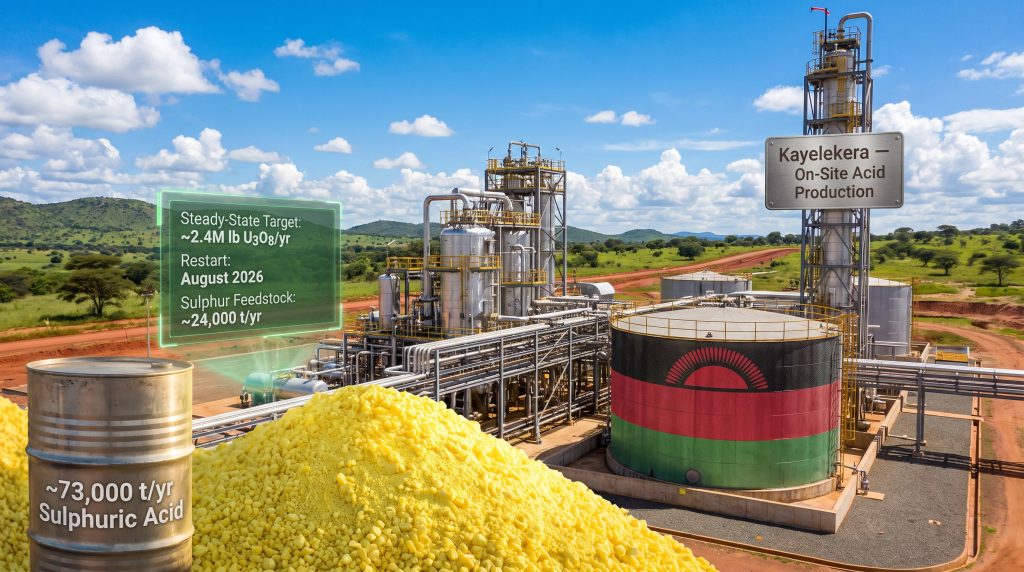
At steady-state, Kayelekera is targeting annual production of approximately 2.4 million pounds of U3O8, a volume that would make it a meaningful contributor to global uranium supply at a time when new mine supply has consistently disappointed relative to demand forecasts. In the context of a global uranium market that has seen production from legacy operations in Kazakhstan dominate supply, the emergence of additional African producers matters disproportionately to spot price dynamics.
What Went Wrong: Unpacking the June 2026 Shutdown
The Refractory Brick Failure and Its Cascade Effects
Understanding the technical nature of the failure is important for assessing the durability of the remediation. A sulphur burner works by combusting elemental sulphur in a refractory-lined furnace at very high temperatures, producing sulphur dioxide gas. That gas is then passed over a vanadium pentoxide catalyst in a converter, oxidising SO2 to SO3, which is subsequently absorbed in water or dilute acid to produce concentrated sulphuric acid. This is the contact process, the dominant industrial method for acid production globally.
The critical role of refractory brickwork is thermal protection. The furnace interior operates at temperatures that would rapidly destroy ordinary steel. Refractory bricks, composed of heat-resistant alumina or silica materials, line the interior and protect the structural shell. A partial failure of these bricks, as occurred at Kayelekera during commissioning, can cause hot spots, shell damage, or gas bypass, all of which require the furnace to be shut down for inspection and repair before safe recommissioning can proceed.
What compounded the severity of the June 2026 incident was its timing. The refractory failure did not occur in isolation; it coincided with a disruption to Kayelekera's third-party acid supply. With both the on-site production pathway and the external supply pathway simultaneously compromised, the uranium processing plant lost its reagent supply entirely and was forced to halt.
This dual-failure scenario is a textbook example of single-point-of-failure risk compounding during a commissioning phase. When two independent supply streams both fail at once, the absence of a buffering inventory becomes immediately critical. It also illustrates why acid supply security is not merely a cost consideration but an operational resilience requirement at remote African mining operations.
The Landlocked Logistics Problem
Malawi's geographic position creates structural supply chain vulnerability that is worth understanding in full. The country has no coastline and limited rail infrastructure. Road freight from the port of Nacala in Mozambique or Dar es Salaam in Tanzania represents the primary logistics corridor for bulk inputs. Sulphuric acid, classified as a dangerous good, requires specialised tanker trucks, adds border crossing documentation complexity, and is subject to seasonal road condition constraints.
This is not unique to Kayelekera. Indeed, African uranium disruption events across the continent illustrate just how consequential logistics vulnerabilities can be. African uranium and base metal producers operating in landlocked jurisdictions have repeatedly encountered acid supply disruptions. Zambian copper operations, for instance, have at various points faced acid supply constraints that directly suppressed cathode production. The lesson across the industry is consistent: reagent supply security in landlocked African jurisdictions cannot be treated as an afterthought.
How the Restart Was Executed and What the Numbers Tell Us
Following the June shutdown, Lotus Resources undertook interim refractory repair works on the sulphur furnace and simultaneously sourced external acid deliveries to bridge the processing gap while remediation was completed. By August 2026, both the acid plant and the uranium processing circuit had returned to operation. According to the company's production update, the restart marks a significant milestone in Kayelekera's path towards steady-state output.
The operational specifications of the acid plant put the scale of the asset in perspective:
| Operational Metric | Detail |
|---|---|
| Acid Plant Output Capacity | ~73,000 t/yr sulphuric acid |
| Sulphur Feedstock Required | ~24,000 t/yr at full capacity |
| Supply Security Horizon | Remainder of CY2026 confirmed |
| Steady-State U3O8 Target | ~2.4 million lb/yr |
| Restart Confirmed | August 2026 |
At full capacity, producing 73,000 tonnes of sulphuric acid per annum from 24,000 tonnes of sulphur feedstock reflects a conversion ratio broadly consistent with standard contact process efficiency, where approximately 3 tonnes of acid are produced from every tonne of elemental sulphur. This on-site production capability, if sustained, substantially reduces Kayelekera's dependence on road-freighted finished acid.
The company confirmed that sufficient sulphur inventory is held on site and that supply visibility is secured through the remainder of calendar year 2026. In a practical sense, supply visibility means contracted volumes in transit or in warehouse, not merely an expectation of availability. For a landlocked site, this distinction matters considerably.
Strategic Implications: Beyond the Cost Reduction Narrative
Why On-Site Acid Production Changes the Mine's Risk Profile
The cost reduction argument for on-site acid production is frequently cited and is straightforward: converting elemental sulphur into acid at the mine gate is materially cheaper than purchasing finished acid and paying to transport it hundreds of kilometres inland. In a mining operation where reagent costs can represent a significant proportion of total cash operating costs, this is a genuine structural advantage.
However, the more important argument is operational resilience. Lotus Resources' management characterised the acid plant as a key strategic project that will deliver improved acid supply security and significantly reduced reagent costs, with the June 2026 events now serving as a live demonstration of precisely why that framing is accurate. Consequently, the broader uranium market dynamics at play make operational continuity at emerging producers all the more strategically significant.
Once fully commissioned and operating reliably, Kayelekera's on-site acid production effectively converts a variable external cost with supply chain exposure into a more predictable internal input. The mine's operating cost per pound of U3O8 becomes less sensitive to acid commodity price movements and third-party logistics performance, both of which have historically been volatile in this region.
For long-run margin sustainability, this is a meaningful structural shift. Mines that control their reagent supply chain are less vulnerable to the cost spikes and production halts that have historically plagued African producers during supply disruptions.
Ramp-Up Timeline and Production Trajectory
The June shutdown necessarily deferred Kayelekera's ramp-up trajectory. Steady-state production of approximately 2.4 million lb U3O8 per annum is now being targeted for achievement in late calendar year 2026, with the August restart re-establishing the processing circuit and allowing the ramp-up to resume.
Investors should understand the difference between restart and steady-state. Recommissioning a processing plant after a shutdown involves progressive throughput increases, reagent concentration adjustments, and circuit stabilisation before nameplate recovery rates are reliably achieved. The gap between first production and sustained steady-state can span several months even when no further technical issues arise.
Three commissioning scenarios illustrate the range of potential outcomes:
| Scenario | Assumption | Likely U3O8 Output Impact |
|---|---|---|
| Base Case | Smooth ramp to steady-state by late CY2026 | ~2.4 million lb/yr annualised |
| Delayed Commissioning | Further acid plant issues push steady-state to early CY2027 | Materially below nameplate in CY2026 |
| Accelerated Ramp | Acid plant performs above expectation, full throughput achieved early | Potential upside to CY2026 production guidance |
The next major ASX story will hit our subscribers first
How Kayelekera Fits Into the Global Uranium Supply Picture
Africa's contribution to global uranium supply has historically been concentrated in Niger and Namibia, with Namibia in particular emerging as a major producer through operations including Rossing and Husab. Malawi's insertion into this landscape through Kayelekera represents a geographic diversification of African uranium supply that carries strategic relevance for utilities seeking offtake from stable, diversified sources.
Global uranium markets have been characterised by persistent uranium supply-demand volatility since the early 2020s. The combination of post-Fukushima production cuts, underinvestment in new mine development through the low-price decade of 2013 to 2020, and resurging demand linked to the nuclear power renaissance has tightened the supply-demand balance materially. The World Nuclear Association and other industry bodies have projected demand growth driven by new reactor builds across Asia, the Middle East, and Europe, alongside licence extensions for existing plants.
In this context, commissioning delays at emerging producers like Kayelekera attract attention that may appear disproportionate relative to the volume impact. A two-month production interruption at a 2.4 million pound per year operation is not a market-moving supply event on its own. However, it signals the operational complexity of bringing new uranium supply online, reinforcing the market's awareness that nameplate capacity and realised production are very different things. Furthermore, the divergence between spot versus term pricing in the uranium market adds another layer of complexity for producers trying to optimise revenue during ramp-up phases.
Remaining Risks to Monitor Through to Steady-State
With the restart confirmed, the key risks to track are:
-
Refractory integrity post-repair: Interim repairs are exactly that, interim. The furnace will need to demonstrate sustained performance under operational temperatures before the acid plant can be considered reliably commissioned. A secondary refractory failure would represent a significant setback.
-
Sulphur supply chain continuity: Inventory secured through end of 2026 provides a meaningful buffer, but replenishment logistics into northern Malawi remain a structural challenge. Monitoring sulphur procurement and delivery cadence will be important beyond the current inventory horizon.
-
Processing circuit recovery rates: Uranium recovery efficiency during ramp-up can differ materially from design assumptions, particularly when reagent concentrations and residence times are being optimised. Lower-than-expected recovery rates would suppress actual output below nominal capacity.
-
Commissioning timeline slippage: The late CY2026 steady-state target leaves limited buffer. Any additional mechanical issue, wet season logistics constraint, or reagent supply gap could push full steady-state into early 2027.
-
Regulatory and community context: Malawi's mining regulatory environment has been evolving, and community relations in the Karonga District are an ongoing consideration for all operators in the region. These factors do not currently appear to represent acute risks but warrant monitoring as production scales.
Frequently Asked Questions: Kayelekera Acid Plant and Uranium Processing Restart
What caused the acid plant shutdown at Kayelekera in June 2026?
A partial failure of refractory bricks inside the sulphur furnace during initial commissioning, occurring at the same time as a disruption to third-party acid deliveries, left the processing plant without a viable reagent supply and forced a halt to both the acid plant and the uranium circuit.
How much sulphuric acid can the Kayelekera plant produce at capacity?
The sulphur burner at Kayelekera is designed to produce approximately 73,000 tonnes of sulphuric acid per year, requiring around 24,000 tonnes of elemental sulphur as feedstock annually at full throughput.
When did processing operations resume at Kayelekera?
Both the acid plant and the uranium processing plant returned to operation in August 2026, following interim refractory repair works and the reinstatement of on-site acid supply through a combination of delivered external acid and on-site production. Lotus Resources Kayelekera sulphuric acid production resumes as a direct result of these remediation efforts.
What is Lotus Resources' production target for Kayelekera?
The operation is targeting steady-state uranium output of approximately 2.4 million lb U3O8 per annum, with that production level now expected to be achieved in late calendar year 2026.
Why does on-site acid production matter strategically?
Beyond the cost advantage of producing acid from elemental sulphur rather than purchasing finished acid at delivered prices, on-site production insulates Kayelekera from the kind of third-party supply disruptions that directly caused the June 2026 shutdown. In a landlocked African operating environment, this supply security dimension may ultimately prove more valuable than the cost saving itself.
This article is intended for informational purposes only and does not constitute financial advice. The scenario analyses and production outlook references involve forward-looking assumptions subject to change. Readers should conduct independent due diligence before making investment decisions. For ongoing sulphur and sulphuric acid market intelligence relevant to mining operations, Argus Media's sulphur and sulphuric acid coverage provides detailed price assessments and supply-demand analysis.
Want to Stay Ahead of the Next Major Uranium Discovery on the ASX?
Discovery Alert's proprietary Discovery IQ model scans ASX announcements in real time, instantly identifying significant mineral discoveries — including uranium — and translating complex data into actionable insights for investors at every experience level. Explore historic discoveries and the returns they generated, then begin your 14-day free trial to position yourself ahead of the broader market.