August 12, 2026
The Infrastructure Gap That Processing Innovation Is Beginning to Close
Uranium mining in the American West carries a long industrial memory. The Colorado Plateau produced significant volumes of uranium oxide during the Cold War era, supplied by a network of small mines dotting the canyon country of Utah, Colorado, and Arizona. When uranium prices collapsed in the late 1970s and early 1980s, most of those operations shuttered, and the milling infrastructure that supported them followed shortly after. What remained was a landscape rich in geological endowment but commercially stranded by processing economics that never recovered.
That infrastructure gap has not closed in the decades since. The United States has not commissioned a new conventional uranium mill in more than four decades, a fact that sits at the centre of ongoing domestic supply constraints. Meanwhile, the deposits themselves have not improved in grade or accessibility. What has changed is the processing toolkit available to developers, and it is within that shift that the investment thesis surrounding IsoEnergy DISA Uranium Utah uranium assets becomes technically coherent.
When big ASX news breaks, our subscribers know first
Why Grade Uplift Changes Everything for Low-Grade US Uranium Deposits
The Real Problem With American Uranium Economics
The conventional narrative around US uranium focuses on price: domestic production costs are structurally higher than supply sourced from Kazakhstan, Russia, or Uzbekistan, and without a sustained spot price premium, domestic mines struggle to attract development capital. Understanding the broader uranium market dynamics helps frame why this framing is accurate but incomplete.
An underappreciated dimension of the problem is processing inefficiency at source. When uranium-bearing ore must be hauled from a remote mine to a mill facility at its natural grade, the economics of transport, leaching, and chemical recovery are all working against marginal deposits. For carnotite-hosted uranium in the Utah canyon country, where quartz is the dominant host rock and uranium grades frequently fall below 5,000 parts per million, the haulage cost burden alone can render a deposit commercially unviable regardless of headline uranium prices.
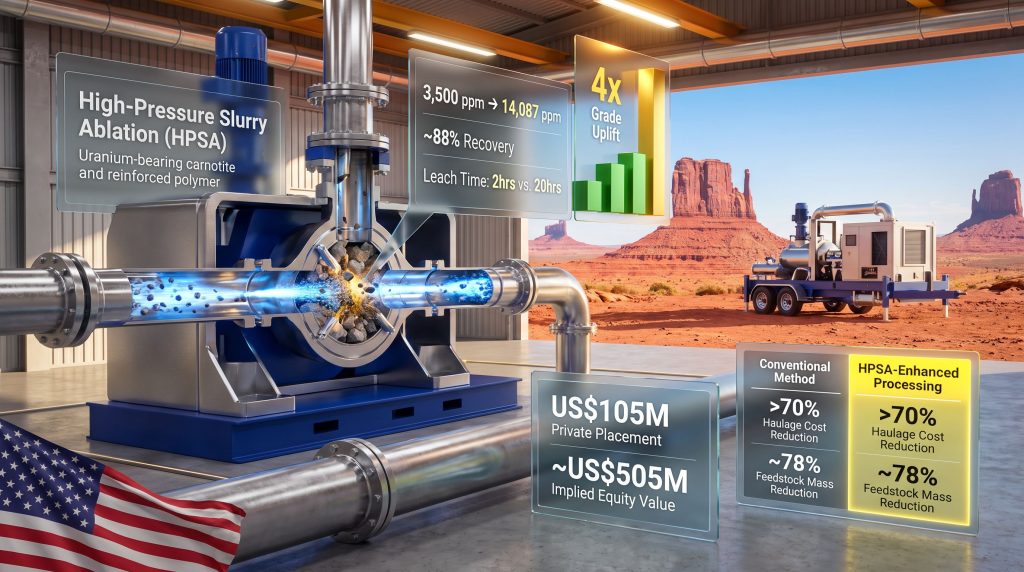
This is the specific problem that High-Pressure Slurry Ablation, or HPSA, is designed to address. Rather than treating grade as a fixed input, HPSA applies it as a variable that can be significantly improved before material ever leaves a mine site.
How HPSA Works at a Mineralogical Level
The operating principle of HPSA depends on a physical property that is easy to overlook: not all minerals in a rock are equally hard. Carnotite, the potassium uranium vanadate mineral that hosts uranium across much of the Colorado Plateau, is measurably softer than the quartz matrix surrounding it. HPSA exploits this differential hardness by directing high-velocity slurry jets at the ore material, generating particle-to-particle collisions that preferentially break down and liberate the softer carnotite while leaving harder quartz fragments largely intact.
The result is not a leaching or chemical process. HPSA functions as a pre-concentration step, selectively concentrating uranium-bearing minerals upstream of conventional acid leaching rather than replacing that leaching step. This distinction matters: the technology integrates into existing processing flowsheets rather than demanding entirely new infrastructure. Furthermore, the in-situ leaching benefits of complementary extraction methods offer additional context for why processing innovation is reshaping domestic uranium economics.
One important distinction for evaluating this technology: HPSA is not experimental in a commercial sense. Units operating on this principle are currently deployed at active US mines processing nickel, copper, and phosphate. The technology diligence process for uranium applications involved independent technical experts observing thousands of tonnes of material being processed through operational machines at these facilities. What remains to be validated is uranium-specific commercial economics, not the underlying mechanical principle.
Quantifying the Tony M Results
The most concrete data point in the DISA Uranium thesis comes from bulk sample testing at the Tony M Mine in Utah, the primary test site within IsoEnergy's Utah portfolio. The results from an approximately 2,100-tonne bulk sample program provide a statistically meaningful dataset that goes well beyond laboratory-scale testing.
| Processing Metric | Conventional Baseline | HPSA at Tony M |
|---|---|---|
| Starting uranium grade | 3,500 ppm | 3,500 ppm |
| Post-process uranium grade | Unchanged | 14,087 ppm (4x uplift) |
| Uranium recovery rate | Variable | ~88% |
| Remaining feedstock mass | 100% | ~22% of original |
| Post-process leach time | >20 hours | ~2 hours |
| Haulage cost reduction potential | Baseline | >70% |
The grade uplift from 3,500 parts per million to 14,087 parts per million is the headline figure, but the feedstock mass reduction is arguably more significant from an operational cost perspective. Reducing the material that needs to be transported to a mill to approximately 22% of its original volume while retaining 88% of the uranium transforms the haulage economics of a remote Utah deposit. For reference, the greater than 70% reduction in haulage costs cited in company materials reflects this mass reduction effect directly.
The compression of leach time from more than 20 hours to approximately 2 hours introduces a secondary efficiency gain at the mill stage, reducing reagent consumption and throughput bottlenecks.
Critical distinction for investors: The Tony M results are technically compelling at bulk sample scale. Converting these outcomes into investment-grade economic validation requires an updated preliminary economic assessment (PEA) that incorporates capital expenditure, operating expenditure, and full infrastructure cost assumptions. That PEA is targeted for year-end 2026 and represents the next definitive milestone for the processing thesis.
The Utah Portfolio: Five Assets, Two Development Tracks
Permitted and Past-Producing: What That Status Actually Means
IsoEnergy's Utah portfolio contributing to DISA Uranium comprises five assets across two categories. Three are permitted, past-producing conventional uranium mines; two are earlier-stage exploration projects. The significance of permitted, past-producing status is often overstated in mining communications, so it is worth being precise about what it does and does not mean.
What permitted, past-producing status provides:
- Existing mine permits reduce regulatory timeline risk compared to greenfield applications
- Historical production data offers geological precedent and reduces exploration uncertainty
- Pre-existing infrastructure footprints lower early-stage capital requirements
- Community engagement history, for better or worse, frames the social licence environment
What it does not mean:
- Permits do not guarantee production-readiness; maintenance, renewal, and compliance requirements still apply
- Past production economics are not a reliable guide to current economics given changed cost structures
- Historical geological data may predate modern resource estimation standards
Asset-by-Asset Overview
The five assets within the contributed Utah portfolio span a range of development maturity:
- Tony M Mine – The most advanced asset and primary HPSA test site. Bulk sample completed. Updated PEA incorporating HPSA efficiencies targeted by year-end 2026.
- Daneros Mine – Permitted, past-producing conventional uranium mine in Utah's White Canyon district.
- Rim Mine – Permitted, past-producing conventional uranium mine within the broader Colorado Plateau uranium system.
- Sage Plain Project – Uranium exploration project within the Utah portfolio, at an earlier development stage.
- Flatiron Project – Uranium exploration project where drilling has been advanced as part of the broader Utah strategy.
Utah's position within the Colorado Plateau uranium district carries geological significance beyond individual mine grades. The region's carnotite deposits are sandstone-hosted, forming in oxidised sedimentary environments where uranium was mobilised from source rocks and trapped in reduced zones. This mineralisation style has historically supported high-grade ore shoots within lower-grade bulk mineralisation, a characteristic that makes selective mining and pre-concentration approaches like HPSA particularly relevant.
In addition, the broader context of uranium supply challenges facing the US market reinforces why developing these stranded assets through processing innovation is attracting serious capital attention.
The Remediation Pathway: A Second Feedstock Source That Did Not Exist Before
Understanding the Scale of Abandoned Uranium Mine Waste in the US
One of the least-publicised dimensions of the US uranium sector is the sheer volume of legacy mine waste sitting across the American West. More than 15,000 sites associated with abandoned uranium mine waste have been identified across the United States, with more than 4,200 of those linked to defence-era uranium mining programs from the Cold War period.
This material was historically uneconomic to process for two reasons: recovery rates from low-grade waste using conventional leaching were insufficient to justify the cost, and there was no efficient way to concentrate uranium-bearing fines at remote locations before transport. Mobile HPSA units address the second constraint directly, enabling on-site pre-concentration at individual remediation locations without building fixed processing infrastructure at each site. For context on how innovative uranium extraction approaches are reshaping legacy asset economics elsewhere, similar technology-driven models are gaining traction across the sector.
The NRC Source Materials License as a Competitive Moat
The regulatory architecture supporting DISA Uranium's remediation model centres on a United States Nuclear Regulatory Commission (NRC) Source Materials License for uranium recovery from legacy waste across multiple sites. Holding such a licence is not straightforward: the NRC application process for source materials recovery involves detailed safety assessments, environmental reviews, and operational plans that represent a genuine barrier to entry.
For competitors attempting to pursue the same remediation opportunity, the absence of an existing multi-site NRC licence represents a meaningful head start that DISA Uranium holds. The regulatory credential also signals operational credibility to site owners, communities, and potential offtake partners.
The appointment of former NRC Commissioner Jeffrey Merrifield to DISA Uranium's board is not an incidental governance choice. It reflects the centrality of regulatory navigation to the company's business model across both conventional mine development and multi-site remediation operations. Former regulators bring institutional knowledge of licence interpretation, compliance expectations, and agency decision-making culture that external counsel cannot fully replicate.
The Navajo Nation Remediation Program
Among the early operational milestones for DISA Uranium is a maiden cleanup at a Navajo Nation remediation location. This program sits at the intersection of uranium recovery economics and a well-documented environmental health legacy. Abandoned uranium mines on Navajo land represent one of the most studied cases of Cold War-era mining's long-term community health impacts, with decades of research connecting mine dust and contaminated water sources to elevated disease rates in affected communities.
Remediation activity at these sites consequently carries dimensions that extend beyond feedstock economics, influencing social licence, community relationships, and potentially the pace of regulatory cooperation across other remediation sites.
Capital Architecture: How the Platform Is Structured and Why It Matters
The Logic of a Separately Capitalised Vehicle
IsoEnergy's decision to place its Utah assets into a separately capitalised platform rather than developing them on its own balance sheet reflects a capital allocation logic that deserves examination. The conventional approach would have IsoEnergy funding Tony M development, remediation programs, and eventually milling infrastructure from its own treasury, progressively diluting shareholders in the process.
The uranium mining status debate in other jurisdictions provides useful comparative context here. However, the DISA Uranium structure instead shifts development funding into a dedicated entity capitalised by third-party investors, while IsoEnergy retains approximately 33% ownership on a fully diluted basis as the single largest shareholder. IsoEnergy also retains two board seats and the right to participate in future financing rounds.
The practical effect is that IsoEnergy's Utah asset exposure advances on third-party capital while IsoEnergy preserves balance sheet flexibility for its other programs.
The US$105 Million Private Placement: Capital Allocation and Investor Composition
| Capital Allocation Category | Purpose |
|---|---|
| Conventional mine development | Advancing Tony M, Daneros, Rim, and project assets |
| Remediation and recovery programs | Funding mobile HPSA operations at legacy waste sites |
| Domestic uranium milling infrastructure | Progressing toward the first new conventional US mill in 40+ years |
| Longer-term growth | Platform expansion and additional asset acquisition |
The US$105 million private placement was secured from a syndicate that includes Tembo Capital as lead investor, alongside BHP Ventures, Galvanise Climate Solutions, Valour Equity Partners, Evok Innovations, Halliburton Labs, and Veriten. IsoEnergy's own contribution within the placement is US$33 million, consistent with maintaining its approximately 33% stake.
The investor composition is worth reading carefully. BHP Ventures, the venture investment arm of one of the world's largest mining companies, signals major industry validation of the processing technology thesis specifically. Halliburton Labs and Evok Innovations suggest crossover interest from energy transition and industrial technology sectors, while Tembo Capital brings specialist natural resources private equity discipline to the lead investor role. According to the official IsoEnergy announcement, the implied pro forma fully diluted equity value of the platform at close is approximately US$505 million.
Execution Risk: What Has to Go Right
Four Variables That Will Define Commercial Outcomes
No amount of technically compelling bulk sample data eliminates execution risk in uranium development. The IsoEnergy DISA Uranium Utah uranium assets investment case rests on four execution variables that remain open:
- HPSA commercial repeatability – Bulk sample results at Tony M must translate into consistent processing performance across varying ore types and at production scale, not just at the specific material tested.
- Remediation site economics – Each individual abandoned mine waste site will have different uranium concentrations, mineralogy, and logistics. Demonstrating commercially viable recovery rates across a diverse site portfolio is a meaningful operational challenge.
- Permitting and community requirements – Even permitted assets require ongoing compliance management. Navajo Nation engagement and other community obligations are operational inputs, not administrative formalities.
- Processing infrastructure funding – The centralised milling infrastructure ambition, potentially the first new conventional uranium mill built in the US in more than four decades, will require capital well beyond the initial private placement.
Near-Term Milestones to Track
- Mid-August 2026: Transaction and financing close targeted
- Year-end 2026: Updated PEA for Tony M incorporating HPSA processing economics
- Near-term: First pilot program at an NRC-licensed remediation site
- Near-term: Maiden cleanup at a Navajo Nation remediation location
- Ongoing: Progress toward centralised conventional uranium milling infrastructure
The management team assembled to execute against these milestones includes CEO Greyson Buckingham, COO John Lee, Chief Regulatory Affairs Officer Stephen Cohen, Chief Commercial Officer Jay Shopsowitz, and VP Engineering Brett Bart, providing operational depth across the technical, regulatory, and commercial dimensions of the platform. World Nuclear News has also noted the formation of this platform as a significant development in the domestic US uranium landscape.
The next major ASX story will hit our subscribers first
Frequently Asked Questions
What Utah uranium assets is IsoEnergy contributing to DISA Uranium?
IsoEnergy is contributing five assets from its Utah portfolio: the Tony M Mine, Daneros Mine, and Rim Mine, all of which are permitted, past-producing conventional uranium operations, along with the Sage Plain and Flatiron exploration projects.
What is the implied valuation of DISA Uranium?
Based on the US$105 million private placement and the combined asset contributions, the platform carries an implied pro forma fully diluted equity value of approximately US$505 million.
What ownership stake will IsoEnergy hold in DISA Uranium?
IsoEnergy will hold approximately 33% of DISA Uranium on a fully diluted basis, retaining the position of single largest shareholder alongside two board seats and participation rights in future financing rounds.
What did Tony M HPSA testing demonstrate?
Testing across an approximately 2,100-tonne bulk sample produced a uranium grade increase from 3,500 ppm to 14,087 ppm, representing a 4x uplift, alongside approximately 88% uranium recovery, a reduction of feedstock mass to roughly 22% of original volume, and a post-processing leach time of approximately 2 hours compared to more than 20 hours conventionally.
What is the remediation business model within DISA Uranium?
DISA Uranium holds an NRC Source Materials License enabling uranium recovery from legacy mine waste across multiple sites. Mobile HPSA units process material on-site at abandoned uranium mine locations, creating a second feedstock pathway alongside conventional mine production from the IsoEnergy DISA Uranium Utah uranium assets portfolio.
How does HPSA differ from conventional uranium processing?
HPSA is a pre-concentration technology that uses high-velocity slurry jets to selectively liberate uranium-bearing minerals before leaching begins. Compared to processing ore at natural grade, HPSA can improve mill feedstock grades by 3x to 5x, reduce leach time from more than 20 hours to approximately 2 hours, and cut haulage costs by more than 70% through mass reduction at the mine site.
Disclaimer: This article contains forward-looking statements and references to future milestones, economic assessments, and platform valuations. These are subject to risks, uncertainties, and development outcomes that cannot be guaranteed. Nothing in this article constitutes financial or investment advice. Readers should conduct their own due diligence and consult qualified financial advisers before making investment decisions.
Want to Track the Next Major ASX Uranium Discovery Before the Broader Market Does?
Discovery Alert's proprietary Discovery IQ model scans ASX announcements in real time, instantly identifying significant mineral discoveries — including uranium — and delivering actionable alerts to subscribers ahead of the crowd. Explore how historic mineral discoveries have generated substantial returns on Discovery Alert's dedicated discoveries page, and begin your 14-day free trial today to position yourself at the forefront of the next major find.