August 10, 2026
The Electricity Equation That Modern AI Cannot Solve Alone
Every technological revolution eventually collides with a physical constraint. For the industrial age, it was raw materials. For the digital revolution of the 1990s, it was bandwidth. For artificial intelligence, the binding constraint is increasingly clear: reliable, continuous, carbon-free electricity at a scale that existing grids were never designed to support. The convergence of AI uranium demand and nuclear power comeback is reshaping commodity markets in ways few anticipated.
This collision between AI infrastructure growth and electricity supply fundamentals is quietly reshaping one of the most historically overlooked commodity markets in the world: uranium. Understanding why requires looking not at any single company or project, but at the structural mechanics of how AI consumes power and why that consumption profile is uniquely incompatible with the energy mix most countries currently operate.
When big ASX news breaks, our subscribers know first
How AI Infrastructure Rewrote Electricity Demand Forecasting
The Scale of the Data Center Power Surge
Electricity demand forecasting is a precise science built on decades of relatively predictable load growth patterns from residential, commercial, and industrial consumers. AI has broken those models. The growth trajectory for data center power consumption does not follow the gradual curves that utility planners are accustomed to modelling.
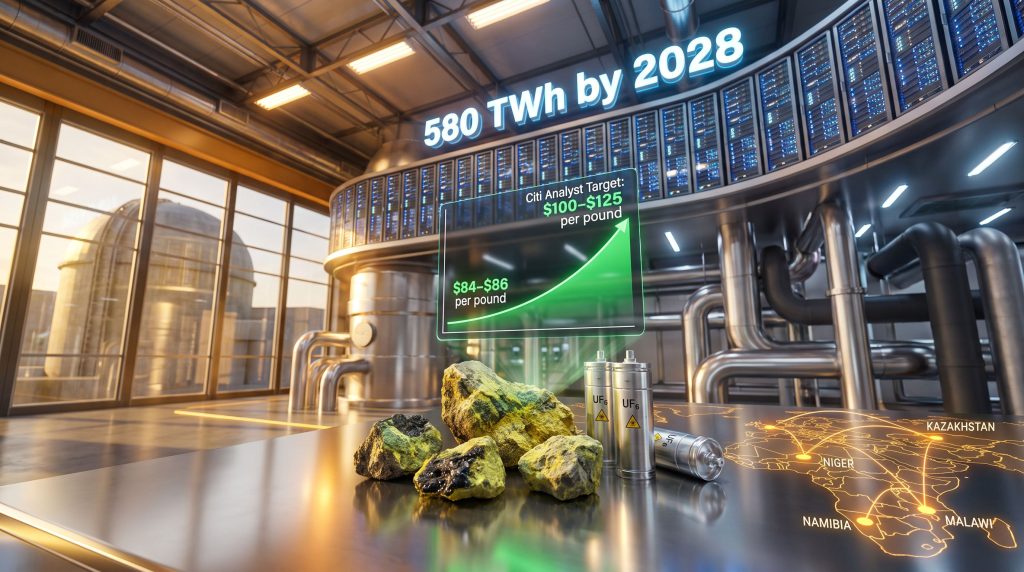
According to research published by Spring Valley Acquisition Corp. II in February 2026, U.S. data center electricity consumption is projected to climb from approximately 176 terawatt-hours to as high as 580 TWh by 2028. That is a more than threefold increase within a span of years, not decades. To put that in context, 580 TWh is roughly equivalent to the entire annual electricity consumption of a mid-sized European nation.
What makes this demand profile particularly demanding from a grid perspective is its operating characteristic. Unlike factories that cycle down on weekends or office buildings that dim at night, AI computing infrastructure runs continuously. The servers processing machine learning workloads, inference tasks, and training runs do not pause. This always-on demand profile is fundamentally different from any prior category of electricity consumption, and it eliminates a core assumption that made intermittent renewable energy viable for so many applications.
Why Solar and Wind Cannot Carry This Load Alone
Renewable energy advocates have made enormous progress demonstrating that wind and solar can power large portions of modern economies. However, the specific requirements of hyperscale AI data centres expose a structural limitation that battery storage alone cannot yet economically bridge. The uranium supply-demand outlook consequently becomes central to any credible energy transition discussion.
Grid reliability for AI computing facilities demands:
- Consistent voltage and frequency stability across 24-hour periods with no unplanned interruptions
- Zero tolerance for extended outages, as even brief power disruptions can corrupt in-progress computations and destroy significant economic value
- Power density at scale, with some hyperscale campuses requiring gigawatts of firm capacity from a single geographic footprint
- Carbon accountability, as major technology companies have made binding commitments to power their operations with verifiable low-carbon electricity
Solar and wind generation, by their nature, are intermittent. Battery storage technology has advanced considerably, but providing days or weeks of backup capacity for gigawatt-scale facilities at an economically viable cost remains beyond current battery economics. Nuclear power, with its ability to deliver dispatchable, carbon-free baseload electricity continuously, sits at the intersection of everything AI infrastructure requires.
Wood Mackenzie's August 2026 analysis identified more than 70 countries actively evaluating new commercial reactor programmes, a figure that reflects how broadly the electricity-nuclear connection has resonated with energy planners globally.
Big Tech and the Nuclear Power Commitment
Corporate Power Purchase Agreements Redefine Energy Procurement
The most significant signal that the nuclear power comeback is a structural rather than cyclical phenomenon is the behaviour of technology companies themselves. Microsoft, Google, Amazon, and Meta have each executed nuclear-related energy agreements in 2026, spanning reactor restarts, long-term power purchase contracts, and small modular reactor development partnerships. Furthermore, big tech's nuclear energy ambitions are increasingly well-documented across institutional investment research.
This shift is notable because it represents a deliberate departure from the renewable energy certificate model that dominated corporate sustainability strategies for the previous decade. Technology companies are no longer satisfied with purchasing renewable energy credits that may or may not correspond to actual power delivered to their facilities. They are moving toward contracts that guarantee firm, dispatchable generation capacity, and nuclear is the only zero-carbon technology that can currently fulfil that requirement at hyperscale.
These corporate commitments also have a practical effect on reactor economics. By providing long-term revenue certainty through power purchase agreements, technology companies are making previously marginal reactor restart decisions commercially viable. Projects that might have struggled to secure financing based on wholesale electricity prices alone become bankable when anchored by a decade-long offtake commitment from a creditworthy technology buyer.
Two Phases of Nuclear Capacity Growth
| Nuclear Growth Phase | Timeline | Primary Driver | Capacity Contribution |
|---|---|---|---|
| Reactor Restarts and Life Extensions | 2025 to 2035 | Near-term demand urgency | Moderate |
| New Conventional Reactors | 2030 to 2045 | Corporate PPAs and policy support | High |
| SMR Deployment at Scale | 2035 to 2060 | Manufacturing standardisation | Very High |
Wood Mackenzie projects that global nuclear capacity could more than double by 2060, representing a cumulative investment opportunity of $3.1 trillion. Small modular reactors deserve particular attention in this context. Unlike conventional nuclear plants that require bespoke construction on site over many years, SMRs are designed for modular, factory-style manufacturing and can theoretically be deployed at the scale of individual industrial facilities or data centre campuses.
Several technology companies have already signed agreements specifically to explore SMR capacity to underpin AI infrastructure, making the reactor format potentially the most direct technological intersection between AI uranium demand and nuclear power generation.
The Uranium Supply Crisis Running Beneath the Demand Headlines
A Deficit That Existed Before AI Arrived
The conversation about AI uranium demand tends to focus on the demand side of the equation, but the supply side contains dynamics that are arguably more consequential for market pricing in the near term. Global uranium mine production reached approximately 78,500 tonnes in 2025, while primary reactor demand stood at roughly 92,500 tonnes during the same period. The structural uranium supply deficit of approximately 14,000 tonnes annually is not a new development created by the AI boom.
It is, however, the accumulated consequence of a decade of underinvestment following the post-Fukushima price collapse that began in 2011. Mine development timelines in the uranium sector typically run seven to ten years from discovery through feasibility, permitting, construction, and commissioning. That means the production responses to a demand signal emerging today will not translate into meaningful new supply until the mid-2030s at the earliest.
The production deficit is projected to widen most significantly between 2028 and 2030, creating what market analysts describe as a supply crunch window during which demand growth accelerates while new mine supply remains constrained.
Understanding the Three-Layer Bottleneck
Most commodity supply chain analysis focuses on the mine. For uranium, however, the mine is only the first of three distinct processing stages, each facing independent capacity constraints. Investors and industry observers who focus only on mining output are missing two-thirds of the supply chain problem.
-
Mining: Annual production covers only approximately 85% of current primary demand, with secondary supplies including stockpile drawdowns and re-enrichment of depleted uranium bridging the gap. Secondary supplies are finite and their depletion accelerates the point at which primary production gaps become market-visible.
-
Conversion: Mined uranium oxide must be chemically converted into uranium hexafluoride before it can be enriched. Global conversion capacity is concentrated in a small number of facilities, and the conversion bottleneck has received far less attention than mining supply despite being equally binding on overall fuel availability.
-
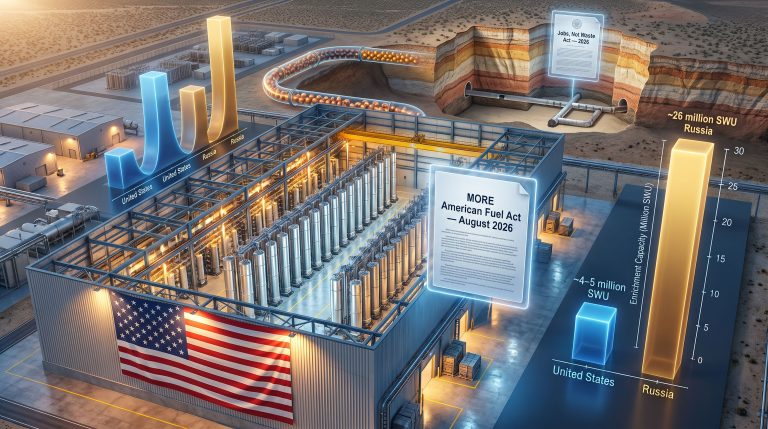
Enrichment: This is where the most significant geopolitical chokepoint exists. Russia controls approximately 44% of global uranium enrichment capacity. Enrichment is the process by which the concentration of fissile uranium-235 is increased from its natural level of about 0.7% to the 3-5% range required for commercial reactor fuel. There is no workaround for this step in the fuel cycle.
Building new enrichment capacity outside Russia requires seven to ten years of construction and regulatory lead time, and no major enrichment projects are currently under active development in the United States, Canada, or France. This is perhaps the least-discussed but most important supply chain vulnerability in the entire uranium market.
Uranium Price Dynamics: Where the Numbers Stand
| Metric | Current Level | Analyst Forecast |
|---|---|---|
| Spot uranium price (June 2026) | ~$84 to $86 per pound | |
| Citi analyst target (end-2026) | $100 to $125 per pound | |
| World Nuclear Association demand growth by 2030 | +28% above current levels | |
| Projected demand by 2040 | ~2x current consumption |
The pricing trajectory reflects growing market awareness of both the demand signal from nuclear power expansion and the structural supply constraints described above. Spot prices in the mid-$80s per pound already represent a significant recovery from the post-Fukushima lows of below $20 per pound recorded in 2016, but Citi analysts project further upside to the $100 to $125 per pound range before the end of 2026, driven by tightening physical market balances.
The Geopolitical Chessboard Controlling Uranium Supply Chains
Russia's Enrichment Position and the Western Response
Russia's approximate 44% share of global enrichment capacity is not simply a market statistic. It represents a geopolitical lever of considerable power over the energy security of countries that have made nuclear power central to their low-carbon electricity strategies. European utilities, in particular, built decades of fuel procurement relationships with Russian enrichment services, and unwinding those dependencies is far more complex than simply finding an alternative supplier.
The Russian uranium import ban introduced by the U.S. Senate underscores how seriously policymakers are treating this dependency. Furthermore, the U.S. government's broader response has been substantial. In 2024, Congress allocated $2.7 billion to the Department of Energy specifically to rebuild domestic nuclear fuel processing capabilities, representing the largest single federal commitment to uranium supply chain security in decades.
Kazakhstan, China, and the Feedstock Competition
Kazakhstan's role in this geopolitical picture adds a layer of complexity that Western uranium market observers sometimes underweight. The country produces roughly 45% of global mine output, making it the single most important uranium-producing nation on earth. However, its geographic and political position means its uranium does not flow freely to the highest bidder.
A supply agreement between Kazakhstan and China covers approximately 20,400 tonnes of uranium deliveries between 2026 and 2030. Those volumes are consequently removed from Western market access during a period when the supply deficit is expected to widen. Combined with Russia's enrichment dominance, this arrangement creates compounding pressure on Western nuclear fuel procurement that no single policy measure can quickly resolve.
Africa: The Emerging Frontier and Battleground
Africa's uranium endowment is becoming a focal point of great-power competition as Western buyers seek supply chain diversification away from Russian and Kazakh dependencies. The continent's uranium story is evolving rapidly across multiple fronts simultaneously.
| Country | Development | Strategic Significance |
|---|---|---|
| Niger | Nationalisation of Orano's Somaïr mine; 58-year concession cancelled May 2026 | Removed more than 25% of Europe's former uranium supply |
| Malawi | Kayelekera mine restarted August 2025 after 11 years idle | First new African supply restoration of the current cycle |
| Botswana | Estimated 800,000-tonne uranium resource; Orano exploration priority for 2026 | Long-term strategic reserve, commercial production years away |
| Namibia | China has strengthened operational presence | Secures Chinese supply chain access in Southern Africa |
| Pan-African | Russia's Rosatom maintains presence across 15 African nations | Broad geopolitical footprint across the continent |
Niger's post-coup nationalisation of French uranium assets deserves particular attention. Until recently, Niger supplied more than a quarter of Europe's uranium. The military government's decision to cancel Orano's 58-year Somaïr concession in May 2026 eliminated what had been one of Europe's most significant supply relationships almost overnight. This development accelerated the search for alternative African sources and elevated the strategic importance of Botswana and Malawi considerably.
In April 2026, Orano agreed to accept Malawi's Kayelekera uranium at its processing facility, a critical step toward the first commercial deliveries from the restarted mine. Botswana's estimated 800,000-tonne uranium resource has attracted Western exploration interest as a long-term strategic reserve, though large-scale commercial production remains some years away from feasibility.
What the Nuclear-AI Convergence Means for Investors
Five Structural Tailwinds Supporting the Bull Case
Current uranium investment trends reflect five distinct structural tailwinds that collectively underpin the long-term bull case:
- AI-driven electricity demand creating sustained corporate and government appetite for nuclear baseload power across more than 70 countries
- Persistent supply deficits with no rapid resolution pathway given the seven-to-ten-year lead times for new mines and enrichment facilities
- Geopolitical supply chain fragmentation incentivising Western governments to pay premium prices for secure, non-Russian uranium sources
- Technology company nuclear commitments providing long-term revenue certainty for reactor operators and creating demand visibility for fuel buyers
- Western government investment in domestic fuel processing capacity, including the U.S. Department of Energy's $2.7 billion allocation
Key Risks That Investors Must Monitor
The structural bull case for uranium is compelling, but it carries meaningful risks that disciplined investors should weigh carefully:
- Permitting and construction delays for new reactors and SMRs could push demand timelines significantly further into the future, deferring the physical fuel demand that underpins price forecasts
- Uranium price volatility may discourage the sustained capital investment needed to develop new mines across seven-to-ten-year development horizons, creating boom-bust cycles in the supply response
- Geopolitical escalation in uranium-producing regions, particularly across Africa and Central Asia, could disrupt supply without a corresponding reduction in demand, creating disorderly market conditions
- Technology substitution risk if alternative energy storage or generation technologies advance faster than current projections suggest, potentially reducing the urgency of nuclear investment programmes
Investors should distinguish carefully between speculative price momentum driven by AI headlines and the durable, multi-decade demand trajectory underpinned by concrete reactor construction pipelines and signed corporate power purchase agreements. These are different investment theses with different risk profiles.
Distinguishing Near-Term Noise from Long-Term Signal
One of the more nuanced challenges in uranium investing is separating the structural demand signal from short-term market activity. Near-term uranium market behaviour is dominated by deal announcements, reactor restart timelines, and revised demand forecasts rather than immediate step-changes in physical consumption. Understanding broader uranium market dynamics is therefore essential for investors attempting to distinguish durable trends from momentum-driven noise.
The World Nuclear Association's projection of a 28% increase in uranium requirements by 2030 and a doubling of consumption by 2040 represents a demand trajectory that unfolds over years and decades, not quarters. Mining companies capable of bringing new production online within that window, and enrichment infrastructure that can process that material outside Russian control, are where the most structurally significant investment opportunities are likely to emerge.
The next major ASX story will hit our subscribers first
Frequently Asked Questions: AI Uranium Demand and Nuclear Power
Does AI directly consume uranium?
No. Artificial intelligence systems run on electricity, not uranium. The connection is indirect: AI data centres require massive quantities of reliable, low-carbon electricity, which is driving utilities and technology companies toward nuclear power as a preferred generation source. This increased nuclear deployment consequently raises demand for uranium as reactor fuel.
Why can't renewable energy alone power AI data centres?
AI computing infrastructure requires uninterrupted power delivery that solar and wind generation cannot reliably provide without substantial and expensive battery storage systems. Nuclear power delivers firm, dispatchable electricity continuously, making it uniquely suited to the operational requirements of hyperscale data centres.
How much could uranium demand increase by 2040?
The World Nuclear Association projects uranium demand will rise approximately 28% above current levels by 2030, with consumption potentially doubling by 2040 relative to today's baseline, driven by new reactor construction and life extensions across more than 70 countries.
Why is Russia's enrichment capacity a problem for Western countries?
Russia controls approximately 44% of global uranium enrichment capacity. Because enrichment is an essential step in converting mined uranium into reactor-ready fuel, this concentration gives Russia significant leverage over Western nuclear power programmes. Building alternative enrichment capacity outside Russia requires seven to ten years, meaning no quick substitute is currently available.
What are small modular reactors and why do they matter for AI?
SMRs are compact nuclear reactors designed for modular, factory-style manufacturing and deployment at smaller scales than conventional nuclear plants. Their flexibility makes them attractive for powering individual data centre campuses or industrial facilities. Several technology companies have signed agreements to develop SMR capacity specifically to support AI infrastructure power requirements, as explored further in analysis from Investing News Network.
The Decade Ahead: Mapping the Nuclear-AI Timeline
2025 to 2028: Announcements and Restarts
Reactor life extensions and restarts dominate near-term supply additions. Corporate nuclear power purchase agreements multiply across the technology sector. Uranium spot prices trend toward analyst targets of $100 to $125 per pound as physical supply deficits become more market-visible.
2028 to 2035: The Supply Crunch Window
The uranium production deficit is projected to widen most acutely during this period. Western governments accelerate domestic fuel processing investments, though new enrichment capacity remains years away from operational readiness. African uranium resources move from exploration priority toward active development programmes as geopolitical pressure intensifies.
2035 to 2060: The New Nuclear Era
Advanced reactor designs and SMRs begin contributing meaningfully to global capacity. Global nuclear generation could more than double from current levels, representing the $3.1 trillion investment deployment identified by Wood Mackenzie. Uranium demand stabilises at approximately twice current consumption levels, requiring a fundamentally restructured global supply chain that does not yet exist in its required form.
The convergence of AI uranium demand and nuclear power economics is not a speculative narrative. It is playing out in contract announcements, government funding allocations, and physical commodity market balances simultaneously. The uranium market's structural characteristics — including its long development timelines, concentrated supply chains, and geopolitically sensitive production geography — mean that the demand signal emerging from AI infrastructure buildout is likely to translate into sustained price support over a timeframe measured in years and decades rather than months.
Want to Position Yourself Ahead of the Next Major Uranium Discovery?
Discovery Alert's proprietary Discovery IQ model scans ASX announcements in real time, instantly identifying significant mineral discoveries — including uranium — and delivering actionable alerts before the broader market can react. Explore historic discoveries and their exceptional returns to understand what early positioning can mean, then begin your 14-day free trial and secure your market-leading advantage.