August 9, 2026
The Long Arc of Nuclear Waste: Why Onkalo's Safety Clearance Rewrites the Rulebook
For more than half a century, the nuclear energy sector has operated under an unresolved tension: the ability to generate low-carbon electricity at scale, paired with an inability to demonstrate a permanent, scientifically validated solution for the highly radioactive material left behind. Spent nuclear fuel does not simply decay into harmlessness within a human lifetime. Certain isotopes remain hazardous across timescales that dwarf recorded human civilisation. Surface storage facilities, cooling pools, and interim dry cask installations have served as practical stopgaps, but the scientific community has never viewed them as anything other than temporary arrangements.
The international consensus, built across decades of geological research, radiological modelling, and regulatory deliberation, has consistently pointed toward one answer: deep geologic repositories. The Onkalo SNF repository safety assessment, completed by Finland's Radiation and Nuclear Safety Authority in August 2026, represents the moment that answer moved from scientific theory into operational reality.
When big ASX news breaks, our subscribers know first
Why Deep Geologic Disposal Is the Only Credible Permanent Solution
The fundamental challenge with spent nuclear fuel is its persistence. Unlike many industrial waste products, SNF cannot be chemically neutralised or rendered inert through conventional treatment. High-level radioactive isotopes such as plutonium-239 have half-lives exceeding 24,000 years. Effective isolation therefore requires a containment system that remains intact not for decades, but for geological epochs.
Surface and near-surface storage was always understood by regulators and scientists as a bridge, not a destination. The physical degradation of engineered structures over centuries, combined with the unpredictability of institutional continuity and climate change impacts on surface hydrology, means no above-ground system can credibly claim to provide the duration of isolation required.
Deep geologic repositories exploit the natural stability of ancient rock formations. At sufficient depth within geologically inert bedrock, groundwater movement slows to near-imperceptible rates, seismic activity becomes far more manageable, and the surrounding geology itself functions as a passive containment barrier with essentially no maintenance requirement. This is the physical logic underpinning the global scientific consensus that has coalesced around DGRs as the appropriate endpoint for high-level nuclear waste. Furthermore, deep geological repository safety frameworks have been refined significantly over the past two decades to account for increasingly complex geological scenarios.
Nations actively pursuing DGR programs reflect this consensus in practice:
| Country | Program Status | Host Organisation | Estimated Operational Timeline |
|---|---|---|---|
| Finland | Safety assessment passed; operating license pending | Posiva | End of 2026 |
| Sweden | Site selected (Forsmark); regulatory review ongoing | SKB | Estimated 2030s |
| Canada | Site selected (northwestern Ontario); early licensing phase | NWMO | Estimated 2040s+ |
| France | Cigéo project in licensing phase | Andra | Estimated 2030s |
| Switzerland | Site selected; regulatory process ongoing | Nagra | Estimated 2050s |
Finland sits at the frontier of this global effort. The Onkalo facility at Olkiluoto island is not simply the most advanced DGR project in the world; following the August 2026 safety assessment clearance, it is now on the verge of becoming the first to actually receive waste.
Onkalo's Engineering Architecture: Isolation Designed to Outlast Civilisations
Repository Depth and Geological Host Rock
Onkalo is carved into Precambrian crystalline granite at depths ranging from approximately 400 to 450 metres below the surface. This is not an arbitrary engineering choice. Precambrian granite at Olkiluoto has remained geologically stable for billions of years, and site characterisation work conducted over multiple decades confirmed that groundwater flow rates at repository depth are extremely low.
The geochemical environment at depth is also reducing rather than oxidising, which is critically important for the long-term corrosion performance of the copper canisters used to contain fuel assemblies. This distinction matters more than it might appear. Copper corrodes orders of magnitude more slowly in anaerobic, chemically reducing environments than it does in the oxygen-rich conditions found near the surface. The bedrock's geochemical character is therefore not simply a passive backdrop; it is an active component of the containment strategy.
The Multi-Barrier Defence-in-Depth System
Onkalo's safety architecture does not depend on any single containment mechanism performing flawlessly across geological timescales. Instead, each barrier is designed so that failure of one layer does not compromise the system as a whole, with redundancy built into the physical and chemical properties of every component.
The layered containment system works as follows:
| Barrier Layer | Material | Primary Safety Function |
|---|---|---|
| Fuel canister | Iron-copper composite | Primary containment; corrosion resistance over millennia in anaerobic conditions |
| Bentonite buffer | Swellable clay surrounding canister | Mechanical protection; limits groundwater contact; retards radionuclide migration |
| Tunnel backfill | Swellable clay material | Seals deposition tunnels; restricts groundwater movement through repository |
| Host bedrock | Stable Precambrian crystalline granite | Geological isolation; retards radionuclide transport to biosphere over million-year timescales |
Each layer performs differently across failure scenarios. If a canister were to develop a breach over thousands of years, the surrounding bentonite buffer would absorb and slow any radionuclide release. If radionuclides penetrated the buffer, the extremely low groundwater velocity through the fractured granite would retard their migration toward the surface to a degree that renders radiological impact negligible within the dose limits required by regulators. Posiva's long-term safety documentation outlines how each barrier layer was modelled and validated throughout the assessment process.
What Fuel Is Designated for Onkalo Disposal
Posiva, jointly owned by Finnish energy producers Fortum and Teollisuuden Voima Oyj (TVO), is seeking an operating license that would cover disposal operations through to 2070. The facility will accept spent nuclear fuel from two sources:
- Fortum's Loviisa nuclear power plant
- TVO's Olkiluoto nuclear power plant
Both plants are operational within Finland's existing nuclear energy infrastructure, making Onkalo both a national waste management solution and, uniquely, a co-located disposal facility on the same island as one of the fuel-generating plants it will serve.
The Regulatory Framework: What STUK Actually Assessed
Scope and Methodology of the Safety Assessment
Finland's Radiation and Nuclear Safety Authority, STUK, conducted a comprehensive evaluation of the Onkalo SNF repository safety assessment that extends well beyond a conventional construction or operational review. The assessment examined repository performance across a minimum timeframe of 100,000 years, with scenario modelling extending to approximately 1 million years. This is not a typographical exaggeration; the regulatory framework genuinely requires that safety cases account for geological processes including future ice ages, seismic events, and transformations in groundwater chemistry across timescales that cannot be empirically observed.
The assessment covered three principal scenario categories:
- Normal evolution scenarios: The repository performs broadly as designed under expected hydrological and geochemical conditions, with canister integrity maintained across the primary assessment period.
- Altered evolution scenarios: Modelling variations in groundwater chemistry, rates of copper canister corrosion under different redox conditions, buffer clay swelling behaviour, and long-term tunnel backfill performance.
- Disruptive event scenarios: Including glaciation-induced pressure changes from future ice sheet loading, seismic fault reactivation, inadvertent future human intrusion into the repository, and significant departures from expected groundwater conditions.
No single scenario is treated as definitive. The entire safety case methodology embeds uncertainty quantification throughout, recognising that precise prediction over geological timescales is inherently impossible. The assessment therefore asks not whether every parameter can be known with certainty, but whether the system performs within acceptable safety limits across the full envelope of plausible futures.
The Dose Limit Standard: Quantifying Acceptable Risk
Posiva's long-term safety criterion sets a clear regulatory benchmark:
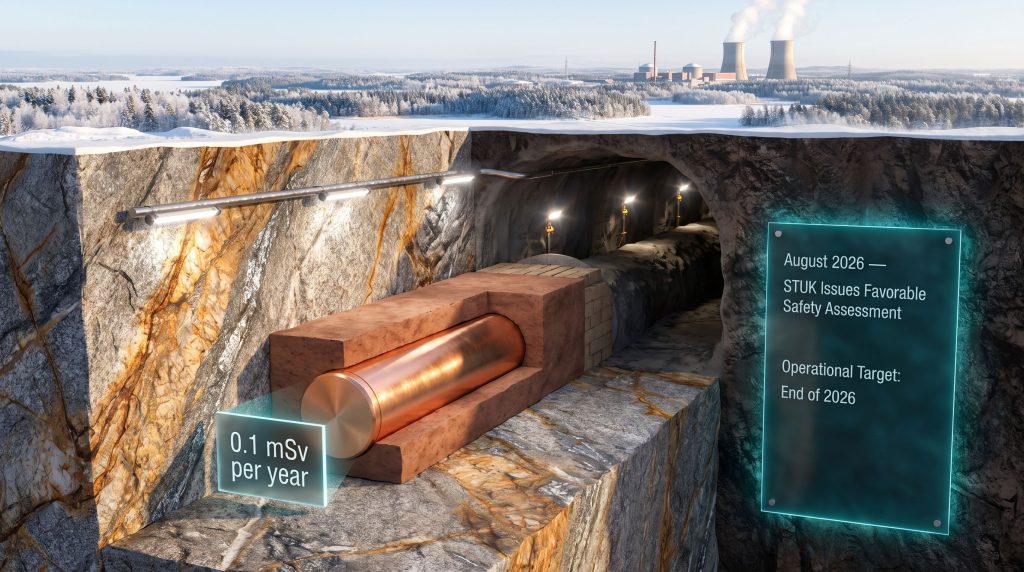
Radiation doses to the maximally exposed individual must remain below 0.1 millisieverts per year throughout the foreseeable assessment period, regardless of which scenario pathway is modelled.
To contextualise this threshold: average natural background radiation exposure globally is approximately 2 to 3 millisieverts per year, meaning the repository's allowable dose contribution is set at roughly 3 to 5 percent of what any person already receives naturally from cosmic rays, terrestrial radiation, and radon exposure. This is a deliberately conservative protection standard, consistent with international radiological protection frameworks established by the International Commission on Radiological Protection.
STUK's Formal Conclusions
STUK's regulatory conclusions addressed multiple assessment domains simultaneously. Across its core findings:
- Olkiluoto's geological conditions were assessed as appropriate for the repository concept
- The engineered barrier system, comprising the copper-iron canister, bentonite buffer, and swellable clay backfill, collectively demonstrated adequate long-term containment capacity
- Groundwater flow characteristics at repository depth were assessed as sufficiently low to support barrier system integrity over the required timescales
- The geochemical environment at depth was considered compatible with long-term copper canister corrosion resistance
- No obstacle was identified to granting an operating licence with respect to radiation and nuclear safety
- The safety requirements for granting the operating permit were assessed as met
From Regulatory Clearance to Operations: What Happens Next
Conditions Remaining Before Fuel Emplacement Begins
A favourable safety assessment does not immediately translate into operational commencement. Several steps remain in the pathway toward Onkalo receiving its first spent fuel canisters:
- Additional testing and commissioning activities must be completed at the disposal site
- STUK inspections are required to verify all conditions for safe operation are satisfied
- Finland's Ministry of Economic Affairs and Employment has indicated readiness to prepare an operating licence proposal for submission to government in autumn 2026
- The Finnish government must formally grant the operating licence
Posiva has stated an operational readiness target of end of 2026 for the commencement of final disposal activities, a timeline that aligns with the broader regulatory sequence now in motion.
Key Regulatory Timeline
| Period | Milestone |
|---|---|
| Multi-decade site characterisation | Geological investigations at Olkiluoto confirm bedrock suitability |
| 2024 | Trial run of spent fuel canister placement in repository tunnels commenced |
| December 2024 | STUK announces further delay to safety statement issuance |
| January 2025 | STUK confirms it remains on track to complete assessment within 2025 |
| August 2026 | STUK issues favourable safety assessment; operating licence pathway formally opens |
| Autumn 2026 | Operating licence proposal to be submitted to Finnish government |
| Target: End of 2026 | Posiva aims to achieve operational readiness for final disposal commencement |
The earlier delays in 2024 reflected the sheer complexity and documentary depth of the safety case review process, not fundamental deficiencies in Posiva's application. Regulatory dialogue between STUK and Posiva during the extended review period involved detailed design clarifications and iterative exchanges on specific technical parameters, a process that ultimately contributed to a more robust and thoroughly scrutinised safety case.
What Onkalo Means for the Global Nuclear Waste Landscape
A Technical and Regulatory Benchmark for Every Other DGR Program
The significance of the Onkalo SNF repository safety assessment extends well beyond Finnish energy policy. Every other national DGR program currently in development, whether in Sweden, Canada, France, or Switzerland, faces the same fundamental challenge: demonstrating to a sceptical public and an independent regulator that geological timescale safety modelling is credible, that engineered barrier systems can be relied upon for durations that exceed the entire span of agricultural human civilisation, and that a multi-decade regulatory process can reach a successful conclusion.
Finland has now demonstrated that all three are achievable. STUK's structured, independent, multi-decade assessment process provides an empirical reference point that other national regulators can study and adapt. Posiva's multi-barrier safety concept, having passed the world's most rigorous DGR safety review, will inevitably inform the safety case development strategies of SKB in Sweden, NWMO in Canada, Andra in France, and Nagra in Switzerland. Understanding the broader global uranium reserves picture also contextualises why nations are so invested in completing the full nuclear fuel cycle responsibly.
The Less-Discussed Technical Insight: Copper Corrosion Science at Repository Depth
One dimension of the Onkalo assessment that receives comparatively little public attention is the geochemical argumentation underpinning copper canister longevity. The safety case does not simply assume copper will last; it models the specific corrosion mechanisms that could act on the canister surface under repository conditions and calculates expected penetration rates across different chemical scenarios.
The reducing, sulphide-limited geochemical environment that Olkiluoto's bedrock provides at depth is a critical enabling condition for the copper canister performance projections. Sites without this geochemical character would face fundamentally different corrosion rate calculations and potentially could not support the same canister design with the same confidence margins. This insight has significant implications for other nations selecting DGR sites. Host rock geology is not evaluated solely for mechanical stability and low groundwater flow; the geochemical environment at depth is an equally critical selection criterion that directly determines which engineered barrier configurations are viable. SKB's corrosion research has similarly highlighted how repository geochemistry shapes long-term canister performance expectations.
Nuclear's Social Licence and the Waste Question
Public opposition to nuclear energy has historically centred on two concerns: reactor safety and the absence of a permanent waste disposal solution. Advanced reactor designs and decades of operational safety data have progressively addressed the first concern. The second has persisted as an open wound in nuclear energy's public credibility precisely because no country had ever successfully demonstrated a complete pathway from fuel use to permanent geological disposal.
Onkalo's progression toward operational status changes this dynamic in a concrete way. When the first spent fuel canisters are emplaced at Onkalo, nuclear energy will for the first time be able to point to a functioning, independently verified permanent disposal solution as a demonstrated reality rather than a regulatory aspiration. The implications for public and political acceptance of both existing nuclear operations and new build programs globally are considerable, even if not immediate. In addition, the nuclear growth investment case is increasingly supported by this kind of regulatory milestone, which removes one of the sector's most persistent credibility barriers.
Furthermore, the improved waste management narrative feeds directly into evolving uranium investment trends, as institutional investors become more comfortable underwriting the full lifecycle of nuclear energy projects. Consequently, shifts in the uranium market dynamics over the coming years are likely to reflect growing confidence in nuclear's long-term regulatory and operational trajectory.
The next major ASX story will hit our subscribers first
Frequently Asked Questions: Onkalo SNF Repository Safety Assessment
What did STUK conclude in the Onkalo safety assessment?
Finland's Radiation and Nuclear Safety Authority concluded that no obstacle exists to granting Onkalo an operating licence on radiation and nuclear safety grounds, and that all safety requirements for the operating permit have been satisfied. The assessment covered repository performance over a minimum of 100,000 years and up to approximately 1 million years.
Why is the repository constructed at 400 to 450 metres depth?
At this depth within stable Precambrian crystalline granite, groundwater flow rates are extremely low, the geochemical environment is chemically reducing, and the rock mass provides a passive geological containment barrier requiring no active maintenance. These conditions collectively enable both the engineered barriers and the geological isolation to perform as modelled across geological timescales.
What makes the bentonite buffer so important to the containment system?
Bentonite clay swells when it contacts water, self-sealing around the fuel canister and creating a tight mechanical and chemical barrier. Its extremely low hydraulic conductivity means that even if a canister were to develop a breach, any radionuclides would migrate through the buffer at an extraordinarily slow rate, providing a critical secondary line of containment before radionuclides could reach the surrounding rock.
What is the allowable dose limit Posiva must demonstrate compliance with?
Posiva's long-term safety criterion requires that radiation doses to the most exposed individual remain below 0.1 millisieverts per year across the full assessment period. This is approximately 3 to 5 percent of the natural background radiation that humans receive globally from environmental sources.
When could Onkalo begin receiving spent nuclear fuel?
Posiva has targeted operational readiness by the end of 2026, contingent on completing commissioning activities, passing STUK inspections, and receiving a formal operating licence from the Finnish government. The Ministry of Economic Affairs and Employment has indicated readiness to submit the licence proposal to government in autumn 2026.
Key Takeaways
- Regulatory validation achieved: STUK's favourable assessment marks the most consequential licensing milestone in Onkalo's multi-decade development history, clearing the final technical barrier to an operating licence
- Multi-barrier containment concept independently verified: the layered system of copper-iron canister, bentonite buffer, swellable clay backfill, and crystalline bedrock has passed the world's most rigorous DGR safety review
- Geological timescale safety modelling is now operationally demonstrated: safety cases spanning 100,000 to 1 million years have been formally assessed and accepted by an independent national nuclear regulator for the first time in history
- Geochemical conditions are an underappreciated DGR selection criterion: the reducing, anaerobic environment at Olkiluoto's repository depth is a critical enabler of copper canister longevity, with direct implications for site selection methodology in other DGR programs
- Global benchmark established: other nations' DGR programs will be measured against the Finnish model, and Posiva's multi-barrier safety case concept is likely to become a reference standard across the international waste management community
- Operating licence pathway formally open: with government submission expected in autumn 2026 and an operational commencement target of end of 2026, Onkalo stands at the threshold of permanently altering the nuclear energy industry's relationship with its most persistent challenge
Readers seeking additional technical depth on deep geologic repository safety cases and the international status of spent nuclear fuel management programs can find further context in reporting published by the American Nuclear Society's Nuclear Newswire at ans.org/news.
Want to Invest Ahead of the Next Major Uranium or Nuclear Discovery?
Discovery Alert's proprietary Discovery IQ model delivers real-time alerts on significant ASX mineral discoveries — including uranium and energy commodities — instantly translating complex data into actionable investment opportunities for both new and experienced investors. Explore Discovery Alert's dedicated discoveries page to see how historic mineral discoveries have generated substantial market returns, and begin your 14-day free trial today to position yourself ahead of the broader market.