August 8, 2026
When Geology Becomes Geopolitics: The Uranium Hidden Inside the World's Cobalt Supply Chain
Mineral supply chains are rarely as simple as they appear on a commodity exchange. Beneath every tonne of battery-grade cobalt sulfate sits a geological reality shaped over hundreds of millions of years, one that extraction metallurgy cannot always fully separate from the economic product being sold. In the case of the Democratic Republic of Congo, DRC cobalt uranium exports to China have quietly accumulated into what may be one of the most consequential regulatory failures in the history of critical minerals trade. The issue is not cobalt itself. It is what travels with it.
Understanding why this matters requires stepping back from the headlines and looking at how the earth's chemistry, industrial processing decisions, and decades of regulatory gaps converged to create a situation that now sits at the intersection of battery supply chain security, nuclear nonproliferation, and great power competition.
When big ASX news breaks, our subscribers know first
The Geological Reality Beneath the Cobalt Belt
The Central African Copperbelt, stretching across Katanga Province in the southern DRC and into Zambia, is one of the most mineralogically unusual regions on Earth. It hosts extraordinarily high concentrations of copper, cobalt, and uranium within the same sediment-hosted ore systems. This is not a coincidence of geography. These elements were co-deposited through the same ancient hydrothermal and diagenetic processes, meaning they are chemically and spatially intertwined at the ore body level.
This co-occurrence is the geological root of the current crisis. When mining operators in Katanga extract cobalt-bearing ore and process it through hydrometallurgical circuits to produce cobalt hydroxide, uranium does not simply disappear. It behaves as a co-precipitate, meaning it can follow cobalt through the leaching and precipitation steps and become embedded in the final exportable product at trace concentrations.
The distinction between deliberately mining uranium and incidentally concentrating it as a by-product of cobalt processing is legally meaningful but practically difficult to enforce. Furthermore, the broader context of DRC mineral wealth makes this challenge all the more complex, given the sheer variety of valuable materials present in the same ore systems.
Uranium has been prohibited as a deliberate extraction target in the DRC since a 2002 amendment to the national mining code, which classified it as a restricted material. Yet the same amendment could not alter the underlying geochemistry of Katanga's ore bodies.
Quantifying the Scale: What the Research Estimates
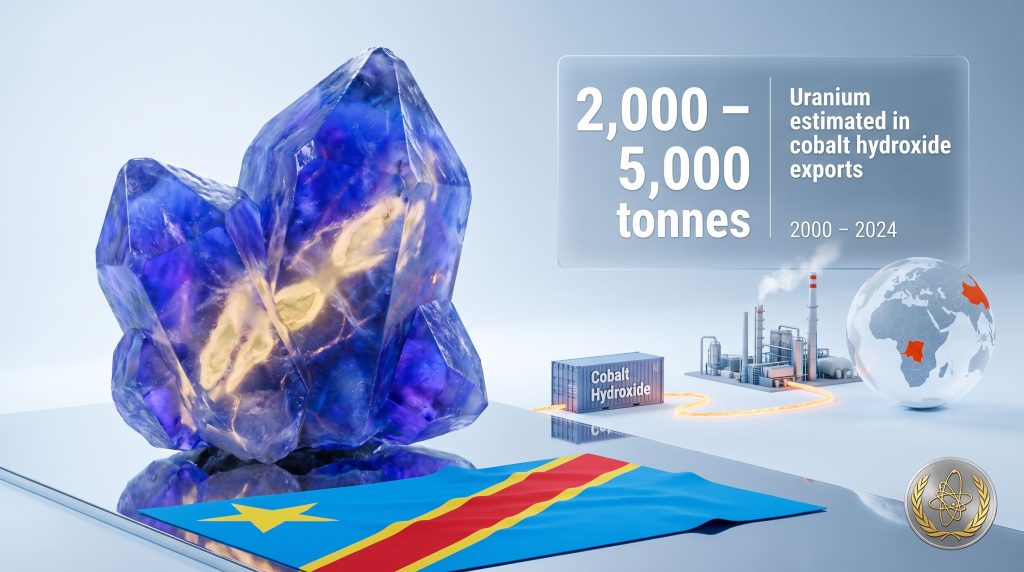
Research published in the peer-reviewed journal Nature Communications produced the most widely cited volume estimate to date, concluding that between 2,000 and 5,000 tonnes of uranium may have been transported out of the DRC embedded within cobalt hydroxide shipments over the period from 2000 to 2024. The DRC accounted for more than 70% of global cobalt production during much of this period, with China serving as the dominant destination for these exports.
| Metric | Estimated Figure |
|---|---|
| Uranium estimated to have left DRC in cobalt shipments | 2,000 to 5,000 tonnes |
| Time period covered | 2000 to 2024 |
| DRC share of global cobalt production | 70%+ |
| Primary export destination | China |
It is important to note that the DRC government has formally challenged these figures. Officials highlighted that the Nature Communications study relied on mathematical modelling derived from known uranium-to-cobalt ratios in Katanga ore bodies rather than direct measurements of actual export shipments. This methodological distinction matters enormously from an evidentiary standpoint, and it forms the basis of the government's counter-verification process currently underway.
That said, even accepting the lower bound of the estimate, the volume involved is considered significant from a nuclear material accounting perspective. Under international safeguards frameworks, cumulative quantities of uranium of this magnitude, moving through commercial trade channels rather than declared nuclear fuel cycles, represent a structural gap that existing monitoring architecture was not designed to address.
For a deeper understanding of these dynamics, Princeton University's research on undocumented uranium exports from the DRC provides additional scholarly context on how these volumes were estimated and what they may mean for international safeguards.
Even if uranium concentrations in any individual cobalt hydroxide shipment appear low, the cumulative volume across two decades of exports could constitute a material quantity under international nuclear safeguards frameworks. This is not simply a trade compliance concern. It is a nonproliferation issue.
How Cobalt Hydroxide Processing Creates a Radiological Blind Spot
The hydrometallurgical production process for cobalt hydroxide follows a relatively standard sequence, but it is within this sequence that uranium contamination can occur without triggering existing inspection protocols:
- Raw ore is extracted from open-cut or underground mines across Katanga Province, where uranium naturally co-exists with cobalt mineralisation.
- Crushed ore enters an acid leach circuit, dissolving cobalt, copper, and other soluble metals, along with uranium, into an aqueous solution.
- Cobalt is selectively precipitated from solution through pH adjustment, forming cobalt hydroxide as a filter cake.
- Uranium, depending on solution chemistry and process control, can co-precipitate with cobalt hydroxide or remain partially absorbed into the filter cake.
- The resulting cobalt hydroxide is packaged and loaded for export, with radiation screening historically absent from standard departure inspections.
The role of artisanal and small-scale mining operations in Katanga adds a further complication. These operations, which represent a significant share of DRC cobalt production and are notoriously difficult to regulate, process ore with far less metallurgical control than large industrial operators. The potential for uranium co-concentration in ASM-derived cobalt hydroxide is considerably higher, and traceability through this portion of the supply chain is substantially weaker.
China's Refining Dominance and the Accountability Gap
China's position at the centre of global cobalt refining creates a structural accountability challenge that goes beyond any single company or shipment. Chinese refineries process the overwhelming majority of the world's cobalt hydroxide, converting DRC feedstock into cobalt sulfate and other battery-ready intermediate products used in lithium-ion cathode manufacturing.
The refining process itself, which involves further dissolution and chemical separation, could theoretically concentrate or redistribute uranium residues within process streams. However, no confirmed public evidence has emerged demonstrating that uranium was deliberately recovered or intentionally utilised in China. Companies identified in investigative reporting by the Financial Times and Lighthouse Reports have denied wrongdoing, with some stating that uranium concentrations in their shipments were within applicable limits.
The core structural problem is simpler and more systemic: uranium tracking has never been embedded as a standard requirement within cobalt-to-battery supply chain compliance frameworks. Conflict mineral due diligence, child labour screening, and environmental audit requirements have all been progressively introduced for DRC cobalt. Radiological characterisation of export shipments has not been.
What Existing Regulatory Frameworks Were Designed to Prevent
The DRC's 2002 mining code amendment represented a clear legislative statement of intent. Uranium was to be treated as a restricted material, distinct from commercial minerals, and its export was prohibited. The gap between that legislative intent and on-the-ground enforcement reflects the structural realities of governing a mineral-rich but institutionally constrained jurisdiction affected by decades of conflict and governance fragility.
Internationally, the IAEA's safeguards system is designed to monitor declared nuclear material within recognised fuel cycle facilities. It was not architected to track uranium that migrates through commercial commodity supply chains as an undeclared co-product of cobalt processing. This represents a recognised gap in the global nuclear accountability architecture, one that the DRC situation has now brought into sharp relief.
A comparison of how other major mining jurisdictions handle radioactive by-products in mineral processing illustrates how far behind the DRC's enforcement framework has lagged:
| Jurisdiction | Regulatory Mechanism | Enforcement Body |
|---|---|---|
| Australia | Radiation Protection and Nuclear Safety Act; mandatory by-product reporting | ARPANSA |
| Canada | Nuclear Safety and Control Act; uranium co-product tracking requirements | CNSC |
| Kazakhstan | State nuclear inspectorate oversight of uranium-bearing ore exports | Ministry of Energy |
| DRC (current) | 2002 mining code restriction; radiation detector rollout at border crossings planned | National nuclear and energy agencies |
The next major ASX story will hit our subscribers first
The DRC Government's Response: Investigation, Detection, and Export Controls
The DRC government's response has proceeded on several parallel tracks following the publication of the Financial Times, Lighthouse Reports, and Nature Communications findings.
A dedicated inter-agency working group has been established, drawing together the country's nuclear safety bodies and energy regulators. This group is partnering with domestic and international laboratories to conduct independent sample verification, and has indicated it will seek technical support from the IAEA for independent testing and guidance on export screening infrastructure.
Practically, the government's planned measures include:
- Deployment of radiation detection equipment at truck exit points from Katanga mining zones to screen cobalt hydroxide shipments before they leave the country.
- A formal 60-day assessment period to evaluate health and environmental risk profiles, after which findings and proposed responses are to be made public.
- Consultation with the IAEA to strengthen the technical basis of the verification process and align it with international nuclear safeguards standards.
Separately, the DRC cobalt export ban on raw cobalt and copper concentrates was enacted. The stated rationale encompasses both the uranium contamination concern and the government's longer-standing ambition to retain more downstream value from its mineral resources within the country. Whether this dual-purpose instrument can be effectively enforced given the DRC's logistics and regulatory infrastructure remains an open question.
The cobalt export ban impacts extend well beyond domestic governance considerations, however. Global commodity markets have responded to the uncertainty, and buyers are actively reassessing their exposure to DRC-origin supply.
The export ban functions simultaneously as a precautionary nuclear safeguards measure and an instrument of resource nationalism. Its effectiveness on both dimensions depends entirely on enforcement capacity, which has historically been the weakest link in the DRC's mineral governance chain.
Geopolitical Stakes: Where Cobalt, Uranium, and Great Power Competition Intersect
DRC cobalt uranium exports to China land at precisely the point where three major geopolitical fault lines converge. The first is cobalt supply chain security for Western battery and electric vehicle manufacturers. The second is China's dominant position in global cobalt refining, which gives it structural leverage over downstream battery material supply. The third is nuclear nonproliferation norms and the integrity of the international safeguards system.
The Congolese cobalt rivalry between Western powers and China has intensified considerably in recent years, with the United States and European Union both pursuing critical minerals frameworks aimed at diversifying supply away from Chinese-controlled processing channels. The uranium contamination controversy adds a layer of complexity to this strategic calculus, raising questions about whether Western investment in DRC processing infrastructure would itself need to incorporate radiological management capabilities not currently standard in cobalt refining operations.
For global cobalt buyers, the risk profile of DRC-origin supply has expanded materially. Battery manufacturers and electric vehicle producers that have historically focused due diligence on conflict mineral and child labour compliance must now consider whether their supply chain traceability systems can demonstrate the radiological safety of incoming feedstock. Shipment rejections on radiation grounds have already been flagged in earlier reporting, suggesting this is not a theoretical future risk but an active commercial disruption scenario.
Could This Accelerate Cobalt Supply Diversification?
Cobalt production in Australia, the Philippines, and Indonesia represents the most credible near-term alternative to DRC-origin supply for buyers seeking to reduce exposure. These jurisdictions operate under more developed radiation protection regulatory frameworks, which may provide importers with greater confidence in the radiological characterisation of their product.
At the same time, the broader adoption of lithium iron phosphate battery chemistry, which eliminates cobalt from the cathode entirely, reduces long-term demand exposure to DRC supply chain risk across the electric vehicle sector. Major automakers and battery producers have already been shifting a portion of their production toward cobalt-free chemistries, a trend that the uranium contamination controversy may accelerate.
Furthermore, the cobalt suspension analysis suggests the longer enforcement measures remain in place, the greater the structural shift in global cobalt sourcing patterns is likely to become. Whether the DRC ultimately benefits or loses from this situation depends on the speed and credibility of its verification process and the extent to which IAEA engagement can provide internationally recognised assurance about the radiological safety of its cobalt exports going forward.
Key Takeaways: Policy and Market Implications at a Glance
| Dimension | Current Status | Near-Term Risk |
|---|---|---|
| DRC regulatory response | Investigation launched; concentrate export ban enacted | Enforcement capacity constraints |
| IAEA engagement | Planned but not yet confirmed as formalised | Delayed verification timeline |
| Chinese refiner exposure | Denied wrongdoing; no confirmed uranium use | Reputational and trade disruption risk |
| Global cobalt supply chain | Disruption risk elevated | Buyer due diligence requirements rising |
| Nuclear nonproliferation | Safeguards gap identified in commercial mineral trade | Calls for expanded IAEA monitoring scope |
| Worker and community health | 60-day risk assessment underway | Long-term occupational exposure data gaps |
Frequently Asked Questions
Is uranium mining legal in the DRC?
No. The DRC's 2002 mining code amendment classified uranium as a restricted material and prohibited its deliberate extraction and export. However, uranium occurs naturally alongside cobalt in Katanga ore bodies, meaning it can enter export streams as an unintentional by-product of cobalt hydroxide processing.
How much uranium may have been exported from the DRC in cobalt shipments?
Research published in Nature Communications estimated between 2,000 and 5,000 tonnes of uranium may have been transported out of the DRC within cobalt hydroxide shipments between 2000 and 2024. The DRC government has disputed this figure, citing the study's reliance on mathematical modelling rather than direct shipment measurements.
Does this mean China received uranium illegally?
No confirmed public evidence has demonstrated that uranium was deliberately extracted or used in China. Companies identified in investigative reporting have denied wrongdoing or stated that uranium concentrations in their shipments fell within applicable limits. The DRC's counter-verification process and potential IAEA engagement are intended to establish factual clarity on the actual volumes involved.
What is cobalt hydroxide and why does it matter?
Cobalt hydroxide is the intermediate chemical form in which most DRC cobalt is exported. Produced through hydrometallurgical processing of cobalt ore, it serves as the primary feedstock for Chinese cobalt refineries that manufacture battery-grade cobalt sulfate. Its chemical composition can retain trace quantities of uranium from the source ore depending on process conditions.
What would IAEA involvement practically entail?
IAEA technical assistance would likely include independent laboratory analysis of cobalt hydroxide samples, guidance on radiation monitoring infrastructure at DRC export points, and potentially recommendations for updated safeguards arrangements to capture uranium moving through commercial mineral trade channels rather than declared nuclear fuel cycles.
What does this mean for electric vehicle battery supply chains?
Cobalt sourced from the DRC underpins a substantial share of global lithium-ion battery production. If uranium contamination is confirmed at scale through independent verification, it could trigger additional shipment rejections, new due diligence requirements for battery manufacturers and EV producers, and further momentum toward cobalt supply diversification and cobalt-free battery chemistries. Consequently, the entire DRC cobalt uranium exports to China issue may prove to be a pivotal turning point for how the battery industry approaches supply chain risk assessment.
This article is intended for informational and analytical purposes only. It does not constitute investment advice. Statistics, estimates, and timelines referenced are drawn from publicly available sources including Nature Communications, Financial Times, Lighthouse Reports, and Business Insider Africa. The Nature Communications uranium volume estimate is based on mathematical modelling and has been formally disputed by the DRC government. Readers should not treat contested estimates as established facts.
Want to Stay Ahead of the Next Major Mineral Discovery Reshaping Global Supply Chains?
Discovery Alert's proprietary Discovery IQ model delivers real-time alerts on significant ASX mineral discoveries — cutting through complex geological and commodity data to surface actionable opportunities the moment they emerge on the exchange. Explore how historic discoveries have generated substantial returns on Discovery Alert's dedicated discoveries page, and begin your 14-day free trial today to position yourself ahead of the broader market.