August 8, 2026
When Cost Structure Meets Strategic Ambition: Reading Energy Fuels' Q2 2026 Numbers Correctly
Most investors reach for the net loss figure first. It is the number that appears in headlines, drives short-term sentiment, and often triggers reflexive selling. But for companies in the middle of transformative capital allocation cycles, that headline number can be among the least informative metrics on the page. Understanding why requires separating the accounting consequence of strategic action from the underlying performance of the business generating cash.
Energy Fuels second quarter results for 2026 present exactly this challenge. The headline net loss of $33.6 million sits alongside working capital of nearly $1 billion, uranium production costs at the bottom of guidance, and a strategic repositioning that, if completed, would create something with no direct comparable anywhere in the Western world. Decoding what these numbers actually mean requires looking at each layer independently.
When big ASX news breaks, our subscribers know first
Q2 2026 Financial Snapshot: The Numbers in Full Context
The top-line figures from the quarter provide an important starting framework before any deeper analysis begins.
| Metric | Q2 2026 Value |
|---|---|
| Total Revenue | $25.0 million |
| Net Loss | $33.6 million |
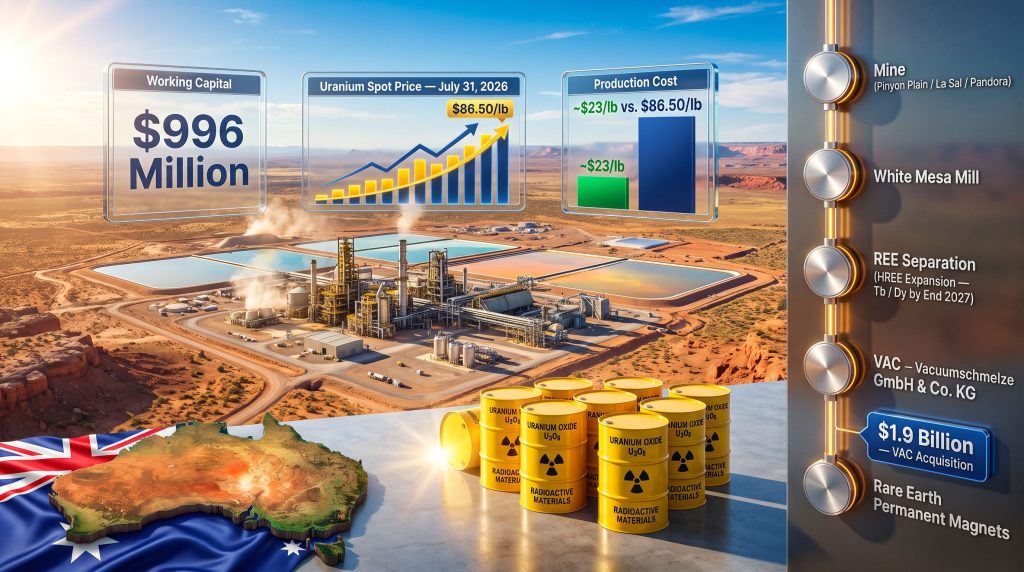
| Working Capital | ~$996 million |
| Cash & Equivalents | $58.4 million |
| Marketable Securities | $878.3 million |
| Trade & Other Receivables | $15.1 million |
| Total Inventory | $75.0 million |
| Total Assets | $1.53 billion |
| Total Liabilities | $736.4 million |
Revenue of $25.0 million came entirely from uranium oxide concentrate sales, with 310,000 pounds sold across spot and long-term contract channels. The loss, by contrast, was not generated by underperforming operations. It was driven primarily by transaction-related costs tied to two major acquisitions currently in progress, combined with elevated operating expenditure as the company scales its workforce and project pipeline.
Furthermore, understanding Energy Fuels' critical minerals strategy provides crucial context for interpreting these figures correctly.
Investor Framework: Companies executing large-scale M&A regularly absorb short-term income statement pressure as the cost of long-term strategic repositioning. A loss driven by deal fees and integration costs on a ~$1.9 billion acquisition is structurally distinct from an operational loss. Investors evaluating this quarter should isolate recurring uranium segment margins from one-time transaction expenses before drawing conclusions about underlying business health.
Uranium Production Performance: Pinyon Plain Sets the Benchmark
The uranium segment delivered results that, on a standalone basis, represent some of the strongest cost economics currently achievable in North American conventional uranium production. This context matters significantly when evaluating Energy Fuels uranium production against the broader industry.
Mine-Level Output and Ore Grades
During Q2 2026, the company mined 315,000 pounds of contained uranium oxide concentrate across three active operations: Pinyon Plain, La Sal, and Pandora. First-half 2026 cumulative mining reached 740,000 pounds.
Pinyon Plain dominated production volumes and quality metrics:
- Approximately 250,000 pounds of uranium oxide concentrate was mined at Pinyon Plain during the quarter alone
- Average ore grade at Pinyon Plain during Q2 2026: approximately 0.71% uranium oxide concentrate
- The conventional Mill run commenced in Q4 2025 and completed in Q2 2026, delivering approximately 2.3 million pounds of finished uranium oxide concentrate
- Total weighted average production cost: ~$23 per pound — at the floor of the previously guided $23 to $30 per pound range
The significance of that 0.71% grade deserves emphasis. Conventional uranium mining economics are highly sensitive to ore grade, and Pinyon Plain's grades are notably high by industry standards. Higher-grade ore requires less material to be moved and processed per pound of finished product, directly compressing per-unit production costs. This is a geological advantage that translates directly into financial performance.
The Cost-to-Price Spread: A Rarely Discussed Margin Dynamic
With uranium spot prices at $86.50 per pound as of July 31, 2026, and a production cost of approximately $23 per pound, the implied gross margin on spot-priced production sits at roughly $63.50 per pound. This is among the widest cost-to-price spreads available to any North American conventional uranium producer at current market prices. Current uranium market trends suggest this favourable spread may persist into the medium term.
For context, the long-term uranium contract price stood at $97.00 per pound as of the same date, implying an even wider theoretical margin on future contracted volumes. This structural advantage has significant implications for how the company can fund its broader transformation without diluting shareholders.
Uranium Sales Mechanics: Dual-Channel Strategy
| Sales Channel | Volume Sold | Weighted Average Price |
|---|---|---|
| Spot Market | 150,000 lbs | $84.92/lb |
| Long-Term Contracts | 160,000 lbs | $76.33/lb |
| Total / Blended | 310,000 lbs | ~$80.48/lb |
The blended realised price of approximately $80.48 per pound reflects a deliberate dual-channel approach. Spot sales capture current market pricing, while long-term contracts provide revenue certainty and reduce exposure to short-term price volatility. Notably, the long-term contract price of $76.33 per pound remains comfortably above industry-average all-in sustaining costs for most conventional US uranium producers, meaning even the lower-priced contracted volumes generate meaningful margin.
Uranium Inventory: Significant Unmonetised Value on the Balance Sheet
| Inventory Category | Volume |
|---|---|
| Ore, Mineralised Material & Raw Materials | ~590,000 lbs |
| Work-in-Process | ~35,000 lbs |
| Finished Uranium Oxide Concentrate | ~1,640,000 lbs |
| Total Contained + Finished | ~2,265,000 lbs |
The 1.64 million pounds of finished uranium oxide concentrate sitting in inventory represents substantial unmonetised value at prevailing market prices. At the July 31 spot price of $86.50 per pound, that finished inventory has a gross market value exceeding $141 million before any cost adjustments.
The Balance Sheet: How $996 Million in Working Capital Changes the Risk Profile
The working capital position as of June 30, 2026 deserves detailed examination, because its composition matters as much as its magnitude when assessing Energy Fuels second quarter results and the company's financial flexibility heading into a period of significant capital deployment.
Breaking Down the ~$996 Million
- $58.4 million in cash and cash equivalents: immediately deployable liquidity for operational needs
- $878.3 million in marketable securities: primarily short-term interest-bearing instruments and uranium equity holdings
- $15.1 million in trade and other receivables
- $75.0 million in total inventory
The concentration of nearly $878 million in marketable securities is a noteworthy structural choice. It reflects capital preservation discipline during a period of high acquisition-related expenditure. Short-term interest-bearing securities generate returns while remaining highly liquid, and the uranium equity component within the portfolio creates indirect leverage to uranium price appreciation without requiring additional physical production.
| Category | Value |
|---|---|
| Total Assets | $1.53 billion |
| Total Liabilities | $736.4 million |
| Net Asset Position | ~$793.6 million |
A net asset position of approximately $793.6 million provides a substantial equity cushion. Critically, the company's approach to its securities portfolio means it can deploy capital for acquisitions or construction at pace without needing to draw down debt facilities or issue new equity, both of which carry their own costs and risks.
From Uranium Producer to Critical Materials Platform: The Strategic Logic
What makes Energy Fuels' current positioning genuinely unusual is that the company is not simply diversifying for the sake of reducing single-commodity exposure. The transformation underway is a tightly integrated vertical supply chain strategy with a specific end market in mind. In addition, growing critical minerals demand driven by the global energy transition is reinforcing the strategic rationale behind this pivot.
The VAC Acquisition: Vertical Integration at Scale
On June 23, 2026, Energy Fuels entered a definitive agreement to acquire Vacuumschmelze GmbH & Co. KG (VAC), a German manufacturer of high-performance permanent magnetic materials, for total consideration of approximately $1.9 billion in cash and stock.
VAC is not a junior or emerging producer. It is an established manufacturer of rare earth permanent magnets, the type used in electric vehicle motors, wind turbines, and defence systems. These magnets require heavy rare earth elements including dysprosium and terbium, primarily sourced today from Chinese processing infrastructure.
If completed, this acquisition would position the company as the first fully integrated rare earth mine-to-magnet operation in the Western world, spanning ore extraction, mineral sands processing, rare earth separation, and finished magnet manufacturing. The transaction costs associated with this deal are the primary driver of the Q2 2026 net loss, which contextualises that headline figure considerably.
The ASM Acquisition: Australian Processing Assets
Running in parallel is the planned acquisition of Australian Strategic Materials Limited (ASM), which holds rare earth mining, processing, and metallization assets in Australia. Australian foreign investment approval was secured during Q2 2026. The transaction remains subject to court, regulatory, and shareholder approvals, with a targeted close date of end of August 2026.
ASM's metallization capability is particularly relevant. Converting separated rare earth oxides into metals and alloys is a technically demanding intermediate step that few Western companies currently do at scale. Adding this capability would further deepen the integrated supply chain Energy Fuels is assembling. Consequently, these moves align with broader efforts to diversify rare earth supply chains away from Chinese dominance.
How Energy Fuels Compares to Traditional Uranium Producers
| Dimension | Traditional Uranium Producer | Energy Fuels (2026 Model) |
|---|---|---|
| Primary Revenue Source | Uranium only | Uranium + REE expanding |
| Processing Infrastructure | Mine-site or contracted mill | Owned White Mesa Mill |
| Downstream Integration | None | REE separation + magnet manufacturing via VAC |
| Geographic Reach | Single jurisdiction | US, Australia, Madagascar, Brazil |
| Balance Sheet Complexity | Simpler | $1.53B total assets, $878M marketable securities |
The White Mesa Mill Expansion: Why Heavy Rare Earths Matter
Construction commenced on July 29, 2026 for a $104 million heavy rare earth element (HREE) separation expansion at the White Mesa Mill in Utah. This facility is already the only fully licensed and operating conventional uranium processing facility in the United States, giving it a regulatory and infrastructure head start that would take competitors years and hundreds of millions of dollars to replicate.
Phased Completion Timeline
| Circuit | Target Completion |
|---|---|
| Terbium (Tb) & Dysprosium (Dy) | End of 2027 |
| Samarium (Sm), Europium (Eu) & Gadolinium (Gd) | End of 2028 |
The prioritisation of terbium and dysprosium in the first phase reflects deliberate market logic. These two elements are among the most strategically sensitive in the entire rare earth periodic table. Both are essential dopants in neodymium-iron-boron (NdFeB) permanent magnets, where small quantities of Dy and Tb dramatically improve the magnet's ability to resist demagnetisation at elevated temperatures, a critical performance requirement in EV drive motors and aerospace applications.
Western supply of these specific elements is acutely constrained. China currently dominates both the mining and processing of heavy rare earths, creating supply chain vulnerability that defence agencies and automotive manufacturers alike have sought to address for years. A licensed, permitted, and constructing separation facility in the United States addresses that gap in a way that no amount of policy discussion achieves independently.
Donald Project JV: Feeding the Mill
The White Mesa Mill's rare earth processing capability requires a reliable feedstock pipeline. The Donald Project in Australia, a joint venture with Astron Limited, is designed to fulfil that role by supplying long-term monazite concentrate to the Mill.
- Energy Fuels' current ownership stake in the Donald Project JV: 12.7% as of June 30, 2026
- Capital contributed to date: AUD$48.83 million
- Final Investment Decision (FID) targeted for Q3 2026
- Upon FID, the company has the right to earn up to a 49% interest in the JV
Monazite is a phosphate mineral that carries both uranium and thorium alongside rare earth elements including lanthanum, cerium, neodymium, and crucially for the heavy circuit, gadolinium. Processing monazite at White Mesa would leverage the Mill's existing uranium recovery capability while simultaneously producing rare earth streams, creating meaningful cost efficiencies across both segments.
The next major ASX story will hit our subscribers first
Upcoming Milestones: What the Catalyst Calendar Looks Like
For investors tracking near-term developments, the schedule of anticipated milestones provides a structured framework for monitoring execution risk and strategic progress.
| Milestone | Target Timeline |
|---|---|
| ASM acquisition close | End of August 2026 |
| Donald Project FID | Q3 2026 |
| Next uranium Mill run commencement | Q4 2026 or early Q1 2027 |
| White Mesa HREE Phase 1 (Tb/Dy circuits) | End of 2027 |
| White Mesa HREE Phase 2 (Sm/Eu/Gd circuits) | End of 2028 |
The next conventional uranium Mill run, targeted for Q4 2026 or early 2027, will draw from the approximately 590,000 pounds of ore and mineralised material already stockpiled following the completion of the Pinyon Plain campaign. This eliminates the need for a new mining ramp-up before the next processing run begins, maintaining production continuity and reducing operational risk. However, investors should remain mindful of the ongoing uranium supply deficit and how it may influence pricing conditions ahead of that Mill run.
Frequently Asked Questions
What drove the net loss in Q2 2026 despite strong uranium margins?
The $33.6 million net loss resulted primarily from transaction-related costs associated with the planned acquisitions of VAC and ASM, combined with higher operating expenditure as the company expands its workforce and project pipeline. Underlying uranium segment margins remained healthy, with production costs at approximately $23 per pound against a spot price of $86.50 per pound.
How significant is the ~$996 million working capital position?
Working capital of approximately $996 million as of June 30, 2026 represents one of the strongest balance sheet positions among uranium-focused producers. The composition matters: $878.3 million in marketable securities provides near-liquid flexibility, while $58.4 million in cash covers immediate operational requirements.
What makes Pinyon Plain's ore grade notable?
An average ore grade of approximately 0.71% uranium oxide concentrate is high by North American conventional mining standards. Higher ore grades compress per-unit processing costs by reducing the volume of material required to produce each pound of finished uranium oxide concentrate, directly supporting the ~$23 per pound production cost outcome.
What is the strategic rationale for acquiring VAC?
The acquisition of Vacuumschmelze GmbH & Co. KG for approximately $1.9 billion would extend Energy Fuels' operations from raw material extraction all the way through to finished permanent magnet manufacturing. No other Western company currently operates a fully integrated rare earth supply chain at this scale, making the potential strategic position genuinely unique if the transaction closes and integration proceeds as planned.
When is the uranium spot price expected to influence inventory realisation?
With approximately 1.64 million pounds of finished uranium oxide concentrate in inventory and a spot price of $86.50 per pound as of July 31, 2026, the timing of sales decisions carries meaningful financial implications. The company has not disclosed specific forward sales plans, and uranium pricing remains subject to market forces. Investors should note that inventory valuations and realised prices may differ materially from spot prices at any given time. Those wishing to explore broader market dynamics may find it useful to review Energy Fuels' SEC filings for additional disclosure on sales strategy.
This article is intended for informational purposes only and does not constitute financial or investment advice. Forward-looking statements, projected timelines, acquisition outcomes, and price forecasts involve risks and uncertainties. Readers should conduct their own due diligence before making any investment decisions. For further coverage of Energy Fuels and other critical minerals producers, visit Crux Investor.
Want to Catch the Next Major Critical Minerals Discovery Before the Market Does?
Discovery Alert's proprietary Discovery IQ model scans ASX announcements in real time, instantly identifying significant mineral discoveries across uranium, rare earths, and over 30 other commodities — transforming complex data into actionable investment insights the moment they hit the exchange. Explore how historic discoveries have delivered extraordinary returns on Discovery Alert's dedicated discoveries page, and begin your 14-day free trial today to position yourself ahead of the broader market.