August 6, 2026
The Structural Fault Line in India's Nuclear Fuel Ambitions
Few energy transitions carry as much geopolitical weight as a nation's decision to scale nuclear power by an order of magnitude. When that nation is home to 1.4 billion people, operates one of the world's fastest-growing electricity grids, and has historically relied on coal for roughly 70% of its power generation, the stakes extend far beyond domestic energy policy. India uranium mining projects sit at the centre of this transformation, as India's commitment to reaching approximately 100 gigawatts of nuclear capacity by 2047 represents a fundamental restructuring of the country's energy security architecture.
The challenge India faces is not a shortage of intent. It is a structural mismatch between the pace of reactor deployment and the pace of domestic uranium production growth. Understanding this gap, and what India is doing to address it, requires a close look at where uranium is actually mined in the country, what the expansion pipeline looks like, and how import dependency is being managed in the interim.
When big ASX news breaks, our subscribers know first
India's Nuclear Capacity: The Numbers Behind the Ambition
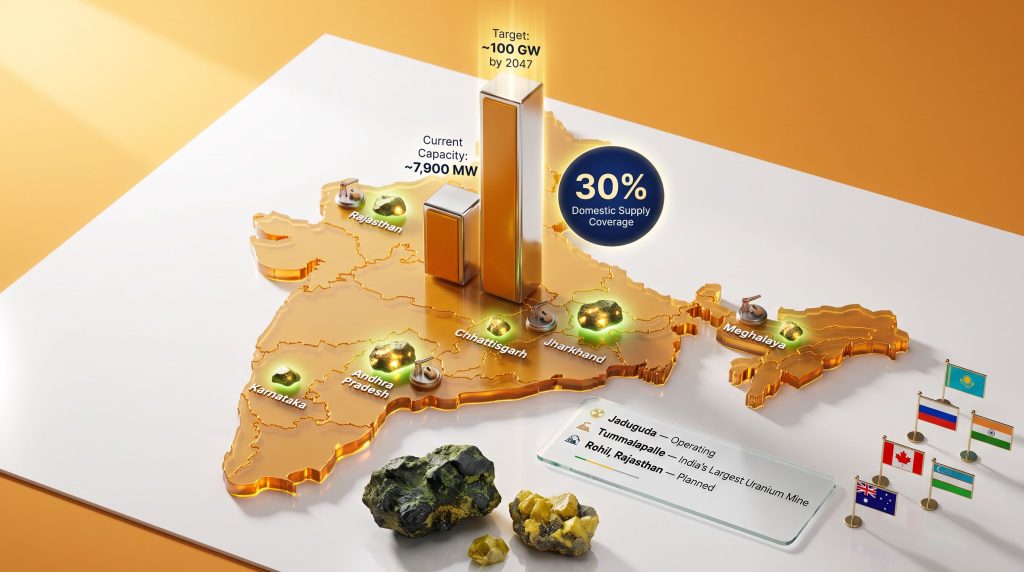
India currently generates nuclear power from 24 operational reactors with a combined installed capacity of roughly 7,900 MW. The national target of approximately 100 GW by 2047 represents a twelve-fold increase from today's base, a scale of expansion that would rank among the most aggressive nuclear buildouts in modern history.
To put this in context, consider the following:
| Metric | Current Status | 2047 Target |
|---|---|---|
| Operable nuclear reactors | 24 | ~100 GW equivalent |
| Installed nuclear capacity | ~7,900 MW | ~100,000 MW |
| Reactors under construction | 7 (13,100 MW combined with pre-project units) | Ongoing additions |
| Domestic uranium supply share | ~30% of projected PHWR need | Target: significantly higher |
Seventeen additional reactors totalling 13,100 MW are at various stages of development, with seven actively under construction and ten in pre-project phases. This pipeline of new capacity is heavily concentrated over the next decade, which creates a critical upstream problem. Pressure-Heavy Water Reactors, or PHWRs, which form the backbone of India's nuclear fleet, are fuel-intensive relative to light water reactor designs. A PHWR fleet of approximately 25 GWe would require an estimated 5,400 tonnes of U₃O₈ per year to operate continuously.
India's state-owned mining enterprise, Uranium Corporation of India Ltd (UCIL), currently estimates it can supply only around 30% of this projected annual requirement. The remaining 70% must be sourced through imports or through accelerated commissioning of domestic projects currently in the pipeline.
This is the defining tension in India's nuclear fuel strategy: reactor additions are front-loaded, while mine commissioning timelines extend as far as 2036. Furthermore, the uranium supply deficit at the global level compounds India's domestic production shortfall, adding urgency to both import diversification and new mine development.
Where India Currently Mines Uranium
Jharkhand: The Production Core
The state of Jharkhand hosts the largest concentration of active uranium mines in India and functions as the operational nucleus of the domestic fuel cycle. UCIL operates seven mines across this region, spanning both underground and open-pit methods.
| Mine | Type | Status |
|---|---|---|
| Jaduguda | Underground | Operating |
| Bhatin | Underground | Operating |
| Narwapahar | Underground | Operating |
| Bagjata | Underground | Operating |
| Turamdih | Underground | Operating |
| Banduhurang | Open-pit | Operating |
| Mohuldih | Underground | Operating |
Jaduguda holds particular historical significance as India's oldest uranium mine, having supplied the domestic fuel cycle since the 1960s. Plans to enhance capacity at Jaduguda form one pillar of UCIL's broader production doubling strategy.
Andhra Pradesh: India's Largest Single Uranium Mine
The Tummalapalle mine in the Kadapa district of Andhra Pradesh holds the distinction of being India's largest uranium deposit currently under extraction. Operating as an underground facility, Tummalapalle contributes meaningfully to national uranium concentrate output and represents southern India's most significant contribution to the domestic fuel supply chain.
UCIL is also pursuing clearances for the Lambapur-Peddagattu project spanning the Andhra Pradesh and Telangana border region. This development is planned to accommodate both underground and open-pit mining configurations, consequently broadening the production base in southern India.
The Next Frontier: Four New State Jurisdictions
India's uranium expansion strategy is deliberately designed to reduce geographic concentration risk. The ageing infrastructure of Jharkhand's mine cluster, combined with growing demand, has prompted UCIL and the Department of Atomic Energy to advance projects across four additional states.
| State | Project / Deposit | Development Stage |
|---|---|---|
| Rajasthan | Rohil (Sikar district) | Mining and processing plant planned |
| Chhattisgarh | New mining cluster | In-principle approval stage |
| Meghalaya | Kylleng-Pyndengsohiong-Mawthabah | Open-pit mine plus processing plant planned |
| Karnataka | Gogi | Exploration and project preparation underway |
The Rohil project in Rajasthan's Sikar district is among the most strategically significant of these developments. It would mark Rajasthan's entry as a uranium-producing state and anchor the western component of India's diversified mining footprint. Similarly, the Kylleng-Pyndengsohiong-Mawthabah deposit in Meghalaya represents a meaningful push into northeastern India, a region with known uranium mineralisation but historically limited extraction activity.
UCIL's 2036 Roadmap: Ambition, Output Projections, and Timing Risks
The Department of Atomic Energy has confirmed that UCIL is working toward doubling its uranium production by 2036. The strategy operates across two simultaneous tracks:
- Capacity enhancement at the existing Jaduguda operation through mine deepening and processing upgrades
- Greenfield commissioning across new mining clusters in Jharkhand, Rajasthan, and Chhattisgarh
Across all 13 projects that have received in-principle government approval, the combined projected output, once fully implemented, is estimated at approximately 11.535 million tonnes of ore per year and 1,095 tonnes of U₃O₈ annually. This would represent a substantial uplift from current production levels, though it would still leave India dependent on imports to fully fuel its expanded reactor fleet.
The timing problem is not lost on India's parliamentary oversight bodies. The Committee on Public Undertakings has formally flagged that NPCIL's reactor capacity additions are concentrated in the near-term decade, while UCIL's production growth does not reach full realisation until 2036. Any commissioning delays across the new mining clusters would extend India's period of strategic import dependency. This vulnerability is particularly acute given the shifting global uranium market dynamics following years of underinvestment in new mine development worldwide.
The uranium market context matters here. Following the Fukushima accident in 2011, uranium prices collapsed and exploration spending dropped sharply across the industry. The resulting decade-long underinvestment in new supply created a structural deficit that has since pushed uranium spot prices significantly higher. India is seeking to ramp up domestic production precisely as global competition for uranium supply has intensified.
Managing Import Dependency: Current Supply Agreements
While domestic production catches up, India has built a diversified import portfolio to ensure uninterrupted reactor fuel supply. Current uranium suppliers include:
| Supplier Country | Agreement Status |
|---|---|
| Kazakhstan | Active supply agreement |
| Russia | Active supply agreement |
| Canada | Active supply agreement (first shipment received) |
| Uzbekistan | Long-term contract valid to 2026 |
The Uzbekistan contract represents a near-term expiry risk. Parliamentary oversight bodies have noted that negotiations for a post-2026 long-term supply agreement with Uzbekistan are underway, though no confirmed replacement contract has been publicly announced.
A notable recent development involves Australia. India and Australia signed an administrative arrangement enabling uranium exports from Australia to India for peaceful purposes, activating a bilateral nuclear cooperation agreement that had been in place for over a decade. This adds a geopolitically stable, tier-one uranium producer to India's supplier network. In addition, understanding the uranium market trends shaping global supply negotiations is increasingly relevant as India locks in long-term procurement strategies.
The Nuclear Fuel Complex and Domestic Fabrication
Imported uranium concentrate does not bypass the domestic industrial chain. The Nuclear Fuel Complex (NFC) manufactures fuel assemblies for PHWRs using uranium concentrate sourced from either UCIL's domestic operations or government-overseen import arrangements. This means India maintains domestic fabrication capability even when the raw material is sourced internationally, an important distinction for energy security planning.
Strategic Stockpiling: The Missing Layer
Parliamentary committees have called for the creation of strategic uranium stockpiles calibrated specifically to reactor refuelling cycles, describing such reserves as essential for ensuring continuous reactor operations during any supply disruption. No confirmed stockpile volumes have been publicly disclosed, which represents a notable transparency gap in India's nuclear fuel security framework.
For comparison, several major nuclear nations maintain uranium reserves equivalent to multiple years of reactor consumption, providing a buffer against both market volatility and geopolitical disruption. The uranium supply-demand volatility observed in recent years further underscores why strategic stockpiling has become a pressing policy priority.
Overseas Equity: The UCIL-NTPC Joint Venture Proposal
One of the more strategically significant developments to emerge from recent parliamentary review is the proposal for a joint venture between UCIL and NTPC to acquire equity stakes in overseas uranium assets. India's parliamentary committee has welcomed this as a constructive step toward stabilising long-term fuel costs and insulating the domestic nuclear fleet from global market volatility.
The strategic logic mirrors approaches taken by other major nuclear nations. France's Orano and China's CNNC have both spent decades building equity positions in uranium mines across Africa, Central Asia, and Canada. South Korea similarly pursued overseas uranium equity acquisition as a cornerstone of its nuclear fuel security strategy. For India, the proposed UCIL-NTPC joint venture would represent a first-generation entry into this model of upstream resource ownership.
Equity ownership in uranium assets abroad offers several advantages that spot market purchasing cannot replicate:
- Price certainty through cost-linked rather than market-linked uranium acquisition
- Supply priority during periods of global market tightness
- Strategic positioning as a participant rather than a buyer in global uranium supply chains
- Hedging capability against geopolitical disruption from any single supplier nation
The next major ASX story will hit our subscribers first
Regulatory Bottlenecks and the Legislative Gap
Beyond the physical challenge of building new mines, India faces a set of regulatory and legislative friction points that have historically slowed uranium project commissioning. Parliamentary committees have explicitly stressed the need for reforms in this area, identifying several key pressure points:
- Environmental and forest clearance timelines for greenfield mining areas in states like Meghalaya and Karnataka
- State-level land acquisition processes that vary in complexity across Rajasthan, Chhattisgarh, and Meghalaya
- Coordination requirements between the DAE, UCIL, state governments, and environmental regulatory bodies
These are not trivial obstacles. India's uranium deposits frequently occur in ecologically sensitive or forested areas, and securing the necessary clearances has historically added years to project timelines. The Lambapur-Peddagattu project, for example, has been in various stages of clearance pursuit for an extended period. When examining global uranium reserves distribution, India's deposits, while significant, are often located in areas where regulatory complexity adds considerable time and cost to development.
NPCIL's International Market Mandate
On the demand side of the equation, parliamentary recommendations call for NPCIL to pursue a focused internationalisation strategy. Specific directions include:
- Accelerating the development and commercialisation of indigenous Light Water Reactors for export markets
- Advancing modular reactor technologies suited to emerging market demand
- Strengthening partnerships with established international nuclear vendors
- Actively participating in global nuclear supply chains and joint ventures
NPCIL has acknowledged these recommendations and indicated it will make efforts to implement them appropriately.
Complete Project Status: India's Uranium Mining Landscape
| Project | State | Type | Status |
|---|---|---|---|
| Jaduguda | Jharkhand | Underground | Operating; expansion planned |
| Bhatin | Jharkhand | Underground | Operating |
| Narwapahar | Jharkhand | Underground | Operating |
| Bagjata | Jharkhand | Underground | Operating |
| Turamdih | Jharkhand | Underground | Operating |
| Banduhurang | Jharkhand | Open-pit | Operating |
| Mohuldih | Jharkhand | Underground | Operating |
| Tummalapalle | Andhra Pradesh | Underground | Operating; largest mine in India |
| Lambapur-Peddagattu | Andhra Pradesh/Telangana | Underground/Open-pit | Clearances being sought |
| Rohil | Rajasthan | Mining plus processing | Planned |
| Kylleng-Pyndengsohiong-Mawthabah | Meghalaya | Open-pit plus processing | Planned |
| Gogi | Karnataka | Underground | Exploration and preparation |
| New cluster | Chhattisgarh | TBD | In-principle approval |
Frequently Asked Questions on India Uranium Mining Projects
Who controls uranium mining in India?
All uranium mining activity in India is carried out by Uranium Corporation of India Ltd (UCIL), a public sector enterprise operating under the Department of Atomic Energy. UCIL holds a statutory monopoly on uranium mining within the country and operates all active mines from its Jharkhand and Andhra Pradesh production base.
Why does India need to import uranium if it has domestic mines?
India's domestic uranium grades are relatively low compared to world-class deposits in countries like Canada and Kazakhstan. Combined with the production limitations of current mine capacity, domestic output covers only an estimated 30% of projected requirements for a 25 GWe PHWR fleet. Import diversification is therefore a structural necessity, not a temporary policy choice.
What is the significance of the Australia-India uranium arrangement?
Australia holds approximately 28% of the world's known uranium resources, making it one of the most significant uranium-producing nations globally. The activation of the administrative arrangement enabling Australian uranium exports to India adds a geopolitically stable and resource-abundant supplier to India's fuel procurement network, complementing existing agreements with Kazakhstan, Russia, Canada, and Uzbekistan.
What does U₃O₈ mean in the context of uranium mining?
U₃O₈, commonly called yellowcake, is the semi-processed uranium oxide concentrate produced at uranium mills after ore is crushed and chemically treated. It is the standard commercial form in which uranium is traded internationally before further processing into nuclear fuel. When India's parliamentary committees reference projected demand of 5,400 tonnes U₃O₈ per annum, they are referring to this traded commodity form.
Key Takeaways
- India's 100 GW by 2047 nuclear target creates an unprecedented upstream demand signal for both domestic and imported uranium
- UCIL's 2036 production doubling roadmap targets approximately 1,095 tonnes of U₃O₈ annually across 13 approved projects, but faces a critical timing mismatch with NPCIL's near-term reactor additions
- Domestic supply currently covers only ~30% of projected PHWR requirements, meaning import diversification is a structural pillar of India's fuel strategy, not a temporary gap-filler
- The proposed UCIL-NTPC overseas equity joint venture would represent India's first meaningful entry into upstream uranium ownership internationally
- Regulatory reform across environmental clearance, land acquisition, and state-federal coordination remains the most significant near-term barrier to India uranium mining projects reaching their commissioning targets
- Australia's activation as a uranium supplier adds a resource-abundant, geopolitically stable source to India's procurement network
This article contains forward-looking projections relating to energy capacity targets, uranium production timelines, and supply agreements. These projections are based on publicly available government statements and parliamentary committee reports and should not be construed as investment advice. Actual outcomes may differ materially from stated targets due to regulatory, technical, financial, or geopolitical factors.
Want to Stay Ahead of the Next Major Uranium Discovery on the ASX?
Discovery Alert's proprietary Discovery IQ model scans ASX announcements in real time, instantly identifying significant mineral discoveries — including uranium — and translating complex data into actionable investment insights for both short-term traders and long-term investors. Explore how historic discoveries have generated extraordinary returns on the Discovery Alert discoveries page, and begin your 14-day free trial today to position yourself ahead of the broader market.