August 6, 2026
The Structural Void at the Heart of America's Nuclear Fuel Chain
For more than four decades, a quiet but consequential gap has persisted in the United States nuclear fuel supply chain: the absence of a new conventional uranium mill. While in-situ recovery operations have expanded across Wyoming and Texas, the hard-rock conventional uranium assets of the Colorado Plateau, including the mesa country of southeastern Utah, have remained largely dormant. Their economics have been constrained not by geology but by the absence of processing infrastructure and technology capable of making them commercially viable at scale.
That structural absence is now the commercial opportunity at the centre of a newly formed uranium platform. When IsoEnergy forms DISA Uranium and contributes its Utah portfolio for a 33% stake, the transaction is not simply an asset transfer. It is an attempt to address the missing middle of the US nuclear fuel cycle by fusing a portfolio of permitted, past-producing conventional assets with a patented processing technology. In preliminary testing, this technology has demonstrated the potential to fundamentally change the economics of what has historically been a marginal segment of domestic uranium supply, as highlighted in recent analysis of uranium supply challenges.
When big ASX news breaks, our subscribers know first
What DISA Uranium Is and How the Capital Architecture Was Built
The creation of DISA Uranium Corporation emerges from a definitive agreement between IsoEnergy Ltd. (NYSE American: ISOU | TSX: ISO) and DISA Technologies, Inc. Under the arrangement, IsoEnergy contributes its five-asset Utah uranium portfolio in exchange for 1,677,350 shares of DISA Uranium Common Stock, representing approximately 33% of the company on a fully diluted basis and making IsoEnergy the single largest shareholder.
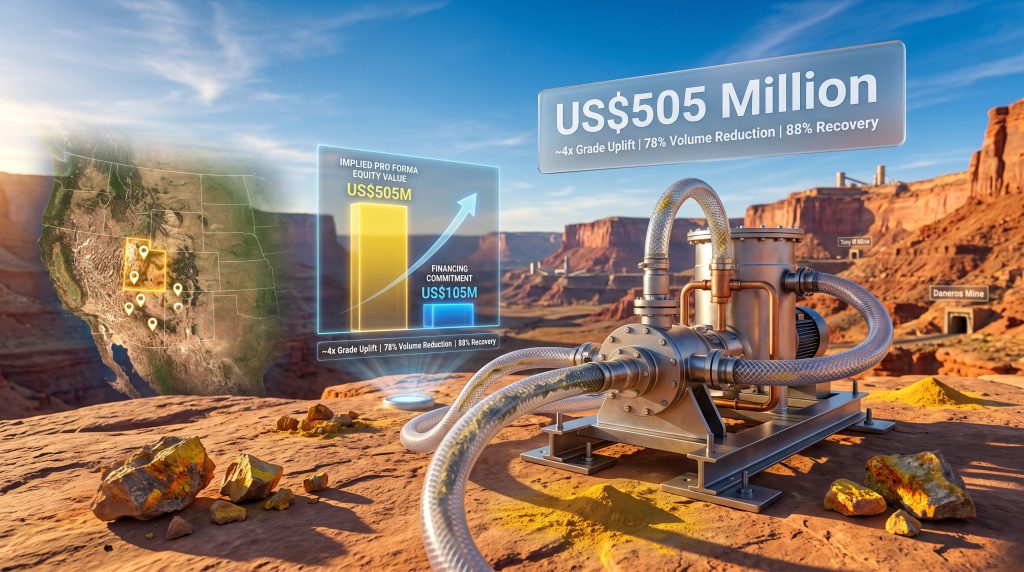
Concurrent with the asset contribution, DISA Uranium has secured US$105 million in private placement financing commitments from a consortium of strategic investors. IsoEnergy will participate in this financing round to the extent of US$33 million. Based on total financing commitments received, the implied pro forma fully diluted equity value of DISA Uranium stands at approximately US$505 million.
Transaction Metrics at a Glance
| Metric | Detail |
|---|---|
| Implied Pro Forma Equity Value | ~US$505 million (fully diluted) |
| Total Financing Commitments | US$105 million private placement |
| IsoEnergy's Participation in Financing | US$33 million |
| IsoEnergy Shares Received | 1,677,350 shares of Common Stock |
| IsoEnergy Ownership (Fully Diluted) | ~33% (largest single shareholder) |
| Board Designees | 2 (expected Chairman Richard Patricio + CEO Philip Williams) |
| Target Transaction Close | August 2026 |
IsoEnergy's Board of Directors unanimously approved the transaction following consultation with both financial and legal advisors, with TD Securities Inc. advising IsoEnergy financially and Cassels Brock & Blackwell LLP alongside Parr Brown Gee & Loveless providing legal counsel. DISA engaged Stifel as financial advisor and Wilson Sonsini Goodrich & Rosati, P.C. as legal counsel.
The Investor Consortium: A Signal Beyond Capital
The composition of the financing group deserves close attention from investors assessing DISA Uranium's strategic positioning. Furthermore, the breadth of this consortium signals confidence well beyond typical junior uranium development. The consortium includes:
- Tembo Capital — specialist mining-focused private equity
- BHP Ventures — the venture arm of one of the world's largest diversified miners
- Galvanise Climate Solutions — climate-focused investment vehicle
- Valour Equity Partners — multi-sector growth investor
- Evok Innovations — cleantech-focused venture fund
- Halliburton Labs — the innovation accelerator of a major oilfield services company
- Veriten — energy transition research and investment platform
The simultaneous presence of BHP Ventures and Halliburton Labs within a uranium financing consortium is unusual and strategically informative. It positions DISA Uranium at the intersection of hard-rock mining, industrial processing innovation, and energy infrastructure, rather than within the narrower frame of conventional uranium junior development.
The Utah Portfolio: Five Permitted Assets With a Compressed Restart Pathway
The assets IsoEnergy contributes carry a characteristic that commands a premium in the current US uranium development environment: they are already permitted. Obtaining new environmental and operational permits for conventional uranium mines in the western United States has historically required between seven and fifteen years, with no guarantee of approval. The Utah Portfolio sidesteps this entirely, a point of considerable relevance when considering the broader uranium mining landscape across developed markets.
Asset Summary
| Asset | Type | Status |
|---|---|---|
| Tony M Mine | Conventional uranium | Primary HPSA test site |
| Daneros Mine | Conventional uranium | Permitted, past-producing |
| Rim Mine | Conventional uranium and vanadium | Permitted, past-producing |
| Sage Plain Project | Uranium development | Permitted |
| Flatiron Project | Uranium and exploration development | Permitted |
All five assets sit on the Colorado Plateau, a geological province known for its sediment-hosted uranium and vanadium mineralisation in Chinle and Morrison Formation host rocks. These formations are the same geological units that produced the majority of US uranium output through much of the twentieth century, and their mineralogy is well-understood by conventional processing operations.
The phrase standby and ready for rapid restart carries specific operational meaning in this context. It indicates that infrastructure, ventilation, ground support, and surface facilities have been maintained in a condition that does not require significant pre-production capital expenditure before material can be extracted. For investors, this narrows the gap between current state and first production in a way that greenfield developments cannot replicate.
HPSA Technology: How a Patented Process Changes the Numbers on Conventional Uranium
The commercial logic behind pairing the Utah Portfolio with DISA Uranium rests heavily on the performance characteristics of High-Pressure Slurry Ablation technology. Understanding how HPSA works at a mechanical level is essential to evaluating whether the preliminary testing results at Tony M Mine are genuinely transformative or simply promising.
What Is HPSA? High-Pressure Slurry Ablation is a patented, modular ore processing method that directs high-velocity slurry streams through a contained chamber, generating particle-on-particle collisions at sufficient energy to fracture material along natural mineral grain boundaries. The practical result is mechanical liberation of target minerals from gangue material before transportation, concentrating valuable content into a fraction of the original volume.
Preliminary Testing Results at Tony M Mine
| Performance Metric | Preliminary Result |
|---|---|
| Grade Uplift Potential | ~4x improvement |
| Reduction in Material Volume Requiring Transport | ~78% |
| Uranium Recovery Rate | ~88% |
To appreciate why these three metrics matter, each needs to be considered through a cost lens:
- Grade uplift of approximately 4x means that material delivered to a downstream processing facility carries four times the uranium content per tonne compared to run-of-mine feed. Processing costs are largely fixed on a per-tonne basis, so a fourfold grade increase dramatically reduces the cost per pound of recovered uranium.
- A 78% reduction in material volume requiring transportation directly addresses one of the most significant cost drivers for remote Utah operations. Truck haulage from mine site to mill over Utah's canyon country roads is expensive. Processing 78% less material through the transport and milling circuit is not a marginal saving.
- An 88% uranium recovery rate is the proportion of in-situ uranium that successfully transfers from ore to saleable product. This figure determines the relationship between a resource estimate and actual revenue, and at 88% it is competitive with conventional processing benchmarks for this ore type.
It is important to note that these are preliminary test results. The pathway from promising pilot-scale data to reliable commercial-scale performance involves additional engineering validation, and investors should treat these figures as directional rather than guaranteed outcomes until further confirmation is provided.
How HPSA Compares Across Processing Approaches
| Approach | Key Characteristic | DISA Uranium Differentiation |
|---|---|---|
| In-Situ Recovery (ISR) | Low capital, sandstone-hosted deposits | DISA targets conventional hard-rock and legacy waste |
| Conventional Mining (No Processing Tech) | Standard grade/tonnage economics | HPSA delivers ~4x grade uplift at mine site |
| Pure Remediation | Environmental services only | DISA monetises recovered uranium and vanadium |
| Greenfield Mill Development | Long permitting timelines | DISA builds on existing permitted asset base |
The Abandoned Mine Remediation Platform: A Regulatory Position No Competitor Holds
Among all the elements that distinguish DISA Uranium from other US-focused uranium developers, the most structurally durable may be the one that appears furthest from conventional mining: its NRC Source Materials Licence. This regulatory advantage is further examined in IsoEnergy's official announcement of the transaction.
DISA Uranium holds the only US Nuclear Regulatory Commission Source Materials Licence authorising uranium recovery from legacy mine waste across multiple sites simultaneously. This is not a standard operating licence for a single facility. It is a multi-site authorisation covering the recovery of uranium from abandoned mine waste, a licence category that requires satisfying a complex set of NRC requirements related to radiological protection, environmental monitoring, and material accountability.
The scale of the problem this licence addresses is significant:
- More than 15,000 sites across the western United States are associated with abandoned uranium mine waste
- Over 4,200 defence-related uranium mines represent the legacy of Cold War-era extraction activity, primarily across Utah, Colorado, Wyoming, New Mexico, and Arizona
- These sites constitute both an ongoing environmental liability and an untapped resource base of uranium and vanadium that was extracted from the ground but never processed
The dual-revenue model embedded in the remediation platform is commercially compelling: DISA Uranium is paid to clean up abandoned mine sites under environmental remediation contracts while simultaneously recovering and monetising the uranium and vanadium content of the waste material. The net effect is that remediation activity subsidises conventional production economics rather than representing a standalone cost centre.
This model is also difficult to replicate. Any competitor seeking to enter the abandoned uranium mine remediation market would need to obtain an equivalent NRC licence, a process that has evidently not resulted in a second holder of this specific authorisation type. Consequently, the regulatory moat is structural, not merely temporal.
IsoEnergy's Position After the Transaction: Retained Exposure, Reduced Capital Risk
For existing IsoEnergy shareholders, the strategic rationale operates on two distinct levels. First, the Utah Portfolio assets, which have been held on standby and have not contributed production revenue to IsoEnergy's financial profile, are now being redeployed into a capitalised platform with an institutional-grade investor consortium and a dedicated management team.
Second, IsoEnergy retains approximately 33% fully diluted ownership of a platform valued at approximately US$505 million, with two board designees, without bearing the full capital burden of developing the Utah assets independently. IsoEnergy's experienced Utah operations team will also transition to DISA Uranium, preserving continuity of site-level knowledge.
IsoEnergy simultaneously continues to advance its Athabasca Basin assets in Canada, including the Larocque East Project, home to the Hurricane deposit, which the company describes as hosting the world's highest-grade Indicated uranium Mineral Resource. The geographic and geological diversification between a Canadian high-grade unconformity deposit and a portfolio of US conventional hard-rock assets with proprietary processing technology represents a genuinely differentiated position within the uranium development sector, as reflected in the broader uranium investment outlook.
Scenario Analysis: Three Outcomes for Shareholders
Scenario 1: HPSA Delivers at Scale
DISA Uranium advances toward becoming the first new conventional uranium mill constructed in the US in more than 40 years. IsoEnergy's ~33% stake in a US$505 million platform appreciates as the processing facility progresses through development and the Utah Portfolio transitions to active production.
Scenario 2: Commercialisation Takes Longer Than Anticipated
Uranium prices remain elevated but HPSA faces engineering or capital hurdles at commercial scale. IsoEnergy retains meaningful equity exposure through its DISA Uranium stake while continuing to advance the Hurricane deposit independently. The Utah Portfolio remains permitted and operationally ready without requiring incremental capital from IsoEnergy's own balance sheet.
Scenario 3: Strategic Acquisition of the DISA Platform
The combination of a unique NRC remediation licence, HPSA technology, and a portfolio of permitted US conventional uranium assets could attract acquisition interest from major nuclear fuel cycle participants seeking US domestic processing exposure. In this scenario, IsoEnergy's 33% position converts into acquisition proceeds at a premium to current carrying value.
The next major ASX story will hit our subscribers first
The 40-Year Infrastructure Gap and What DISA Uranium's Processing Ambition Represents
The last conventional uranium mill built in the United States commenced construction in the early 1980s. The intervening four decades have seen ISR operations expand, though US uranium production has only recently begun recovering from its historic lows. However, conventional hard-rock uranium resources on the Colorado Plateau have largely sat undeveloped, partly because the economics of trucking run-of-mine ore to remote milling facilities have not been competitive at prices below approximately US$65 per pound.
DISA Uranium's stated long-term ambition — to develop a centralised uranium recycling and processing facility supplied by both the Utah Portfolio and the AUM remediation pipeline — addresses this gap directly. The combined feedstock from five permitted conventional mines and access to over 15,000 legacy waste sites across the western US creates the resource scale argument necessary to justify the capital expenditure required for a new processing facility.
The transaction is targeted to close in August 2026, subject to the following conditions:
- Completion of the DISA spin-out separating DISA Technologies' non-uranium and non-vanadium mineral processing operations into DISA Tech, Inc.
- Closing of the US$105 million financing with all committed investors
- Receipt of all required regulatory approvals
- Satisfaction of other customary closing conditions
Key Takeaways for Investors Tracking the US Uranium Development Sector
The formation of DISA Uranium through IsoEnergy's contribution of its Utah portfolio for a 33% stake represents a convergence of several forces that have been building independently across the uranium sector. Understanding the full scope of these developments is aided by considering the wider uranium market dynamics at play: tightening domestic supply, renewed interest in conventional Colorado Plateau assets, the absence of midstream processing infrastructure, and the emergence of processing technologies capable of improving project economics without requiring a new mill from day one.
The essential facts to retain are:
- A ~US$505 million uranium platform has been capitalised by combining permitted conventional assets with patented HPSA processing technology and a one-of-a-kind NRC remediation licence
- IsoEnergy retains ~33% fully diluted ownership and two board seats, unlocking value from assets previously sitting on standby
- HPSA preliminary testing at Tony M Mine demonstrated ~4x grade uplift, 78% volume reduction, and ~88% uranium recovery, though these remain preliminary figures pending commercial-scale validation
- The abandoned mine remediation pipeline spans 15,000+ legacy waste sites and 4,200+ defence-related uranium mines across the western US
- The transaction positions DISA Uranium to potentially develop the first new conventional uranium mill in the US in more than four decades
In addition, further detail on the transaction structure and strategic rationale is available directly via DISA's announcement for investors seeking primary source documentation.
This article is informational and does not constitute financial advice. Forward-looking statements, preliminary test results, scenario projections, and valuation figures carry inherent uncertainty and should not be interpreted as guarantees of future performance. Investors should conduct independent due diligence before making investment decisions.
For broader context on uranium market dynamics and IsoEnergy's full asset profile, additional coverage is available at cruxinvestor.com/companies/isoenergy.
Want to Stay Ahead of the Next Major Uranium Discovery on the ASX?
Discovery Alert's proprietary Discovery IQ model delivers real-time alerts on significant ASX mineral discoveries — including uranium — instantly translating complex data into actionable opportunities for investors at every level. Explore how major mineral discoveries have historically generated substantial returns on Discovery Alert's dedicated discoveries page, and begin your 14-day free trial today to position yourself ahead of the broader market.