August 8, 2026
The Quiet Revolution in Uranium Supply: Why Seawater Extraction Is Attracting Industry Titans
The global nuclear fuel industry is quietly approaching an inflection point. Decades of underinvestment in upstream uranium supply infrastructure, combined with an accelerating wave of reactor restarts, new build programmes, and the emergence of small modular reactors (SMRs), has created a structural gap between what conventional mining can deliver and what a decarbonising world requires. Understanding uranium supply-demand volatility is therefore essential context for what follows. Into this gap steps a company with an unconventional answer: extracting uranium not from rock, but from seawater.
SuperCritical Materials has now formalised one of its most significant governance moves to date. SuperCritical appoints Neal Froneman as chair, bringing one of the mining industry's most recognisable and commercially accomplished executives into a leadership role at a company operating at the very frontier of nuclear fuel supply innovation.
When big ASX news breaks, our subscribers know first
Neal Froneman: A Resume Built at the Intersection of Capital and Complexity
Understanding why this appointment carries weight requires understanding the man behind it. Froneman's career is not simply long — it is strategically varied in a way that is directly relevant to SuperCritical's commercial ambitions.
Over more than three decades, he has served as chief executive of five major mining companies, navigating commodity cycles, geopolitical complexity, and the capital markets pressures that routinely derail early-stage resource ventures. His most prominent role was founding and leading Sibanye-Stillwater for 12 years, during which time he transformed the company from a narrow South African gold producer into one of the world's most diversified critical minerals platforms.
What makes the SuperCritical appointment particularly compelling is not the Sibanye-Stillwater chapter, but an earlier one. Froneman previously led Uranium One, one of the world's largest uranium producers at the time of his tenure. That experience embedded in him a direct understanding of nuclear fuel supply chains, uranium market dynamics, and the commercial requirements of bringing fissile material from extraction through to reactor-ready product.
Very few executives on the planet can claim both that uranium-specific operational depth and the diversified critical minerals capital markets experience Froneman accumulated at Sibanye-Stillwater. His current governance portfolio reinforces this standing. He chairs the World Gold Council, a position that reflects continued influence at the highest tier of global resource governance. That he has now chosen to bring this accumulated institutional capital to an emerging seawater uranium company is, by any measure, a significant signal.
Froneman has also committed personal capital to SuperCritical, functioning simultaneously as investor and chair. In governance terms, this removes the distinction between advisory participation and financial alignment — a combination that tends to draw serious attention from institutional investors conducting early-stage due diligence.
What SuperCritical Materials Is Actually Building
The technology at SuperCritical's core is not science fiction, but it does sit at a frontier that conventional mining has largely ignored. Seawater uranium extraction is the process of recovering dissolved uranium directly from ocean water using specialised sorbent materials, typically polymer-based fibres engineered to selectively bind uranyl ions from the surrounding marine environment.
The chemistry behind this is well-established at laboratory scale. However, what SuperCritical is pursuing is the far more difficult challenge of making it work at industrial scale and at a cost structure that can compete with, or at least complement, conventional terrestrial uranium supply.
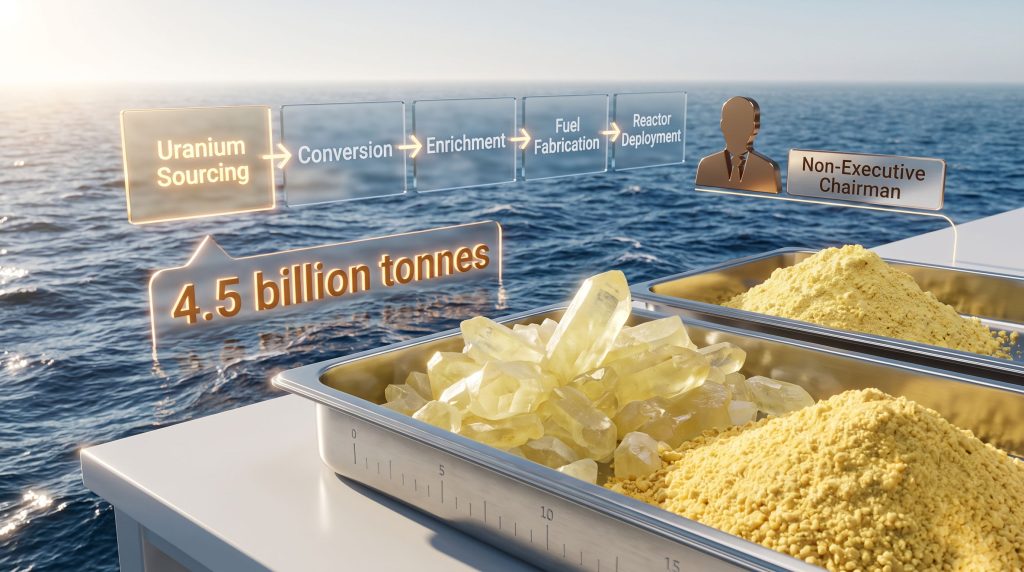
The scale of the resource base is genuinely extraordinary. The world's oceans contain an estimated 4.5 billion tonnes of dissolved uranium — a figure that dwarfs all known terrestrial reserves combined. To put that in context, identified conventional uranium resources stand at approximately 6 to 8 million tonnes, meaning the oceanic resource represents a supply base hundreds of times larger than everything currently mapped in the ground globally.
The Nuclear Fuel Cycle: Where Seawater Extraction Fits
To appreciate the strategic positioning of SuperCritical's technology, it helps to understand how uranium moves from extraction to electricity generation:
- Uranium sourcing — conventional mining or non-conventional recovery (seawater, phosphate by-product streams)
- Conversion — uranium oxide is converted to uranium hexafluoride for processing
- Enrichment — the concentration of fissile U-235 is increased to reactor-grade levels
- Fuel fabrication — enriched uranium is formed into fuel assemblies
- Reactor deployment — controlled fission generates electricity
- Used fuel management — storage, reprocessing, or long-term disposal
SuperCritical operates at Stage 1. That positioning matters because Stage 1 is the rate-limiting constraint for every step that follows. No enrichment, no fabrication, no reactor fuel without upstream supply. The entire downstream chain is only as resilient as its most constrained upstream input.
The Supply Crunch Driving Urgency: Conventional Mining's Structural Limits
Global uranium production is strikingly concentrated. Kazakhstan alone accounts for roughly 45% of world uranium output, with Canada and Australia contributing the majority of the remainder. This geographic concentration creates systemic fragility that reactor operators and fuel buyers are acutely aware of — particularly in a geopolitical environment where supply chain security has become a first-order concern across all critical materials.
The growing uranium supply deficit is compounding these pressures further. Furthermore, the demand side of the equation is shifting rapidly. Reactor restarts in Japan, new build programmes across Asia and Europe, and the emergence of SMR pipelines from developers including NuScale, Rolls-Royce, and X-energy are collectively expanding the long-term demand outlook faster than conventional mine supply can respond.
| Supply Pathway | Resource Scale | Geopolitical Exposure | Cost Certainty | Development Risk |
|---|---|---|---|---|
| Conventional Hard Rock Mining | Finite, deposit-dependent | High (jurisdiction-specific) | Established | Moderate to High |
| In-Situ Recovery (ISR) | Deposit-dependent | Moderate | Lower than hard rock | Moderate |
| Phosphate By-Product Recovery | Limited scale | Low | Variable | Low to Moderate |
| Seawater Extraction (SuperCritical) | Effectively unlimited | Very Low | To be determined | High (early-stage) |
The seawater pathway's near-zero geopolitical exposure is arguably its most underappreciated characteristic. Ocean water is not subject to export controls, sanctions regimes, or sovereign resource nationalism. For nuclear fuel buyers seeking supply chain diversification, that attribute alone represents a structurally differentiated value proposition.
The AI Data Centre Multiplier: Why Electricity Demand Is Reshaping Nuclear Economics
One of the less commonly understood dynamics currently reshaping uranium market trends is the role of artificial intelligence infrastructure. AI model training and inference at scale requires enormous, continuous volumes of electricity. Unlike renewable sources, nuclear power delivers high-capacity baseload electricity around the clock without weather-dependent intermittency.
Major technology companies including Microsoft, Google, and Amazon have already signed or announced nuclear power purchase agreements, signalling a structural shift in how hyperscale data centre operators think about long-term energy procurement. This is not a marginal trend. The International Energy Agency has projected that data centres could account for more than 1,000 terawatt-hours of global electricity consumption annually by 2026 — a figure roughly equivalent to Japan's total national electricity demand.
For uranium suppliers, this creates a demand signal that operates on a timeline measured in decades rather than quarters. Nuclear plants take years to build and decades to operate, meaning fuel procurement decisions being made now will shape supply relationships well into the 2040s and 2050s. Consequently, companies capable of demonstrating credible, scalable, geopolitically secure uranium supply at that horizon are entering conversations that conventional producers have historically dominated by default.
The convergence of AI-driven electricity demand, reactor fleet expansion, and uranium supply concentration in a handful of jurisdictions is producing a structural urgency around alternative supply pathways that has not existed in the uranium market for decades.
Governance Architecture: Why the Chair Role Is More Than Symbolic
In mature mining producers, the role of board chair is primarily one of governance oversight and strategic counsel. In early-stage resource technology companies, the function is fundamentally different. The chair is often the primary vehicle through which institutional credibility, network access, and capital markets trust are transmitted to the market.
SuperCritical appoints Neal Froneman as chair, and in doing so addresses several simultaneous challenges that early-stage ventures routinely encounter:
- Credibility compression: Froneman's track record eliminates years of trust-building that a lesser-known appointment would require
- Network activation: His relationships span mining finance, sovereign wealth funds, energy-focused institutional investors, and nuclear industry operators globally
- Partnership signalling: Senior executives at potential offtake partners, engineering contractors, and co-development candidates are far more likely to engage seriously when a peer-level figure is anchoring the governance structure
- Capital markets readiness: Investment banks and institutional allocators evaluate governance quality as a primary risk factor in early-stage resource investment decisions
The CEO of SuperCritical, Alexander Canon Bryan, has publicly framed the rationale for the appointment around Froneman's demonstrated history of building resource companies from concept through to operating scale. That framing positions the chair appointment not as a branding exercise but as an operational necessity at a critical juncture in the company's development trajectory.
The next major ASX story will hit our subscribers first
Key Risk Factors Investors Should Evaluate
No analysis of this development would be complete without an honest assessment of the risk landscape. Seawater uranium extraction at commercial scale represents a genuine technological frontier. In addition, investors should weigh the following factors carefully before considering the broader uranium investment outlook:
- Commercialisation risk: The leap from laboratory and pilot-scale validation to industrial-volume, cost-competitive production remains the central unresolved challenge in this technology domain
- Capital intensity: Novel extraction infrastructure typically requires long-duration capital commitments before generating revenue, creating funding risk across multiple market cycles
- Cost competitiveness: Current estimates suggest seawater uranium extraction costs remain materially above spot uranium prices, though the trajectory of both variables over the long term remains uncertain
- Regulatory complexity: Nuclear fuel supply chains operate under layered international and domestic regulatory frameworks — from the IAEA at the multilateral level through to national nuclear regulatory bodies — all of which affect commercialisation timelines
- Uranium price sensitivity: If spot uranium prices remain below the cost threshold of seawater extraction, the commercial viability window narrows significantly, though rising long-term contract prices may provide a more relevant benchmark
This article does not constitute financial advice. Investors should conduct independent due diligence and consult qualified financial advisers before making investment decisions related to any company or commodity discussed herein.
What This Appointment Tells Us About Where Senior Mining Leadership Is Heading
Froneman's career trajectory is not unique in its broad direction, even if it is exceptional in its scale. Across the global mining industry, executives with deep capital markets experience and operational credibility built in conventional commodity sectors are increasingly migrating toward early-stage ventures addressing structural supply gaps in the clean energy economy.
This pattern reflects a rational response to where value creation is expected to occur over the next two to three decades. Conventional gold and base metals producers face known cost curves, well-mapped resource bases, and intensifying ESG scrutiny. Early-stage critical mineral and nuclear fuel supply companies, by contrast, offer asymmetric upside if their technologies prove commercially viable.
However, such ventures require precisely the governance credibility and network access that figures like Froneman provide. Furthermore, evolving uranium market dynamics continue to favour those positioned at the frontier of supply innovation. The fact that Froneman has moved from chairing one of the world's largest precious and critical metals producers to backing an emerging seawater uranium company — with both personal capital and his governance reputation — tells a story about conviction that extends well beyond a single board appointment.
Frequently Asked Questions
What is SuperCritical Materials?
SuperCritical Materials is a company developing industrial-scale seawater uranium extraction technology, targeting the upstream supply constraints of the global nuclear fuel cycle. The company is currently transitioning from technology validation toward engineering and commercial infrastructure deployment.
Why does seawater uranium extraction matter?
The world's oceans contain an estimated 4.5 billion tonnes of dissolved uranium, far exceeding all known terrestrial reserves. If extraction can be made commercially viable, it would represent an effectively inexhaustible, geopolitically neutral uranium supply source with a fundamentally different risk profile to conventional mining.
What is Neal Froneman's background in uranium specifically?
Froneman previously served as CEO of Uranium One, one of the world's largest uranium producers, giving him direct operational experience across the nuclear fuel supply chain before his more widely known tenure at Sibanye-Stillwater.
How does AI growth connect to uranium demand?
Hyperscale AI data centres require large volumes of continuous, carbon-free baseload electricity. Nuclear power is increasingly identified as the primary solution for this requirement, accelerating uranium demand and creating urgency around securing long-term, diversified fuel supply.
What are the main risks for seawater uranium extraction?
Key risks include proving commercial-scale cost competitiveness, securing long-duration capital, navigating complex nuclear regulatory frameworks, and demonstrating consistent extraction performance at industrial volumes. These are early-stage technology risks that investors should evaluate carefully.
Ready to Identify the Next Major Uranium Discovery Before the Market Does?
Discovery Alert's proprietary Discovery IQ model delivers real-time alerts on significant ASX mineral discoveries — including uranium and critical minerals — instantly translating complex data into actionable insights for investors at every level. Explore historic discoveries and the returns they generated to understand the opportunity, then begin your 14-day free trial to position yourself ahead of the broader market.