August 8, 2026
Why Processing Economics, Not Just Geology, Define the Next US Uranium Cycle
For most of the past two decades, the conventional diagnosis for America's uranium supply problem has pointed to geology and politics: too few permitted mines, too much imported material, not enough domestic will to restart Cold War-era production infrastructure. What that diagnosis consistently missed was the processing layer sitting between ore in the ground and uranium oxide ready for delivery to a nuclear fuel fabricator.
Haulage economics, leaching throughput, and upgrading efficiency per tonne of mineralised material have quietly determined whether US uranium projects make financial sense long before they reach a production decision. That reality is now at the centre of the IsoEnergy DISA Uranium Corporation partnership, a transaction that reframes what a competitive US uranium development platform actually looks like in 2026.
When big ASX news breaks, our subscribers know first
What DISA Uranium Corporation Is and How It Was Assembled
The formation of DISA Uranium Corporation emerged from a definitive agreement struck on August 4, 2026, between IsoEnergy Ltd. (TSX: ISO | NYSE American: ISOU) and DISA Technologies, Inc. Rather than functioning as a conventional mine developer, the resulting entity was architected around three distinct but complementary business lines operating simultaneously.
The first pillar is a portfolio of permitted, past-producing conventional uranium assets in Utah. The second is a proprietary mine-site mineral upgrading technology called High-Pressure Slurry Ablation, or HPSA. The third is a federally licensed remediation recovery pipeline targeting legacy uranium mine waste across federal and tribal lands.
Headquartered in Casper, Wyoming, which sits within the historic US uranium production corridor, DISA Uranium Corporation absorbed IsoEnergy's Utah operations team to preserve technical continuity from day one of operations.
Structural Note: This three-pillar model is deliberately constructed so that each business line generates independent value drivers. A setback in conventional mine restart timelines does not neutralise the remediation pipeline, and technology licensing revenue does not depend on mine production schedules.
The Capital Architecture Behind a US$505 Million Implied Valuation
How the Pro Forma Equity Value Was Constructed
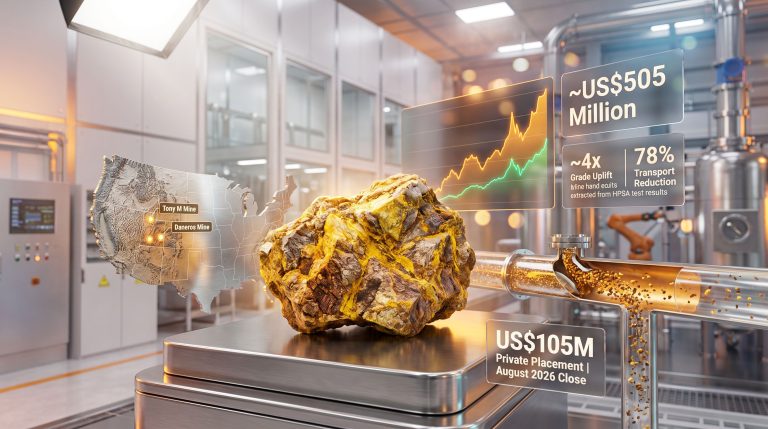
The transaction's implied pro forma fully diluted equity value of approximately US$505 million was anchored by US$105 million in committed concurrent private placement financing. IsoEnergy contributed US$33 million of that placement amount and exchanged its Utah asset portfolio for 1,677,350 common shares of DISA Uranium Corporation, resulting in an approximate 33% fully diluted equity stake that positions IsoEnergy as the entity's single largest shareholder.
Strategic Investor Composition
The identity of the investors backing the US$105 million raise is as analytically significant as the capital amount itself.
| Investor | Strategic Relevance |
|---|---|
| Tembo Capital | Specialist natural resources fund with deep mining sector exposure |
| BHP Ventures | Strategic investment arm of a global major, providing institutional-grade validation |
| Halliburton Labs | Energy technology accelerator, reinforcing HPSA technology's scalability thesis |
BHP Ventures participation in particular carries signal weight, given that major mining companies typically apply rigorous internal due diligence before committing strategic capital to junior or early-stage entities. Halliburton Labs' involvement is equally notable: as an energy technology accelerator, its engagement suggests independent confidence in HPSA's potential to scale modularly across multiple sites.
IsoEnergy's Portfolio Diversification Rationale
IsoEnergy's decision to contribute its Utah portfolio to DISA Uranium Corporation rather than develop it independently reflects a deliberate risk management philosophy. IsoEnergy CEO Philip Williams has articulated the company's view that concentrating shareholder exposure within a single asset or single jurisdiction creates an unacceptable binary outcome risk. This is particularly relevant in the context of broader uranium market dynamics, where regulatory, geopolitical, and operational variables can disrupt development timelines in ways that management cannot fully anticipate or control. Structuring assets within a multi-jurisdictional portfolio framework, by contrast, provides meaningful insulation from those risks.
The Utah Asset Base: Five Mines With a Critical Regulatory Advantage
Inventory of Contributed Assets
IsoEnergy's contribution to the IsoEnergy DISA Uranium Corporation partnership comprises five permitted, past-producing conventional uranium assets in Utah:
- Tony M Mine
- Daneros Mine
- Rim Mine
- Sage Plain Project
- Flatiron Project
Together, these assets carry a National Instrument 43-101 Indicated mineral resource of 6.61 million pounds of uranium oxide as of September 9, 2022.
Why Permitting Status Is a Disproportionate Value Driver
A fact that is frequently underappreciated by generalist investors is the scale of the regulatory barrier facing new uranium mining entrants in the United States. Obtaining a new NRC licence combined with state-level environmental approvals and land use permits for a greenfield uranium mine typically requires between 7 and 10 years, with no guarantee of success. Projects navigating tribal land consultations or proximity to sensitive water resources can experience even longer timelines.
Past-producing, already-permitted assets sidestep the most capital-intensive and time-consuming phase of that process entirely. Furthermore, the Tony M, Daneros, and Rim mines carry existing infrastructure, established environmental baselines, and active permit status, which compresses the path to production restart by years and eliminates a category of binary regulatory risk that kills many junior development projects before they generate a dollar of revenue. Understanding uranium mining regulation is consequently essential for appreciating why this permitting advantage translates directly into measurable commercial value.
How HPSA Technology Works: A Step-by-Step Process Breakdown
The Mechanics of High-Pressure Slurry Ablation
HPSA is a mechanical upgrading process that operates at the mine site before any material is loaded onto a truck for transport to a processing facility. Understanding how it works requires understanding the mineralogy it targets.
Utah's uranium deposits are dominantly hosted in carnotite, a uranium-vanadium oxide mineral that occurs in relatively soft, fine-grained sedimentary rock within the Colorado Plateau region. Carnotite ore is typically intimately associated with harder quartz-rich host rock, and conventional processing treats the entire ore mass as a single feed stream, hauling all of it to a mill regardless of grade heterogeneity.
HPSA exploits the hardness contrast between carnotite and its quartz host through the following sequence:
- Mineralised feedstock is introduced into the HPSA system as a water-based slurry
- High-velocity slurry streams are generated within the processing unit
- Particle-on-particle collisions are produced by those high-velocity streams
- Uranium-bearing carnotite fractures preferentially along its natural grain boundaries due to its lower hardness relative to quartz
- The liberated carnotite separates from the harder quartz host matrix without requiring chemical reagents or mechanical grinding media
- The concentrated, upgraded feedstock exits the primary processing phase ready for downstream acid or alkaline leaching
The absence of chemical reagents during this primary upgrading stage is both an environmental and economic advantage. It eliminates reagent procurement and handling costs, reduces environmental liability during the upgrading phase, and simplifies the regulatory profile of mine-site operations. This approach to innovative uranium extraction represents one of the more compelling developments in domestic uranium processing in recent years.
What the Tony M Mine Metallurgical Results Demonstrate
The 2026 Tony M HPSA Leach Study produced results that quantify the operational impact of this technology at a specific asset level.
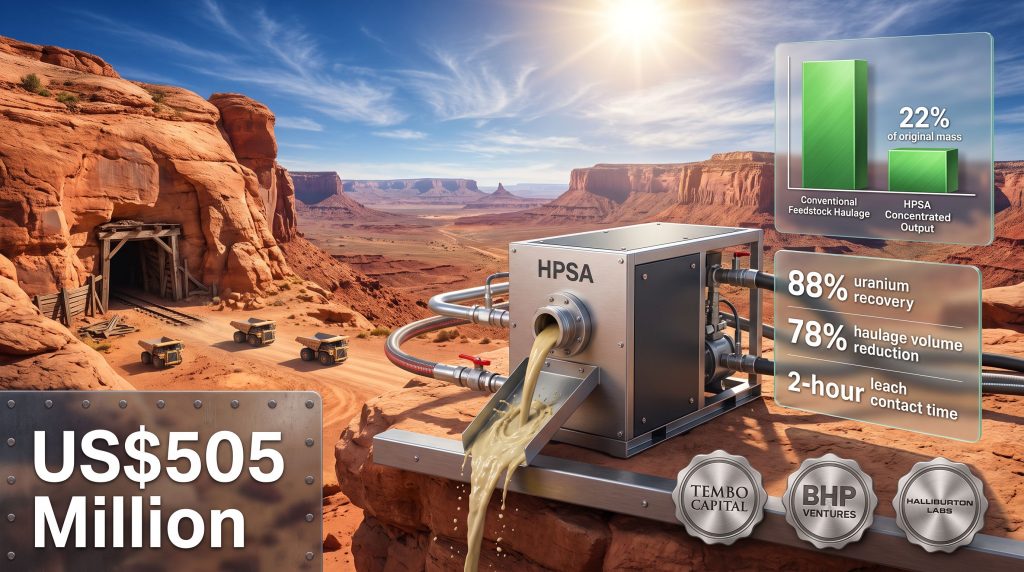
| Performance Metric | HPSA Result | Conventional Baseline |
|---|---|---|
| Feedstock mass after upgrading | 22% of original mass | 100% (no upgrading) |
| Uranium recovery rate | 88% | Variable |
| Downstream leaching contact time | 2 hours | 20+ hours |
| Road haulage volume reduction | 78% decrease | Baseline |
| Estimated transport cost reduction | >70% | Baseline |
Key Insight: The 78% reduction in haulage volume is not a marginal efficiency improvement. For Utah's geographically dispersed mine sites, where material must be transported across remote terrain to reach a toll mill or processing facility, haulage cost can represent a dominant component of the total operating cost per pound of recovered uranium. Cutting that cost by more than 70% restructures the entire unit economics of the operation.
Modular Deployment and Multi-Site Scalability
HPSA units are designed for modular deployment, which means the same technology can theoretically be installed at each of the five Utah mine sites as production activity scales up. This scalability is strategically significant: rather than requiring a centralised upgrading facility that creates a single point of operational failure, the modular architecture distributes processing capacity across the portfolio. Each mine becomes more economically self-contained as a result.
The critical caveat here is that metallurgical testing at the Tony M Mine, while producing compelling results, represents a single-site validation. Transitioning modular HPSA units from testing throughput to full commercial capacity across multiple sites simultaneously is a genuine execution challenge and represents one of the primary technical risks investors should monitor.
The Remediation Business: A Legally Distinct Commercial Pathway
Understanding the NRC Source Materials License
The remediation pipeline is the most technically specialised and least widely understood component of the DISA Uranium Corporation business model. At its core, the business depends on an NRC Source Materials License, a specific licence class that authorises uranium and vanadium recovery from legacy mine waste on federal and tribal lands.
Critically, this licence permits those recovery activities without triggering the regulatory requirements associated with initiating new mining operations. That distinction creates a legally protected commercial pathway that is entirely inaccessible to conventional uranium developers who lack this specific licence class.
The Scale of the National Remediation Opportunity
The addressable pipeline for this business unit is substantial. In addition, these figures highlight why the remediation segment is being treated as a structurally significant revenue stream rather than a secondary consideration:
- 15,000+ abandoned mine waste sites identified across EPA and US Geological Survey databases
- 4,200 defence-related uranium mines compiled across federal and tribal lands
- Navajo Nation remediation activities represent a high-profile early deployment target, combining commercial uranium and vanadium recovery with fulfilment of long-standing environmental obligations on tribal lands
Capital Intensity Comparison
The remediation business model differs structurally from greenfield mine development in one fundamental way: the mineralised feedstock already exists in pre-excavated waste stockpiles. Capital expenditure is weighted heavily toward processing equipment and logistics rather than drilling, blasting, mucking, and ground support. This creates a lower-capital, higher-optionality business unit relative to conventional mine development, with the added benefit that successful remediation activities generate an environmental liability reduction credit alongside commercial revenue.
The next major ASX story will hit our subscribers first
Governance Architecture and the Regulatory Risk Mitigation Logic
The seven-member Board of Directors assembled for DISA Uranium Corporation reflects the multi-jurisdictional complexity of the business model. The inclusion of former US Nuclear Regulatory Commission Commissioner Jeffrey Merrifield is particularly consequential for the remediation pipeline: direct familiarity with how the NRC constructs and interprets its licensing frameworks provides a navigational advantage when operating across state, federal, and tribal regulatory environments simultaneously.
IsoEnergy Chairman Richard Patricio and CEO Philip Williams joining the board ensures continuity of the strategic philosophy that drove the Utah asset portfolio's development under IsoEnergy's stewardship. The absorption of IsoEnergy's Utah operations team provides an additional layer of continuity at the technical and site management level.
Primary Execution Risks to Monitor
Investors evaluating the IsoEnergy DISA Uranium Corporation partnership should track the following risk categories:
- HPSA scale-up risk: Moving from metallurgical testing throughput to full commercial capacity across multiple sites simultaneously is the primary technical uncertainty
- Jurisdictional complexity: Coordinating regulatory execution across state, federal, and tribal frameworks for the remediation pipeline creates multi-layered compliance obligations
- Infrastructure coordination: Aligning conventional mine restart timelines with the development of new centralised processing infrastructure requires precise sequencing
- Capital allocation dynamics: IsoEnergy's 33% equity stake and its largest-shareholder position may influence future funding and dilution decisions within the pro forma entity in ways that individual shareholders should consider
The Long-Cycle Infrastructure Ambition: A New Conventional Uranium Mill
No new conventional uranium processing mill has been constructed in the United States in over four decades. That infrastructure gap is not simply a historical footnote. It represents the single largest structural constraint on US uranium supply growth that cannot be solved by mine restarts or in-situ recovery expansion alone.
Conventional uranium mills are required to process ore from hard-rock mines at scale. Their absence forces existing and future conventional mine operators to rely on toll milling arrangements, which introduce cost uncertainty, scheduling constraints, and dependency on third-party infrastructure owners. However, these uranium supply challenges are precisely the structural gaps that DISA Uranium Corporation's centralised resource base is being explicitly positioned to address, eventually underpinning the business case for new mill construction. This would represent a generational infrastructure investment in the US uranium supply chain.
Whether the combined resource base is sufficient to justify that capital commitment will be one of the defining questions answered by the updated Preliminary Economic Assessment targeted for delivery by year-end 2026.
Transaction Timeline and Key Catalysts Through 2026
Milestone Sequence
| Milestone | Target Date |
|---|---|
| Definitive agreement announced | August 4, 2026 |
| Transaction closing | Mid-August 2026 |
| Non-uranium spin-out into DISA Tech, Inc. completed | Mid-August 2026 |
| Updated Tony M Mine PEA delivery | Year-end 2026 |
| First NRC-licensed pilot program deployment | 12-month horizon |
| Navajo Nation remediation site commencement | 12-month horizon |
Investor Monitoring Checklist:
- Transaction closing confirmation (mid-August 2026)
- Non-uranium spin-out into DISA Tech, Inc. completion
- Updated Tony M Mine PEA release integrating HPSA metallurgical economics
- First NRC-licensed pilot program deployment
- Navajo Nation remediation activity commencement
Frequently Asked Questions
What assets did IsoEnergy contribute to DISA Uranium Corporation?
IsoEnergy contributed five permitted, past-producing Utah uranium assets: the Tony M Mine, Daneros Mine, Rim Mine, Sage Plain Project, and Flatiron Project. These collectively hold a NI 43-101 Indicated mineral resource of 6.61 million pounds of uranium oxide as of September 9, 2022, and were exchanged for 1,677,350 common shares of DISA Uranium Corporation.
What is DISA Uranium Corporation's implied valuation?
An implied pro forma fully diluted equity value of approximately US$505 million was derived from US$105 million in committed private placement financing. IsoEnergy contributed US$33 million toward this raise and retains approximately 33% of the fully diluted entity.
How does HPSA reduce operating costs at Utah uranium mines?
By concentrating mineralised feedstock to approximately 22% of its original mass at the mine site while retaining 88% uranium recovery, HPSA reduces road haulage volumes by 78% and cuts estimated transport costs by more than 70%. Downstream leaching contact time is simultaneously reduced from over 20 hours to approximately 2 hours.
What makes the remediation business legally distinct?
DISA Uranium Corporation's NRC Source Materials License specifically authorises uranium and vanadium recovery from legacy mine waste on federal and tribal lands without requiring new mining permits, providing access to a pipeline of more than 15,000 abandoned mine waste sites and 4,200 defence-related uranium mines.
Who are the key investors backing the US$105 million private placement?
Tembo Capital, BHP Ventures, and Halliburton Labs committed to the concurrent private placement, providing capital validation across the mining, major resources, and energy technology sectors. The broader context of US uranium production reaching a six-year high further reinforces the strategic timing of this investor commitment.
Three Pillars, One Thesis: Why Technology Integration May Define the Next Phase of US Uranium Development
The IsoEnergy DISA Uranium Corporation partnership is a direct challenge to the assumption that domestic uranium production growth depends primarily on mine restarts and commodity price cycles. By combining permitted conventional assets with proprietary mine-site upgrading technology and a federally licensed remediation pipeline, the entity attempts to solve three distinct problems simultaneously: unit economics, regulatory access, and environmental liability conversion.
Whether a US$505 million implied valuation is justified will ultimately depend on operational execution across all three pillars through 2026 and beyond. The updated Tony M Mine PEA, the first HPSA pilot deployment at an NRC-licensed site, and the commencement of Navajo Nation remediation activities are the measurable data points that will begin answering that question. For further context on how this entity fits within the evolving domestic supply landscape, the IsoEnergy corporate presentation provides a useful overview of the company's broader strategic positioning.
This article contains forward-looking information regarding exploration targets, metallurgical test results, and development timelines. Such information involves known and unknown risks and uncertainties. Past metallurgical test results are not necessarily indicative of future commercial performance. Investors should conduct their own due diligence and consult a qualified financial adviser before making investment decisions.
Want to Be First When the Next Major Uranium Discovery Hits the ASX?
Discovery Alert's proprietary Discovery IQ model scans ASX announcements in real time, instantly identifying significant mineral discoveries across uranium and 30+ other commodities — the same kind of technology-enabled edge that separates informed investors from the rest of the market. Explore historic discovery returns that demonstrate just how transformative early positioning can be, and start your 14-day free trial at Discovery Alert to gain immediate access to actionable opportunities as they emerge.