August 8, 2026
The Hidden Uranium Economy Sitting in America's Backyard
For most of the past four decades, the dominant narrative around U.S. uranium has focused on what lies underground and how difficult it is to extract. What has received far less attention is the vast inventory of uranium that has already been mined, processed, and left behind. Across the western United States, legacy mine waste accumulated over generations of Cold War-era extraction sits in open piles, slowly weathering, leaching into surrounding environments, and representing both an ongoing remediation liability and a largely untapped domestic feedstock opportunity.
That overlooked dynamic is now at the centre of one of the most structurally innovative uranium transactions in recent memory. The DISA Uranium IsoEnergy deal does not follow the conventional mining company playbook. Instead, it fuses permitted mine assets with a patented processing technology and a singular regulatory licence to create a platform that could fundamentally redefine how the United States thinks about domestic uranium supply.
When big ASX news breaks, our subscribers know first
Why the U.S. Uranium Supply Problem Has No Simple Fix
Decades of Structural Underinvestment Left a Processing Void
The United States was once the world's largest uranium producer. By the 1980s and 1990s, a combination of falling uranium prices, Cold War wind-down, and shifting energy policy caused systematic abandonment of mines, mills, and processing infrastructure. Unlike oil and gas, where infrastructure can be restarted relatively quickly, uranium processing requires highly specialised facilities, multi-year regulatory approval processes, and sustained capital commitment.
The last conventional uranium mill built in the United States was commissioned more than four decades ago. That infrastructure gap has left domestic producers heavily reliant on foreign-sourced uranium, with a supply chain that has grown increasingly exposed to geopolitical disruption. Understanding the uranium supply challenges facing the sector helps contextualise why a platform like DISA Uranium carries such strategic weight. According to the U.S. Energy Information Administration, the United States sourced the majority of its reactor uranium from imports in recent years, with Kazakhstan, Canada, and Russia historically among the top suppliers.
Legacy Waste: An Environmental Liability With Hidden Value
The scale of the legacy waste problem is significant. More than 15,000 abandoned mine waste sites exist across the American West, including over 4,200 sites directly connected to Cold War-era defence-related uranium extraction programmes. These sites were often abandoned without meaningful remediation, leaving behind tailings, heap leach material, and run-of-mine waste that still contains recoverable quantities of uranium and, in many cases, vanadium.
Industry Context: The uranium grades found in legacy waste piles vary considerably, but many sites contain material that was considered uneconomic to process under older technological assumptions. Modern concentration and separation technologies have fundamentally changed that calculus, making previously stranded material commercially viable for the first time.
What has historically prevented the conversion of this waste inventory into a resource is not the absence of uranium, but the absence of a regulatory framework enabling multi-site recovery operations and the absence of technology capable of doing so economically. Both of those barriers are now being addressed through the DISA Uranium IsoEnergy deal structure.
What DISA Uranium Corporation Actually Is
A New Entity Born From Two Complementary Capabilities
DISA Uranium Corporation is a newly formed, U.S.-focused uranium company created through a definitive agreement between IsoEnergy Ltd. and DISA Technologies Inc., a Casper, Wyoming-based company with a specialised focus on uranium recovery from legacy mine waste. The combination brings together two capabilities that, when separated, each face meaningful limitations, but together form a more complete and defensible business model.
IsoEnergy contributes a portfolio of permitted, past-producing uranium mines in Utah, along with an experienced operational team that has been actively maintaining and advancing those assets. DISA Technologies contributes its patented High-Pressure Slurry Ablation (HPSA) processing technology and, critically, the only U.S. Nuclear Regulatory Commission (NRC) source material licence authorising uranium recovery from legacy mine waste across multiple sites simultaneously.
Transaction Mechanics at a Glance
| Transaction Component | Detail |
|---|---|
| IsoEnergy assets contributed | Tony M, Daneros, Rim mines + Sage Plain & Flatiron projects |
| Shares received by IsoEnergy | 1,677,350 common shares of DISA Uranium Corp. |
| IsoEnergy's pro forma ownership | ~33% (fully diluted) |
| IsoEnergy's shareholder position | Largest single shareholder |
| Total private placement size | US$105 million |
| IsoEnergy's co-investment | US$33 million |
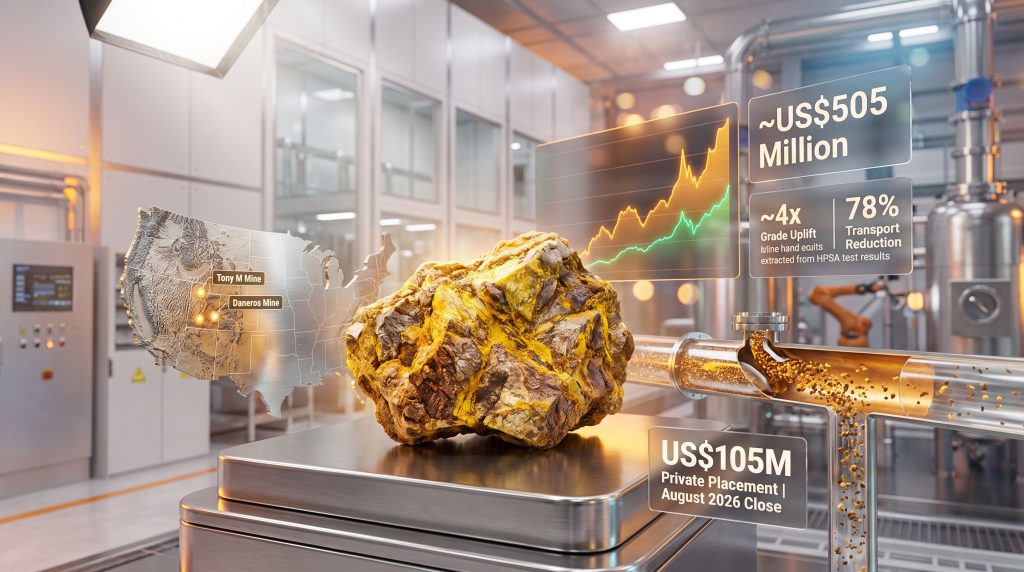
| Implied pro forma equity value | ~US$505 million |
| Expected close | August 2026 |
This structure most closely resembles an asset drop-down into a newly capitalised entity. IsoEnergy exchanges physical properties for equity in a better-funded vehicle, while retaining meaningful economic participation through its approximately 33% fully diluted ownership stake. Unlike a traditional joint venture, DISA Uranium will operate as a standalone company with its own balance sheet, management team, and investor base.
Before the transaction closes, DISA Technologies will spin out its non-uranium and non-vanadium mineral processing operations into a separate entity called DISA Tech Inc., ensuring the new platform is a pure-play uranium and vanadium remediation and recovery business.
How HPSA Technology Restructures Uranium Project Economics
The Mechanics of High-Pressure Slurry Ablation
Most conventional uranium processing involves transporting large volumes of ore from mine to mill, a logistical and cost burden that can make lower-grade deposits economically marginal or entirely unviable. HPSA attacks this problem at the source by concentrating valuable mineral fractions before material ever leaves the mine site. Furthermore, advances in US uranium production technology have made this kind of upstream concentration increasingly viable at commercial scale.
The process works through the following sequence:
- Mineralised material is introduced into a high-velocity slurry stream within the HPSA system.
- The slurry creates rapid particle-on-particle collisions that physically separate valuable mineral grains from surrounding host rock without the use of chemicals.
- Concentrated mineral fractions are isolated into a significantly reduced material volume at or near the mine site.
- Only the concentrated fraction requires downstream transportation and processing, slashing logistics costs.
- The stripped gangue material remains on-site, substantially reducing waste transport volumes.
This upstream concentration approach is not conceptually new in mining, but applying it to uranium ore with the precision required by NRC regulatory standards is technically demanding. The fact that HPSA has now been commercially deployed through eight continuous units operating across four continents indicates the technology has cleared the highest-risk phase of development: the transition from pilot scale to commercial validation.
What the Tony M Test Results Reveal
Test work conducted on mineralised material from IsoEnergy's Tony M mine in Utah produced results that carry meaningful implications for the economics of the broader DISA Uranium asset base:
| Performance Metric | Outcome |
|---|---|
| Grade improvement achieved | ~4x increase in uranium grade |
| Reduction in material requiring transport | 78% |
| Uranium recovery rate | ~88% |
| Commercial deployment scale | 8 continuous units across 4 continents |
Technical Insight: A 78% reduction in transportable material volume combined with a fourfold grade uplift fundamentally changes the cost structure of a uranium operation. Projects that sit below the economic threshold under conventional processing assumptions can cross into viability when upstream concentration is applied. This is particularly significant for Utah's Colorado Plateau uranium deposits, which historically exhibit variable grades and complex mineralogy.
The ~88% uranium recovery rate achieved in HPSA test work is also noteworthy. Uranium recovery losses in conventional milling can be meaningful, and recovering an additional fraction of contained uranium from each tonne of ore processed compounds positively across a multi-mine portfolio.
The Utah Asset Portfolio: Why Permitted Mines Are Scarce and Valuable
Five Properties With Different Stages of Development Maturity
IsoEnergy's contribution to DISA Uranium spans five distinct Utah properties, each at a different point along the development curve:
- Tony M Mine: A permitted, past-producing underground uranium mine where IsoEnergy's team has already reopened underground infrastructure, making it the most operationally advanced asset in the portfolio.
- Daneros Mine: A permitted uranium operation with an established production history on the Colorado Plateau, providing immediate optionality for resumption.
- Rim Mine: Part of the permitted Utah cluster, contributing additional permitted extraction capacity to the combined entity.
- Sage Plain Project: A development-stage uranium project within the same regional geology, offering pipeline inventory.
- Flatiron Project: An exploration and development asset providing longer-dated exploration upside within the portfolio.
In today's regulatory environment, the word permitted carries enormous weight. Obtaining new uranium mining permits in the United States involves multi-year environmental review processes, engagement with multiple federal and state agencies, and, in some cases, community consultation requirements that can extend timelines unpredictably. Permitted, past-producing assets bypass much of that risk, making them disproportionately valuable relative to greenfield exploration properties.
IsoEnergy's Utah operations team will transfer to DISA Uranium upon transaction close, preserving institutional knowledge accumulated through the process of maintaining permits in good standing, completing underground development at Tony M, and advancing the broader portfolio.
The Investor Syndicate: Reading the $105 Million Signal
A Roster That Spans Mining, Energy, and Climate Capital
The composition of the US$105 million private placement investor group is arguably as informative as the dollar figure itself. The syndicate brings together capital from meaningfully different parts of the investment universe:
| Investor | Strategic Relevance |
|---|---|
| Tembo Capital | Specialist mining-focused private equity with deep resource sector expertise |
| BHP Ventures | Strategic corporate venture arm of diversified global mining major BHP |
| Galvanize Climate Solutions | Climate-focused investment platform backing low-carbon energy technologies |
| Valor Equity Partners | Growth equity investor with industrial and energy sector exposure |
| Evok Innovations | Clean energy and industrial innovation fund |
| Halliburton Labs | Energy technology incubator backed by oilfield services giant Halliburton |
| Veriten | Energy transition research and investment platform |
BHP Ventures' participation warrants particular attention. BHP is one of the world's largest diversified mining companies, and its venture arm participates selectively in transactions that align with the parent company's long-term strategic positioning. The presence of BHP Ventures alongside climate-focused investors like Galvanize signals that uranium's narrative within the energy transition has shifted considerably.
Nuclear power is increasingly being evaluated by institutional capital not as a legacy technology, but as a reliable, low-carbon baseload complement to intermittent renewable energy sources. In addition, broader uranium market dynamics have reinforced institutional appetite for platforms with genuine supply-side differentiation.
IsoEnergy's own decision to co-invest US$33 million of the US$105 million raise is a meaningful signal of internal conviction. When a company contributes assets to a new vehicle and then writes a significant cheque to participate in that vehicle's financing, the market typically interprets it as a strong endorsement of the combined entity's prospects.
The next major ASX story will hit our subscribers first
The NRC Licence: A Regulatory Moat With No Equivalent
Why This Licence Cannot Be Easily Replicated
DISA Technologies holds what is described as the only NRC source material licence in the United States authorising uranium recovery from legacy mine waste across multiple sites simultaneously. This is not a technicality. It is a structural barrier to entry that took years to construct and cannot be replicated quickly.
Regulatory Reality: The NRC licencing process for uranium recovery operations involves detailed environmental assessments, radiological safety reviews, operational plan submissions, and an extended agency review period. A competitor seeking to establish a comparable multi-site remediation and recovery operation would face a minimum of several years of regulatory engagement before receiving comparable authorisation, assuming approval was granted at all.
The licence also enables a business model that is genuinely dual-purpose. By recovering uranium and vanadium from abandoned mine waste, DISA Uranium simultaneously addresses an environmental remediation liability and generates a commercial feedstock stream. This dual-revenue dynamic, combining remediation service economics with uranium sales economics, is uncommon in the sector and provides a degree of revenue diversification that conventional uranium miners cannot access.
Vanadium, often co-located with uranium in Colorado Plateau deposits, adds a secondary commodity revenue layer. Vanadium's primary modern market is in large-scale vanadium redox flow batteries, a grid storage technology that is gaining traction as utilities seek long-duration storage solutions for renewable energy integration.
The Long-Term Vision: Could DISA Build the First New U.S. Uranium Mill in 40 Years?
An Infrastructure Gap That Has Compounded Over Decades
The absence of new conventional uranium milling capacity in the United States for more than four decades is not simply a historical footnote. It represents a structural vulnerability in the domestic nuclear fuel supply chain. Uranium ore and concentrate from U.S. mines must currently be processed through a very limited number of operating facilities, creating concentration risk and logistical constraints that limit how quickly domestic production can be scaled.
DISA Uranium's stated long-term ambition is to develop a centralised uranium recycling and processing facility that would serve both its conventional mine production and its legacy waste recovery feedstock. If realised, this would be the first new conventional uranium mill commissioned in the United States in over four decades, an infrastructure milestone with implications well beyond the company's own balance sheet.
The combined feedstock base that DISA Uranium could theoretically aggregate, spanning multiple permitted mines plus recovered material from thousands of legacy waste sites, creates the volumetric rationale for a centralised processing facility that a single mine operator could never justify independently. Scale aggregation is the economic logic that makes a new mill plausible where it has not previously been viable.
How the DISA Uranium IsoEnergy Deal Fits the Broader Sector in 2026
Contextualising Within Recent Major U.S. Uranium Transactions
| Transaction | Value | Strategic Angle |
|---|---|---|
| IsoEnergy + DISA Technologies forming DISA Uranium Corp. | US$105M raise / ~US$505M implied equity value | Permitted mines + remediation technology + legacy waste recovery |
| Energy Fuels acquisition of VAC | US$1.9B | Rare earth and uranium processing consolidation |
The Energy Fuels and VAC transaction at US$1.9 billion represents one end of the consolidation spectrum, combining scale with processing infrastructure. The DISA Uranium IsoEnergy deal represents a different kind of strategic logic: creating a new platform by fusing underutilised permitted assets with technology that expands the economic universe of recoverable uranium beyond what conventional approaches can access.
Both transactions reflect the same underlying conviction: the United States urgently needs to rebuild domestic uranium supply chain capacity. Consequently, the US uranium production rebound already underway provides a compelling backdrop against which the DISA Uranium platform could scale meaningfully. Companies positioning themselves to fill that gap carry significant strategic value, particularly given the geopolitical context created by the Russian uranium import ban and its structural impact on domestic supply priorities.
Frequently Asked Questions: DISA Uranium IsoEnergy Deal
What is DISA Uranium Corporation?
DISA Uranium Corporation is a newly formed, U.S.-focused uranium company created through a definitive agreement between IsoEnergy Ltd. and DISA Technologies Inc. The entity combines IsoEnergy's portfolio of five permitted Utah uranium mines with DISA Technologies' patented HPSA processing technology and its NRC-licenced uranium recovery operations targeting legacy mine waste sites across the western United States.
How much is DISA Uranium worth?
Based on the US$105 million private placement financing commitments secured at formation, DISA Uranium Corporation carries an implied pro forma fully diluted equity value of approximately US$505 million.
What is HPSA technology?
High-pressure slurry ablation is a patented mineral processing technology that uses high-velocity slurry streams to generate particle-on-particle collisions, physically liberating valuable minerals from host material without the use of chemical reagents. Test work at IsoEnergy's Tony M mine achieved approximately a fourfold uranium grade increase, an 88% recovery rate, and a 78% reduction in material requiring downstream transportation.
What ownership stake will IsoEnergy hold in DISA Uranium?
Following transaction close and associated financing, IsoEnergy is expected to hold approximately 33% of DISA Uranium on a fully diluted basis, making it the company's largest single shareholder.
When is the deal expected to close?
The transaction is expected to close in August 2026, subject to completion of the DISA Tech Inc. spinout, regulatory approvals, and other standard closing conditions.
Key Takeaways
- A US$505 million implied equity value uranium platform has been formed by combining permitted Utah mines with patented processing technology and a unique NRC remediation licence.
- HPSA technology demonstrated a ~4x grade uplift, 88% uranium recovery, and a 78% reduction in transport material in real-world test conditions at Tony M.
- More than 15,000 legacy mine waste sites across the American West represent a largely untapped uranium feedstock inventory that DISA Uranium is uniquely licenced to access.
- A blue-chip investor syndicate including BHP Ventures validates the platform's strategic and commercial credibility across both mining and energy transition capital.
- The deal positions DISA Uranium as a potential builder of the first new conventional U.S. uranium mill in more than four decades, a prospect that carries implications for the entire domestic nuclear fuel supply chain.
- Vanadium co-recovery from legacy waste sites adds a secondary commodity revenue stream linked to growing grid-scale battery storage demand.
Disclaimer: This article is intended for informational purposes only and does not constitute financial advice or an investment recommendation. The DISA Uranium IsoEnergy deal involves forward-looking statements subject to risks, uncertainties, and regulatory approvals that may cause actual outcomes to differ materially from those described. Readers should conduct their own due diligence and consult a qualified financial adviser before making any investment decisions. All financial figures and timelines referenced are sourced from publicly available company announcements and may be subject to change.
Want to Stay Ahead of the Next Major Uranium Discovery on the ASX?
Discovery Alert's proprietary Discovery IQ model scans ASX announcements in real time, instantly identifying significant mineral discoveries — including uranium — and delivering actionable insights directly to subscribers before the broader market has a chance to react. Explore how historic discoveries have generated substantial returns on Discovery Alert's dedicated discoveries page, and begin your 14-day free trial today to position yourself ahead of the market.