August 6, 2026
The Conviction Economics of Uranium: Why the Smartest Mining Capital Is Repositioning Now
Commodity markets have a rhythm that most investors misread. The loud phases, the speculative peaks, the retail-driven enthusiasm — those are the moments that dominate headlines. But the periods that matter most to sophisticated capital allocators are quieter: the years when credentialed operators, people who have actually built commodity businesses from the ground up, begin quietly repositioning into sectors that the broader market still treats with scepticism. Neal Froneman uranium and nuclear bull positioning represents exactly this kind of quiet, conviction-driven signal.
The structural case for nuclear energy has been building for years, shaped by the compounding pressure of decarbonisation targets that intermittent renewables alone cannot satisfy, ageing grid infrastructure, and the geopolitical reconfiguration of energy supply chains following Russia's 2022 invasion of Ukraine. What has changed in 2026 is not the thesis itself, but the quality of the people now acting on it with real capital and reputational commitment.
Among the most significant signals of this shift is the strategic repositioning of Neal Froneman, one of the most accomplished mining executives of the past three decades, into uranium-focused platforms at the frontier of supply innovation. Understanding why he is making these moves, and what they reveal about the uranium and nuclear investment landscape, requires examining both the man's track record and the structural dynamics of the fuel cycle itself.
When big ASX news breaks, our subscribers know first
Three Decades of Capital Allocation: Who Is Neal Froneman?
Neal Froneman's career spans more than 30 years across some of the most complex and capital-intensive segments of the global mining industry. His tenure as chief executive of Sibanye-Stillwater transformed a gold-focused South African mining company into a diversified precious and platinum group metals producer, executing a series of acquisitions that few contemporaries considered executable at the pace and scale he achieved. That track record established Froneman as one of the most aggressive and ultimately vindicated capital allocators in modern mining history.
What is less widely discussed outside specialist mining circles is that Froneman's exposure to uranium predates his Sibanye years entirely. Before the 2008 commodity downturn, he was instrumental in building Uranium One, which grew to become one of the world's largest uranium producers. That experience gave him direct operational knowledge of uranium mine development, fuel cycle economics, and the brutal dynamics of a commodity market that can turn sharply on geopolitical events.
When uranium prices collapsed in the post-2007 correction, Froneman witnessed firsthand how quickly sentiment can overwhelm fundamentals, and how long recoveries can take to materialise. This background is not incidental to his current uranium positioning. It is central to it. Executives who have built, managed, and wound down uranium assets across multiple price cycles carry a fundamentally different quality of conviction than those whose bullishness is formed in bull markets alone.
When a mining executive with a verifiable history of building billion-dollar commodity businesses deploys capital and reputational credibility into a sector, it functions as a form of informed market signalling that sits in a different category from analyst price targets or retail-driven enthusiasm.
How Froneman's Uranium Thesis Has Evolved Across Three Distinct Phases
Understanding Froneman's current positioning requires mapping how his uranium conviction has shifted over time — not as a story of changing direction, but as a study in thesis refinement under changing capital conditions.
Phase One: Peak Optimism and the Green Metal Framing (2021)
In 2021, Froneman was among the most vocal executive-level uranium bulls in the global mining sector. He publicly positioned uranium as a zero-carbon baseload solution and framed it within the ESG narrative that was then dominating institutional capital conversations. Under his leadership, Sibanye-Stillwater developed a uranium strategy built around two South African assets: the Beisa uranium project in the Free State province, a development-stage resource, and the Cooke tailings dam, a uranium-bearing tailings deposit with reprocessing potential.
The framing at this stage was deliberately aligned with institutional ESG mandates: uranium as an enabler of the energy transition rather than a Cold War relic. This positioning was strategically astute for attracting capital in an environment where ESG screens were reshaping portfolio construction across major asset managers. Furthermore, considering the nuclear growth investment case at the time, such alignment made considerable commercial sense.
Phase Two: Recalibration Without Abandonment (2024)
By 2024, Froneman's public commentary had moderated noticeably. He acknowledged that nuclear's role in future energy systems would be less dominant than he had initially projected. Sibanye-Stillwater shelved direct uranium asset development and began exploring asset-for-equity swap structures and outright sale arrangements for its uranium resources.
Critically, however, he maintained that the uranium market was not experiencing a speculative bubble. This distinction matters enormously. The moderation was not a reversal of the structural thesis; it was a recalibration of near-term capital efficiency priorities against a balance sheet that had other demands. The long-term conviction remained intact while the corporate vehicle for expressing it was adjusted.
Phase Three: Platform Building and Strategic Re-Entry (2026)
In 2026, Froneman made two appointments that signal a deliberate return to active uranium positioning. He accepted the chairmanship of SuperCritical Materials, a company developing seawater-based uranium extraction infrastructure, and the chairmanship of Neo Energy Metals, a uranium developer focused on South African uranium projects. These are not passive advisory roles. They represent real capital and reputational commitment to early-stage uranium platforms at a moment when the structural demand case is strengthening.
| Phase | Year | Stance | Strategic Action |
|---|---|---|---|
| Peak Optimism | 2021 | Strongly bullish | Uranium framed as green metal; Sibanye uranium strategy launched around Beisa and Cooke assets |
| Recalibration | 2024 | Cautiously bullish | Direct development shelved; deal-driven monetisation structures explored |
| Platform Re-Entry | 2026 | Selectively bullish | Chairman of SuperCritical Materials and Neo Energy Metals |
The pattern across these three phases is instructive. Rather than cycling between bull and bear positioning based on short-term price signals, Froneman has progressively refined his approach to uranium exposure, moving from corporate-level strategy to targeted, early-stage platform building in companies addressing the supply innovation bottleneck.
The Structural Bull Case for Neal Froneman's Uranium and Nuclear Conviction
The Supply-Demand Imbalance That Persists Beneath the Headlines
The fundamental tension in uranium markets is well understood within the sector but consistently underappreciated by generalist investors. Global uranium mine production has run below reactor consumption requirements for an extended period, with the gap historically bridged by drawdowns of legacy Cold War-era stockpiles accumulated during decades of military disarmament. That inventory buffer is now structurally depleted, meaning the market must increasingly rely on active mine production to satisfy reactor fuel demand.
The challenge is that uranium mine development operates on timelines that make oil or gold project lead times look short. From initial resource definition to first production, a uranium mine typically requires 10 to 15 years of permitting, engineering, and construction. This creates a structural asymmetry between demand responsiveness and supply elasticity. Consequently, the uranium market deficit underpins the long-term bull case in ways that near-term price movements alone do not capture.
Small Modular Reactors: The Demand Variable That Changes the Equation
The conventional uranium demand model is built around the existing fleet of approximately 440 operating reactors globally, with incremental additions from large-scale conventional nuclear plant construction programmes, primarily in China, India, and South Korea. However, the variable that most significantly changes the long-term demand trajectory is the commercialisation of small modular reactors, or SMRs.
SMRs represent a fundamentally different nuclear deployment model:
- Generating capacity typically below 300 megawatts per unit, compared to 1,000 to 1,600 megawatts for conventional large-scale plants
- Factory-manufactured modular components, reducing on-site construction complexity and cost escalation risk
- Deployment timelines estimated at 3 to 7 years, compared to 10 to 20 years for conventional nuclear construction
- Scalable to industrial, remote, and data centre energy applications where large-scale nuclear is economically unsuitable
- Active regulatory review programmes underway in the United States, United Kingdom, Canada, and South Korea
The significance of SMRs for uranium demand is not simply additive to the existing reactor fleet. If SMR deployment reaches commercial scale within the next decade, it would represent a step-change increase in uranium consumption that existing supply projections do not fully account for. This is precisely the type of demand catalyst that experienced commodity investors, those who understand the 10 to 15-year mine development lag, position for years in advance.
The Policy Dimension: What COP28 and Western Supply Chain Diversification Mean for Uranium
The 2023 COP28 climate conference produced an unprecedented commitment: a declaration signed by 22 nations pledging to triple global nuclear capacity by 2050. This is not a binding legal instrument, but it represents the most significant multilateral policy endorsement of nuclear energy in decades and is reshaping capital allocation and regulatory priorities across multiple jurisdictions.
Simultaneously, the geopolitical reconfiguration of uranium supply chains following Russia's isolation from Western energy markets has created structural urgency around non-Russian uranium enrichment capacity. The Russian uranium import ban, formalised in 2024, accelerated demand for uranium from Western-aligned producers and created a premium for supply chains that sit outside Russian influence. For uranium producers with assets in politically stable jurisdictions, this geopolitical tailwind represents a durable structural advantage.
Why is uranium considered critical for the energy transition? Unlike solar and wind generation, nuclear power produces electricity continuously regardless of weather or season. This baseload characteristic makes it essential for grid stability as fossil fuel capacity is retired, particularly during the transition period before battery storage technology reaches the scale required to fully backstop intermittent renewables.
SuperCritical Materials: The Technological Frontier of Uranium Supply
Seawater Uranium Extraction: From Laboratory Curiosity to Commercial Candidate
SuperCritical Materials is developing infrastructure to extract uranium dissolved in seawater, a concept that has been studied since the 1960s but has historically been dismissed as commercially unviable due to the extremely low concentration of uranium in ocean water, approximately 3.3 parts per billion by weight.
What has changed is the materials science underpinning the extraction process. Advances in polymer-based adsorbents, specifically amidoxime-functionalised fibres and braided polymer systems designed for marine deployment, have dramatically improved extraction efficiency and reduced the cost per kilogram of recovered uranium. Research programmes at institutions including Oak Ridge National Laboratory in the United States have demonstrated that the technical barriers to seawater uranium extraction are progressively being reduced, though commercial viability at scale remains a subject of ongoing development.
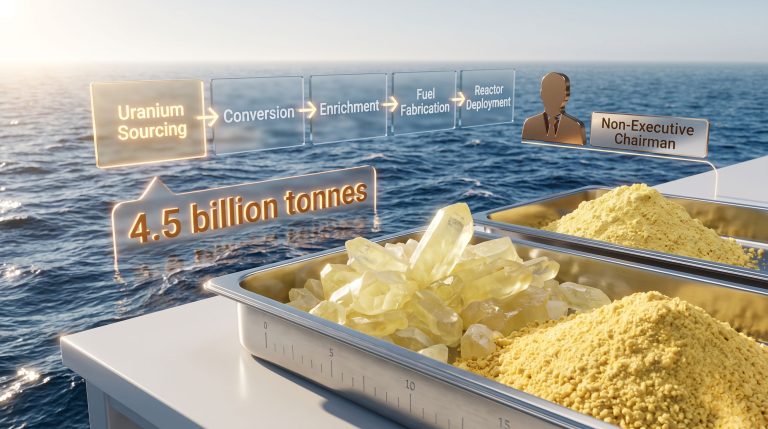
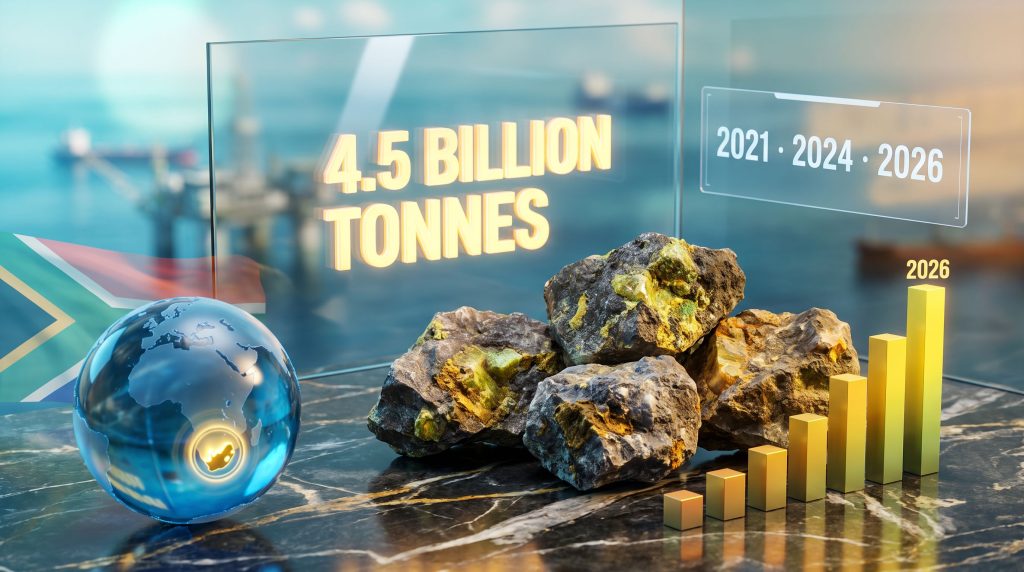
The scale of the resource is the aspect of this technology that most dramatically reframes conventional thinking about uranium supply security. The world's oceans are estimated to contain approximately 4.5 billion tonnes of dissolved uranium, a figure roughly 1,000 times the known terrestrial uranium reserves. This resource is geographically unlimited, politically neutral, and not subject to the geological concentration constraints that make conventional uranium mining dependent on a small number of high-grade deposits in a limited number of jurisdictions.
Why Froneman's Involvement Carries Institutional Weight
For a technology that has spent decades on the margins of commercial feasibility, Froneman's appointment as chairman of SuperCritical Materials is a significant credibility event. His track record building Uranium One into a major uranium producer demonstrates that he understands what it takes to scale unconventional uranium assets from early-stage development through to commercial production.
His involvement also signals to institutional investors that the SuperCritical platform is being built with a serious understanding of the uranium fuel cycle's commercial requirements, not simply as a technology demonstration project. In addition, his reputational endorsement is the kind of signal that sophisticated investors in the uranium supply-demand volatility space watch closely.
Neo Energy Metals and the South African Uranium Renaissance
An Underappreciated Resource Endowment
South Africa's uranium endowment is one of the most structurally interesting and least discussed aspects of the global uranium supply picture. The Witwatersrand Basin, the geological formation responsible for South Africa's extraordinary gold production history, contains significant uranium mineralisation that was historically extracted as a by-product of gold processing.
During the peak years of South African gold mining, the country was one of the world's major uranium producers. As gold mine closures accelerated from the 1980s onward, driven by declining ore grades and rising production costs, uranium production collapsed with them. The result is a substantial uranium resource base that has been largely dormant for decades. However, the combination of materially higher uranium prices and improved processing economics has revived interest in these assets as primary uranium development targets. Furthermore, the uranium supply-demand volatility of recent years has made these formerly overlooked South African assets considerably more attractive to capital allocators.
Froneman's Structural Advantage at Neo Energy Metals
Froneman's chairmanship of Neo Energy Metals brings a specific set of advantages that go beyond general mining credibility. His career has been built almost entirely within the South African mining sector. He has established relationships with South African mining regulators, community stakeholders, and capital markets participants that represent a meaningful operational advantage for a uranium developer navigating the country's permitting environment.
His prior experience at Sibanye-Stillwater, which itself developed uranium assets including the Beisa project in South Africa's Free State, means he has direct familiarity with the specific geological, regulatory, and community engagement challenges that South African uranium development entails.
The next major ASX story will hit our subscribers first
The Counterarguments: What Could Derail the Nuclear Renaissance
A credible analysis of the uranium bull case must engage seriously with the bearish scenarios. Several structural risks are capable of materially disrupting the timeline and magnitude of the nuclear renaissance that the supply-demand data appears to support.
| Risk Factor | Nature of Risk | Assessment |
|---|---|---|
| Capital cost escalation | Large nuclear projects have severely overrun budgets (Hinkley Point C, Vogtle Units 3 and 4) | Structural risk for conventional nuclear; less applicable to SMR model |
| Regulatory complexity | Nuclear project approvals remain the most complex in the energy sector | Jurisdiction-specific; improving in some markets |
| SMR commercialisation delay | Most designs remain in regulatory review or early construction | 5 to 10-year commercial deployment timeline widely accepted |
| Renewable cost deflation | Continued solar and battery cost reductions may reduce nuclear urgency in some markets | Most acute in markets with high solar irradiance and flexible demand |
| Geopolitical risk | Uranium supply concentration in Kazakhstan and Canada creates concentration risk | Partially mitigated by diversification of new project pipeline |
Froneman's own 2024 recalibration, acknowledging that nuclear's role would be less dominant than initially projected, reflects an intellectually honest engagement with these risks. The moderation of his near-term enthusiasm did not constitute abandonment of the structural thesis. It represented a sophisticated operator adjusting the capital efficiency dimension of his uranium exposure while preserving the long-duration conviction.
This distinction between thesis abandonment and thesis refinement is one that generalist investors frequently misread. A commodity veteran who moderates near-term projections while deepening structural exposure is often making a more informed long-term bet than one whose conviction remains undimmed through every market phase.
How to Read Executive Capital Signals in the Uranium Sector
The Difference Between Commentary and Commitment
The uranium market has no shortage of commentators, analysts, and fund managers willing to articulate a bull case in investor presentations and industry conferences. What it has far fewer of is experienced mining operators willing to put their own reputations and capital to work building the supply infrastructure that a genuine nuclear renaissance would require.
Froneman's dual chairmanships in 2026 sit firmly in the commitment category. Chairing two early-stage uranium companies simultaneously is not a passive endorsement. It involves governance responsibility, strategic direction-setting, and direct engagement with the financing and operational challenges of bringing uranium assets to production. The reputational exposure alone makes this a qualitatively different signal than a bullish interview or an increased allocation to uranium equities.
Tactical Versus Structural Uranium Exposure
For investors seeking to understand the uranium landscape, there is a meaningful distinction between two types of exposure. Exploring uranium investment strategies in detail reveals this divergence clearly:
- Tactical exposure involves riding uranium spot price movements through equities, exchange-traded funds, or physical uranium investment vehicles. This approach captures near-term price volatility but does not necessarily benefit from the long-duration structural demand thesis.
- Structural exposure involves owning or building the actual supply infrastructure that a uranium demand step-change would require, including mines, processing facilities, and novel extraction technologies. This is the approach Froneman has consistently adopted across his career.
Key Metrics for Monitoring Uranium Market Development
| Indicator | Relevance | Why It Matters |
|---|---|---|
| Uranium spot price (U3O8) | Near-term market sentiment benchmark | Drives project financing economics and equity valuations |
| Global reactor construction pipeline | Approximately 60 reactors under construction globally as of 2024 | Underpins medium-term demand growth |
| SMR regulatory approvals | Multiple designs in NRC and ONR review | Determines timeline for demand step-change |
| Western enrichment capacity expansion | Accelerating post-Russian import restrictions | Critical for supply chain security pricing |
| Seawater extraction cost curve | Declining with polymer adsorbent advances | Sets long-term supply ceiling for uranium pricing |
Disclaimer: This article contains forward-looking statements and thematic analysis that involve inherent uncertainty. Uranium markets are subject to significant price volatility, regulatory change, and technological risk. Nothing in this article constitutes financial or investment advice. Readers should conduct their own due diligence and seek independent professional advice before making any investment decisions.
Frequently Asked Questions
What Is Neal Froneman's Background in Uranium?
Froneman's uranium experience spans multiple phases of his career. He was involved in building Uranium One prior to the 2008 commodity downturn, developed a South African uranium strategy at Sibanye-Stillwater centred on the Beisa project and Cooke tailings dam, and in 2026 became chairman of both SuperCritical Materials and Neo Energy Metals. His uranium credentials are grounded in operational and commercial experience rather than financial analysis alone.
Why Did Sibanye-Stillwater Not Proceed with Direct Uranium Development?
By 2024, Sibanye-Stillwater had shifted its capital allocation priorities, exploring asset-for-equity structures and sale options for its uranium resources rather than direct development. This decision reflected balance sheet management considerations and near-term capital efficiency priorities rather than a rejection of the long-term uranium thesis.
What Makes Seawater Uranium Extraction Potentially Transformative?
The oceans contain an estimated 4.5 billion tonnes of dissolved uranium, roughly 1,000 times known terrestrial reserves. Recent advances in amidoxime-based polymer adsorbents have improved extraction efficiency significantly. While commercial viability at scale is still being established, the technology could fundamentally change uranium supply security by offering a geographically unlimited, politically neutral resource base.
How Do Small Modular Reactors Affect Uranium Demand Projections?
SMRs are designed for factory manufacture and rapid deployment, with generating capacity typically below 300 megawatts per unit. If deployed at commercial scale within the next decade, they would represent a step-change increase in uranium demand beyond the existing reactor fleet — a demand signal that experienced commodity investors position for well in advance given the 10 to 15-year mine development lag in uranium supply responses.
From Corporate Strategy to Platform Architecture: The Long Game
The arc of Neal Froneman's uranium journey — from Uranium One through Sibanye-Stillwater to SuperCritical Materials and Neo Energy Metals — is not a story of inconsistency. It is a case study in how experienced commodity operators refine their thesis expression across changing market conditions without abandoning the underlying structural conviction. This evolution is precisely what makes the Neal Froneman uranium and nuclear bull narrative so compelling to informed observers.
The transition from corporate-level uranium strategy to targeted early-stage chairmanships reflects a sophisticated reading of where value creation is most likely to occur in the next phase of the uranium cycle. Corporate mining companies are constrained by balance sheet pressures, shareholder expectations, and diversified capital priorities. Early-stage platforms, built around specific technological innovations or underdeveloped resource bases, can move faster, take more focused risks, and capture disproportionate value if the structural thesis plays out.
For the broader uranium and nuclear investment landscape, the re-entry of credentialed mining executives into early-stage uranium platforms in 2026 is a qualitative signal that complements the quantitative supply-demand data. The nuclear renaissance, if it materialises at the pace suggested by policy commitments and SMR development timelines, will require uranium supply innovation at a scale that conventional mining alone cannot deliver. The infrastructure to serve that future needs to be built now, and the people building it are worth watching carefully.
Want to Track the Next Major Mineral Discovery Before the Broader Market Does?
Discovery Alert's proprietary Discovery IQ model scans ASX announcements in real time, instantly converting complex mineral data across more than 30 commodities into clear, actionable insights — giving subscribers a genuine edge in identifying high-potential opportunities the moment they emerge. Explore historic examples of major discovery returns and begin your 14-day free trial today to position yourself ahead of the market.