August 9, 2026
The Uranium Supply Equation Driving India's Most Ambitious Energy Programme
Few energy transitions in the modern era match the sheer structural complexity of what India is attempting with nuclear power. Unlike the relatively straightforward deployment curves associated with solar or wind capacity, scaling a nuclear fleet requires resolving a fuel security equation years, sometimes decades, in advance. India's uranium requirement for nuclear power expansion is not an energy input that can be procured on short notice or substituted in a crisis. For a country with India's appetite for power and its particular reactor architecture, the uranium supply question is not peripheral to the 100 GW nuclear ambition. It is foundational to whether that ambition survives contact with reality.
Understanding why this matters requires looking beyond capacity megawatt targets and into the physical and geopolitical mechanics of how India's reactors actually get fuelled. Furthermore, the uranium supply and demand dynamics shaping global markets will directly influence how quickly India can secure the volumes it needs.
When big ASX news breaks, our subscribers know first
India's Nuclear Expansion: The Capacity Numbers Behind the Ambition
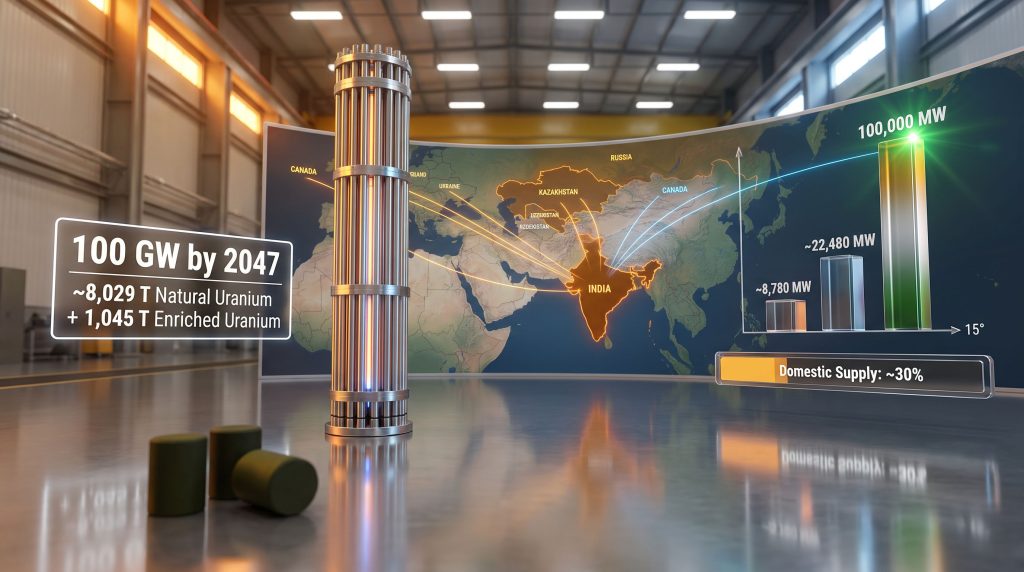
India's government has established a target of 100 GW of installed nuclear capacity by 2047, placing it among the most aggressive nuclear expansion programmes globally. To appreciate the scale of this undertaking, consider the baseline: the Nuclear Power Corporation of India Limited (NPCIL) currently operates 25 reactors with a combined installed capacity of 8,780 MW. A further 17 reactors totalling 13,100 MW are at various stages of construction or advanced execution.
The near-term milestone is itself striking. India is targeting a capacity increase from approximately 8,180 MW to 22,480 MW by 2031-32, which represents a near-tripling of output within a single decade. NPCIL is expected to account for roughly half of the 100 GW target, with the remainder derived from private sector and international joint venture contributions over the longer term.
This trajectory creates a uranium demand profile that scales steeply and rapidly, leaving very little margin for supply chain errors.
Why India's Reactor Architecture Creates a Unique Uranium Dependency
A detail that is frequently overlooked in broad discussions of India's nuclear ambitions is the specific reactor technology at the programme's core. India's fleet is anchored by Pressurised Heavy Water Reactors (PHWRs), a design choice with profound fuel implications. Unlike the light water reactors that dominate nuclear fleets in the United States, France, and most of East Asia, PHWRs operate on natural uranium rather than enriched uranium.
This distinction matters enormously from a supply chain perspective. Enriched uranium requires access to complex enrichment infrastructure, but the input commodity is traded through a relatively liquid global market. Natural uranium oxide, or U₃O₈, is the direct fuel input for PHWRs with no enrichment intermediary, meaning India's PHWR fleet is directly and continuously exposed to raw uranium supply conditions.
The Parliamentary Committee on Public Undertakings, in its formal review of NPCIL's performance, confirmed that the planned PHWR expansion alone is projected to require approximately 5,400 tonnes of uranium oxide (U₃O₈) per annum. Scaling further toward the full 100 GW target by 2047 pushes total annual uranium requirements to an estimated 8,029 tonnes of natural uranium plus 1,045 tonnes of enriched uranium (the latter reflecting the growing share of light water reactor designs in the expanded fleet).
Against those numbers, domestic production currently satisfies only around 30% of the projected PHWR annual fuel baseline. The remaining 70% must be sourced internationally, creating a structural import dependency that is both a fuel cost vulnerability and a geopolitical exposure. Consequently, understanding broader uranium market dynamics becomes essential for anticipating how India will manage this gap over time.
Mapping India's Domestic Uranium Resource Base
The Atomic Minerals Directorate for Exploration and Research (AMD) has mapped a total uranium oxide resource base of approximately 4.31 lakh tonnes (431,000 tonnes) across India's geological terrain. On the surface, this appears substantial. The complexity emerges when you examine how much of that resource has already moved through the production pipeline.
| Metric | Figure |
|---|---|
| Total uranium oxide resources established by AMD | ~4.31 lakh tonnes (431,000 tonnes) |
| Reserves transferred to UCIL for extraction | ~80,423 tonnes |
| Proportion of transferred reserves already depleted | ~39.22% |
| Estimated remaining reserve life at current production rates | ~40 years |
| Domestic supply coverage of projected PHWR annual demand | ~30% |
Of the reserves formally transferred to the Uranium Corporation of India Limited (UCIL) for operational mining, nearly 40% has already been extracted. At current production rates, the remaining accessible reserves are estimated to sustain approximately 40 years of output. However, this figure carries a critical hidden assumption: it is calculated at current production rates, not at the accelerated extraction rates that a 100 GW nuclear fleet would demand.
If UCIL executes on its commitment to double domestic uranium production and reactor capacity scales as planned, the effective reserve life of currently identified resources could compress significantly. New exploration activity and resource definition work will be essential to maintaining uranium self-sufficiency beyond the 2040s. In addition, a broader review of global uranium reserves reveals just how concentrated and constrained accessible high-grade resources remain worldwide.
UCIL's primary operational mining infrastructure is concentrated in Jharkhand, which houses India's most established uranium mining facilities. Expansion plans are targeting new projects across Rajasthan and Chhattisgarh, with the stated objective of doubling national uranium output through a combination of capacity expansions at existing mines and greenfield project development.
The Nuclear Fuel Complex serves as the downstream processing link, manufacturing fuel assemblies for PHWRs using uranium concentrate sourced from UCIL or supplemented through government-managed import arrangements.
India's Uranium Import Portfolio: Partners, Risks, and a Looming Contract Gap
India's approach to import diversification reflects a deliberate strategy of spreading supply risk across multiple geographies and political relationships. The current import portfolio spans four countries, each carrying its own risk profile.
| Supplier Country | Supply Status | Risk Profile |
|---|---|---|
| Kazakhstan | Active supplier | Moderate – landlocked, complex transit logistics |
| Russia | Active supplier | Elevated – evolving international sanctions environment |
| Uzbekistan | Active supplier | Elevated – contract valid only to 2026, renewal urgency |
| Canada | Active supplier | Low – stable, treaty-aligned relationship |
The most immediate pressure point is the Uzbekistan supply agreement, which carries validity only through 2026. Uzbekistan has emerged as a meaningful uranium producer in recent years, but the contract renewal process will require India to navigate a geopolitically complex Central Asian environment where multiple competing interests intersect.
The concentration of supply from Russia and Central Asian states introduces a layer of geopolitical risk that extends beyond simple commercial negotiation. International sanctions frameworks, regional transit route vulnerabilities, and the broader evolution of great power competition in Central Asia all have potential to disrupt supply lines that India currently depends upon. For instance, Kazakhstan uranium production alone accounts for a significant share of global output, making any disruption there consequential for India's programme.
India's uranium import dependency is not merely a procurement challenge. It is a geopolitical risk exposure that requires active management at the diplomatic level, not just the commercial level.
The absence of a formalised strategic uranium stockpile compounds this vulnerability. Unlike France, the United States, and Japan, all of which maintain uranium reserves calibrated to months or years of forward fuel requirements, India currently lacks a formally legislated buffer against supply disruptions. The Parliamentary Committee has explicitly identified this gap and recommended establishing stockpiles aligned to reactor refuelling cycles and planned outage schedules.
The Three-Pillar Strategy India Is Building to Close the Gap
India's response to its uranium supply challenge is taking shape across three interconnected strategic initiatives, each at different stages of development.
1. Doubling Domestic Production Through UCIL Expansion
UCIL has committed to doubling domestic uranium output by expanding mine capacity in Jharkhand and advancing new mining projects in Rajasthan and Chhattisgarh. The Department of Atomic Energy has formally endorsed this expansion pathway, though the Parliamentary Committee has pressed for specific timelines and binding implementation milestones.
The Parliamentary Committee has also recommended developing a Mine Developer-cum-Operator (MDO) framework for uranium production, a model successfully deployed in India's coal sector to accelerate output through private sector operational expertise. MDO participation could unlock capital, technology, and efficiency improvements in uranium mining without requiring full privatisation of a strategically sensitive national resource.
2. The UCIL-NTPC Joint Venture for Overseas Equity Acquisition
A proposed joint venture between UCIL and NTPC to acquire equity stakes in overseas uranium mining assets represents the most structurally transformative element of India's fuel security strategy. The strategic logic is compelling: equity ownership in foreign uranium mines locks in supply at cost-of-production economics rather than spot-market or contract prices, insulating India's fuel cost base from global uranium price volatility.
This model has strong precedents. Japan, South Korea, and China have all pursued equity ownership in foreign uranium mines as core components of their nuclear fuel security strategies. China's state-owned nuclear enterprises have systematically acquired uranium assets across Africa, Central Asia, and Canada over the past two decades, creating a vertically integrated supply chain that provides both price stability and supply security.
The Parliamentary Committee formally described the UCIL-NTPC proposal as a constructive step toward stabilising long-term fuel costs. However, the Committee simultaneously demanded specific timelines, a detailed implementation roadmap, and a defined governance framework from the Department of Atomic Energy, signalling that the initiative remains at a pre-execution stage requiring considerable development before it delivers tangible supply security benefits.
3. Establishing Strategic Uranium Reserves
The Parliamentary Committee has recommended that India create strategic uranium stockpiles calibrated to reactor refuelling cycles and outage risk windows. This recommendation mirrors established practices in major nuclear-dependent economies and would provide a critical buffer layer between any external supply disruption and reactor operational continuity. Furthermore, the broader uranium geopolitical supply landscape is shifting rapidly, reinforcing why holding physical reserves matters more than ever.
The next major ASX story will hit our subscribers first
Comparative Context: How India's Supply Challenge Measures Up Globally
India's uranium self-sufficiency position is not unusual among major nuclear-dependent economies. What distinguishes India is the velocity and scale of its planned expansion.
| Country | Nuclear Capacity Target | Domestic Uranium Coverage | Primary Supply Strategy |
|---|---|---|---|
| India | 100 GW by 2047 | ~30% of projected need | Multi-country imports + equity acquisition |
| China | 150+ GW by 2035 | ~20-25% of need | Equity stakes in African/Central Asian mines |
| South Korea | ~30% of power mix | Minimal domestic supply | Long-term contracts + spot market |
| France | Maintain ~70% nuclear share | Minimal domestic supply | Equity in African mines via Orano |
| USA | Nuclear renaissance underway | ~5% domestic production | Domestic revival + allied nation imports |
India's 30% domestic coverage is broadly consistent with peer nuclear economies. The critical differentiator is that India is targeting a near 12-fold capacity increase from current levels, compressing the timeline within which every element of the uranium supply chain must be scaled, secured, and de-risked simultaneously. The World Nuclear Association provides extensive comparative data on how other nations are managing equivalent fuel security challenges.
Key Milestones and Projected Uranium Requirements
| Milestone Year | Projected Nuclear Capacity | Estimated Annual Uranium Need | Domestic Coverage Trajectory |
|---|---|---|---|
| 2026 (current) | ~8,780 MW | Baseline PHWR fleet demand | ~30% |
| 2031-32 | ~22,480 MW | Approximately 3x baseline | Likely declining as % of total |
| 2047 | 100 GW | ~8,029T natural + 1,045T enriched | Dependent on UCIL expansion success |
The 2031-32 milestone represents the first major stress test for India's uranium requirement for nuclear power expansion. Tripling reactor capacity within a decade requires not just procurement agreements, but operational mines, processing infrastructure, fuel fabrication capacity, and strategic reserves all scaling in lockstep.
The 40-year domestic reserve life estimate is frequently cited as reassuring, but it is calculated at current production rates. A 100 GW nuclear fleet would require extraction rates far exceeding current benchmarks, potentially compressing that timeline dramatically.
What Successful Execution Requires
Closing India's uranium supply gap before 2047 is achievable, but it is not the default outcome. It requires deliberate, funded, time-bound action across multiple fronts simultaneously:
- Accelerate AMD exploration programmes to expand the identified uranium resource base and extend the domestic reserve runway beyond current estimates
- Formalise and fund the MDO framework for private sector participation in domestic uranium mining, drawing on the proven coal sector model
- Execute the UCIL-NTPC joint venture with binding capital commitments and clear overseas acquisition targets, particularly in politically stable jurisdictions such as Canada and Australia
- Diversify the import portfolio toward treaty-aligned, geopolitically stable suppliers to reduce dependence on Central Asian and Russian supply chains
- Legislate and capitalise strategic uranium reserves as a formal component of national energy security infrastructure, calibrated to forward refuelling requirements
The Parliamentary Committee's formal findings provide institutional momentum for these actions. Whether that momentum translates into executed policy within the timeframes that India's uranium requirement for nuclear power expansion demands remains the central question for the country's most ambitious energy security programme. The International Atomic Energy Agency continues to monitor global nuclear fuel supply developments that will directly influence how India navigates this challenge.
This article is based on publicly available information, including findings published by India's Parliamentary Committee on Public Undertakings in its report on NPCIL performance. Projections relating to uranium demand, reserve lifetimes, and capacity targets involve forward-looking estimates subject to change based on policy decisions, geological discoveries, and geopolitical developments. Nothing in this article constitutes investment advice.
Want to Stay Ahead of the Next Major Uranium Discovery?
Discovery Alert's proprietary Discovery IQ model delivers real-time alerts on significant ASX mineral discoveries — instantly transforming complex resource data into actionable investment insights for both short-term traders and long-term investors. Explore why historic mineral discoveries have generated extraordinary returns on Discovery Alert's dedicated discoveries page, and begin your 14-day free trial today to position yourself ahead of the broader market.