August 10, 2026
The Nuclear Fuel Cycle's Two Weakest Links: Why Congress Is Acting on Both Ends at Once
For most of the past three decades, the nuclear energy debate in the United States revolved around reactor design, cost overruns, and public perception. Relatively little legislative attention was paid to the infrastructure that sits at either end of the fuel cycle: the enrichment facilities that produce the fuel going in, and the repository that would permanently store the waste coming out. In August 2026, Congress moved to address both gaps simultaneously, introducing paired pieces of legislation around domestic uranium enrichment and Yucca Mountain bills that together represent the most comprehensive attempt in years to restructure how America manages its nuclear fuel chain from start to finish.
Understanding why this moment matters requires stepping back from the individual bills and examining the structural pressures that made inaction increasingly untenable.
When big ASX news breaks, our subscribers know first
America's Enrichment Deficit: A Vulnerability Decades in the Making
The United States once led the world in uranium enrichment capacity. That position eroded steadily through the post-Cold War era as commercial enrichment was treated as a commodity service rather than a strategic asset. Domestic capacity was allowed to atrophy while cheaper imports from Russia, Western Europe, and eventually elsewhere filled the gap.
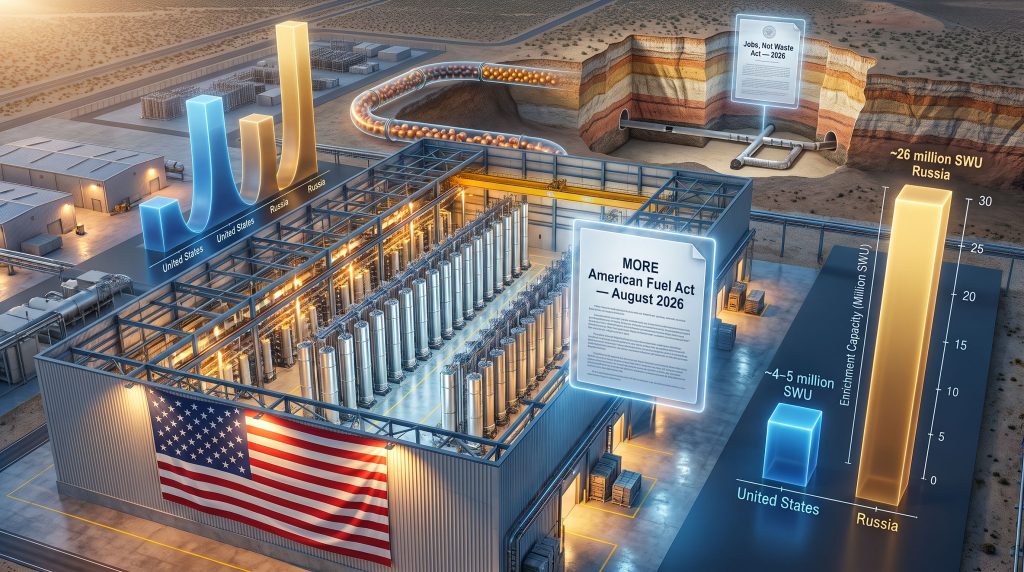
Today, the consequences of that decision are measurable and urgent. The U.S. currently operates somewhere between 4 and 5 million separative work units (SWU) per year of domestic enrichment capacity, a figure that falls well short of what would be needed to independently supply the existing reactor fleet, let alone the wave of new builds currently in various stages of planning and licensing.
The global enrichment landscape looks like this:
| Country / Region | Approx. Enrichment Capacity (SWU/year) | Key Operators | Notable Context |
|---|---|---|---|
| Russia (ROSATOM) | ~26 million SWU | ROSATOM | Dominant global supplier; U.S. ban effective 2028 |
| European Union (URENCO) | ~18 million SWU | URENCO (incl. URENCO USA) | Operates a facility in the U.S. |
| China | Rapidly expanding | CNNC | Domestic-focused; growing export ambitions |
| France | ~10 million SWU | Orano | Major EU supplier |
| United States | ~4-5 million SWU | Centrus, URENCO USA | Significant gap relative to projected demand |
Russia's ROSATOM has historically supplied a substantial portion of low-enriched uranium (LEU) used in American reactors. That arrangement is coming to a hard stop. The Russian uranium import ban is set to take full effect in 2028, a deadline that has crystallised what was previously an abstract policy concern into an immediate operational challenge.
Adding further pressure, China's nuclear buildout has dramatically reshaped global uranium demand. China's installed nuclear capacity grew from 31.4 gigawatts in 2016 to 58.7 GW by mid-2026, an increase of roughly 87 percent over a decade, according to the U.S. Energy Information Administration. That trajectory is accelerating competition for enrichment services and uranium feedstock at the same time the U.S. is trying to reduce its exposure to Russian supply.
The primary existing domestic enrichment operators, Centrus Energy and URENCO USA, are insufficient on their own to close this gap within the timeframe the 2028 deadline demands. That reality is what drove the introduction of the MORE American Fuel Act.
What the MORE American Fuel Act Actually Changes About NRC Licensing
The bill's full name, the Modernizing Outdated Regulations to Expand American Fuel Act, signals its primary intent: removing procedural friction from the Nuclear Regulatory Commission's (NRC) licensing process for uranium enrichment facilities. The existing regulatory framework was designed during a prior era of nuclear development and includes mandatory hearing requirements and sequential licensing steps that critics argue extend timelines without adding proportionate safety value.
The MORE American Fuel Act, introduced in early August 2026 with bipartisan co-sponsorship from Sen. Mark Kelly (D-AZ) and Sen. Cynthia Lummis (R-WY), proposes one structural change in particular that the nuclear industry has long sought: pre-license construction authorization.
What Pre-License Construction Authorization Means in Practice
Under existing rules, construction on an enrichment facility cannot begin until the NRC has issued an operating licence, a process that can span years. The MORE American Fuel Act would allow construction to commence before that licence is issued, subject to specific conditions:
- Applicants must provide advance written notification to state, local, and tribal governments before any construction begins.
- The public retains the right to request hearings on licence applications.
- Mandatory hearings that the bill's sponsors argue serve no practical safety purpose would be eliminated.
- National Environmental Policy Act (NEPA) environmental reviews remain fully required before any uranium enrichment or on-site storage commences.
- The NRC's full review authority over enrichment facility applications is preserved without modification.
The logic is straightforward: site preparation, civil construction, and structural work can proceed in parallel with the licensing review, compressing an otherwise sequential timeline. Environmental safeguards and community notification requirements remain intact as non-negotiable preconditions.
The Clean Air Task Force's advanced nuclear technology and regulation expert, Patrick White, described the pre-licence construction pathway as vital to deploying new nuclear reactors, framing accelerated enrichment infrastructure as a prerequisite for the broader nuclear buildout rather than an optional enhancement.
The Bipartisan Architecture of Energy Security Legislation
The co-sponsorship pairing of Kelly and Lummis is politically instructive. Kelly represents Arizona, a state with significant nuclear power infrastructure and direct dependence on reliable enriched uranium supply. Lummis represents Wyoming, one of the country's leading uranium mining states with substantial economic interest in the expansion of domestic enrichment capacity.
The bill frames enrichment expansion primarily around energy security and job creation, a rhetorical combination that has demonstrated unusual durability across partisan lines. Uranium-producing states like Wyoming have strong economic incentives to support domestic fuel cycle development regardless of party affiliation, which helps explain why nuclear legislation in 2026 has assembled bipartisan coalitions that would have seemed improbable a decade ago.
LEU vs. HALEU: Understanding the Two-Tier Fuel Supply Problem
One dimension of the enrichment debate that often receives insufficient attention is the distinction between two fundamentally different fuel types that the next generation of reactors requires. Furthermore, the uranium supply and demand pressures underpinning this debate continue to intensify globally.
Low-Enriched Uranium (LEU) is enriched to less than 5% U-235 and has powered conventional light-water reactors for decades. It is the fuel type that existing domestic enrichment capacity, however limited, is designed to produce.
High-Assay Low-Enriched Uranium (HALEU) is enriched to between 5% and 20% U-235. It is not a marginal upgrade; it is a categorically different product that most advanced reactor designs cannot operate without. Small modular reactors (SMRs), microreactors, and many Generation IV concepts are specifically engineered around HALEU, which allows for higher energy density, smaller core sizes, and extended fuel cycles that make these reactor designs commercially attractive.
The supply chain problem for HALEU is more acute than for conventional LEU. Currently, the only commercial-scale source of HALEU outside Russia is effectively non-existent in the United States. Congress allocated $2.7 billion toward LEU and HALEU production infrastructure, but that capital deployment requires a permitting and licensing environment capable of translating investment into operational facilities within a competitive timeframe.
This is precisely where the MORE American Fuel Act intersects with the DOE funding commitment. Without licensing reform, funding alone cannot accelerate the construction of enrichment capacity at the pace the 2028 Russian LEU ban deadline requires.
How the MORE American Fuel Act Fits Into the Broader 2026 Legislative Landscape
The MORE American Fuel Act is not the only enrichment-related legislation moving through Congress in 2026. A comparison of the key bills clarifies how each piece fits into the overall policy architecture:
| Bill | Primary Mechanism | Fuel Types Addressed | Key Sponsors | Status |
|---|---|---|---|---|
| MORE American Fuel Act | NRC licensing modernization, pre-license construction | LEU and HALEU | Sen. Kelly (D-AZ), Sen. Lummis (R-WY) | Introduced August 2026 |
| Nuclear Fuel Security Act | DOE program expansion, American Assured Fuel Supply | LEU, HALEU for advanced reactors | Bipartisan | Active |
| Enrichment Licensing Modernization Act (ELMA) | NRC streamlining, fuel supply chain reform | LEU, foreign source reduction | Senate sponsors | 2026 proposal |
Each bill targets a different leverage point in the same systemic problem. The MORE American Fuel Act focuses on regulatory process speed. The Nuclear Fuel Security Act addresses DOE programme infrastructure. ELMA targets the broader licensing framework. Together, they reflect a legislative strategy of attacking enrichment bottlenecks from multiple directions simultaneously. Understanding the broader uranium market dynamics helps contextualise why this multi-pronged approach has gained such urgency.
Yucca Mountain: The Nuclear Waste Problem That Never Found Its Solution
While the front end of the nuclear fuel cycle struggles with enrichment capacity, the back end faces a decades-old impasse that has never been resolved. Yucca Mountain in Nevada was designated by Congress in 2002 as the permanent repository for the United States' high-level radioactive waste. More than two decades later, it has never opened.
The reasons are not primarily technical. Geologically, Yucca Mountain was studied extensively and found to meet the basic criteria for deep geological disposal. The barrier has been political and social: sustained opposition from Nevada's elected officials, tribal communities with longstanding cultural and territorial concerns about the site, and a state government that has consistently refused to accept the federal imposition of a waste repository on its territory.
The result is a legal and regulatory stalemate. Federal investment has been made. NRC licensing proceedings were initiated. Yet the proceeding remains unresolved, and spent nuclear fuel continues to accumulate at reactor sites across the country under interim storage arrangements that were never intended to be permanent solutions.
As of 2026, the United States has tens of thousands of metric tons of spent nuclear fuel sitting in pools and dry casks at more than 70 reactor sites in 35 states, with no clear permanent disposal pathway.
What the Jobs, Not Waste Act Proposes
Introduced by Nevada senators Jacky Rosen and Catherine Cortez Masto, both Democrats, the Jobs, Not Waste Act takes a definitive position on Yucca Mountain's future by proposing its permanent closure. The bill would:
- Terminate Yucca Mountain's statutory designation as the national nuclear waste repository.
- Require the DOE to formally withdraw and terminate the NRC licensing proceeding.
- Mandate environmental reclamation and mitigation of any adverse impacts to the Yucca Mountain site resulting from prior federal activity.
- Direct the Office of Management and Budget to study and report on alternative economic uses for the site, including potential job-creating applications.
The philosophical foundation of the bill is a consent-based framework: the principle that a nuclear waste repository cannot be imposed on a community against its will, regardless of federal designation. This represents a direct departure from the top-down statutory model Congress used in 2002, and it aligns with the approach that the Department of Energy has itself articulated as necessary for any future repository siting process to succeed.
It is worth noting that this is not new legislation in its principles. The same Nevada senators introduced substantially similar bills in 2024. The 2026 version represents a continuation of a consistent, long-standing state policy position rather than a reactive response to any single development.
The Two Competing Philosophies on Nuclear Waste Disposal
The Yucca Mountain debate ultimately frames a broader question about how democratic societies site unwanted but necessary infrastructure. Two clear positions have emerged:
| Policy Position | Representative Legislation | Core Argument | Key Supporters |
|---|---|---|---|
| Proceed with Yucca Mountain | Prior congressional designations (e.g., H.R. 3053) | Site extensively studied, federal investment already made, further delay imposes its own costs | Pro-repository advocates, some nuclear industry stakeholders |
| Permanently close Yucca Mountain | Jobs, Not Waste Act (2026) | Community consent violated, political pathway unworkable, alternative uses more viable | Nevada senators, state government, tribal representatives |
| Consent-based alternative siting | Interim storage plus new framework | Yucca is a political dead end; a new participatory process is needed | Some DOE stakeholders, parts of the nuclear industry |
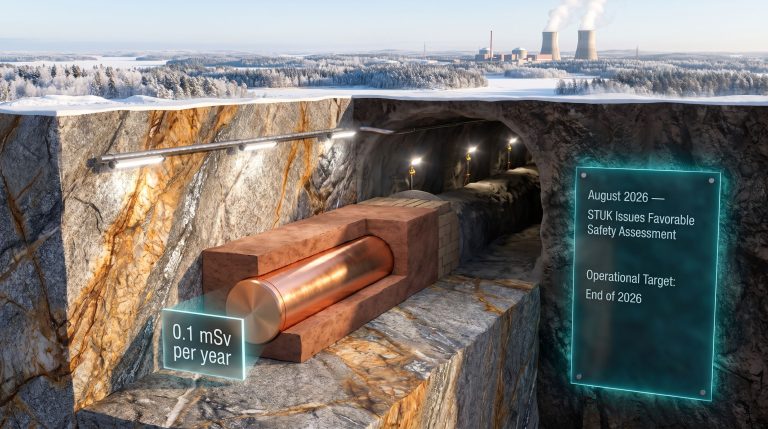
Finland's Onkalo repository offers an instructive international comparison. Onkalo is currently the world's only operational deep geological repository for spent nuclear fuel, having passed its most recent safety assessment in August 2026. Its development succeeded in part because of an extended, community-engaged process in which local populations were genuine participants in the siting decision rather than recipients of a federal mandate. That model is precisely what the Jobs, Not Waste Act's consent-based framework is gesturing toward for any future U.S. repository development. Consequently, the uranium supply challenges posed by inadequate waste management infrastructure remain a persistent concern for the industry.
The next major ASX story will hit our subscribers first
What These Two Bills Mean for the Nuclear Energy Buildout
The simultaneous introduction of the MORE American Fuel Act and the Jobs, Not Waste Act in the same legislative cycle is not coincidental. It reflects a growing recognition that the nuclear energy expansion the United States is pursuing cannot succeed if only the middle of the fuel cycle — the reactors themselves — receives policy attention.
Fuel production and waste disposal are not separate problems. They are the bookends of the same system, and a credible nuclear energy strategy requires coherent answers to both. In addition, the broader context of global uranium reserves and their distribution adds another layer of complexity to long-term fuel security planning.
The timeline pressures are real and compounding:
- The 2028 Russian LEU ban creates a hard deadline for domestic enrichment scale-up that cannot be extended through policy negotiation.
- New reactor deployments, including SMRs requiring HALEU, are advancing through licensing faster than the fuel supply infrastructure needed to support them is being built.
- Tens of thousands of metric tons of spent fuel continue to accumulate at reactor sites without a permanent disposal pathway, creating long-term liability and public confidence challenges for the industry.
Whether the MORE American Fuel Act and the Jobs, Not Waste Act advance through committee, reach the Senate floor, and ultimately become law remains to be seen. Legislative progress on nuclear energy bills has historically been uneven, and neither bill faces a frictionless path. What their simultaneous introduction does establish, however, is that the political appetite for addressing the full nuclear fuel cycle — front end and back end together — has reached a level of maturity that was not present even a few years ago.
Frequently Asked Questions: Domestic Uranium Enrichment and Yucca Mountain Bills
What is the MORE American Fuel Act?
The MORE American Fuel Act is bipartisan legislation introduced in August 2026 that proposes to modernise NRC licensing procedures for uranium enrichment facilities. It would allow construction to begin before an operating licence is issued, while preserving environmental review requirements and community notification obligations. Its full name is the Modernizing Outdated Regulations to Expand American Fuel Act.
What is the Jobs, Not Waste Act?
The Jobs, Not Waste Act is legislation introduced by Nevada's two U.S. senators that would permanently repeal Yucca Mountain's designation as the national nuclear waste repository, require the DOE to terminate the NRC licensing proceeding, mandate environmental reclamation at the site, and direct a study of alternative economic uses for the Yucca Mountain area.
Why is domestic uranium enrichment a national security issue?
The United States currently relies heavily on imported enriched uranium, including from Russia. With a comprehensive ban on Russian LEU imports taking full effect in 2028, insufficient domestic enrichment capacity creates a fuel supply risk for the existing U.S. reactor fleet and all planned new builds. The gap between current domestic capacity and projected demand is substantial and cannot be closed without significant infrastructure investment paired with licensing reform.
What is HALEU and which reactors need it?
High-Assay Low-Enriched Uranium is uranium enriched to between 5% and 20% U-235. It is required by most advanced reactor designs, including small modular reactors and microreactors, which are engineered around HALEU's higher energy density. Conventional LEU enriched below 5% cannot substitute for HALEU in these reactor designs.
What happens to nuclear waste if Yucca Mountain is permanently closed?
Without a permanent repository, spent nuclear fuel would continue under interim storage at reactor sites. Policy alternatives include consolidated interim storage facilities and a new consent-based process for identifying and developing a permanent deep geological repository, along the lines of models used successfully in countries such as Finland.
Has the Jobs, Not Waste Act been introduced before?
Yes. Substantially similar legislation was introduced in 2024 by the same Nevada senators. The 2026 bill represents a continuation of a consistent and longstanding state policy position. Furthermore, this history of repeated introduction underscores that domestic uranium enrichment and Yucca Mountain bills remain among the most persistently debated issues in U.S. nuclear policy.
This article contains forward-looking statements and legislative analysis based on publicly available information as of August 2026. Bill introductions do not guarantee legislative passage, and regulatory timelines, funding disbursements, and policy outcomes are subject to change. Nothing in this article constitutes investment advice. Readers should consult primary legislative sources and qualified advisers before making decisions based on information contained herein. For ongoing coverage of domestic uranium enrichment and Yucca Mountain bills and related nuclear policy developments, the American Nuclear Society's Nuclear Newswire provides regular updates on NRC regulatory activity, fuel supply chain developments, and nuclear energy legislation. Additional background on the US nuclear fuel cycle is available through the World Nuclear Association.
Want to Know Which ASX Uranium Discoveries Could Benefit From America's Nuclear Fuel Push?
Discovery Alert's proprietary Discovery IQ model scans ASX announcements in real time, instantly identifying significant uranium and mineral discoveries before they capture broader market attention — explore historic discovery returns to understand the potential scale of opportunity, then begin your 14-day free trial at Discovery Alert to position yourself ahead of the market.