
July 17, 2026
Constitutional Boundaries: Can Presidential Authority Override Federal Reserve Independence?
The intersection of executive power and monetary policy independence has never faced more direct challenges than in the current political climate. Recent developments surrounding Trump's Powell arrest threat have intensified scrutiny of constitutional frameworks governing central bank autonomy. When examining the legal architecture, complex layers of protection exist to insulate critical economic decisions from political interference.
The Legal Framework Governing Executive-Fed Relations
The Federal Reserve's independence rests on three foundational pillars established under the Federal Reserve Act of 1913. These statutory protections create a unique constitutional position that distinguishes central bank leadership from typical executive branch officials.
Table: Presidential Powers vs. Federal Reserve Autonomy
| Executive Authority | Fed Independence Protections | Legal Precedents |
|---|---|---|
| Appointment power (Chair/Board) | 14-year Board terms | Humphrey's Executor (1935) |
| Budget oversight limitations | Self-funding structure | Myers v. United States (1926) |
| Policy influence restrictions | Statutory mandate protection | Federal Reserve Act (1913) |
The "for cause" removal standard represents the highest level of protection available to independent agency officials. Under Section 10 of the Federal Reserve Act (12 U.S.C. § 247), Board members can only be removed for demonstrable legal cause, not policy disagreement.
This protection extends beyond typical executive officials and requires specific justification such as criminal conviction, mental incapacity, or breach of duty. Furthermore, Fed Governors serve 14-year staggered terms with no possibility of reappointment, creating institutional continuity that transcends political cycles.
The Chair position, while serving a 4-year renewable term, cannot be dismissed for policy positions that differ from executive preferences. In addition, the self-funding structure eliminates Congressional appropriation vulnerability, removing a critical pressure point that could compromise monetary policy decisions.
Historical Context of Executive-Central Bank Tensions
Three major periods in American history illustrate how political pressure tests Federal Reserve independence, with market consequences varying based on the intensity and nature of executive intervention.
Nixon-Burns Era (1970-1978)
The most documented case of presidential pressure occurred during Richard Nixon's administration. Inflation rates climbed from 5.5% in 1970 to 11.3% in 1974, reaching 12.2% in 1975. Despite political pressure captured in declassified Oval Office recordings, Fed Chair Arthur Burns maintained operational independence in decision-making processes.
The federal funds rate averaged 6.4% during 1970-1975, often below the inflation rate. This period demonstrated how political pressure can create suboptimal economic outcomes when monetary policy independence is compromised. However, understanding today's historic gold surge explained provides context for how investors responded during that turbulent era.
Reagan-Volcker Period (1979-1987)
Paul Volcker's inflation-fighting campaign represents the strongest historical example of Fed independence prevailing over political pressure. Starting in October 1979, aggressive rate increases pushed the federal funds rate to a peak of 20% in June 1981.
The economic consequences were severe, with unemployment reaching 10.8% in December 1982, the highest since the Great Depression. Congressional criticism intensified, yet Reagan publicly supported Volcker's independence. The outcome validated institutional autonomy: inflation fell from 13.5% in 1980 to 3.2% in 1983.
Trump-Powell Dynamics (2018-2021)
Recent political pressure provides contemporary context for understanding executive-Fed relations. Public criticism occurred approximately 90 times between 2018-2020, primarily through social media platforms. Powell raised rates from 1.5% in December 2017 to 2.5% in December 2018, then cut to 0% in March 2020 during the pandemic.
Despite suggestions of impeachment and reappointment questions, no legal action materialised. Powell completed his term and received reappointment, demonstrating institutional resilience against rhetorical pressure.
Criminal Investigation Implications for Institutional Credibility
No previous criminal investigations of sitting Fed Chairs have occurred in U.S. history, making Trump's Powell arrest threat unprecedented in American monetary policy. Constitutional scholars emphasise that criminal proceedings against Powell require Department of Justice independence and probable cause determination through established legal processes.
Key Insight: Investigations targeting Fed leadership create unprecedented constitutional questions about the separation of monetary policy from political influence.
The absence of historical precedent for criminal charges against central bank leadership reflects the protected status these officials maintain under constitutional separation of powers doctrine. Previous challenges to Fed officials have remained civil rather than criminal in nature.
When big ASX news breaks, our subscribers know first
How Market Psychology Responds to Central Bank Independence Threats
Financial markets demonstrate consistent patterns when Federal Reserve independence faces political challenges. Historical analysis reveals distinct market behaviours based on the severity and credibility of institutional threats.
Immediate Market Reaction Patterns
Bond Market Dynamics
Treasury markets typically experience immediate volatility during Fed independence challenges. Historical patterns show 10-30 basis point increases in 10-year yields during the initial 48-hour period following political pressure announcements. This "inflation uncertainty premium" reflects investor concerns about monetary policy politicisation.
During the Nixon-Burns period (1971-1974), 10-Year Treasury yields rose from 5.76% to 8.19%, reflecting inflation expectations amid perceived Fed policy politicisation. The Volcker period demonstrated opposite dynamics, with yields reaching 15.84% in September 1981 as markets priced in aggressive independence.
Credit Spreads During Uncertainty
Investment-grade credit spreads typically widen 5-15 basis points during Fed independence questions, while high-yield spreads expand 15-40 basis points. These movements reflect market concerns about policy consistency and institutional credibility.
Currency Impact
The USD index historically weakens 1-2% when Fed independence faces credible threats. International investors reduce dollar holdings anticipating policy instability, creating safe-haven flows to Swiss Francs (+1% to +2%) and Japanese Yen (+0.5% to +1%).
Recent market reaction to Trump's Powell arrest threat demonstrated limited systemic disruption. U.S. bond yields increased moderately, gold prices rose supporting materials sectors, and the ASX 200 gained over 1%. This pattern aligns with historical responses to rhetorical pressure without accompanying legal action.
Sector-Specific Investment Implications
Financial Services Vulnerability
Regional banks historically decline 2-4% during Fed independence challenges due to interest rate policy uncertainty and regulatory unpredictability. The US economy & tariffs analysis shows how policy uncertainty creates specific sector impacts, with companies like ZIP Co falling -6% on policy announcements.
Insurance sectors face yield curve sensitivity challenges. Long-duration liability insurers rely on elevated bond yields, experiencing 1-2% sector declines per 25 basis point yield decline during uncertainty periods.
Defensive Asset Performance
Gold demonstrates the strongest correlation with Fed independence concerns. During the Nixon Shock period (1971), gold prices rose from $35/oz to $183/oz by 1974 after Bretton Woods collapse. The Trump criticism period (2018-2019) saw gold increase from $1,265/oz to $1,393/oz, representing a 10% gain during peak criticism phases.
Materials sectors benefit from precious metals price acceleration. Recent market sessions showed +2% gains in materials indices following Fed independence concerns and higher gold prices. For instance, understanding gold prices as inflation hedge strategies becomes particularly relevant during these uncertain periods.
International Precedents: When Politics Targets Central Bankers
Global examples provide crucial context for understanding the consequences of political interference in central bank operations. These case studies demonstrate consistent patterns of economic disruption when monetary policy independence becomes compromised.
Global Case Studies of Executive-Central Bank Conflicts
Turkey (2021-2022)
Presidential dismissal of multiple central bank governors created severe economic instability. The Turkish Lira experienced dramatic devaluation as market confidence eroded following repeated leadership changes. Inflation targeting abandonment led to sustained economic deterioration and international currency crisis.
Argentina (2010s)
Government pressure on monetary authorities resulted in inflation targeting abandonment and economic stability deterioration. The peso's collapse and hyperinflation demonstrated the long-term consequences of political interference in central bank decision-making.
Hungary (2013)
Central bank governance changes prompted EU regulatory response and international scrutiny. However, institutional independence restoration through judicial review processes eventually stabilised monetary policy credibility.
Comparative Analysis: Democratic vs. Authoritarian Approaches
| Democratic Systems | Authoritarian Systems | Market Response |
|---|---|---|
| Legal/constitutional challenges | Direct dismissal/replacement | Gradual confidence erosion |
| Judicial review processes | Policy mandate changes | Sharp volatility spikes |
| Legislative oversight | International isolation | Long-term credibility damage |
Democratic systems typically maintain stronger institutional protections through constitutional separation of powers, judicial review mechanisms, and legislative oversight. Authoritarian approaches demonstrate more severe market disruption and sustained economic consequences.
Risk Assessment Framework for Investors
Constitutional crisis probability modelling requires scenario-based analysis considering legal precedents, institutional protections, and political dynamics surrounding Federal Reserve independence.
Constitutional Crisis Probability Modelling
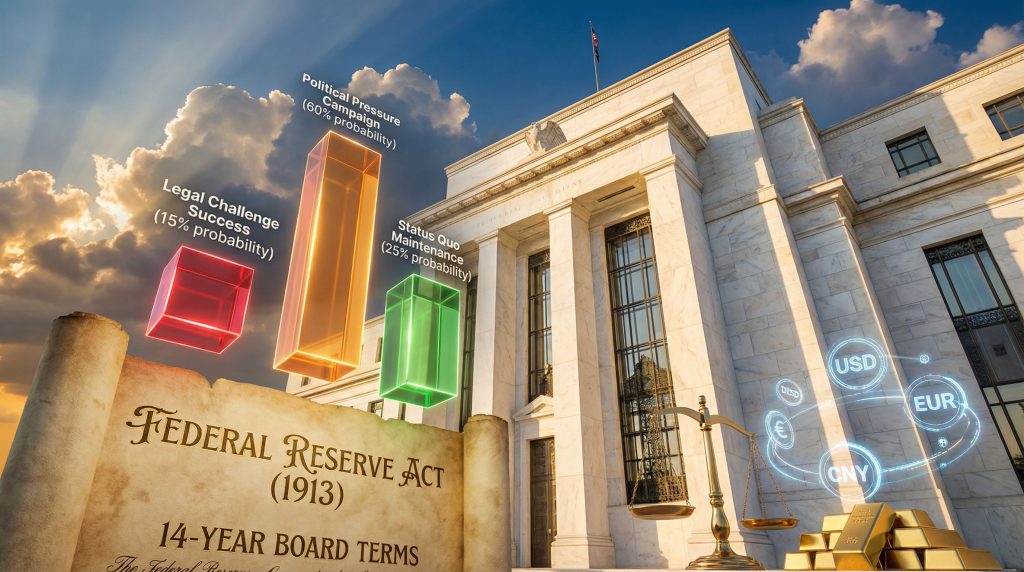
Scenario 1: Legal Challenge Success (15% probability)
Fed Chair removal through criminal proceedings would create unprecedented constitutional crisis. Market chaos and dollar volatility would likely trigger Congressional intervention and judicial review processes. Historical lack of precedent suggests low probability of successful legal action.
Scenario 2: Political Pressure Campaign (60% probability)
Public criticism without legal action represents the most likely outcome based on historical patterns. Gradual policy influence attempts through rhetorical pressure would create market adaptation to new dynamics without institutional destruction. Nevertheless, analysing the tariffs impact on markets provides additional context for understanding broader economic pressures.
Scenario 3: Status Quo Maintenance (25% probability)
Constitutional protections holding and normal Fed operations continuing would preserve market stability. Judicial precedents and statutory protections suggest institutional resilience against political pressure.
Portfolio Protection Strategies
Hedging Mechanisms
Currency diversification beyond USD exposure provides protection against dollar volatility during institutional uncertainty. Precious metals allocation increases offer traditional safe-haven benefits during constitutional crises. Volatility protection instruments help manage short-term market disruption.
Sector Rotation Considerations
Defence contractors benefit from geopolitical tensions surrounding institutional stability. Materials sector strength during uncertainty periods reflects precious metals demand increases. Technology sector resilience during institutional stress provides portfolio stability.
What This Means for Federal Reserve Policy Going Forward
Institutional adaptation strategies will likely emerge regardless of immediate political pressure outcomes. The Federal Reserve faces unprecedented challenges requiring enhanced communication protocols and stronger legal precedent establishment.
Institutional Adaptation Strategies
Communication Protocol Changes
Enhanced transparency in decision-making processes will become essential for maintaining public confidence. The Fed will likely emphasise educational outreach regarding monetary policy independence benefits and constitutional protections.
Stronger legal precedent establishment through proactive judicial clarification may provide additional protection against future political interference attempts. Considering the gold price forecast 2025 helps investors understand potential safe-haven flows during such uncertainty.
Long-term Independence Preservation
Structural Reforms Under Consideration
Extended term lengths for Fed leadership could enhance independence protection. Enhanced removal protection mechanisms through statutory clarification would strengthen constitutional foundations. Clearer statutory mandate definitions could reduce political interpretation ambiguity.
Expert Analysis: Constitutional scholars suggest that successful challenges to Fed independence would require unprecedented legal precedents, making dramatic institutional changes unlikely despite political pressure.
International central bank coordination provides additional institutional support. Collaborative approaches with European Central Bank, Bank of Japan, and other major central banks reinforce independence principles globally.
Global Economic Implications of US Monetary Policy Politicisation
The international ramifications of Federal Reserve independence challenges extend far beyond domestic market impacts. As the issuer of the world's primary reserve currency, Fed institutional credibility affects global financial stability.
International Reserve Currency Status
Dollar Dominance Factors
Central bank independence serves as a credibility anchor for international confidence in U.S. institutions. Reserve currency status depends significantly on predictable, politically-insulated monetary policy decision-making.
Alternative reserve currency development could accelerate if Fed independence becomes compromised. European Union, China, and other economic powers monitor U.S. institutional stability as factors in currency diversification strategies.
Trade and Diplomatic Consequences
Allied Nation Responses
European Central Bank coordination strategies will likely adapt to changing U.S. institutional dynamics. Asian central bank policy adjustments reflect concerns about dollar stability and Federal Reserve credibility.
Multilateral institution relationships face potential strain if U.S. monetary policy becomes perceived as politically motivated rather than economically driven. According to the Guardian's analysis, international partners are closely monitoring these developments.
Emerging Market Vulnerability
Capital Flow Disruption Risks
Dollar funding market instability creates particular challenges for emerging economies dependent on U.S. currency financing. Commodity price volatility increases when dollar stability becomes questioned.
Development finance access challenges emerge when international confidence in U.S. institutional stability declines. These effects demonstrate the global interconnectedness of Federal Reserve independence.
The next major ASX story will hit our subscribers first
Frequently Asked Questions About Executive-Fed Relations
Can a President Actually Arrest the Federal Reserve Chair?
Presidential arrest authority over Fed officials lacks clear constitutional basis. Criminal investigations require Department of Justice independence and probable cause determination through established legal processes. No historical precedent exists for criminal charges against sitting Federal Reserve leadership.
What Historical Precedents Exist for Political Pressure on Central Banks?
Multiple administrations have criticised Fed policies publicly, including Nixon's documented pressure on Arthur Burns and recent Trump's Powell arrest threat campaigns. However, direct legal action against Fed leadership represents unprecedented territory in U.S. monetary policy history.
How Do Markets Typically React to Central Bank Independence Threats?
Historical patterns show initial volatility followed by adaptation, with long-term consequences depending on actual institutional changes rather than rhetorical pressure. Bond yields typically rise 10-30 basis points initially, while defensive assets like gold experience increased demand.
What Legal Protections Exist for Federal Reserve Officials?
Federal Reserve Board members enjoy removal protection similar to other independent agency officials, requiring "for cause" justification rather than political disagreement. The Supreme Court precedents in Humphrey's Executor (1935) and Morrison v. Olson (1988) establish constitutional foundations for these protections.
Investment Strategy Implications Moving Forward
Portfolio positioning during periods of Federal Reserve independence uncertainty requires balancing defensive measures with opportunities created by market volatility and sector rotation dynamics.
Defensive Positioning Recommendations
Asset Class Priorities
Physical precious metals allocation provides traditional safe-haven benefits during constitutional uncertainty. Gold's historical performance during Fed independence challenges, including the 47% increase from 1971-1974 and 10% gain during 2018-2019, demonstrates consistent defensive value.
International equity diversification reduces concentration risk in U.S. institutional stability. Currency-hedged investment vehicles protect against dollar volatility while maintaining global market exposure.
Sector Focus Areas
Defence and security contractors benefit from geopolitical tensions surrounding institutional stability. Essential materials producers gain from commodity price increases during uncertainty periods. Financial services companies with regulatory clarity provide selective opportunities amid sector-wide volatility.
Monitoring Key Indicators
Early Warning Signals
Constitutional law expert commentary provides leading indicators of legal challenge credibility. Congressional hearing schedules and Federal court filing activities offer insight into institutional response development.
International central bank statements reflect global confidence in U.S. monetary policy independence. Coordinated responses from major central banks signal institutional support or concern.
Market Stress Indicators
VIX volatility measurements above 25-30 historically indicate severe institutional uncertainty. Credit spread widening patterns, particularly high-yield spreads exceeding 500 basis points, suggest systemic stress development.
Currency pair fluctuation ranges, especially EUR/USD and USD/JPY volatility increases, reflect international confidence changes. Precious metals premium expansion beyond normal trading ranges indicates safe-haven demand acceleration.
Investment Disclaimer: The scenarios discussed involving Trump's Powell arrest threat involve significant uncertainty and speculation. Political and constitutional developments can create unprecedented market conditions that differ from historical patterns. Investors should consult financial advisors and conduct thorough due diligence before making investment decisions based on institutional uncertainty factors.
Further Research Considerations
Monitoring Federal Reserve communication strategies, Congressional oversight activities, and international central bank coordination efforts will provide ongoing insight into institutional stability trends. Legal scholarship regarding presidential powers and independent agency protection continues evolving through constitutional interpretation and judicial precedent development.
Ready to Invest in the Next Major Mineral Discovery?
Discovery Alert instantly alerts investors to significant ASX mineral discoveries using its proprietary Discovery IQ model, turning complex mineral data into actionable insights. Understand why historic discoveries can generate substantial returns by visiting Discovery Alert's dedicated discoveries page, showcasing exceptional examples like De Grey Mining and WA1 Resources' remarkable gains.