July 17, 2026
The Economic Powerhouse of Continental Mineral Resources
Africa's copper reserves in Africa represent one of the most significant concentrations of strategic minerals globally, positioning the continent at the forefront of international economic transformation. Furthermore, the intersection of geological advantages, technological advancement, and growing global demand creates unprecedented opportunities for African nations to leverage their natural endowments. This convergence becomes particularly evident when examining how mineral exploration importance continues to reshape continental economic prospects and influence global supply chain dynamics.
The strategic value of these resources extends far beyond traditional commodity trading, creating complex economic systems where geological advantages translate directly into geopolitical influence and industrial development potential.
When big ASX news breaks, our subscribers know first
The Geological Foundation of Continental Economic Influence
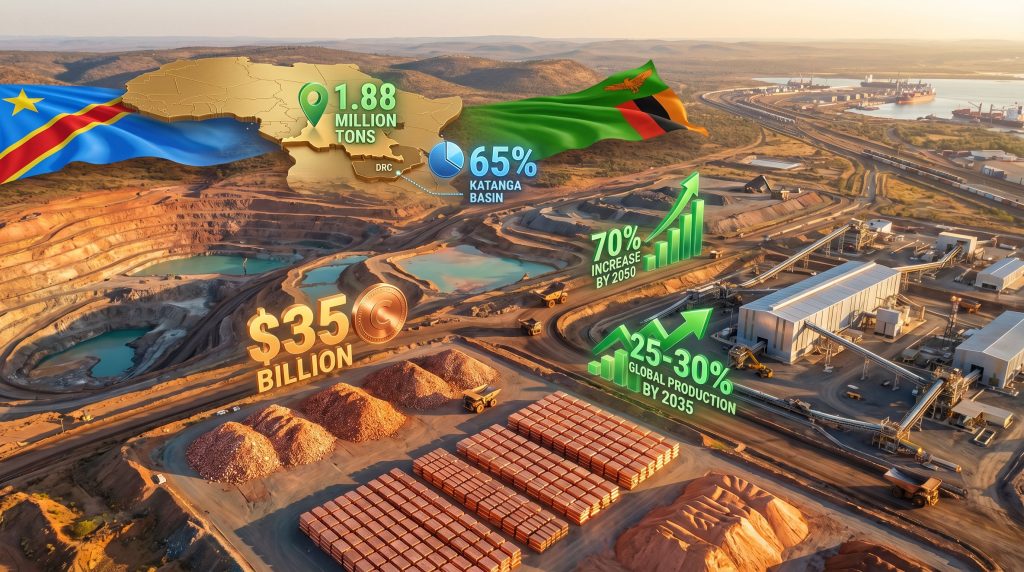
The Central African Copperbelt represents one of the world's most significant mineral formations, extending approximately 700 kilometres across the Democratic Republic of Congo and Zambia. This geological structure contains what industry analysis suggests comprises roughly 65% of all new copper discoveries made in 2023, positioning the region as the primary source of fresh copper reserves entering global markets.
Moreover, the Katanga Basin's unique geological characteristics have produced ore deposits with substantially higher concentrations than typical global formations. While average copper ore grades worldwide hover around 0.6%, African deposits consistently demonstrate grades between 2% and 4%, representing a three to six-fold advantage in mineral concentration.
This geological superiority translates directly into economic advantages through reduced processing costs and higher recovery rates per ton of material extracted. Consequently, these natural advantages create sustainable competitive positioning that extends beyond simple resource availability.
According to recent industry reporting, African copper exports reached approximately $35 billion in 2024, representing 15.3% of total global copper trade flows. The sector generates employment for more than 200,000 individuals directly engaged in mining operations across copper-producing nations, with additional economic multiplier effects supporting hundreds of thousands more jobs in related industries and services.
The economic multiplier effects extend far beyond direct mining employment, catalysing infrastructure development across the continent. In addition, mining revenue streams have enabled governments to invest in transportation networks, power generation capacity, and processing facilities that benefit broader economic development initiatives.
Continental Leaders in Strategic Copper Control
The Democratic Republic of Congo has established itself as the continental powerhouse in copper production, currently ranking as the fourth-largest copper producer globally. Recent data indicates the DRC produces approximately 1.88 million tons annually, generating export revenues of $19.8 billion in 2024 and securing its position as Africa's leading copper exporter.
The Kamoa-Kakula deposit complex exemplifies the DRC's geological advantages, containing an estimated 90 million tons of copper resources at an average grade of 3.13%. Industry analysts identify this as the highest-grade major copper deposit currently in operation worldwide, providing the DRC with substantial competitive advantages in global markets.
Furthermore, the operation has attracted significant international investment, including partnerships between state-owned Gécamines and international mining companies. This collaboration demonstrates how major copper system analysis approaches can be applied across different geographical contexts to optimise resource development.
Key Performance Metrics:
- Annual Production: 1.88 million tons (#4 globally)
- Export Revenue (2024): $19.8 billion (Continental leader)
- Kamoa-Kakula Grade: 3.13% copper (World's highest major deposit)
- Reserve Quality: 90 million tons (Premium grade resources)
Zambia has positioned itself as Africa's second-largest copper producer while implementing aggressive expansion strategies. Current operations at the Sentinel Mine demonstrate measured resources of 828.2 million tons, providing substantial long-term production capacity.
The government has established national targets to achieve 3.1 million tons of annual copper production by 2031, requiring an estimated $4.2 billion in infrastructure modernisation and expansion investments. Officials project copper output will exceed one million tons by 2026, with production potentially tripling by 2031 through coordinated investment programmes.
Emerging Regional Players
Tanzania currently produces approximately 44,000 tons annually while geological surveys have identified 13.7 million tons of additional copper deposits for potential development. South Africa's Okiep Project contains an estimated 159,000 tons of copper resources at 1.4% average grade, representing substantial development potential.
Angola's Tetelo Mine is transitioning to underground operations scheduled for completion by 2026, expanding the country's production capacity. These emerging producers demonstrate the continental scope of copper reserves in Africa and the potential for continued expansion.
How Do African Operations Compare Economically?
African copper mining operations typically achieve production costs between $2,800 and $3,200 per ton, compared to the global average of approximately $4,100 per ton. This cost advantage stems primarily from labour cost differentials, where African operations benefit from costs that are 60-70% below those in developed mining markets.
Additionally, many African deposits require less complex extraction methods due to their geological characteristics and ore grade advantages. However, infrastructure investment requirements represent both challenges and opportunities for African copper development.
Transportation network upgrades require an estimated $12 billion investment to optimise rail and port facilities for increased copper export volumes. Power generation capacity needs an additional 2,400 megawatts by 2030 to support expanded mining operations.
Processing facility development includes plans for 15 new smelters across the region, enabling value-added processing and reducing dependence on raw material exports. This infrastructure development creates strategic opportunities for countries that can coordinate mining expansion with broader economic development initiatives.
Demand Drivers Reshaping African Copper Economics
Continental electrification infrastructure development represents the largest single driver of copper demand growth across Africa. Power grid expansion initiatives require an estimated 2.3 million tons of copper by 2035 to support increased electricity access and industrial development.
Electric vehicle manufacturing is gaining momentum with eight planned assembly plants across Nigeria, Kenya, and South Africa, creating new sources of copper demand for automotive applications. This aligns with global copper investment strategies focused on transportation sector transformation.
Renewable Energy and Technology Demand
Renewable energy project development adds substantial copper consumption requirements through solar and wind installations. Current planning documents indicate 45 gigawatts of additional solar and wind capacity additions, each requiring significant copper infrastructure for power generation, transmission, and storage systems.
Data centre construction represents an emerging demand category with particularly strong growth projections. Industry analysis suggests a 340% increase in server installations between 2024 and 2027, driven by artificial intelligence applications and cloud computing expansion.
The implementation of AI in mining operations also creates additional demand for specialised copper applications in automated mining equipment and control systems. Each data centre requires substantial copper infrastructure for power distribution, cooling systems, and telecommunications connectivity.
Investment Capital Transformation of Regional Markets
Foreign direct investment patterns demonstrate significant international confidence in African copper development potential. Chinese investment commitments across DRC and Zambian projects total approximately $28 billion, representing the largest single source of development capital for regional mining operations.
European partnerships focused on sustainable mining initiatives have committed €15 billion to African copper projects, emphasising environmental responsibility and community development. North American involvement includes $8.5 billion in exploration and development activities, with particular emphasis on projects meeting international environmental and governance standards.
Investment Distribution:
- Chinese Partnerships: $28 billion (Infrastructure & Operations)
- European Initiatives: €15 billion (Sustainable Mining)
- North American Projects: $8.5 billion (Exploration & Development)
Capital market development across African exchanges reflects growing investor interest in copper-related investments. The Johannesburg Stock Exchange hosts 12 major copper producers with combined market capitalisation of $45 billion, representing substantial public market access for regional mining companies.
Sovereign wealth fund strategies across six African copper-producing nations demonstrate sophisticated approaches to resource revenue management. These funds implement copper price hedging mechanisms while directing infrastructure investments that link mining development to broader economic diversification initiatives.
The next major ASX story will hit our subscribers first
What Are the Main Supply Chain Challenges?
Transportation bottlenecks represent the most significant constraint on African copper export capacity. Port facilities at Durban and Dar es Salaam face capacity limitations that restrict export volumes despite increased production capability.
Approximately 70% of African copper moves via aging rail infrastructure, creating dependencies on systems that average 14-day transit times compared to six-day global benchmarks. Cross-border logistics complexities add additional time and cost to copper export operations.
Political risk assessment varies significantly across major copper-producing nations. The Democratic Republic of Congo maintains a regulatory stability index of 6.2 out of 10, while Zambia achieves 7.8 and Tanzania scores 7.1. These ratings influence international capital allocation decisions and project development timelines.
Currency and financial market exposure creates additional volatility for copper-producing nations. Exchange rate fluctuations can impact revenue by 15-25% annually, requiring sophisticated hedging strategies and financial market development.
Technology Integration and Productivity Enhancement
Automation technologies are transforming African copper production economics through significant productivity improvements. Autonomous mining equipment deployment can reduce labour costs by 30-40% while improving safety and operational consistency.
Artificial intelligence-driven ore sorting systems achieve recovery rates between 94% and 96%, substantially improving resource utilisation and reducing waste. Remote operations centres enable management of multiple mining sites from regional hubs, reducing on-site personnel requirements while maintaining operational control.
Environmental technology integration represents both regulatory compliance and cost reduction opportunities. Carbon capture systems require an estimated $2.1 billion investment across major African mines but can improve environmental performance while potentially generating carbon credit revenues.
Water recycling technologies achieving 85% reuse rates reduce both environmental impact and operational costs, particularly important in regions with water scarcity. Renewable energy integration at mining sites can reduce operational costs by 18-22% while improving environmental sustainability.
Long-term Economic Implications and Strategic Positioning
Global energy transition dependencies position African copper producers at the centre of fundamental economic transformation. Projected demand growth of 70% by 2050, driven primarily by electrification across transportation, power generation, and industrial applications, suggests sustained market expansion.
Africa's potential market share could reach 25-30% of global copper production by 2035, representing substantial economic influence. This aligns with global copper supply forecast projections that emphasise Africa's growing importance in international markets.
Strategic mineral classification elevates copper's geopolitical importance beyond traditional commodity considerations. Nations with substantial copper reserves increasingly find themselves involved in broader international economic and security discussions, creating both opportunities and responsibilities.
Economic Diversification Opportunities
Economic diversification opportunities emerge from copper sector development through value-added processing initiatives. Twelve planned copper refineries across the continent could create approximately 45,000 direct jobs while capturing additional value from raw material processing.
Manufacturing cluster development around mining centres can leverage infrastructure investments while building industrial capacity for domestic and export markets. Technology transfer agreements between international mining companies and African partners build local engineering capacity while creating foundations for independent technological development.
Regional integration benefits through the African Continental Free Trade Area could reduce intra-regional trade costs by 40%, improving overall economic efficiency and creating opportunities for regional supply chain optimisation.
Future Economic Projections and Sustainability
Copper price volatility demonstrates direct correlation with national economic performance across major producing countries. Analysis indicates that each 1% change in copper prices typically generates 0.3% to 0.8% fluctuation in gross domestic product for copper-dependent economies.
Government revenue dependencies range from 15% to 35% of national budgets in major producing nations, creating significant fiscal exposure to commodity price cycles. Employment sensitivity to copper price movements affects regional economic stability, with 10% price declines typically resulting in 5-8% workforce reductions.
According to data from the African Development Bank, copper reserves in Africa continue to demonstrate exceptional potential for sustained development. Industrialisation strategy implementation across Africa positions copper as a foundational material for manufacturing sector development.
Continental manufacturing expansion requires an estimated 1.2 million tons of copper annually by 2030 for industrial equipment, power infrastructure, and production facilities. Infrastructure modernisation for power grid expansion alone consumes approximately 800,000 tons of copper, representing substantial domestic demand growth.
Furthermore, statistics show that African copper mine production continues to increase year-over-year, demonstrating the continent's growing capacity and market influence.
Sustainability and Reserve Longevity
Sustainability assessments indicate current African copper production levels can be maintained for 45-60 years at current extraction rates, based on known reserves and anticipated discovery rates. Exploration success rates in African markets exceed global averages by 15-20%, suggesting continued reserve replacement potential.
Environmental rehabilitation costs average $180-250 per ton of production, requiring incorporation into long-term economic planning and mining project economics. Export diversification strategies focus on value addition through processed copper products rather than raw material exports, potentially reducing commodity dependence while capturing additional revenue.
The combination of substantial reserves, favourable geology, competitive production costs, and growing domestic demand positions African copper producers to play increasingly important roles in global mineral markets. Strategic management of these resources can provide the foundation for broader economic transformation across the continent while maintaining environmental sustainability and community development objectives.
In conclusion, copper reserves in Africa represent more than geological endowments; they constitute the foundation for continental economic transformation, technological advancement, and strategic positioning in global markets. The successful development and management of these resources will determine Africa's role in the global economy for decades to come.
Looking to Capitalise on Africa's Copper Boom?
Discovery Alert's proprietary Discovery IQ model delivers real-time alerts on significant ASX mineral discoveries, instantly empowering subscribers to identify actionable opportunities ahead of the broader market. Understand why major mineral discoveries can lead to significant market returns by exploring Discovery Alert's dedicated discoveries page, showcasing historic examples of exceptional outcomes, then begin your 14-day free trial today to position yourself ahead of the market.