August 5, 2026
The Hidden Chokepoint: Why Conveyor Condition Monitoring in Mining Has Become a Boardroom Priority
Picture a bulk materials handling operation running at full capacity. Ore moves continuously from pit to crusher, crusher to stockpile, stockpile to ship. Every tonne of that movement depends on conveyor systems that can stretch for kilometres, carry thousands of tonnes per hour, and spin tens of thousands of individual rollers simultaneously. Now picture a single bearing seizing inside one of those rollers. Left undetected, it generates heat, transfers abnormal load to the belt, and within hours can escalate into a full belt fire or catastrophic belt rip requiring days of emergency shutdown.
This scenario is not a theoretical worst case. It is the operational reality that has pushed conveyor condition monitoring in mining from a maintenance department concern into a strategic priority discussed at the highest levels of mine management. The gap between what conveyors cost when they fail unexpectedly and what it costs to monitor them continuously has never been more visible, or more commercially significant.
When big ASX news breaks, our subscribers know first
Understanding What Makes Conveyors So Difficult to Manage
Conveyors are the circulatory system of bulk mining operations. They are also deeply underappreciated as a risk asset. Unlike mobile haul trucks or processing plant equipment, conveyor systems tend to receive less real-time monitoring investment despite their outsized influence on production continuity. The reasons are largely structural: conveyors are long, linear, and can traverse terrain that makes physical inspection hazardous or impractical.
A single overland conveyor might carry hundreds of individual idler rollers, each a potential failure point, spread across several kilometres of structure. Manual walk-down inspections, the historical standard for conveyor maintenance, are poorly matched to this challenge. A maintenance worker physically inspecting roller condition can only assess the state of a component at the precise moment of inspection.
Intermittent faults, developing bearing degradation that worsens under load, or acoustic signatures that only appear at specific belt speeds are effectively invisible to periodic human inspection. By the time a roller sounds audibly rough during a walk-down, the degradation may already be advanced enough to threaten belt integrity.
The operational and financial weight of unexpected conveyor shutdowns extends well beyond the direct repair cost. Emergency maintenance carries significant labour and parts premiums, secondary damage to belts frequently multiplies repair bills, and production losses compound with every hour the conveyor remains offline.
The shift from reactive to predictive maintenance in mining frameworks has therefore become a genuine boardroom-level discussion in high-throughput mining environments, where the cost of unplanned downtime can outpace the capital expenditure required to deploy continuous monitoring technology many times over.
What Conveyor Condition Monitoring in Mining Actually Involves
Defining the Discipline
Conveyor condition monitoring in mining refers to the continuous or periodic measurement of physical signals across conveyor components to detect developing faults before they cause operational failure. The parameters typically measured span multiple physical domains, each suited to detecting different failure modes.
| Component | Primary Monitoring Signal | Key Failure Risk |
|---|---|---|
| Idler rollers | Vibration, acoustic emissions | Bearing seizure, belt surface damage |
| Pulley bearings | Vibration, temperature | Catastrophic seizure, structural damage |
| Drive motors | Current draw, temperature | Overload, winding failure |
| Belt surface | Wear sensors, imaging systems | Rip propagation, splice failure, mistracking |
| Belt speed and tension | Speed encoders, load cells | Slip events, belt mistracking |
The Fundamental Shift Away from Periodic Inspection
The critical distinction between traditional inspection and modern condition monitoring is continuity. Periodic inspection creates snapshots; continuous monitoring creates a living data record. Faults that develop between inspection intervals, or that only manifest under specific loading conditions, can be captured by a monitoring system that never goes offline. This continuity is what makes the data strategically valuable, not just operationally useful.
It is also worth noting that conveyor condition monitoring has historically lagged behind monitoring investment in mobile fleet equipment and processing plant assets. Furthermore, this imbalance is increasingly difficult to justify given that a conveyor failure at a single transfer point can halt production across an entire mine circuit simultaneously. ABB's condition monitoring for belts illustrates how purpose-built digital solutions are beginning to address this gap at scale.
How Distributed Acoustic Sensing Works on Mining Conveyors
The Physics of Fibre Optic Fault Detection
Distributed acoustic sensing (DAS) uses laser pulses transmitted through a fibre optic cable to detect vibration and acoustic energy along the full length of the monitored structure. The underlying mechanism is Rayleigh backscattering: when a laser pulse travels through the fibre, microscopic imperfections in the glass scatter a tiny fraction of the light back toward the source.
Any vibration or acoustic event along the fibre physically deforms the glass at that location, altering the backscattered light signal in a way that encodes both the intensity of the event and its precise position along the cable. In practice, an interrogator unit sends thousands of laser pulses per second through the fibre. The returning light signals are processed to produce a continuous, spatially resolved map of acoustic activity along the entire conveyor length simultaneously.
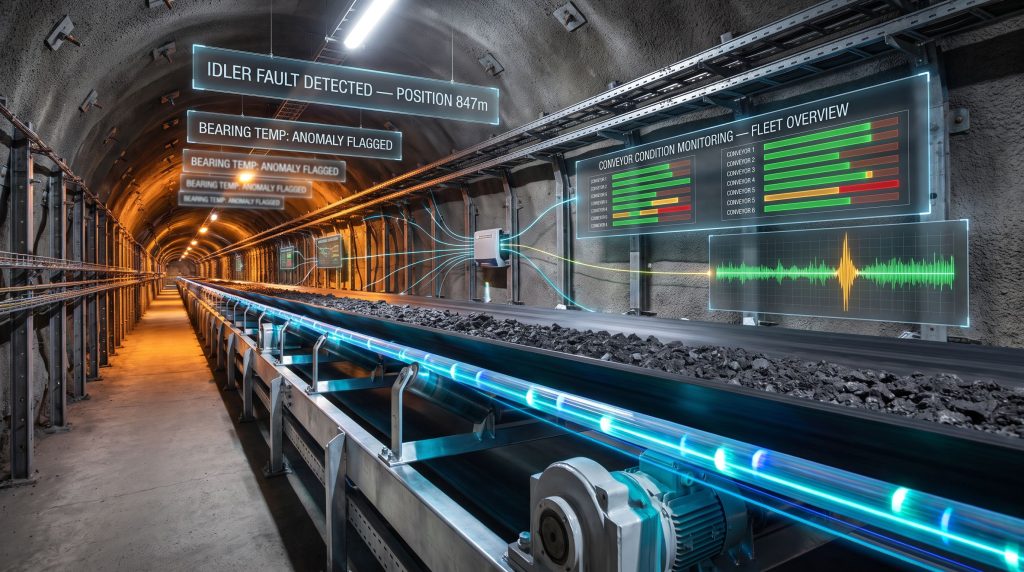
A developing roller fault generates a characteristic acoustic signature at its physical location, and the DAS system identifies that location to within metres, without any discrete sensor hardware at that point.
Why Fibre Optic Sensing Suits Harsh Mining Environments
The physical characteristics of fibre optic cable make it particularly well suited to mining deployments. Because there are no active electronic components along the cable itself, the sensing element is inherently maintenance-free. It carries no electrical current, generates no electromagnetic interference, and is unaffected by the dust, moisture, and vibration that routinely degrade conventional sensor hardware in mining environments.
For underground conveyors or remote overland systems where ongoing sensor maintenance is logistically challenging, this characteristic is especially valuable. A single DAS installation can also monitor the entire conveyor length from one interrogator unit, and that same unit can cover multiple conveyors depending on the system architecture. The scalability advantage over point-sensor networks, which require individual hardware installation, wiring, and maintenance at each measurement location, is substantial.
Translating Raw Acoustic Data into Maintenance Decisions
Why Raw Sensing Data Is Only the Starting Point
DAS technology generates high-volume, continuous data streams that cannot be practically reviewed by human analysts. In a mining environment, this challenge is compounded by the acoustic complexity of the operating environment itself. Blasting activity, heavy mobile equipment, variable belt loading, and changing conveyor speeds all contribute dynamic background noise that must be distinguished from genuine fault signatures.
Traditional frequency-based diagnostic approaches attempt to address this by defining known fault frequencies for each roller type and searching for those frequencies in the data. However, this approach carries a fundamental structural weakness: it assumes that roller faults produce consistent and repeatable acoustic signatures regardless of where they occur. In practice, differences in belt construction, load weight, operating speed, and conveyor structure mean that the same fault type can present very differently from site to site.
Machine Learning and the Baseline Deviation Model
The more capable approach, now being deployed in advanced conveyor monitoring systems, shifts the analytical framework entirely. Rather than searching for predefined fault signatures, machine learning algorithms establish a site-specific baseline of normal conveyor behaviour at each monitored location. The system then continuously compares incoming acoustic data against that baseline, flagging deviations that exceed configured thresholds as potential developing faults.
This baseline deviation approach is analytically superior for several reasons:
- It accounts for the unique acoustic character of each conveyor installation without requiring manual calibration of fault frequencies.
- It can detect emerging faults whose signatures do not match any predefined pattern, including unusual failure modes or early-stage degradation that has not yet developed a recognisable frequency signature.
- It improves over time as the baseline becomes more statistically robust through accumulated operational data.
- It reduces false positive rates because alarms are triggered by genuine deviations from normal behaviour, not by noise that happens to overlap with a predefined frequency band.
The shift from pattern-matching to baseline deviation represents a fundamental change in how fault detection is framed. Instead of asking "does this signal look like a known fault?" the system asks "does this signal look different from what is normal here?" That reframing is what makes machine learning-based detection genuinely more capable in variable mining environments.
Multi-Algorithm Architectures and Detection Reliability
A further refinement involves abandoning the premise that a single algorithm should handle all fault detection for a given component type. Advanced implementations use multiple detection algorithms running in parallel across the same data stream. Different algorithms may be more sensitive to specific fault characteristics, operating conditions, or frequency ranges. By combining their outputs, the system achieves detection robustness across a wider range of operating scenarios than any single algorithm could deliver.
This layered approach also has a practical benefit for maintenance operations: it reduces the false positive rate. A fault that triggers multiple independent detection pathways simultaneously carries higher credibility than one flagged by a single algorithm. When maintenance teams trust that alerts represent genuine developing faults, they act on them consistently. When alarm credibility is low, alerts are ignored, and the monitoring investment is effectively wasted.
Installation Strategy: Why Fibre Positioning Is Not a Universal Decision
Belt Weight as the Primary Installation Variable
How a fibre optic sensing cable is physically installed along a conveyor structure has a direct impact on detection performance. The guiding principle is that fibre positioning should maximise signal strength from fault locations while minimising susceptibility to background vibration noise. However, the optimal application of this principle varies significantly depending on belt characteristics.
| Belt Type | Signal Characteristics | Recommended Fibre Configuration | Rationale |
|---|---|---|---|
| Heavy-duty conveyor belt | Generates strong roller fault signatures | Central or straight configuration, not tightly mounted to structure | Signal strength is sufficient; avoiding tight mounting reduces cable vibration noise |
| Light-duty conveyor belt | Generates weaker roller fault signatures | Mounted closer to conveyor structure | Proximity improves sensitivity and compensates for lower signal amplitude |
This distinction is not widely appreciated outside specialist circles. The instinctive assumption that fibre should always be positioned as close as possible to potential fault points is not universally correct. For heavy belts, close mounting can introduce excessive cable vibration that degrades signal quality. The optimal installation balances proximity to fault sources against susceptibility to structural vibration.
Site Scoping as a Critical Pre-Installation Requirement
Proper site assessment before installation is not a procedural formality; it is a technical requirement that determines long-term system performance. Evaluating conveyor structure, baseline vibration levels, ambient noise sources, and belt characteristics during scoping provides the information needed to make informed fibre positioning decisions. Installations configured without adequate site scoping tend to either under-perform on detection sensitivity or generate excessive background noise alarms, both of which undermine the commercial case for the monitoring system.
The next major ASX story will hit our subscribers first
Scaling Conveyor Condition Monitoring Across an Entire Operation
The Data Management Challenge
Scaling conveyor condition monitoring beyond a single conveyor introduces a new class of operational challenge. A single DAS installation already generates substantial continuous data volumes. Across multiple conveyors operating simultaneously, those data streams multiply rapidly. Without a centralised analytics platform capable of consolidating and prioritising that information, the volume becomes operationally unmanageable.
Data-driven mining operations address this challenge by aggregating health data from multiple conveyor systems into a single interface. Maintenance teams can view alarm-state rollers across an entire site, ranked by fault severity and physical location, without manually reviewing individual data streams. Reporting tools further streamline the workflow by producing prioritised inspection and replacement schedules that integrate directly with maintenance planning processes.
The Commissioning Sensitivity Problem
One aspect of scaling that receives insufficient attention is the configuration of detection sensitivity thresholds during system commissioning. Setting these thresholds correctly is as technically important as the underlying sensing technology.
The failure modes are symmetrical and equally damaging:
- Overly sensitive configuration generates excessive alarms across normal operating variations. Maintenance teams receive more alerts than they can practically action, trust in the system erodes, and alerts begin to be ignored routinely.
- Under-sensitive configuration misses developing faults that fall below the threshold. The system appears to be functioning but provides no practical maintenance value.
A well-configured condition monitoring system should make maintenance decisions easier and more confident, not create additional noise that teams must filter through. Sensitivity calibration at commissioning is as important as the underlying technology itself.
Finding the balance requires both technical expertise and an understanding of the specific operational context. Maintenance teams that are overwhelmed by false alarms quickly lose confidence in the technology, which can set back the broader adoption of predictive maintenance culture within an organisation.
Comparing Conveyor Monitoring Technologies: Matching Approach to Application
No single monitoring technology is optimal for every conveyor type or operational context. Understanding the relative strengths and limitations of available approaches is essential for making sound investment decisions.
| Technology | Coverage Scope | Best Application | Primary Limitation |
|---|---|---|---|
| Distributed Acoustic Sensing (DAS) | Full conveyor length | Long overland conveyors, inaccessible runs | High data volume; requires sophisticated analytics layer |
| Point vibration sensors | Discrete locations only | Critical bearings, drive stations | Misses faults developing between sensor points |
| Thermal imaging | Surface temperature, line of sight | Drive pulleys, motor housings | Requires physical access and line-of-sight conditions |
| Motor current analysis | Drive system only | Overload detection, slip events | Provides no information on distributed conveyor components |
| Belt wear and rip detection | Belt surface condition | High-value ore conveyors, long-haul belts | Component-specific; not a whole-of-system solution |
Prioritising Which Conveyors to Monitor First
For operations establishing a condition monitoring programme with finite capital budgets, a risk-based prioritisation framework is the most defensible starting point:
- Overland and long-distance conveyors where the cost of downtime per failure event is highest.
- Mill feeders and process-critical transfer conveyors that feed directly into production circuits.
- Underground or physically inaccessible conveyors where manual inspection creates meaningful safety exposure.
- High-throughput trunk conveyors where volume throughput means any stoppage generates disproportionate production loss.
Safety Benefits That Extend Beyond Uptime
Reducing Exposure During Manual Inspections
The safety case for conveyor condition monitoring in mining is distinct from the productivity case, and in some regulatory environments, it may be equally or more compelling. Manual inspection of long conveyor runs exposes maintenance workers to moving machinery, fugitive dust, noise, and in underground settings, restricted egress. When continuous remote monitoring reduces the frequency of walk-down inspections required, the corresponding reduction in worker exposure is a measurable safety improvement.
Early fault detection also changes the nature of maintenance interventions. Instead of emergency responses to catastrophic failures, monitoring enables planned replacement during scheduled maintenance windows with proper isolation and controls in place.
Conveyor Belt Fires and Thermal Runaway Prevention
Seized rollers and overheating bearings are a well-documented cause of conveyor belt fires in mining operations globally. The sequence is straightforward: a bearing fails, the roller stops spinning, the belt continues to run across the stationary roller surface, frictional heat builds rapidly, and the belt material ignites. In underground mines, a belt fire is among the most serious safety scenarios possible.
Acoustic and thermal monitoring systems that detect the early stages of bearing degradation, before a complete seizure occurs, provide warning at a point when intervention is still straightforward. Roxon's research on belt monitoring highlights that this early warning function has genuine safety value independent of its productivity benefit, and it connects directly to site fire risk management obligations.
ESG and Workforce Safety Reporting
The intersection of predictive maintenance technology and ESG performance reporting is increasingly significant. Documented condition monitoring programmes that demonstrably reduce worker exposure to hazardous environments and lower the frequency of emergency maintenance interventions contribute measurable evidence to safety performance disclosures. For mining companies with formal ESG commitments, the ability to quantify reductions in high-risk maintenance activities represents reporting value as well as operational value.
The Future Trajectory of Conveyor Condition Monitoring
From Detection to Predictive Failure Modelling
The current generation of condition monitoring technology is primarily oriented toward fault detection: identifying that something is developing and alerting maintenance teams to investigate. The next evolution is predictive failure modelling, which aims to estimate the remaining useful life of monitored components based on the rate and trajectory of detected degradation.
This shift requires moving from signal analysis to prognostic modelling, integrating condition data with operational parameters such as load cycles, belt speed history, and environmental conditions to project when a component is likely to reach end of serviceable life. The practical value is significant: rather than scheduling replacements based on calendar intervals or responding to detected faults, maintenance teams can optimise replacement timing against actual component condition trajectories.
Integration With Digital Twins and Autonomous Mine Systems
Conveyor condition data is increasingly being considered as an input layer for digital twin models of mine infrastructure. A digital twin that incorporates real-time conveyor health data can simulate the consequences of different maintenance scheduling decisions before they are implemented, allowing maintenance planners to evaluate trade-offs between production continuity and component longevity.
The convergence of conveyor monitoring with mining automation technologies and autonomous haulage ecosystems represents a longer-term trajectory. Furthermore, AI-powered mining efficiency platforms are increasingly incorporating conveyor condition data as one input among many in coordinated operational intelligence systems that optimise material flow across the entire production chain. Consequently, as mines move toward integrated autonomous operations, conveyor health monitoring becomes a critical enabling layer within broader mining innovation trends.
Frequently Asked Questions: Conveyor Condition Monitoring in Mining
What signals are most commonly monitored on mining conveyors?
Vibration, acoustic emissions, temperature, motor current draw, and belt speed are the core monitoring parameters in most installations. Supplementary parameters including belt wear, misalignment, rip detection, and tension monitoring are added based on the specific failure risk profile and throughput criticality of each conveyor.
How does distributed acoustic sensing differ from conventional vibration sensors?
Conventional vibration sensors are installed at discrete points and monitor only those locations. Distributed acoustic sensing uses a single continuous fibre optic cable to monitor the entire conveyor length simultaneously, localising faults to precise positions without any active hardware along the monitoring length.
Why is site-specific calibration essential for reliable condition monitoring performance?
Belt weight, operating speed, load variability, structural design, and environmental noise all influence how fault signatures manifest acoustically at each installation. Systems calibrated to a universal standard produce either excessive false positives or miss site-specific fault patterns. Baseline development tied to each conveyor's unique operating character is the foundation of reliable detection performance.
What is the primary challenge when scaling monitoring across multiple conveyors?
The volume of continuous data generated across multiple simultaneous monitoring streams is the dominant scaling challenge. Centralised cloud-based analytics platforms with prioritised alerting, consolidated dashboards, and maintenance planning integration are essential to making fleet-level monitoring operationally manageable rather than analytically burdensome.
Can condition monitoring systems integrate with existing maintenance management software?
Modern condition monitoring platforms are generally designed with integration capability for Computerised Maintenance Management Systems (CMMS) and enterprise resource planning (ERP) environments, enabling detected faults to automatically generate work orders and feed into planned maintenance scheduling workflows.
What does the return on investment case look like for conveyor condition monitoring?
The ROI case combines avoided unplanned downtime costs, reduced emergency maintenance expenditure, extended component life through optimally timed replacements, and quantifiable reductions in worker exposure during manual inspections. For high-throughput operations, the avoided cost of a single major unplanned belt failure can exceed the entire capital cost of a monitoring installation.
This article presents technical and operational information for educational purposes. Readers evaluating specific conveyor condition monitoring technologies, systems, or investment decisions should conduct independent technical assessment and consult qualified professionals. Forecasts and projections regarding technology evolution represent reasonable industry-informed perspectives, not guaranteed outcomes.
Want to Invest in the Mining Companies Driving These Operational Advances?
Discovery Alert's proprietary Discovery IQ model delivers real-time alerts the moment significant ASX mineral discoveries are announced, translating complex data across 30+ commodities into clear, actionable insights for both short-term traders and long-term investors. Explore how major discoveries have historically generated substantial returns on Discovery Alert's dedicated discoveries page, and begin your 14-day free trial today to position yourself ahead of the broader market.