August 5, 2026
The Hidden Fragility Inside America's Most Profitable Vehicle Segment
Automotive manufacturing has long operated on the assumption that raw material risk is a commodity problem, manageable through futures contracts, price hedging, and diversified procurement. That assumption holds reasonably well for steel, plastics, and standard-grade metals. It breaks down entirely when the material in question is aerospace-specification aluminium body sheet, a product so technically demanding that only a handful of facilities in North America can produce it at automotive scale. When one of those facilities catches fire, the consequences ripple far beyond the mill floor.
That is precisely the scenario that played out across Ford Motor Company's truck manufacturing network throughout late 2025 and into 2026, exposing a structural vulnerability that sits at the heart of the Ford aluminium shortage F-Series production crisis. Understanding it requires looking upstream, deep into the metallurgical and industrial architecture that modern aluminium-intensive truck manufacturing depends upon.
When big ASX news breaks, our subscribers know first
Why High-Specification Aluminium Sheet Is Not a Commodity
Most people understand aluminium as a broadly available industrial metal. What is far less appreciated is the enormous technical distance between commodity aluminium and the flat-rolled, aerospace-derived body sheet used in vehicles like the Ford F-Series. When Ford redesigned the F-150 in 2015, switching from steel to an aluminium-intensive body structure, it did not simply start buying aluminium from the open market.
The alloys required for structural automotive body panels, typically from the 5000 and 6000 series families, must meet precise specifications for formability, dent resistance, surface quality, and corrosion performance. Achieving these properties at the thicknesses and tolerances required for stamped body panels demands:
- Dedicated hot-rolling mill infrastructure engineered for aluminium, not steel
- Precise alloy chemistry control at the casting stage, with tight tolerances on magnesium, silicon, and manganese content
- Multi-pass cold rolling and annealing sequences to achieve target temper conditions
- Surface treatments and lubrication systems compatible with automotive stamping operations
- Rigorous quality inspection for surface defects that would be unacceptable on visible body panels
This technical complexity is why the qualified supplier base for automotive-grade aluminium sheet in North America is extremely narrow. The Novelis facility in Oswego, New York, is one of the few plants capable of producing this material at the volumes Ford's F-Series program demands. Novelis itself is the world's largest aluminium rolling company by volume, and the Oswego plant represents a critical node in its North American automotive supply network. Furthermore, the aluminium supply leaders in this space operate within tight technical constraints that make rapid substitution exceptionally difficult.
From Fire to Forecourt: How One Mill Outage Became a Billion-Dollar Problem
The sequence of events that translated a fire at a New York hot mill into a measurable drag on Ford's financial results is worth tracing carefully, because the causal chain is longer and more operationally complex than most coverage acknowledges.
Step-by-Step: The Supply Chain Cascade
- Multiple fire incidents at the Novelis Oswego hot mill disrupted production beginning in autumn 2025, reducing aluminium sheet output below the volumes committed to Ford under supply agreements
- Ford's stamping operations, which press sheet aluminium into body side panels, hoods, and cargo beds, faced incoming material shortfalls that could not be bridged through spot purchasing of equivalent-grade material
- Assembly scheduling was restructured, with lower-margin F-Series configurations deprioritised or deferred to protect the revenue per unit on vehicles that were built
- Finished vehicle output declined, tightening the units available for dealer allocation across Ford's retail and fleet networks
- Dealer inventory contracted to approximately 45 days of supply by the end of July 2026, a level considered lean for a vehicle class that typically carries deeper buffers to accommodate customer configuration preferences
- Fleet and rental channel allocation was sharply curtailed, with daily rental fleet sales collapsing by 96% during July as Ford redirected available production toward higher-margin retail customers
- The Novelis hot mill restarted in June 2026, but aluminium inventory normalisation lagged by weeks as the supply pipeline gradually refilled from the upstream end
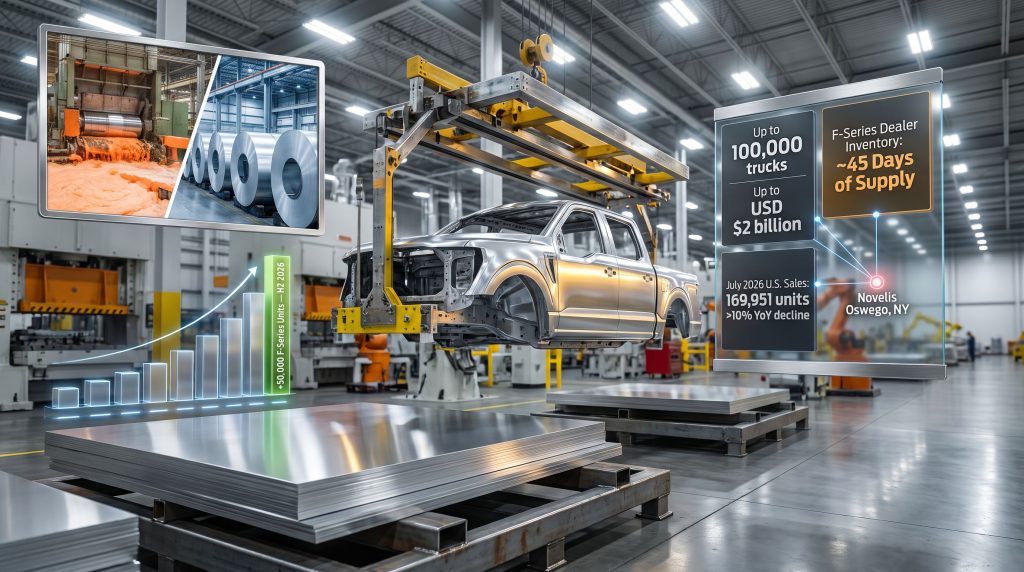
The financial scale of this cascade is substantial. Ford's production idle period illustrated just how exposed a single-source dependency can leave a manufacturer. Ford indicated the disruption could reduce F-Series output by as many as 100,000 trucks from 2025 production levels, with associated earnings exposure estimated at up to USD $2 billion. For context, that is a sum comparable to the annual capital expenditure budgets of mid-sized industrial corporations, generated not by a strategic miscalculation but by a fire at a single upstream facility.
Decoding Ford's July 2026 Sales Data
Ford reported sales of 169,951 vehicles in the U.S. during July 2026, representing a decline of more than 10% year-on-year. A surface reading of that number suggests serious demand deterioration. A more granular operational analysis tells a considerably different story.
What the Headline Number Obscures
| Sales Category | July 2026 Performance |
|---|---|
| Total U.S. vehicle sales | 169,951 units, >10% YoY decline |
| F-Series sales decline | 6.5% year-on-year |
| F-Series dealer inventory | ~45 days of supply |
| Daily rental fleet sales | Down 96% |
| Maverick pickup | Up 29% YoY |
| Bronco Sport | Up ~11% YoY |
| Maverick + Bronco Sport + Ranger combined (YTD) | Up 10.4% through July |
| Off-road performance variants | Up 4.8%, ~25% of total sales |
| Mustang Mach-E | Down 65% |
| Expedition | Down 23% |
| Mustang coupe | Down ~20% |
When stripped of deliberate portfolio management decisions, including the discontinuation of the Escape crossover and Lincoln Corsair and the planned reduction in low-margin rental fleet volumes, Ford's adjusted sales decline narrows to less than 1% year-on-year. That is a meaningfully different picture from the headline figure, and it matters for correctly attributing cause.
Ford's Head of U.S. Sales characterised the results as a reflection of deliberate strategic choices, noting that the company had intentionally moved away from selected models and pulled back on low-margin fleet volume to create commercial and manufacturing space for an upcoming wave of new product introductions.
Where Demand Actually Softened
Not all of July's declines were supply-driven or strategically managed. Some segments showed genuine demand pressure:
- The Mustang Mach-E fell 65% following the expiry of U.S. federal EV tax incentives. This is a policy-driven demand cliff rather than a product quality issue. When a subsidy worth thousands of dollars disappears overnight, purchase decisions shift materially, regardless of vehicle merit
- Expedition sales dropped 23%, consistent with broader softening in large SUV demand as fuel economy concerns and vehicle pricing weigh on the segment
- Mustang coupe sales declined nearly 20%, reflecting category-wide pressure in performance coupes as buyer preferences evolve
The Metallurgical Reason Aluminium Supply Chains Break Differently
Steel and aluminium are often discussed interchangeably as automotive structural materials, but their supply chain risk profiles are fundamentally different. The steel versus aluminium dynamics at a macro level further complicate how manufacturers plan and hedge their material procurement strategies.
Steel flat-rolled production is distributed across dozens of mills in North America with broadly interchangeable product grades for most automotive applications. If one steel supplier faces a production disruption, a carmaker can typically redirect procurement within weeks because the technical barriers to qualification are lower and the alternative supplier base is wider.
Aluminium automotive body sheet operates under an entirely different logic:
- Alloy specificity: Each aluminium body sheet application is engineered to a precise alloy specification. Substituting a different mill's product requires requalification testing that can take months, covering formability trials, corrosion certification, and surface quality audits
- Capital concentration: The hot-rolling infrastructure required for automotive-grade aluminium sheet is enormously capital-intensive, resulting in a highly concentrated supplier base with few alternatives in any given geography
- Process interdependency: The aluminium forming process in automotive stamping plants uses tooling and lubrication systems calibrated to specific material parameters. Changing material source is not a simple procurement swap
- Temper and surface sensitivity: Automotive-grade sheet must arrive at stamping plants within narrow temper windows and with surface conditions compatible with downstream painting. These properties degrade with time and handling, limiting the usefulness of stockpiles built under different conditions
The Novelis Oswego outage did not merely reduce aluminium availability. It removed a source of material that could not be technically substituted at speed, which is precisely why the disruption translated so directly into lost production rather than simply higher costs.
What Ford's Strategic Response Reveals About Modern Margin Management
Ford's response to the aluminium supply constraint is instructive beyond the immediate operational context. Rather than attempting to maintain volume at any cost, the company made deliberate sequencing decisions that prioritised margin preservation:
- Higher-specification F-Series trims were prioritised over entry-level configurations, protecting revenue per unit even as total output fell
- Fleet and rental deliveries were deprioritised in favour of retail customers, who generate higher per-vehicle margins and stronger residual value performance for the brand
- SUV production lines were temporarily adjusted to redirect available aluminium toward the most commercially valuable truck configurations
- F-150 Lightning production experienced intermittent pauses as conventional high-margin truck variants absorbed the limited material supply
This approach reflects a broader shift in how sophisticated automotive manufacturers think about supply constraints. The instinctive response to a production shortfall is to maximise units. The strategically superior response, at least in margin terms, is to maximise value per constrained unit. Ford's July results, once adjusted for deliberate portfolio decisions, suggest this calculus produced the intended outcome. In addition, the commodity price impacts of constrained aluminium availability further reinforced Ford's rationale for prioritising higher-value configurations.
The next major ASX story will hit our subscribers first
Recovery Trajectory and the Road to 50 Consecutive Years
With the Novelis hot mill back in operation from June 2026, Ford's attention has shifted to inventory rebuild and production recovery. The company has outlined plans to add approximately 50,000 additional F-Series trucks to its 2026 output as supply normalises, deploying additional production shifts to accelerate the rebuild of dealer stock toward more comfortable buffer levels.
The commercial stakes attached to this recovery are significant. The F-Series is tracking toward its 50th consecutive year as America's best-selling truck, a milestone with both brand equity and commercial weight that extends well beyond any single model year's sales figures. Ford's recovery after the supply drought illustrates just how consequential getting the aluminium pipeline flowing again has been for restoring production momentum.
Ford's Longer-Term Product Roadmap
| Initiative | Timeline | Detail |
|---|---|---|
| Hybrid or multi-energy powertrain across near-full model range | By end of decade | Broad electrification optionality without full EV dependency |
| Five new affordable vehicle introductions | Starting 2027 | Targeting accessible price segments to broaden volume base |
| U.S.-assembled all-electric midsize pickup | Within the decade | Built on the next-generation Universal Electric Vehicle Platform |
| F-Series volume recovery | H2 2026 | Approximately 50,000 additional units planned |
Ford's management has framed the near-term volume sacrifice explicitly as a trade-off made in advance of this product expansion, accepting compressed output today to preserve the manufacturing and commercial bandwidth needed to execute a substantial new model launch program.
The Broader Industry Risk That the Ford Case Illuminates
The Ford aluminium shortage F-Series production disruption is not simply a company-specific operational story. It points to a structural vulnerability that is growing across the entire automotive industry as aluminium intensity increases.
Every major automaker pursuing lightweighting strategies for fuel economy compliance or EV range optimisation is increasing its exposure to the same narrow base of technically qualified aluminium flat-rolled producers. As platforms transition from steel to aluminium-intensive architectures, the concentration risk demonstrated by the Novelis outage will apply to a growing proportion of global vehicle production. Moreover, the aluminium tariffs impact introduced in 2025 have added another layer of complexity to procurement strategies for North American manufacturers already contending with supply chain fragility.
The risk management implications are clear:
- Multi-supplier qualification for critical aluminium body sheet grades should be a baseline requirement, even where single-source arrangements offer cost or process simplicity advantages
- Strategic material inventory buffers specific to technically complex input materials deserve investment as a form of supply chain insurance
- Long-term offtake agreements with multiple qualified suppliers reduce exposure to the kind of concentrated single-facility risk that the Oswego outage demonstrated so vividly
- Upstream supplier resilience auditing should extend to facility-level fire suppression, business continuity planning, and alternative production routing capability
Furthermore, the supply chain disruption risks exposed by this episode are likely to inform how Ford and its peers structure procurement contracts for the next generation of aluminium-intensive platforms.
As automotive aluminium intensity deepens across electrified platforms, the industry's exposure to upstream material concentration risk will grow proportionally. The Ford aluminium shortage F-Series production case is an early and visible example of a systemic vulnerability that is becoming structurally embedded across the sector.
Frequently Asked Questions: Ford Aluminium Shortage and F-Series Production
What caused the Ford F-Series aluminium shortage?
Multiple fire incidents at the Novelis hot mill facility in Oswego, New York, a critical supplier of high-specification aluminium sheet used in F-Series truck body construction, disrupted production from autumn 2025. The facility could not be substituted at speed due to the technical complexity of automotive-grade aluminium body sheet, creating a sustained supply shortfall that constrained Ford's truck output well into mid-2026.
How many F-Series trucks did Ford lose to the aluminium shortage?
Ford indicated the disruption could reduce F-Series output by up to 100,000 trucks from 2025 production levels, with associated earnings exposure estimated at up to USD $2 billion.
Has the aluminium supply issue been resolved?
The Novelis Oswego hot mill restarted in June 2026. However, as of late July 2026, F-Series dealer inventory remained lean at approximately 45 days of supply, with full inventory normalisation still progressing as the supply pipeline gradually refills.
How did Ford respond to the shortage?
Ford prioritised higher-margin F-Series trim configurations, sharply reduced fleet and rental channel allocations, temporarily adjusted SUV production lines, and plans to add approximately 50,000 additional F-Series trucks to 2026 output as supply normalises.
Did the shortage affect Ford's electric vehicles?
Yes. The F-150 Lightning experienced intermittent production pauses as Ford redirected available aluminium supply toward its highest-margin conventional truck configurations.
Is the F-Series still on track to be America's best-selling truck in 2026?
Ford has confirmed that despite the production constraints, the F-Series remains on track to record its 50th consecutive year as the best-selling truck in the United States.
Why couldn't Ford simply source aluminium sheet from a different supplier?
Automotive-grade aluminium body sheet requires supplier-specific qualification involving formability trials, corrosion certification, and surface quality audits. This requalification process takes months and cannot be compressed to match the timeline of an unexpected production disruption. Consequently, the narrow qualified supplier base in North America made rapid substitution operationally impractical.
Want to Stay Ahead of the Next Major Commodity Supply Shock?
Discovery Alert's proprietary Discovery IQ model scans ASX announcements in real time, delivering instant alerts on significant mineral discoveries — including the critical materials that underpin industries like automotive manufacturing — so subscribers can identify actionable opportunities before the broader market reacts. Explore historic discoveries and the returns they generated, then begin your 14-day free trial to secure a market-leading edge.