August 4, 2026
The Structural Flaw Hidden Inside India's Mineral Revenue Architecture
Every royalty system built on declared commodity values carries an embedded vulnerability: the entity responsible for calculating the payment is also the entity most incentivised to minimise it. In large-scale open-cut mining, where ore moves in millions of tonnes across dozens of dispatch points, this tension between declared value and actual value becomes a governance problem of the first order. India's iron ore sector, anchored by the state of Odisha, is now confronting exactly this structural flaw in a highly visible way.
Odisha iron ore grade manipulation has moved from an administrative concern to a live enforcement crisis, with 65 mines issued show-cause notices following state inspections, billions of rupees in alleged revenue losses under investigation, and some of India's largest integrated steelmakers named in government correspondence. Understanding what is at stake requires looking beyond the headlines and into the mechanics of how mineral royalty systems work, where they fail, and what the downstream consequences are for a nation with ambitious steel production targets.
When big ASX news breaks, our subscribers know first
How Iron Ore Grades Determine Financial Obligations in India's Mining Framework
The Grade-Royalty Linkage Explained
Iron ore is not a uniform commodity. It exists across a spectrum of iron content, typically expressed as a percentage of iron (Fe) by weight. In India, the Indian Bureau of Mines (IBM) provides the technical standards and classification framework against which ore grades are formally assessed and recorded in approved mining plans.
What makes grade classification so financially consequential is its direct link to statutory payment obligations. India's iron ore royalty is assessed on an ad valorem basis, meaning the levy is calculated as a percentage of the declared mineral value, which is itself a function of the declared grade. Understanding iron ore grades and deposits is therefore essential to understanding where the financial incentive to manipulate arises. A higher iron content classification produces a higher assessed value, which produces a higher royalty obligation. The inverse is equally true.
The statutory payment stack affected by grade declaration includes:
- Royalty: Calculated as a percentage of mineral value, directly sensitive to declared grade
- District Mineral Foundation (DMF) contribution: Calculated as a percentage of royalty, therefore proportionally reduced by any downward grade shift
- National Mineral Exploration Trust (NMET) levy: Also a royalty derivative, compounding the financial effect of misclassification
- Auction premium realisation: Linked to mineral value, indirectly suppressed when declared grades fall
This cascading structure means the total financial benefit of declaring ore at a lower grade than its actual iron content far exceeds the royalty saving alone. Every statutory lever attached to declared value moves in the same direction simultaneously.
Four Manipulation Methods Identified in Enforcement Findings
State inspections identified four primary mechanisms through which grade outcomes can be manipulated at the operational level:
- Dilution: Blending high-grade ore with waste material or low-grade overburden to reduce the average iron content of a dispatch parcel
- Blending across grade streams: Mixing ore from different grade categories before dispatch documentation is finalised, obscuring the true grade composition of individual shipments
- Misclassification: Formally declaring a higher-grade ore parcel under a lower-grade category in dispatch records
- Mis-declaration: Submitting inaccurate dispatch documentation that understates the assessed mineral value relative to what was actually extracted
The compounding effect is critical to understanding the scale of the problem. At production volumes of hundreds of millions of tonnes annually, even a small per-tonne discrepancy between declared and actual grade translates into a massive aggregate revenue gap for the state exchequer.
Odisha's Dominant Position and Why Compliance Failures Have National Consequences
India's Iron Ore Production Trajectory
Odisha is not merely one of India's iron ore producing states. It is the largest by a substantial margin, functioning as the foundational supply source for the country's entire steel production ecosystem. The national significance of its compliance environment cannot be overstated.
India, the world's second-largest crude steel producer after China, is tracking an ambitious output expansion trajectory for iron ore. Furthermore, iron ore price trends in global markets mean the financial stakes of grade compliance are amplified beyond domestic royalty calculations alone:
| Financial Year | Projected Iron Ore Output |
|---|---|
| 2025-26 | Approximately 316 million metric tonnes |
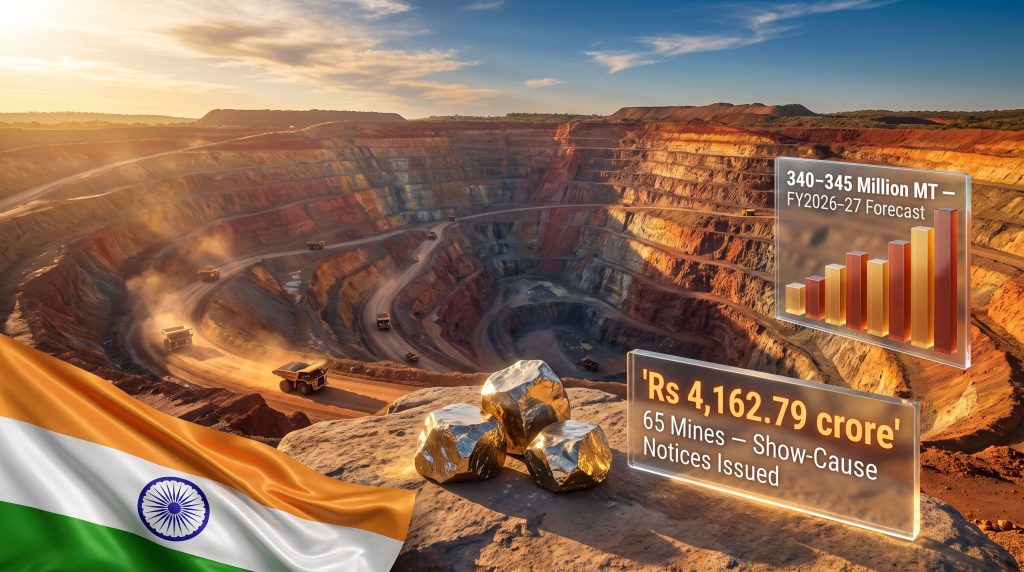
| 2026-27 (Forecast) | 340 to 345 million metric tonnes |
Source: BigMint commodities consultancy projections.
Any sustained disruption to Odisha's ore supply carries the potential to derail these national targets, with cascading effects across India's downstream steel industry, infrastructure programmes, and export commitments.
The Koira and Joda Mining Belts: Where Enforcement Meets Maximum Output
Enforcement activity has concentrated most intensively in the Koira and Joda mining circles, the two highest-volume iron ore production zones in Odisha. This geographic concentration carries a specific market risk: when regulatory scrutiny falls precisely on the regions generating the greatest tonnage, the market-wide availability effects of any operational disruption are maximised rather than diluted.
Mining expert B.K. Bhatia, former director general of the Federation of Indian Mineral Industries, has noted that given Odisha's position as the country's largest iron ore producer, any escalation of the current enforcement action carries the potential to affect national iron ore availability broadly, not just within the state's borders.
A Structured View of the Enforcement Findings
What State Inspections Revealed
According to official enforcement documents, the July 2025 enforcement campaign produced documented findings across several violation categories:
| Violation Category | Description | Documented Scope |
|---|---|---|
| Grade downgrading | Systematic lower-grade declaration relative to actual ore quality | Found across multiple mine leases |
| Overproduction | Output volumes exceeding limits approved in mining plans | Identified in show-cause notices |
| Illegal sub-leasing | Unauthorised transfer or delegation of mining rights | Cited in official enforcement documents |
| Mining plan non-compliance | Actual extracted grades diverging from IBM-approved plan grades | Directed for revision by state authorities |
The July 6 government document described inspections as having revealed consistent grade manipulation across lessee operations, resulting in what was characterised as a substantial loss of state revenues. The July 13 meeting between state officials and industry representatives produced minutes formally declaring that deliberate grade manipulation, misdeclaration, or suppression of mineral value affecting government revenue would be treated as a serious compliance breach subject to strict enforcement action.
The Fiscal Damage: What the Numbers Suggest
Estimating the precise revenue loss from grade manipulation is methodologically complex, and figures from different sources reflect different audit windows, grade differential assumptions, and sampling approaches:
| Source Type | Estimated Revenue Loss |
|---|---|
| Government audit documentation | Rs 4,162.79 crore (cited in official records) |
| Separate government-linked assessment | In excess of Rs 10,000 crore for FY2021-22 |
| Current enforcement period | Described officially as "substantial" with quantum under review |
Important caveat: These figures originate from government notices, internal audit processes, and media-reviewed documentation. The loss quantum varies materially depending on the time period examined, the grade differential assumptions applied, and the sampling methodology used to establish what the actual ore grade was versus what was declared.
The audit methodology problem runs deeper than it might first appear. Grade verification typically relies on statistical sampling of dispatch parcels rather than continuous measurement at the point of extraction. This creates genuine scope for disagreement over whether a given sample is representative of an entire ore stream, particularly in deposits with natural internal variability.
Industry's Counterposition: Geology as Defence
The Central Dispute Between State and Sector
Not all parties have accepted the state's characterisation of events. Industry representatives have formally contested the findings, advancing the position that ore grades extracted from any given mine are determined by the underlying geological conditions of that deposit, not by operator decisions made at the surface.
This is not an unreasonable technical argument. Iron ore deposits in the eastern Indian shield, including those in the Koira and Joda belts, contain significant internal grade variability. A single mining lease may contain zones of high-grade hematite ore sitting adjacent to lower-grade goethitic or limonitic material. Blending across these zones during extraction is operationally normal rather than exceptional.
The resolution of this dispute ultimately depends on where grade measurement occurs. If verification is conducted only at the dispatch stage, there is a window between extraction and shipment during which blending or dilution could occur without detection. Independent verification at the point of extraction, not just at dispatch, is the only technically robust way to distinguish geological variability from deliberate manipulation.
Tata Steel has publicly stated that it pays royalties in accordance with prescribed norms and that the substantial majority of its iron ore dispatches fall within the highest royalty grade category. JSW Steel declined to comment publicly, while Steel Authority of India (SAIL) and Jindal Steel did not provide responses to media enquiries. ArcelorMittal Nippon Steel India was also named in the July 6 government letter.
Market Consequences: The Paradox of Grade Enforcement
Supply Tightening Already Underway
Intensified inspections have already produced a measurable market effect. BigMint has reported that offers for lower-grade iron ore in the merchant market have become constrained over the inspection period, as operators limit dispatches pending compliance review and potential reclassification.
This creates a market paradox worth noting: enforcement targeting grade misclassification simultaneously reduces the declared supply of lower-grade ore in the market. Whether this happens through upward reclassification of previously mis-declared material, or through operational caution among producers who pause lower-grade dispatches pending clarification, the commercial effect is the same. Consequently, the global iron ore market impact of these domestic enforcement actions may extend well beyond India's borders.
Three Scenarios for the Enforcement Trajectory
| Scenario | Trigger Condition | Likely Market Impact |
|---|---|---|
| Contained enforcement | Administrative corrections without mine suspensions | Moderate lower-grade supply tightening; partial royalty revenue recovery |
| Escalated enforcement | Production halts or lease suspensions at non-compliant operations | Material risk to India's 340-345 million MT FY2026-27 production target |
| Prolonged legal dispute | Lessees challenge findings through courts, delaying remediation | Extended supply uncertainty; sustained merchant market price pressure on lower-grade ore |
The next major ASX story will hit our subscribers first
Reforming the Architecture: From Enforcement to Prevention
Why the Current System Creates the Conditions It Attempts to Police
The deeper policy insight from the Odisha situation is that the grade manipulation incentive is not an accident of bad behaviour. It is a structural feature of an ad valorem royalty system applied to a commodity where declared value is self-reported by the party with the most to gain from a lower declaration. This is a governance design problem as much as a compliance enforcement problem. In addition, the China steel and iron ore market provides a useful comparative lens, given China's more integrated approach to grade verification across its domestic supply chains.
A Layered Reform Framework
Short-term enforcement improvements:
- Mandatory independent third-party grade verification at the point of extraction, not solely at dispatch
- Real-time electronic dispatch documentation integrated with IBM grade records to prevent post-extraction adjustment
- Substantially escalated financial penalties for repeat misclassification findings to shift the cost-benefit calculus
Medium-term structural changes:
- Integration of drone-based remote sensing and geological grade mapping into IBM's mine plan approval and monitoring process
- Mandatory quarterly reconciliation between geological survey grades and dispatch-declared grades, with automatic audit triggers where divergence exceeds defined thresholds
- Independent audit rights for state revenue authorities over IBM-approved mining plans, removing the current reliance on lessee self-reporting
Long-term policy consideration:
A shift toward volumetric royalty assessment, where the levy is calculated per tonne of ore extracted regardless of declared grade, would eliminate the grade manipulation incentive entirely. This approach, used in various forms in some other mining jurisdictions, trades royalty revenue sensitivity to commodity price movements for revenue certainty and reduced compliance risk. However, the iron ore price decline already being observed in global markets adds further urgency to structural reform, as lower prices intensify the financial incentive to misclassify grades. Whether India's mineral governance architecture is ready for such a structural reform remains an open question, but the current enforcement crisis makes the conversation unavoidable.
FAQ: Odisha Iron Ore Grade Manipulation
What is iron ore grade manipulation and why does it matter financially?
Grade manipulation involves declaring iron ore at a lower iron content than its actual measured quality at the point of dispatch. Because India's royalty system is ad valorem, every statutory levy attached to mineral value is proportionally reduced by a lower grade declaration, creating systematic underpayment to the state.
How many mines have received show-cause notices?
State enforcement actions following inspections resulted in 65 mines receiving show-cause notices, covering alleged violations including grade downgrading, overproduction, and mining plan non-compliance.
What is the scale of alleged revenue losses?
Government documentation has cited losses of approximately Rs 4,162.79 crore in one audit period, with a separate government-linked assessment placing losses above Rs 10,000 crore for FY2021-22. The state has described ongoing losses as substantial, with the final quantum dependent on audit methodology.
Which companies were named in the government's July 6 letter?
The letter named JSW Steel, Tata Steel, Steel Authority of India (SAIL), Jindal Steel, and ArcelorMittal Nippon Steel India as lessees subject to the Odisha iron ore grade manipulation findings.
Could this situation affect India's national iron ore output targets?
Yes, potentially. Odisha is India's largest iron ore producing state. If enforcement escalates to production suspensions at non-compliant leases, India's projected output of 340-345 million metric tonnes in FY2026-27 faces meaningful downside risk.
What is the industry's formal position on the allegations?
Industry representatives have formally disputed the findings, arguing that extracted ore grades reflect underlying geological conditions at mine sites and are not within operator control. The resolution of this dispute requires independent grade measurement at the point of extraction rather than at the dispatch stage alone.
This article is intended for informational purposes only and does not constitute financial, investment, or legal advice. Revenue loss figures cited reflect government documents, audit summaries, and media-reviewed materials; they should not be treated as independently verified financial data. Production forecasts are third-party estimates and are subject to change. Readers should conduct their own research before making any decisions related to companies or sectors discussed.
Want To Stay Ahead of Major Mineral Discoveries Before the Market Catches On?
Discovery Alert's proprietary Discovery IQ model delivers real-time alerts on significant ASX mineral discoveries — instantly turning complex commodity data into actionable investment insights for traders and investors at every experience level. Explore historic examples of exceptional discovery returns and begin your 14-day free trial today to secure a market-leading edge.