August 4, 2026
The Hidden Economics of Repetitive Motion: Why Mining's Energy Problem Starts With Physics
Every time a conventional excavator lowers its boom, energy disappears. It converts into heat through hydraulic resistance, dissipated silently into the air while the operator repositions for the next dig cycle. Across thousands of cycles per shift, across hundreds of shifts per year, that lost energy accumulates into a staggering volume of wasted diesel and unnecessary emissions. For open-pit mineral extraction operations, where the dig-and-swing sequence repeats with metronome-like regularity, this thermodynamic inefficiency has long represented one of the most structurally overlooked cost centres in surface mining.
Hybrid excavator technology addresses this problem at its physical root, and the deployment of the Volvo EC400 Hybrid excavator at Clariant's bentonite site in Bavaria has produced real-world results that are reshaping procurement conversations across European mining operations. Furthermore, understanding mining electrification trends helps contextualise why this deployment matters at an industry level.
When big ASX news breaks, our subscribers know first
What Makes the Volvo EC400 Hybrid Technically Distinct From Conventional Excavators
A Regenerative System Built Around the Boom Cycle
The EC400 Hybrid's core innovation lies in its energy recovery architecture. During boom-lowering phases, a regenerative hydraulic system captures the kinetic energy that conventional machines simply waste. Rather than dissipating this force as heat through pressure relief valves, the EC400 converts it into stored energy that is then redistributed during the next power-intensive phase of the work cycle, typically boom-lifting or swing acceleration.
This mechanism transforms what has historically been a wasteful motion into a productive energy input, effectively shrinking the diesel engine's net workload without compromising machine output or cycle speed.
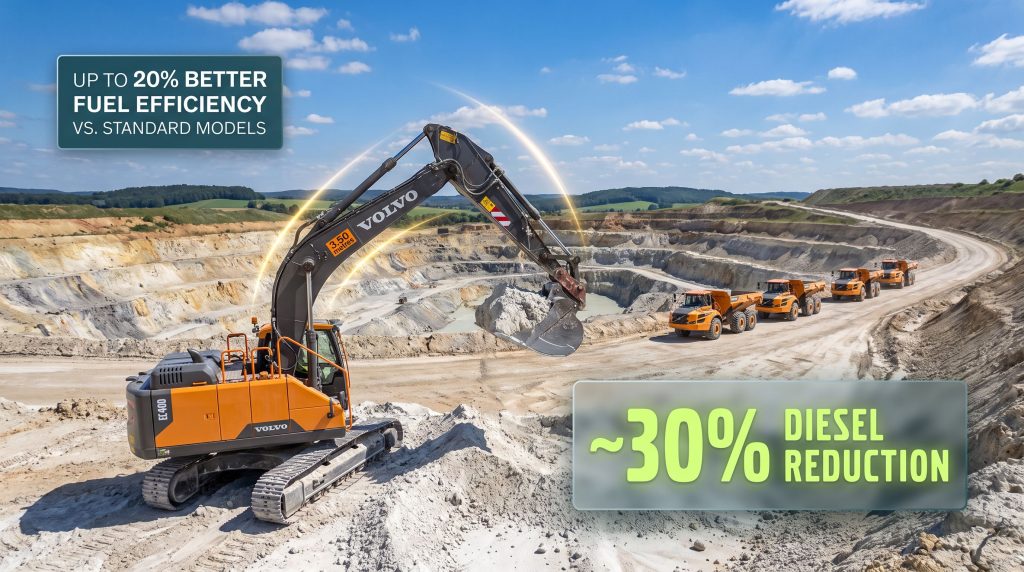
The technical result is a machine that consumes up to 20% less fuel than equivalent conventional excavators under standard operating comparisons, according to Volvo's published performance data. In real-world, high-frequency open-pit applications, that figure can climb considerably higher depending on site-specific duty cycles.
Why Open-Pit Bentonite Extraction Is an Ideal Application
Not every mining environment suits hybrid powertrain technology equally well. The regenerative advantage compounds with operational repetition. The more consistent and frequent the dig-and-swing-and-lower sequence, the greater the proportion of energy that can be captured and reused.
Open-pit bentonite extraction is, by its nature, precisely the kind of operation where this physics-driven efficiency advantage is maximised. Material depths are relatively consistent, pit geometry is predictable, and extraction cycles repeat with minimal variation across long operational periods. This operational profile creates near-ideal conditions for energy recovery systems to deliver their maximum return.
The Bavarian Bentonite Belt: Site Context and Operational Setup
Why Bavaria Hosts a World-Class Bentonite Deposit
The Bavarian region of southern Germany sits atop one of Europe's most significant bentonite deposits. The mineral itself is a smectite clay derived from the chemical weathering of volcanic ash, typically montmorillonite-dominant, and Bavaria's geological history has produced deposits of exceptional purity and consistency. German bentonite, particularly from this region, carries a strong commercial reputation across multiple downstream industries.
Bentonite is considerably more industrially versatile than its clay classification might suggest. Its applications span:
- Drilling fluids in oil, gas, and geothermal well construction, where it provides viscosity and borehole stability
- Foundry casting processes, where it acts as a binding agent for sand moulds
- Pharmaceutical and cosmetic formulations, where its absorption properties are exploited
- Food-grade applications, including wine clarification and edible oil processing
- Geotechnical engineering, where bentonite slurry walls are used as waterproof barriers in civil construction and landfill containment
The diversity of bentonite's end markets means that extraction quality is not merely an operational concern but a commercial imperative. Material contamination or inconsistent extraction can degrade the mineral's industrial specification, directly affecting its price and marketability.
This downstream sensitivity makes equipment selection a strategic decision. Low-disturbance, precision extraction preserves material grade and minimises processing costs at the plant.
Fleet Integration at the Clariant Site
Clariant's Bavarian operation deploys the Volvo EC400 Hybrid excavator at Clariant's bentonite site within a coordinated mixed fleet rather than as a standalone asset. The machine works alongside five Volvo A40 articulated haulers, with overall service and maintenance handled through Robert Aebi, the regional Volvo equipment partner.
| Fleet Component | Units | Primary Role |
|---|---|---|
| Volvo EC400 Hybrid Excavator | 1 | Primary material extraction |
| Volvo A40 Articulated Haulers | 5 | Material haulage from the pit |
| Robert Aebi (Service Partner) | Full-service contract | Maintenance, telematics, and support |
This fleet design is not incidental. Matching excavator output capacity to hauler volume and payload capacity is a core principle of productive open-pit logistics. Mismatches between loading and haulage assets generate queuing delays, idle time, and suboptimal cycle efficiency, all of which erode the fuel and cost savings that hybrid technology is intended to deliver.
Breaking Down the 30% Diesel Reduction: What the Numbers Actually Mean
Reported Performance at the Clariant Site
Clariant has reported that the EC400 Hybrid reduced diesel consumption at the Bavarian site by approximately 30% compared to the older conventional machine it replaced. This figure sits comfortably above the manufacturer's standard benchmark of up to 20% efficiency improvement, which reflects the site's exceptionally well-suited operational profile.
| Performance Metric | EC400 Hybrid | Conventional Baseline |
|---|---|---|
| Reported On-Site Fuel Reduction | ~30% | Baseline |
| Manufacturer's Stated Efficiency Gain | Up to 20% | Baseline |
| Transport Width | 3.50 metres | Variable by model |
| Energy Recovery Mechanism | Regenerative hydraulic system | None |
A 30% diesel reduction is not a marginal improvement. For a machine operating continuously across extended shifts in an active open-pit environment, the cumulative fuel volumes involved are substantial. Translated into annual terms, this represents a significant reduction in both direct operating costs and the site's Scope 1 greenhouse gas emissions. In addition, the mining decarbonisation benefits extend well beyond simple fuel savings into regulatory and financial territory.
The ESG Dimension: Scope 1 Emissions and Regulatory Compliance
European mining operators face increasing environmental scrutiny under frameworks including the EU Emissions Trading System and national-level regulations governing industrial site emissions. Diesel-powered equipment represents one of the most controllable Scope 1 emissions sources available to open-pit operators.
A 30% reduction in diesel consumption does not merely lower a fuel bill. In the European regulatory context, it directly reduces the carbon liability associated with site operations, strengthens ESG reporting metrics, and may influence the terms and cost of future permitting processes in emissions-sensitive jurisdictions.
For mining companies with published decarbonisation targets, deployments like this provide measurable, auditable progress data rather than the aspirational commitments that have drawn increasing scepticism from regulators and institutional investors alike.
How the Extended Boom Configuration Changes Pit Geometry
Eliminating Intermediate Benching Steps
The EC400 Hybrid deployed at the Clariant site features an extended boom configuration, which significantly expands the machine's effective working reach and depth capability. This geometric advantage has meaningful operational implications beyond raw digging performance.
In conventional open-pit excavation, limited boom reach often necessitates the creation of intermediate benches — essentially stepped platforms cut into the pit wall to allow equipment to access progressively deeper material. Each additional bench requires earthmoving work, increases the volume of overburden handling, and adds time and cost to the extraction process.
An extended boom eliminates or substantially reduces the need for these intermediate construction steps, allowing the excavator to reach target material from a single working position across a greater vertical range. For a bentonite deposit where maintaining clean separation between ore zones and overburden is critical to product quality, this precision-reach capability has direct commercial value.
Transport Width and Permit Compatibility
The EC400 Hybrid's 3.50-metre transport width is a specification that carries practical regulatory significance in European jurisdictions. Equipment exceeding standard road width thresholds requires special transport permits, escorts, and in some cases route-specific approvals that introduce lead time and cost into fleet mobilisation.
A 3.50-metre profile keeps the machine within manageable transport parameters for most European road networks, reducing logistical friction when moving between sites or repositioning equipment within a regional operation. In regulated jurisdictions where permit timelines can affect operational scheduling, this dimension is a legitimate procurement consideration.
Full-Service Contracts and the Role of Telematics in Hybrid Excavator Performance
Why Service Architecture Matters for Hybrid Equipment
Hybrid excavators introduce powertrain complexity that conventional service frameworks are not always equipped to handle. The EC400's energy recovery system, electrical components, and regenerative hydraulics require diagnostic capability and component knowledge that goes beyond standard diesel excavator maintenance.
The Robert Aebi full-service contract at the Clariant site addresses this through an OEM-aligned service structure that includes telematics monitoring. Consequently, this arrangement provides several operational advantages. Moreover, data-driven mining operations are increasingly central to how operators extract value from connected equipment like the EC400:
- Continuous machine health data transmitted in real time allows service technicians to identify emerging issues before they develop into unplanned failures
- Predictive maintenance scheduling replaces reactive breakdown responses, reducing costly downtime in a continuous extraction operation
- Warranty protection through OEM-certified service ensures that hybrid-specific components are maintained within manufacturer specifications
- Performance benchmarking via telematics data allows the operator to track fuel consumption trends and identify deviations that might indicate efficiency degradation
For a remote or semi-rural site like Bavaria's bentonite operation, where equipment availability directly determines daily extraction output, minimising unplanned downtime has a disproportionately large impact on site economics.
The next major ASX story will hit our subscribers first
Hybrid vs. Conventional vs. Full-Electric: Where the EC400 Sits on the Decarbonisation Spectrum
A Technology Maturity Comparison for Surface Mining Operators
The heavy equipment market is currently navigating a transition between three distinct technology paradigms. Understanding where each sits in terms of commercial maturity, infrastructure requirements, and emissions performance is essential for operators making fleet investment decisions with 5-to-10-year depreciation horizons.
| Criteria | Hybrid (EC400) | Conventional Diesel | Full-Electric |
|---|---|---|---|
| Fuel Consumption | 20-30% lower than baseline | Baseline | Near-zero operational |
| Infrastructure Change Required | Minimal | None | Significant charging infrastructure |
| Energy Recovery Capability | Yes, regenerative hydraulic | None | Partial, model-dependent |
| Scope 1 Emissions Profile | Meaningfully reduced | Highest | Lowest |
| Commercial Maturity | Proven in production | Fully mature | Emerging in heavy class |
| Remote Site Suitability | High | High | Currently limited |
| Capital Cost Premium | Moderate | None | High |
Full electrification of heavy mining excavators remains a medium-to-long-term horizon goal. Battery energy density, charging infrastructure requirements, and total cost of ownership at scale have not yet converged to a point where electric machines are commercially compelling across all surface mining applications. Hybrid systems occupy a commercially viable intermediate position that delivers real emissions reductions now, without demanding the capital or grid investment that full electrification requires.
However, renewable mining solutions are advancing rapidly and will increasingly complement hybrid deployments as the broader energy transition matures across the sector.
Operational Profiles That Favour Hybrid Deployment
Not every site will generate equivalent returns from hybrid technology. The operational characteristics that most strongly predict hybrid excavator performance include:
- High-frequency, repetitive dig-and-swing cycles with consistent material depth
- Open-pit geometries where boom-lowering phases are frequent and predictable
- Sites operating under strict emissions, noise, or environmental management conditions
- Operations with published ESG targets requiring measurable, auditable fuel reduction data
- Locations where infrastructure investment for full electrification is not yet economically justified
Conversely, highly variable extraction profiles, irregular duty cycles, or deep underground environments generate fewer regenerative events and therefore dilute the efficiency advantage that makes hybrid systems compelling.
Frequently Asked Questions: Volvo EC400 Hybrid in Mining Applications
What fuel efficiency improvement does the EC400 Hybrid deliver compared to standard excavators?
Volvo rates the EC400 Hybrid at up to 20% better fuel efficiency than comparable conventional excavators under standard conditions. In well-suited applications with highly repetitive duty cycles, such as the Clariant bentonite site, real-world savings of approximately 30% have been reported.
How does the energy recovery system function during excavation?
During boom-lowering sequences, the machine's regenerative hydraulic system captures kinetic energy that would otherwise be lost as heat. This stored energy is then redeployed during the next power-intensive phase of the cycle, reducing the net load on the diesel engine without any operator input or change in working method.
What mining operations benefit most from hybrid excavator technology?
Open-pit operations with consistent, repetitive extraction cycles generate the greatest efficiency gains. The higher the frequency of boom-lowering events within each shift, the greater the volume of energy available for recovery and reuse. Furthermore, mining automation advances are creating additional opportunities to stack efficiency gains across connected fleets.
Why does the 3.50-metre transport width matter for site logistics?
In European jurisdictions with standard road width regulations, equipment exceeding certain dimensions requires special transport permits and escorts. A 3.50-metre profile reduces this administrative and logistical burden when mobilising or repositioning equipment across a regional network of sites.
How does telematics monitoring support hybrid excavator performance?
Real-time telematics data enables predictive maintenance scheduling, early fault detection in hybrid-specific components, and ongoing fuel consumption benchmarking. This reduces unplanned downtime and ensures the machine's efficiency advantage is maintained across its operational lifecycle.
Can hybrid excavators meaningfully contribute to ESG targets?
Yes. A verified 30% reduction in diesel consumption at a continuous open-pit operation constitutes a directly measurable reduction in Scope 1 emissions. This type of auditable, technology-driven data carries weight in both regulatory compliance reporting and investor-facing ESG disclosures.
Five Operational Lessons the Clariant Deployment Delivers for Mining Fleet Strategy
The evidence from the Volvo EC400 Hybrid excavator at Clariant's bentonite site in Bavaria offers procurement and operations decision-makers a set of transferable insights that extend well beyond one machine at one mine. For instance, the deployment demonstrates how site-specific conditions can amplify manufacturer benchmarks considerably.
- Real-world fuel savings can exceed manufacturer benchmarks when site operational profiles align closely with the conditions hybrid powertrains are engineered to exploit
- Fleet integration is a multiplier, not an afterthought. Matching excavator output to hauler capacity ensures the efficiency gains from hybrid technology are not diluted by logistical mismatches elsewhere in the production chain
- Equipment geometry is a strategic variable with direct cost implications. Extended boom configurations reduce intermediate earthworks requirements and preserve material quality during extraction
- Service contracts structured around telematics and predictive maintenance amplify the return on hybrid technology investment by protecting machine availability across the asset's full operating life
- Permit-relevant specifications such as transport width now sit alongside performance data as legitimate factors in equipment procurement decisions within regulated European jurisdictions
For mining operators assessing fleet investment timelines through 2026 and beyond, the commercial case for hybrid excavator technology is no longer theoretical. As detailed by Volvo CE, the Bavarian bentonite operation demonstrates that fuel savings, emissions reductions, and operational advantages are measurable, reproducible, and strategically significant in environments where repetitive duty cycles and ESG accountability converge.
Readers interested in the broader trajectory of hybrid and electric equipment adoption in surface mining operations can explore ongoing technical coverage through Mining Magazine's equipment and power sections, which provide continuing analysis of fleet decarbonisation trends across global mining jurisdictions.
Want to Stay Ahead of the Next Major Mineral Discovery?
While hybrid excavator technology is reshaping how miners extract value from the ground, Discovery Alert's proprietary Discovery IQ model ensures you never miss a significant ASX mineral discovery — delivering real-time alerts that turn complex data into actionable investment opportunities the moment announcements hit the market. Explore historic discoveries and the returns they generated, then begin your 14-day free trial to position yourself ahead of the broader market.