August 4, 2026
The Iron Ore Grade Problem That Could Reshape Global Mining Technology
The steel industry is undergoing one of its most consequential transformations in a century. Hydrogen-based direct reduction ironmaking, widely regarded as the foundational process for producing low-emissions steel, operates under a constraint that conventional blast furnace steelmaking never faced: it demands iron ore grades that the world's existing mine supply is largely unable to deliver at scale.
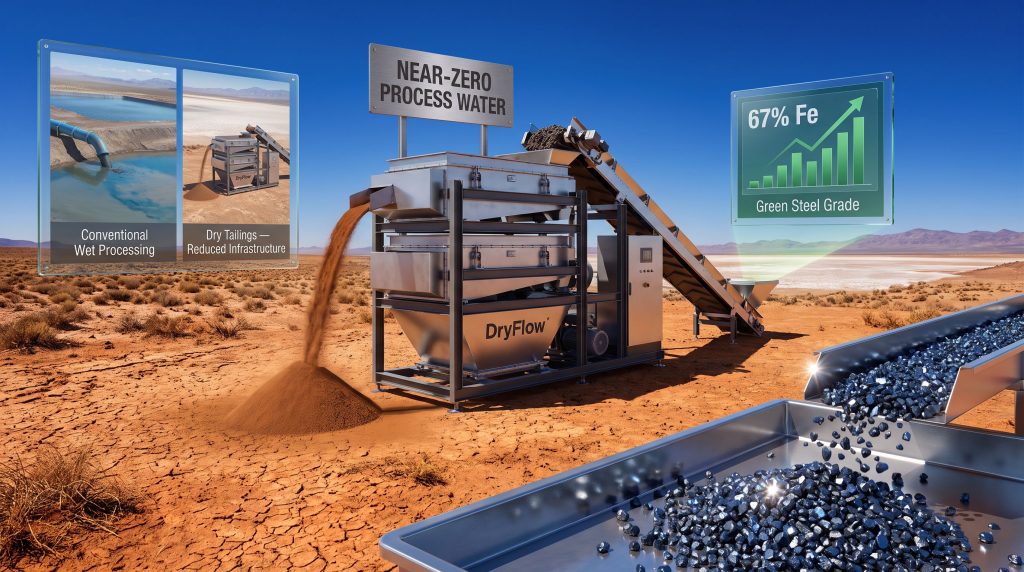
Standard blast furnace operations can process ore grading in the range of 58 to 62 percent iron (Fe). Hydrogen-based direct reduced iron (DRI) processes, by contrast, typically require feedstock grading 67 percent Fe or above. That gap of five to nine percentage points may sound modest, but it represents a structural supply problem of significant scale. The global inventory of naturally occurring high-grade iron ore types meeting DRI specifications is limited, and the gap between what mines produce and what green steel processes require is where technologies like DryFlow waterless mineral processing become strategically relevant.
When big ASX news breaks, our subscribers know first
Why Water Is the Invisible Constraint on Mineral Supply
Solving the ore grade problem through conventional beneficiation creates a second problem: water. Wet magnetic separation and flotation-based upgrading processes consume substantial volumes of process water per tonne of ore treated. In regions where water is already a contested resource, this creates a compounding constraint that goes beyond environmental compliance.
Key water-stressed mining regions include:
- Australia's Pilbara and inland South Australia where iron ore, copper, and critical mineral deposits coexist with chronic water scarcity
- Chile's Atacama Desert, home to world-class lithium and copper deposits but with some of the most restricted freshwater availability on earth
- The American West, where mining operations compete with agricultural, municipal, and ecological water users under intensifying regulatory scrutiny
- Southern Africa, where mine water licensing has become an increasingly complex social licence challenge
The consequence is that a meaningful proportion of the world's undeveloped mineral deposits sit in regions where conventional wet processing is either prohibitively expensive or legally constrained. These are not marginal deposits; many contain resources of genuine strategic significance. They are stranded not by geology, but by water.
What DryFlow Waterless Mineral Processing Technology Actually Does
DryFlow waterless mineral processing technology, developed by Australian mining technology company DryFlow Magnetics, addresses both the grade upgrading and water dependency problems simultaneously through a patented dry magnetic separation process called the Kuchel Process.
The core principle is straightforward: separate valuable magnetic minerals from waste material earlier in the processing flowsheet, before water ever enters the system. By doing so, the technology eliminates the need for slurry formation, wet tailings dams, and the extensive water recycling infrastructure that conventional processing requires.
What makes the Kuchel Process technically distinct from other dry processing approaches is what it does not use. It does not rely on energy-intensive drying circuits to pre-condition wet feed material, and it does not use forced-air fluidisation to separate particles. Both of these approaches, used in competing dry processing technologies, introduce substantial energy costs that can erode the economic advantage of going waterless. The Kuchel Process's stacked magnetic separation design avoids these energy penalties by working with naturally dry or semi-dry feed material and relying on magnetic susceptibility differences alone to drive separation.
The Kuchel Process Step-by-Step
- Feed introduction – Raw ore is fed into the modular processing unit without pre-wetting or slurry formation, preserving the dry state of the feed material throughout
- Progressive magnetic concentration – Multiple stacked magnetic separation stages sequentially concentrate iron-bearing minerals, with each stage improving the grade of the output stream
- Gangue rejection – Non-magnetic waste material exits the system as dry or semi-dry tailings, without requiring dam containment infrastructure
- High-grade concentrate production – The output is an iron concentrate suitable for downstream steelmaking applications, including DRI-based green steel processes
- Dry tailings discharge – Residual material is managed as dry solids, significantly reducing the engineering footprint and liability associated with wet tailings storage
How Does Dry Magnetic Separation Compare to Conventional Processing?
The differences between DryFlow waterless mineral processing technology and conventional wet beneficiation are not incremental; they represent a fundamentally different approach to how mineral upgrading is structured.
| Processing Factor | Conventional Wet Processing | DryFlow Waterless Technology |
|---|---|---|
| Process water required | High volumes (hundreds of litres per tonne) | Near-zero process water |
| Tailings management | Wet tailings dams required | Dry tailings, reduced infrastructure |
| Operational regions | Limited by water availability | Viable in arid and remote regions |
| Energy profile | High (pumping, drying, slurry circuits) | Lower, no forced-air fluidisation |
| Modular scalability | Limited by fixed plant design | Designed for modular deployment |
| Environmental footprint | Significant water and land use | Reduced water and tailings footprint |
| Tailings dam risk | High (failure risk, regulatory liability) | Substantially reduced |
Which Minerals Can Dry Magnetic Separation Recover?
| Mineral Category | Applicability to Dry Processing | Development Stage |
|---|---|---|
| Magnetite iron ore | Primary application | Commercial |
| Copper | Secondary potential | Development stage |
| Nickel and Cobalt | Emerging application | Dependent on ore mineralogy |
| Rare Earth Elements | Exploratory | Early-stage research |
| Tailings reprocessing | High potential | Active research |
The primary commercial application is magnetite iron ore, where the high magnetic susceptibility of the target mineral makes dry magnetic separation highly effective. The research expansion into copper, nickel, cobalt, and rare earth elements reflects the technology's potential to address a broader set of critical mineral supply challenges, though these applications remain at earlier stages of development than the core iron ore use case.
From South Australia to the Western United States: The First International Deployment
DryFlow Magnetics has commissioned its first commercial-scale waterless mineral processing unit, designed and manufactured in South Australia green iron country, for export to an operating mine in the western United States. This marks the technology's first international commercial deployment and represents a significant transition from domestic research and development to active international commercialisation.
The US deployment is designed to demonstrate meaningful ore grade improvement at operating scale, which serves a dual purpose: validating the technology's commercial performance under real mining conditions and opening new markets for the mine operator by enabling it to produce a higher-specification product. Alongside the operational deployment, DryFlow is establishing a research laboratory in Texas to support a collaborative critical minerals research partnership, extending the technology's development pipeline into the United States research ecosystem.
The sequencing of an international pilot deployment ahead of a domestic commercial validation reflects a deliberate strategy of building market credibility across two jurisdictions simultaneously, with the US site providing real-world performance data that feeds directly into the next-generation platform's development.
The 200 t/h Platform and Peak Iron Mines Validation
The US deployment is informing the development of DryFlow's next-generation platform: a 200 tonne-per-hour (t/h) modular commercial system that represents a substantial scale-up from current demonstrated capacity. The first units of this next-generation platform are targeted for validation deployment at Peak Iron Mines in South Australia, under a commercial agreement that includes federal government grant assistance to support the deployment phase.
The Peak Iron Mines validation is a critical milestone. Transitioning from pilot-scale to full commercial-scale operation is historically the most challenging and risk-laden phase of any novel processing technology's development. The 200 t/h system, if validated successfully under real operating conditions, would generate the performance dataset that underpins the broader commercial rollout of the platform across multiple markets.
The Investment Ecosystem Behind DryFlow Magnetics
The technology's development trajectory from CSIRO-backed research to international commercial deployment has been supported by both public research institutions and private capital. The involvement of CSIRO (Australia's Commonwealth Scientific and Industrial Research Organisation) in the technology's development provides scientific credibility to the underlying process, while the South Australian Government's co-development support reflects the state's interest in advanced minerals processing innovation.
On the private capital side, DryFlow completed an initial $10 million seed funding round backed by three venture capital firms before extending the round to $12.5 million with additional participation from a fourth investor.
| Investor | Investment Focus | Round Participation |
|---|---|---|
| Orion Industrial Ventures | Industrial technology | Initial $10M seed round |
| Virescent Ventures | Clean energy and sustainability tech | Initial $10M seed round |
| Taronga Ventures | Nature-positive innovation | Initial $10M seed round |
| Significant Ventures | Technology venture capital | Extended round to $12.5M |
The investor composition is notable. Spanning industrial technology, clean energy, sustainability, and nature-positive mandates, the consortium reflects how DryFlow is being positioned at the intersection of mining efficiency and environmental technology. Furthermore, the extension of the round specifically to fund US market expansion, with Significant Ventures joining at that stage, signals investor confidence in the international commercialisation pathway.
The next major ASX story will hit our subscribers first
The Green Steel Supply Chain Opportunity
The commercial logic behind DryFlow waterless mineral processing technology becomes clearest when examined through the lens of the green steel transition. The broader steel and iron ore market is evolving rapidly as European steelmakers, along with major buyers in Japan and South Korea, progressively commit to DRI-based production pathways under climate policy frameworks. Each of these commitments creates demand for iron ore that meets the 67 percent Fe threshold that most standard benchmark iron ore exports do not reach.
Australia, as the world's largest iron ore exporter, sits at the centre of this supply chain transition. The majority of Australia's iron ore exports are haematite, which is processed differently from magnetite. However, magnetite deposits are increasingly being developed specifically to supply green steel supply chains, and these are precisely the ore types where dry magnetic separation technology delivers its strongest performance characteristics.
If Australian magnetite producers can supply high-grade DRI-specification concentrate processed without water, they may be positioned to command a meaningful price premium over standard iron ore benchmarks in markets where green steel mandates are tightening.
The Tailings Dam Risk Dimension
An often-underestimated advantage of waterless processing is its impact on tailings dam liability. High-profile tailings dam failures globally have generated intense regulatory and investor scrutiny of wet tailings exposure across the mining sector. Institutional investors and insurers have become increasingly sophisticated in their assessment of tailings dam risk, and the liability associated with large wet tailings storage facilities has become a genuine factor in mining company valuations.
Dry tailings produced by the Kuchel Process are structurally more stable than wet slurried tailings and carry significantly reduced catastrophic failure risk. In some configurations, dry tailings can be repurposed as backfill material or construction aggregate, consequently converting a liability into a revenue stream or cost offset.
Limitations and Technical Challenges of Dry Processing
Balanced assessment requires acknowledging where dry magnetic separation faces constraints. Several technical realities are worth understanding:
- Ore type specificity: Dry magnetic separation performs best with strongly magnetic minerals like magnetite. Weakly magnetic or non-magnetic ore types present considerably greater technical challenges and may require complementary separation stages
- Fine particle recovery: Recovering very fine mineral particles in a dry environment is technically more difficult than in wet processing, where surface chemistry and density differences can be exploited. This can affect concentrate grade and overall recovery rates for certain ore textures
- Dust management: Dry processing environments generate dust that requires active engineering controls, adding operational complexity and cost relative to wet processing environments
- Scale-up risk: The 200 t/h modular system represents a significant scale-up from demonstrated capacity. Commercial-scale performance cannot be assumed from pilot-scale results alone, and the Peak Iron Mines validation will be closely watched by the industry for precisely this reason
- Competitive landscape: DryFlow's Kuchel Process competes with other dry processing approaches including electrostatic separation, air classification, and sensor-based ore sorting. Each has different applicability profiles, and the market will ultimately determine which approaches gain commercial traction across different deposit types
Frequently Asked Questions About DryFlow Waterless Mineral Processing Technology
What is DryFlow waterless mineral processing technology?
DryFlow waterless mineral processing technology is a dry magnetic separation system based on the Kuchel Process. It upgrades iron ore and recovers certain critical minerals without requiring process water, using stacked magnetic separation stages to concentrate target minerals and producing dry tailings rather than wet slurry.
How does DryFlow technology differ from conventional wet processing?
Conventional wet mineral processing uses large volumes of water to create slurries that separate minerals through density and chemical differences, generating wet tailings that require engineered dam storage. DryFlow's approach eliminates process water entirely, enabling operation in water-scarce regions where conventional processing would be economically or logistically impractical.
What minerals can DryFlow technology process?
The primary application is magnetite iron ore. The company has also identified potential applicability to copper, nickel, cobalt, and rare earth elements, as well as tailings reprocessing, though these applications are at earlier stages of development.
Where is DryFlow technology currently being deployed?
The first commercial-scale unit has been commissioned in South Australia and is being exported to an operating mine in the western United States. A next-generation 200 t/h modular system is planned for validation at Peak Iron Mines in South Australia, supported by federal government grant funding.
Why is waterless mineral processing important for green steel?
Green iron production via hydrogen-based direct reduction requires iron ore grading 67 percent Fe or above, a specification that most standard iron ore exports do not meet. Dry magnetic separation can upgrade lower-grade magnetite deposits to meet this threshold, potentially expanding the feedstock supply base for green steel production while eliminating the water demand of conventional beneficiation. In addition, hydrogen iron ore reduction technologies are increasingly reliant on consistent high-grade supply chains that waterless processing could help secure.
What the Commercialisation Trajectory Signals for the Industry
DryFlow's progression from CSIRO-supported research to a $12.5 million venture-backed company with its first international commercial export is a data point in a broader pattern: mining technology investors are increasingly willing to back solutions that address both resource efficiency and environmental sustainability simultaneously.
The near-term milestones that will determine whether this technology achieves mainstream commercial adoption are clear:
- Performance validation of the first commercial-scale unit in the western United States under real operating conditions
- Commissioning and throughput performance of the 200 t/h modular system at Peak Iron Mines
- Outputs from the Texas research laboratory's critical minerals partnership, which may expand the technology's applicable mineral portfolio
- Additional capital raises or strategic partnerships as the platform scales toward broader commercial deployment
Australia's position as the world's largest iron ore exporter, combined with a strong national research base and growing commercial interest in critical minerals processing innovation, creates a logical foundation for this category of technology to develop further. Whether DryFlow waterless mineral processing technology achieves the scale required to meaningfully shift how the industry approaches beneficiation in water-stressed regions will depend on the performance data its current deployments generate, and how quickly the broader market is prepared to act on it.
Readers seeking additional context on waterless mineral processing developments and Australian mining technology innovation may find relevant reporting and analysis at Mining Weekly, which covers emerging processing technologies and critical minerals developments across global mining markets. Furthermore, those interested in the broader landscape of dry processing equipment and innovation may find useful technical resources at International Mining, which regularly profiles advances in mineral processing engineering.
Want To Stay Ahead Of The Next Major ASX Mineral Discovery?
Discovery Alert's proprietary Discovery IQ model scans ASX announcements in real time, instantly identifying high-potential mineral discoveries across iron ore, critical minerals, and beyond — turning complex data into actionable investment insights for traders and long-term investors alike. Explore Discovery Alert's discoveries page to see how historic finds have generated exceptional returns, and begin your 14-day free trial today to position yourself ahead of the broader market.