August 4, 2026
The Compliance Imperative Reshaping How Mining Giants Govern Their Workforces
Large-scale mining operations have always relied on a complex web of contractors, subcontractors, and specialist service providers to keep production moving. However, the governance of those relationships has historically lagged behind the operational sophistication of the mines themselves. As environmental scrutiny intensifies, community expectations evolve, and safety regulators tighten their frameworks across Latin America, the gap between best-practice contractor governance and actual site-level execution has become one of the most consequential risk variables in the sector.
That gap is precisely what the Veriforce Canada Cerrejón contractor management partnership is designed to close. Furthermore, understanding what drives this partnership reveals much about where contractor governance in mining industry evolution is heading.
When big ASX news breaks, our subscribers know first
Why Contractor Governance Has Become a Strategic Priority
In most large open-cut mining environments, contractors do not just supplement the workforce — they often constitute the majority of workers on site at any given time. Equipment maintenance crews, environmental monitoring teams, haulage operators, and blasting specialists may all arrive through third-party contracts, each carrying distinct compliance obligations, training histories, and qualification records.
Managing that complexity through manual processes — spreadsheets, paper-based induction records, and fragmented tracking systems — creates structural vulnerabilities that are difficult to audit and almost impossible to resolve in real time. Consequently, the results are measurable: access by unqualified personnel, lapses in safety-critical training, environmental non-compliance, and audit failures that expose operators to regulatory and reputational risk.
Contractor management is increasingly recognised not as an administrative overhead, but as a direct input into mine safety performance, ESG compliance, and operational continuity.
Three converging pressures are accelerating demand for centralised contractor management platforms across the mining sector. In addition, approaches to natural capital in mining are further shaping how operators think about contractor obligations:
- Growing regulatory complexity in Latin American jurisdictions, where environmental, labour, and community relations obligations frequently intersect
- ESG reporting requirements from institutional investors and parent companies demanding verifiable, auditable compliance evidence
- The operational reality that contractor workforces in complex mining environments routinely outnumber direct employees by a significant margin
What the Veriforce Canada and Cerrejón Partnership Actually Delivers
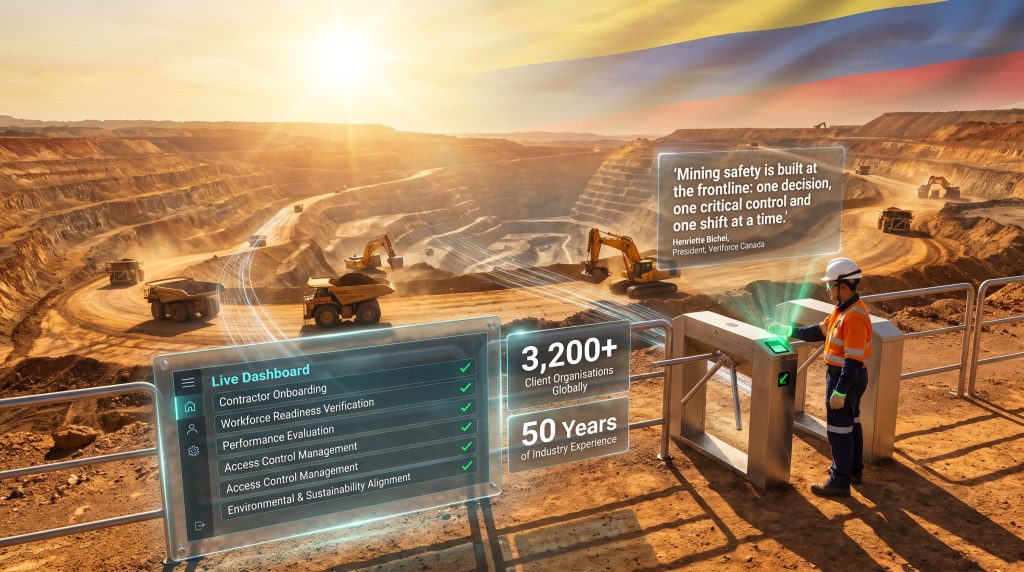
Cerrejón, the large-scale Colombian coal operation owned by Glencore, has formalised a partnership with Veriforce Canada to deploy the SafeContractor Canada platform across its contractor management function. The deployment covers five integrated operational areas:
| Functional Area | Operational Objective |
|---|---|
| Contractor Onboarding | Standardised qualification entry pathways |
| Workforce Readiness Verification | Pre-site competency and training confirmation |
| Performance Evaluation | Ongoing contractor assessment against defined KPIs |
| Access Control Management | Site entry governance tied to compliance status |
| Environmental and Sustainability Alignment | Contractor adherence to ESG and community standards |
What distinguishes this deployment from conventional compliance software is the integration of access control directly into compliance status. Under the SafeContractor Canada model, a contractor's ability to physically enter the site is gated by their standing within the platform. If qualifications have lapsed, required training has not been completed, or any compliance threshold has not been met, access is restricted automatically — removing the inconsistencies inherent in manual gatekeeping.
This shift from human-administered access decisions to system-enforced compliance verification represents a meaningful operational advancement, particularly at a mine of Cerrejón's scale.
Understanding Veriforce Canada's Platform Depth and Industry Reach
Veriforce Canada's position in this space is underpinned by two complementary platforms: SafeContractor Canada, which manages contractor qualification and prequalification, and ComplyWorks, which provides compliance workflow and risk management integration. Together, they represent more than 50 years of combined industry experience and support a client base of more than 3,200 organisations globally.
That scale matters beyond the headline figure. A contractor management platform operating across thousands of client organisations has the capacity to generate cross-industry benchmarking data that no single operator's in-house system can replicate. Mining operators using the platform can, for instance, compare their contractor performance against a broad baseline, identifying outliers and systemic compliance gaps that internal metrics alone would never surface.
The comparative advantage of different contractor management approaches illustrates why platform scale is such a meaningful differentiator:
| Approach | Scalability | Compliance Depth | Administrative Burden | Benchmarking Capability |
|---|---|---|---|---|
| Centralised Third-Party Platform | High | Comprehensive | Low | Cross-industry benchmarks available |
| Manual / Spreadsheet-Based | Low | Inconsistent | Very High | None |
| In-House Proprietary System | Medium | Variable | Medium | Internal only |
| Hybrid Partial Automation | Medium | Moderate | Medium-High | Limited |
The Operational Logic: How SafeContractor Canada Works in Practice
Understanding why this platform delivers measurable outcomes requires examining how the contractor management lifecycle actually functions under the system. The process follows a structured sequence:
- Pre-qualification Submission — Contractors submit credentials, certifications, and compliance documentation through the centralised portal before any site engagement begins
- Automated Qualification Review — The platform cross-references submissions against defined site-specific and regulatory compliance thresholds, removing manual review inconsistencies
- Competency and Training Verification — Workforce readiness is confirmed systematically before any site access is granted, ensuring individuals are trained and current
- Access Control Integration — Compliance status directly governs physical site entry, replacing manual gatekeeping with system-enforced verification
- Ongoing Performance Monitoring — Contractors are evaluated continuously against safety, environmental, quality, and sustainability KPIs throughout the engagement lifecycle
- Audit Trail and Reporting — All compliance activity is logged in a defensible, retrievable record format suitable for regulatory review and internal governance
The significance of step six is often underestimated. In the event of a safety incident, a regulatory inquiry, or a community complaint, the ability to produce a complete, timestamped compliance record for every contractor who accessed the site is not just operationally useful — it is legally and reputationally essential.
Why Cerrejón Is Investing in This Transformation Now
Cerrejón operates within one of the most scrutinised mining environments in Latin America. As a Glencore subsidiary, it operates under the parent company's established sustainability and governance frameworks, which include detailed expectations for contractor conduct across environmental performance, community engagement, and occupational health and safety.
Veriforce Canada's president has described the company's work with Cerrejón as grounded in a shared responsibility for protecting people at the point of work, from workforce readiness and access compliance through to real-time risk visibility. The company has also characterised the Cerrejón deployment as reflective of a broader need across Latin American mining for practical, scalable safety systems that function in complex operational environments.
That broader regional context is significant. Latin America hosts some of the world's highest-output mining operations, yet contractor management maturity varies substantially across jurisdictions:
| Market | Contractor Management Maturity | Key Compliance Drivers |
|---|---|---|
| Colombia | Advancing — active platform adoption | Environmental, community, safety regulation |
| Chile | High — established frameworks | Labour law, environmental permitting |
| Peru | Developing — regulatory pressure increasing | Community relations, safety incidents |
| Brazil | Mixed — large operators more advanced | Environmental licensing, labour compliance |
| Mexico | Evolving — investment-driven improvements | Safety reform, foreign operator standards |
Colombia's positioning as an actively advancing market is partly a function of the operational complexity of its major mines and partly a reflection of the stringent community relations obligations that Colombian mining law places on operators. Contractor behaviour directly affects community outcomes — and community outcomes directly affect operating licences.
The next major ASX story will hit our subscribers first
The Five Pillars of World-Class Contractor Governance
The SafeContractor Canada deployment at Cerrejón maps closely onto what industry analysis identifies as the five foundational pillars of contractor governance in large-scale mining. These pillars also reflect the broader mining sustainability transformation occurring across the sector.
Pillar 1: Qualification and Prequalification Integrity
Ensuring that contractors meet defined competency, certification, and insurance thresholds before any site engagement begins. This eliminates the most basic source of contractor-related risk: unqualified personnel entering high-hazard environments.
Pillar 2: Real-Time Access Control Tied to Compliance Status
Moving beyond periodic compliance checks to continuous verification that gates physical access. If compliance status changes — through an expired certification or a failed safety assessment — access restrictions activate immediately rather than at the next scheduled audit.
Pillar 3: Continuous Performance Evaluation Beyond Onboarding
Onboarding checks capture compliance at a single point in time. Ongoing KPI evaluation against safety, environmental, quality, and sustainability metrics captures how contractors actually perform across the full duration of their engagement.
Pillar 4: Environmental, Community, and Human Rights Standard Alignment
In Latin American mining contexts specifically, contractor alignment with environmental and community standards is not peripheral to the compliance function — it is central to the social licence to operate.
Pillar 5: Audit-Ready Documentation and Regulatory Defensibility
A compliance framework is only as strong as its evidentiary record. Platforms that generate structured, retrievable audit trails convert compliance activity into defensible documentation that can withstand regulatory scrutiny.
What This Partnership Signals for Latin American Mining Technology Adoption
The Veriforce Canada Cerrejón contractor management partnership carries implications that extend well beyond the immediate operational context. It represents a concrete data point in a broader transition: the migration of contractor governance from a largely administrative, paper-intensive function to a data-driven, platform-mediated discipline.
Several factors make this transition particularly consequential for Latin American mining:
- Multi-tiered contractor structures are common across the region's large operations, creating compliance complexity that manual systems cannot adequately govern
- Language and documentation standardisation across diverse contractor pools is significantly more manageable within a centralised digital platform than through distributed paper-based processes
- Remote and environmentally sensitive operating environments increase the cost of compliance failures, making upfront qualification integrity more valuable
- Institutional ESG demands from global investors and parent companies are raising the minimum acceptable standard for contractor governance documentation
The scalability argument for the SafeContractor Canada model is substantive. A platform that has demonstrated deployment viability at a major Colombian coal operation carries a credible proof-of-concept for replication across comparable operations in Chile, Peru, and Brazil — each of which faces its own version of the contractor governance challenge. Moreover, responsible mining ESG training continues to raise workforce standards that effective contractor platforms must accommodate.
Disclaimer: This article contains forward-looking analysis regarding market trends and technology adoption patterns. Such analysis represents informed assessment rather than guaranteed outcomes. Readers should conduct independent research before making any business or investment decisions based on information presented here.
Frequently Asked Questions: Contractor Management in Large-Scale Mining
What is contractor management in mining, and why does it matter?
Contractor management in mining refers to the structured processes by which operators qualify, onboard, monitor, and govern third-party contractors working on their sites. Because contractors frequently perform high-risk activities — from equipment operation and maintenance to environmental monitoring and blasting — robust contractor governance frameworks are directly linked to safety outcomes, regulatory compliance, and operational continuity.
What does SafeContractor Canada do differently from generic compliance software?
SafeContractor Canada is purpose-built for industries with complex, multi-tiered contractor ecosystems, including mining, energy, and construction. Unlike generic compliance tools, it integrates qualification management, access control, performance evaluation, and sustainability compliance into a single centralised workflow designed to function at operational scale.
Why is contractor compliance particularly difficult in Latin American mining?
Latin American mining operations frequently involve large contractor workforces operating across remote, environmentally sensitive, and community-adjacent locations. Regulatory frameworks vary by jurisdiction and documentation standardisation across diverse contractor pools presents ongoing challenges. Furthermore, community relations obligations require that contractor conduct be measurable and verifiable — all factors that favour centralised digital management platforms.
How does access control integrate with compliance status in the platform?
Under the SafeContractor Canada model, a contractor's physical site access is directly linked to their platform compliance status. Lapses in qualification, incomplete training records, or unmet compliance thresholds trigger automatic access restrictions, removing the dependency on manual gatekeeping decisions that can introduce inconsistency and human error. Effective risk management in mining increasingly depends on precisely this kind of system-enforced verification.
What compliance areas does the Cerrejón deployment cover?
The Veriforce Canada Cerrejón contractor management partnership addresses workforce readiness, environmental standards, quality requirements, health and safety protocols, and sustainable development commitments — covering the full spectrum of contractor compliance obligations relevant to a large-scale open-cut mining operation in Colombia.
Want to Know Which ASX Mining Companies Are Making Significant Discoveries Right Now?
Discovery Alert's proprietary Discovery IQ model delivers real-time alerts the moment significant ASX mineral discoveries are announced, cutting through complex data across more than 30 commodities to surface actionable opportunities for both short-term traders and long-term investors — explore the historic returns major discoveries have generated and begin your 14-day free trial at Discovery Alert to position yourself ahead of the broader market.