August 4, 2026
The Investigative Reporter Reshaping How Australia Understands Power
There is a particular type of journalism that rarely earns clicks but always earns consequence. It does not chase daily news cycles or trending social media topics. It builds slowly, through court filings, freedom of information requests, and sources who speak carefully. In an era when regional Australia is chronically under-reported and accountability journalism is increasingly concentrated in metropolitan newsrooms, the work of a Hobart-based investigative reporter at ABC News offers a revealing case study in what sustained, document-driven public interest journalism actually looks like in practice.
Paddy Manning ABC News coverage represents one of the more distinctive editorial portfolios currently operating within Australian public broadcasting. His work sits at the intersection of resource extraction, environmental regulation, corporate misconduct, and political accountability, mostly from a base in Tasmania that many national outlets treat as an afterthought.
When big ASX news breaks, our subscribers know first
Who Is Paddy Manning and Where Does He Work?
Paddy Manning is an investigative reporter for ABC News, based in Hobart, Tasmania. His work appears across multiple ABC platforms, including Background Briefing and Australian Story, two programmes with strong reputations for long-form investigative content.
His professional background spans some of Australia's most prominent mastheads. Before joining ABC News, Manning worked for Crikey, Fairfax Media, and News Corp publications, giving him a working knowledge of the commercial media environment that now directly informs his most significant long-term research project. For a broader look at his journalism at Crikey, readers can explore his archived editorial work across those platforms.
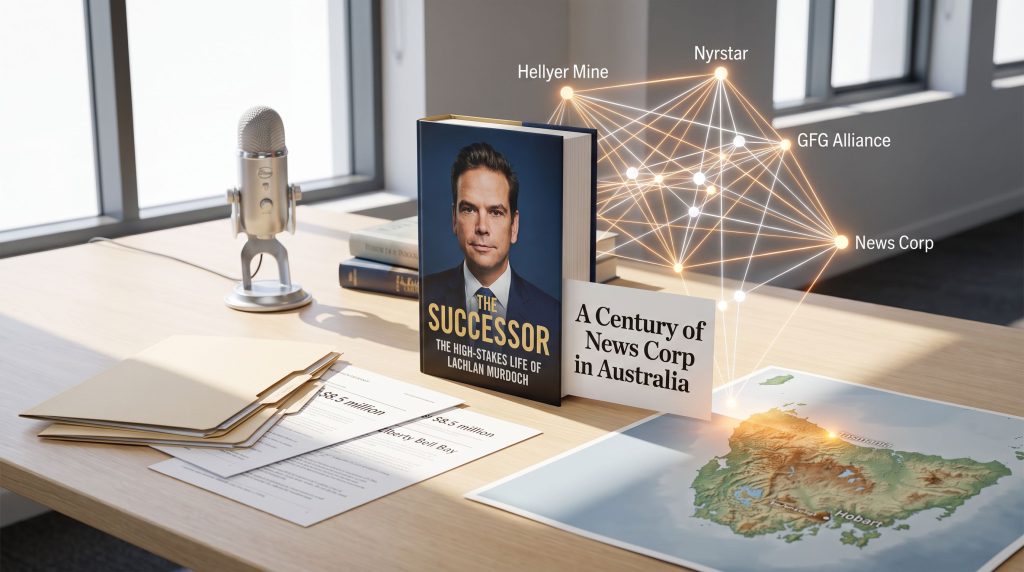
Beyond his broadcast and editorial work, Manning is the author of six published books. His most prominent title is The Successor: The High-Stakes Life of Lachlan Murdoch, published by Black Inc. in 2022. He followed that with the co-hosted podcast Rupert: The Last Mogul in 2023, and has since extended that investigation into ABC television through Australian Story and Background Briefing programmes examining Murdoch succession dynamics and editorial influence.
He is also completing a PhD at Macquarie University, with his doctoral research focused on A Century of News Corp in Australia, positioning him as one of the few working journalists in the country simultaneously producing academic peer-reviewed analysis on media ownership concentration.
Published Works at a Glance
| Work | Format | Year |
|---|---|---|
| The Successor: The High-Stakes Life of Lachlan Murdoch | Book (Black Inc.) | 2022 |
| Rupert: The Last Mogul | Podcast (co-hosted) | 2023 |
| Making Lachlan Murdoch | ABC Australian Story | 2024–25 |
| Murdoch's Endgame | ABC Background Briefing | 2024–25 |
| Five additional books | Various formats | Prior years |
The Hellyer Mine Investigation: Organised Crime, Liquidation, and Bankruptcy
Among the most consequential investigations in Manning's recent portfolio is a multi-story series examining the Hellyer lead and zinc mine in Tasmania's north-west. What began as a mining governance story evolved into an investigation touching on alleged money laundering, bikie-affiliated shareholders, threats against a new mine owner, and ultimately, formal bankruptcy proceedings. The story also raises broader questions about corporate governance issues in extractive industries more generally.
The investigation's key data points illustrate its scope:
- The Tasmanian government moved to revoke the mine's operating licence after receiving warnings that it had allegedly been used as a vehicle for money laundering
- Former owners were alleged to have associations with underworld figures, including shareholders with links to bikie organisations
- The incoming mine owner claimed to have faced personal threats after attempting to remove those shareholders
- Tasmania's Labor opposition formally called on the state government to launch an investigation into the allegations
- Hellyer Metals entered liquidation in January 2026
- In August 2026, former operators were ordered by the Federal Court to repay a combined $8.5 million in allegedly misappropriated funds after failing to overturn a bankruptcy ruling
This single investigation arc produced at least six interconnected reports, demonstrating a follow-through methodology uncommon in regional journalism. Each story built evidentiary layers onto the previous one rather than treating separate developments as standalone news events.
Liberty Bell Bay: Australia's Only Manganese Smelter in Crisis
The Liberty Bell Bay smelter story carries strategic significance that extends well beyond its Tasmanian location. The facility is Australia's sole manganese smelting operation, meaning its potential closure raises questions about domestic industrial capability in a critical materials sector. Furthermore, the circumstances surrounding this case offer important lessons for mining risk management across the broader industry.
Manning's coverage of this story tracked multiple concurrent threads:
-
The workforce crisis: Approximately 175 workers were given a stark ultimatum — accept unpaid leave or face termination — as administrators worked to find a buyer for the facility.
-
The regulatory dimension: The Australian Securities and Investments Commission had alleged that the facility's former owner, Sanjeev Gupta's GFG Alliance, failed to lodge financial returns across numerous years. That legal action was subsequently dropped as the company entered administration.
-
The acquisition process: A window for non-binding purchase offers formally closed with no confirmed buyer announced, leaving workers and their families in sustained uncertainty. A union delegation travelled to Canberra as the deadline passed, seeking federal engagement with the situation.
The Liberty Bell Bay situation illustrates a recurring tension in Australian industrial policy: the gap between the strategic importance of a facility and the speed at which regulatory and market mechanisms can respond to its failure.
Manning's longitudinal coverage of this story — from the initial worker stand-down notice through the ASIC case and the collapsed acquisition window — reflects an editorial commitment to following consequences rather than simply reporting events.
Environmental Accountability: Lead Contamination and Regulatory Rollback
Manning's investigation into lead contamination near the Nyrstar zinc smelter in Hobart represents a textbook example of regulatory accountability reporting. The story contained two distinct findings of public interest.
Finding one: Dust samples taken from suburban locations close to the Nyrstar facility returned lead contamination results characterised as unacceptably high.
Finding two: Tasmania's Environment Protection Authority had proposed tightening lead-in-air emission standards approximately three years before the reporting, bringing the state into alignment with national benchmarks. Following pushback from the facility's operator, the proposal was quietly abandoned.
This sequence — where a regulator proposes reform, faces industry opposition, and then shelves the reform without public explanation — is what media scholars and governance researchers would identify as a potential indicator of regulatory capture. Manning's reporting surfaced the documented evidence of this sequence, making visible a process that had until then occurred without public scrutiny.
The story carries implications beyond Tasmania. Consequently, state-level environmental accountability is increasingly under the spotlight, as regulators across Australia operate with varying degrees of independence from the industries they oversee. When a regulator's proposed tightening of pollution standards is reversed following operator objection, and when those standards govern exposure levels in residential suburbs, the public interest dimension is clear.
Mental Health Infrastructure: The Hobart Clinic Saga
The Hobart Clinic story demonstrates Manning's capacity to report on institutional failure in the social sector with the same document-driven rigour he applies to mining and industrial stories. The Clinic is Tasmania's largest private mental health hospital, and its near-closure exposed governance vulnerabilities in how private mental health facilities are structured and overseen.
Key developments in Manning's ongoing coverage included:
- The facility's initial closure and subsequent rescue through a $2 million emergency funding injection from the Tasmanian state government, enabling six months of continued operation
- A formal complaint lodged by the facility's former chief executive, which triggered a government-commissioned corporate governance review
- The resignation of the CEO amid reported tensions with the board
- A board restructure and the appointment of new members as the facility worked toward reopening
- A last-minute rescue push involving the facility's former clinical director, psychiatrist Dr Hannah Lake
Mental health service infrastructure in regional Australia sits in a particular funding grey zone — partially private, partially dependent on state health systems, and vulnerable to the kind of governance failures that affect any organisation under sustained financial pressure. Manning's coverage made that vulnerability visible in ways that a single news report could not.
The next major ASX story will hit our subscribers first
The Murdoch Investigations: Long-Form Media Analysis
Manning's investigation into the Murdoch media empire represents his highest-profile body of work and the one with the greatest national and international reach. His approach is notable for its cross-platform architecture.
The Successor, published in 2022, examined Lachlan Murdoch's trajectory and the dynamics of succession within one of the world's most powerful private media companies. It provided a book-length evidentiary foundation for claims about how editorial direction and corporate strategy intersect within News Corp's Australian operations. Further details about Manning's published research and authorship are available through his publisher profile.
The Rupert: The Last Mogul podcast extended that analysis into audio format for a 2023 audience, reaching listeners who would not engage with a 300-page book. The ABC television programmes Making Lachlan Murdoch and Murdoch's Endgame then carried the investigation into broadcast audiences on Australian Story and Background Briefing respectively.
This sequencing — book to podcast to television — represents a replicable model for investigative journalism in the digital era. It demonstrates how a single investigative thesis can be reformatted for different audience habits and attention spans without diluting the underlying analytical substance.
Manning's PhD research provides the academic scaffolding for this entire body of work. Studying a century of News Corp's presence in Australia requires engagement with archival sources, institutional history, and media theory that would not fit within a commercial journalism workflow. The academic channel allows for a depth of analysis that complements rather than duplicates the broadcast and print output.
Investigating Tasmanian Politics and Social Policy
Manning's Hobart base produces reporting that captures the particular political dynamics of a small state with an upper house that frequently generates crossbench complexity.
His coverage of Tasmania's Labor Party ahead of a state conference revealed internal tensions that senior figures within the party were willing to articulate publicly. Former Labor premiers and treasurers described the party's policy positions as indistinguishable from the Liberal opposition, while identifying the absence of a credible path to government without crossbench support as a structural problem the party had not yet honestly confronted.
His coverage of the greyhound racing phase-out tracked the legislative arc from industry consultation through to the passage of phasing legislation through Tasmania's House of Assembly in December 2025, including the industry's formal rejection of the state government's exit compensation offer.
Manning also reported on the debate over firearm legislation reform following the Bondi mass shooting, framing the event within the long-term erosion of the landmark regulatory architecture established after the Port Arthur massacre in 1996.
What Makes Manning's Investigative Model Distinctive
Comparing Manning's approach to other investigative journalism models in Australian media reveals what makes state-based, document-driven reporting structurally different from its commercial alternatives. In addition, his model intersects with broader conversations around mining industry consolidation and mining sustainability when those themes surface in the resource stories he covers.
| Attribute | Manning / ABC News | Traditional Masthead | Commercial TV |
|---|---|---|---|
| Geographic focus | State-based, national reach | Metro-centric | National / capital cities |
| Investigation duration | Multi-month story arcs | Single news cycle | Short-form segments |
| Document reliance | High (FOI, court, regulatory) | Variable | Low to moderate |
| Academic integration | Yes (PhD research) | Rare | Absent |
| Cross-platform output | Print, podcast, broadcast | Print-primary | Broadcast-primary |
Three structural features distinguish this approach:
-
Document primacy: Each investigation builds from FOI-obtained records, court filings, corporate registry data, and regulatory documents rather than from source relationships alone. This creates a verifiable evidentiary chain that persists after the story is published.
-
Multi-story arc construction: Rather than treating separate developments as unconnected events, Manning's investigations are structured so that each subsequent story adds analytical weight to the previous one. The Hellyer mine series is the clearest example, with six interconnected reports building toward the bankruptcy outcome.
-
Academic-journalistic integration: The combination of active doctoral research and broadcast journalism is rare in Australian media. It means that the analytical frameworks applied to complex stories like media ownership or environmental regulation are informed by a level of systematic literature review that standard newsroom work does not accommodate.
Frequently Asked Questions About Paddy Manning
Who is Paddy Manning?
Paddy Manning is an Australian investigative journalist and author working as a reporter for ABC News, based in Hobart, Tasmania. He has previously worked for Crikey, Fairfax Media, and News Corp publications.
What Has Paddy Manning Written About?
His work covers corporate governance, mining accountability, environmental regulation, media ownership, Tasmanian politics, industrial workforce issues, and mental health infrastructure. His most prominent long-term body of work involves the Murdoch media empire and News Corp's influence on Australian public life.
What Books Has Paddy Manning Written?
Manning has authored six books. The most prominent is The Successor: The High-Stakes Life of Lachlan Murdoch, published by Black Inc. in 2022.
What Podcast Did Paddy Manning Co-Host?
Manning co-hosted Rupert: The Last Mogul in 2023, a multi-episode audio investigation into Rupert Murdoch's media legacy and its impact on Australian public discourse.
What Is Paddy Manning's PhD Research About?
He is completing doctoral research at Macquarie University examining A Century of News Corp in Australia, a study of the long-term institutional influence of the Murdoch media company on Australian public life, politics, and journalism.
Where Can Readers Find Paddy Manning's Work?
His full portfolio of investigations and articles is available through the ABC News website at abc.net.au/news.
Want to Know Which ASX Mining Discoveries Could Deliver Exceptional Returns?
Discovery Alert's proprietary Discovery IQ model scans ASX announcements in real time, instantly identifying significant mineral discoveries and turning complex data into actionable investment insights — just as it did for early investors in De Grey Mining and WA1 Resources. Explore historic discovery returns on Discovery Alert's dedicated discoveries page and begin your 14-day free trial to position yourself ahead of the broader market.