August 4, 2026
The Industrial Energy Crossroads: Why Long-Duration Storage Is Rewriting Heavy Industry Economics
Across the world's most energy-intensive industrial corridors, a structural shift is quietly gathering momentum. AVL partners with Alcoa on vanadium BESS in a development that exemplifies how the economics of continuous-process manufacturing are forcing a fundamental rethink of industrial energy strategy. Facilities cannot simply switch off during periods of high electricity pricing, creating asymmetric cost burdens that erode margins in ways that are difficult to hedge through conventional means.
Alumina refining sits squarely in this category, consuming enormous quantities of electricity and thermal energy around the clock, with little operational flexibility to curtail demand when wholesale power prices spike.
This structural vulnerability is now colliding with an accelerating energy transition, creating a genuinely novel set of strategic pressures for large-scale industrial operators across Western Australia. The question is no longer whether energy storage will become a core infrastructure requirement for heavy industry, but which technology can deliver the discharge duration, cycle longevity, and supply chain resilience that industrial-scale deployment demands.
When big ASX news breaks, our subscribers know first
Alcoa's Western Australian Footprint and the Energy Cost Imperative
Few industrial clusters in the Southern Hemisphere carry the energy intensity of Alcoa's Western Australian alumina refining operations. The Pinjarra refinery, with annual production capacity of 4.2 million tonnes, and the Wagerup refinery at 2.85 million tonnes per annum, form the backbone of the company's existing WA portfolio. Alcoa's metals strategy is evolving considerably, furthermore, with an announced A$4.1 billion acquisition of South32's bauxite, alumina, and aluminium assets bringing the 4.4 million tonne per annum Worsley alumina refinery into the fold — a transaction expected to close in the first half of 2027.
The combined emissions profile of these assets underscores the urgency of decarbonisation planning. South32's Worsley refinery recorded 3.18 million tonnes of scope 1 CO₂ equivalent emissions in 2024-25, ranking it as Australia's third-largest non-LNG emitter according to the Clean Energy Regulator. Alcoa's existing Pinjarra and Wagerup refineries collectively added a further 2.58 million tonnes of scope 1 CO₂e in the same period.
When the Worsley acquisition closes, Alcoa will be managing a combined annual emissions footprint of more than 5.7 million tonnes of scope 1 CO₂e across its WA operations alone — an exposure that carries material financial implications under Australia's evolving emissions policy architecture.
Currently, Alcoa's WA alumina refineries operate primarily on natural gas. The company recently extended a gas supply agreement with Woodside covering 31.1 petajoules over three years from 2027 to 2030, and holds a separate 10-year arrangement with Chevron for 130 petajoules commencing in 2028. These long-dated gas commitments provide energy security during the transition period, but they also define a structural window within which battery storage must begin meaningful integration.
What Is a Vanadium Battery Energy Storage System and Why Does Scale Matter?
To understand why AVL partners with Alcoa on vanadium BESS is a strategically significant development, it is necessary to appreciate how vanadium redox flow battery (VRFB) technology differs from the lithium-ion systems that have dominated public discourse around energy storage.
A VRFB stores energy in liquid vanadium electrolyte contained in external tanks, which is pumped through an electrochemical cell stack where ion exchange across a membrane converts chemical energy to electrical energy and back. Because energy capacity is determined entirely by the volume of electrolyte and power output by the size of the cell stack, the two parameters can be scaled independently. This architectural feature makes VRFBs fundamentally better suited to long-duration applications than lithium-ion systems, where power and energy capacity are coupled.
The practical implications of this design distinction are significant for industrial operators:
| Feature | Vanadium Redox Flow | Lithium-Ion |
|---|---|---|
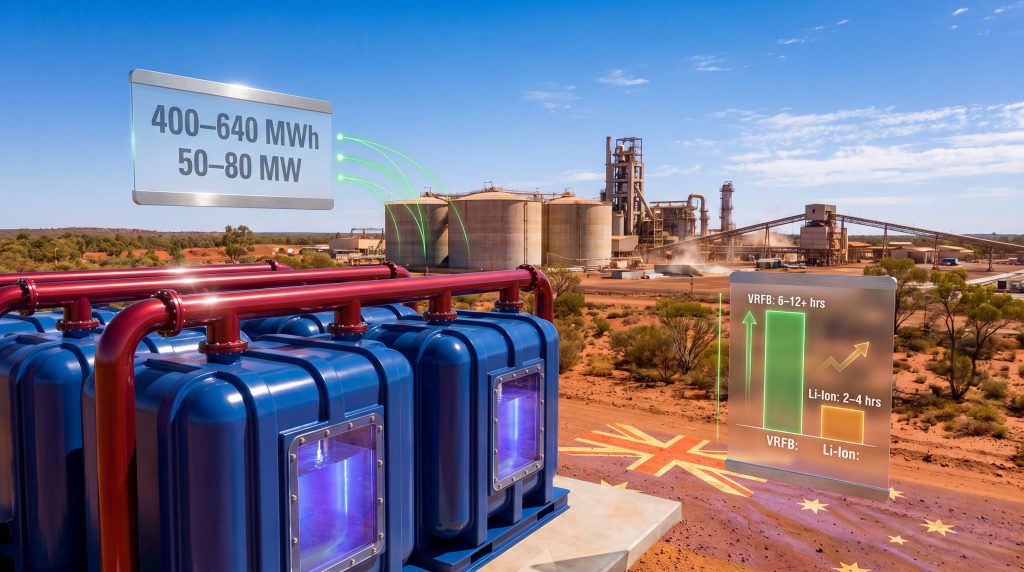
| Discharge Duration | 6–12+ hours | 2–4 hours (typical) |
| Cycle Degradation | Near-zero capacity loss over lifetime | Gradual capacity fade over cycles |
| Scalability | Power and energy scaled independently | Coupled scaling constraints |
| Electrolyte Reusability | Indefinite (vanadium is retained and recoverable) | Not applicable |
| Optimal Use Case | Industrial baseload smoothing, long-duration grid support | Short-duration peak shaving, EV applications |
| Fire Risk Profile | Low (aqueous, non-flammable electrolyte) | Higher thermal runaway risk |
A particularly underappreciated characteristic of VRFB technology is that the vanadium electrolyte does not degrade over time in the way that electrode materials in lithium-ion cells do. The electrolyte retains its energy capacity indefinitely, meaning the asset essentially holds its performance for the full operational life of the system, which can extend to 25 years or more.
One lesser-known implication for project economics is that the vanadium electrolyte itself retains significant residual commodity value at end-of-life, functioning almost as a liquid asset on the balance sheet rather than a depreciating consumable. Consequently, this is a concept increasingly relevant to institutional project finance assessments and the broader battery raw materials market.
The AVL-Alcoa Scoping Study: Unpacking the Six Evaluation Pillars
The non-binding memorandum of understanding signed between AVL, VSUN Energy, and Alcoa of Australia establishes a structured framework for evaluating whether a vanadium battery energy storage system is technically and financially viable at Alcoa's WA refinery sites. It does not commit either party to construction or capital deployment.
The system parameters under assessment are substantial: a power output range of 50 to 80 MW, with total energy storage capacity of 400 to 640 MWh, and an examination of whether discharge duration could be extended beyond eight hours. At the upper bound, this would represent one of the largest industrial behind-the-meter vanadium BESS deployments proposed anywhere globally.
The scoping study examines six interconnected workstreams:
- Technical feasibility and system design specific to Alcoa's refinery load profiles and grid interconnection constraints
- Financial modelling and capital cost estimation benchmarked against Alcoa's energy procurement economics
- Electrolyte supply chain mapping, including potential procurement from AVL's operational Perth manufacturing facility
- Project financing structures, encompassing debt, equity, and potential asset-backed arrangements given the electrolyte's residual value
- Government funding and incentive eligibility across federal and state-level programs relevant to industrial energy transition
- Deployment site selection across Alcoa's Western Australian landholdings at Pinjarra, Wagerup, and Worsley
What makes this scoping study more than a routine feasibility exercise is the supply chain dimension embedded within it. The electrolyte supply considerations workstream directly connects the viability of a deployment at Alcoa's sites to the commercial throughput of AVL's upstream production assets, creating an integrated commercial test that very few vanadium battery evaluations have attempted at this scale in Australia.
AVL's Vertically Integrated Model: From Mine to Megawatt-Hour
The strategic architecture underlying the AVL-Alcoa collaboration is built on what industry participants are increasingly calling the pit-to-battery model — a vertically integrated supply chain that connects vanadium ore extraction directly to finished battery electrolyte and ultimately to deployed energy storage capacity.
The Supply Chain Architecture in Detail
AVL's primary upstream asset is a vanadium pentoxide project located approximately 50 kilometres south of Meekatharra in Western Australia, currently progressing through feasibility study stage with a targeted annual production capacity of 11,200 tonnes of vanadium pentoxide. This project sits within a broader WA vanadium development landscape that currently includes four active developers, positioning the state as a potentially significant global vanadium supplier.
Downstream of the mine, AVL operates a vanadium electrolyte facility in Perth, currently producing at a rate of 33 MWh per year. Whilst modest by the standards of the proposed Alcoa deployment, this facility serves a critical proof-of-concept function, demonstrating that Australian-origin vanadium can be converted to battery-grade electrolyte domestically rather than exported as a raw commodity and reimported as a finished product.
Why Domestic Electrolyte Supply Changes Project Economics
The global vanadium electrolyte supply chain is currently dominated by Asian manufacturers, particularly in China and Japan. Sourcing electrolyte internationally introduces price volatility exposure tied to vanadium commodity markets, currency fluctuations, and freight cost variability.
For a large-scale deployment in the 400–640 MWh range, electrolyte represents a material proportion of total project cost, meaning supply chain control is not merely a strategic preference but a genuine financial variable. Furthermore, a deployment at Alcoa's scale would require electrolyte volumes that significantly exceed AVL's current 33 MWh per year production capacity. This implies that a successful commercial outcome would simultaneously provide the demand anchor needed to justify a substantial expansion investment in AVL's Perth manufacturing operations — a compounding logic where the customer contract de-risks the supply expansion.
AVL's Parallel Project Pipeline: Building Commercial Momentum on Multiple Fronts
The Alcoa partnership does not exist in isolation. It forms one component of a multi-track commercial strategy that AVL is executing simultaneously across industrial and government market segments.
| Project | Partner | Scale | Status |
|---|---|---|---|
| Alcoa WA Refinery VBESS | Alcoa of Australia / VSUN Energy | 400–640 MWh | Scoping study underway (MoU signed) |
| Kalgoorlie VBESS Tender | Sumitomo Electric | 500 MWh | Stage 2 expression of interest submitted July 2025 |
| Perth Electrolyte Manufacturing | AVL (internal) | 33 MWh/yr production capacity | Operational |
| Meekatharra Vanadium Project | AVL (internal) | 11,200 t/yr V₂O₅ | Feasibility study stage |
The Kalgoorlie VBESS tender — a WA government initiative with a value of A$150 million targeting a 500 MWh system — represents a parallel but distinct commercial opportunity. AVL and Sumitomo Electric submitted a Stage 2 expression of interest in late July, combining AVL's domestic supply chain credentials with Sumitomo's manufacturing track record to create a competitive bid profile that is difficult for offshore-only suppliers to replicate.
Importantly, the two projects serve fundamentally different market segments. The Kalgoorlie tender is a government-procured, grid-scale application focused on network services. The Alcoa project is an industrial behind-the-meter application focused on peak demand management and energy storage supply chains. Running both tracks simultaneously accelerates electrolyte demand development and reduces the single-project concentration risk that has historically constrained junior battery material developers.
The next major ASX story will hit our subscribers first
Decarbonisation Economics: Federal Incentives and the 2028–29 Transition Window
The Australian federal government's announced A$2 billion low-emissions aluminium production credit scheme, commencing in 2028–29, is designed to support aluminium smelters transitioning to renewable energy sources with a target timeline of 2035. For Alcoa, an operator with the combined WA emissions footprint now taking shape, positioning its operations to benefit from these credits carries material revenue implications.
It is important to note that the production credit scheme targets aluminium smelting specifically. Whether Alcoa's alumina refining operations qualify under the programme's specific eligibility criteria will depend on final legislative design. Investors and industry observers should consequently treat the relationship between the Alcoa VBESS project and this federal programme as a directional alignment of incentives rather than a confirmed project-specific support mechanism.
The broader trajectory of mining decarbonisation economics is, however, unambiguous. With scope 1 emissions from Australian heavy industry facing progressive regulatory and financial pressure, the combination of long-dated gas commitments providing a transition bridge and battery storage providing peak demand management creates a hybrid energy architecture logic that is increasingly difficult for major industrial operators to ignore. In addition, renewable energy in mining is rapidly shifting from a sustainability aspiration to a core financial planning imperative.
Three Scenarios: What Happens After the Scoping Study
Scenario 1: Full Commercial Deployment
If the scoping study confirms technical and financial viability, a 400–640 MWh deployment would deliver meaningful peak demand cost savings for Alcoa across its WA refinery network. It would simultaneously create a sustained electrolyte offtake requirement that could justify a multi-fold expansion of AVL's Perth manufacturing capacity. The catalyst effect for Australia's wider vanadium battery industry would be substantial, providing a high-profile reference project capable of de-risking project finance for subsequent industrial deployments.
Scenario 2: Study Identifies Barriers Requiring Redesign
Technical barriers such as grid interconnection constraints or refinery load profile mismatches, or financial barriers around internal rate of return thresholds, could result in a modified project scope rather than a binary pass-or-fail outcome. A smaller initial deployment, a staged rollout, or a modified financing structure could all provide alternative pathways. This scenario does not necessarily redirect AVL's focus away from Alcoa, but it may shift the commercial timeline materially.
Scenario 3: Industry-Wide Catalyst Effect
If the Alcoa pilot proceeds and demonstrates commercial viability, the replication potential across WA's industrial base is considerable. VSUN Energy's deployment approach illustrates how mining processing operations, lithium hydroxide refineries, and LNG facilities — all sharing continuous-process, high peak-demand energy profiles — could benefit from long-duration vanadium battery storage. A successful Alcoa deployment would transform vanadium BESS from a promising industrial option into a validated procurement category for WA's resource sector.
Analyst Note: This article is intended for informational purposes only and does not constitute financial or investment advice. Forward-looking statements, scenario projections, and assessments of commercial outcomes involve inherent uncertainty. Readers should conduct independent due diligence before making any investment decisions related to companies or projects discussed herein.
Frequently Asked Questions: Vanadium BESS and the AVL-Alcoa Partnership
What does the AVL-Alcoa MoU actually commit each party to?
The memorandum of understanding is a non-binding agreement to jointly conduct a scoping study. Neither party is committed to construction or capital expenditure at this stage. It establishes a structured framework for evaluating technical and financial viability.
How does vanadium battery technology compare to lithium-ion at industrial scale?
Vanadium redox flow batteries offer discharge durations of 6–12 or more hours, near-zero capacity degradation over their operational life, and independent scaling of power and energy. Lithium-ion systems typically deliver 2–4 hours of discharge and experience gradual capacity fade. For industrial baseload smoothing, the VRFB profile is structurally better suited.
Is the vanadium electrolyte a depreciating asset?
Unlike lithium-ion electrode materials, vanadium electrolyte retains its energy capacity indefinitely and can be recovered and reused at end-of-system-life. This gives VRFB projects a residual commodity value that affects long-term project economics in ways that are underappreciated in standard energy storage comparisons.
Where would the electrolyte for the Alcoa project come from?
The scoping study explicitly examines electrolyte supply options, which may include AVL's operational Perth manufacturing facility, currently producing at 33 MWh per year. Domestic sourcing reduces exposure to Asian supply chain pricing and logistics variability.
How does this relate to the Kalgoorlie VBESS tender?
The two projects serve distinct markets. The Kalgoorlie tender is a government-procured grid-scale system pursued with Sumitomo Electric. The Alcoa project is a behind-the-meter industrial application. Both, however, advance electrolyte demand development and AVL's commercial pipeline simultaneously.
Has vanadium flow battery technology been deployed at this scale before?
Yes. Multi-hundred MWh vanadium redox flow battery installations have been commissioned in China and Japan, including systems exceeding 800 MWh. The technology is commercially mature at industrial scale; the key variables in the Australian context are project economics, domestic electrolyte supply cost, and site-specific engineering requirements.
Want to Know Which ASX Companies Are Making the Next Major Resource Discovery?
Discovery Alert's proprietary Discovery IQ model scans ASX announcements in real time, instantly identifying significant mineral discoveries across 30+ commodities — turning complex data into actionable investment insights for both short-term traders and long-term investors. Explore historic discoveries and their remarkable market returns, then begin your 14-day free trial at Discovery Alert to position yourself ahead of the broader market.