August 4, 2026
India's Coal Reserve Race: Why State Miners Are Doubling Down on Domestic Geology
Across the global energy landscape, a quiet but consequential tension is playing out between the urgency of energy transition and the stubborn mathematics of baseload power demand. In economies where hundreds of millions of people still depend on coal-fired electricity for daily life, the calculus is far less clean than it appears on a policy document. India sits at the centre of this tension more acutely than almost any other major economy, and the decisions being made by its state-owned coal companies today will define the country's energy architecture well into the 2040s.
It is within this context that the recent coal block auction activity of Singareni Collieries Company Limited (SCCL) takes on considerable strategic weight. The acquisition of the Singareni PKOC-2 coal block, formally designated as the PKOC-2 Dip Side block near Manuguru in Bhadradri Kothagudem district, Telangana, is not simply a routine reserve addition. It is a signal of deliberate institutional repositioning by one of India's most significant sub-national energy companies.
When big ASX news breaks, our subscribers know first
SCCL's Place in India's Coal Supply Architecture
Most discussions of Indian coal production default quickly to Coal India Limited (CIL), the world's largest coal mining company by output. However, SCCL occupies a structurally distinct and critically important role that is often underappreciated. Operating exclusively within the Godavari Valley coalfields of Telangana, SCCL functions as both a commercial mining enterprise and an energy security instrument for the state.
Unlike CIL's decentralised subsidiary model spread across multiple states, SCCL's operational concentration in a single geological basin creates both advantages and vulnerabilities. The advantages are operational: deep institutional knowledge of the Godavari Valley's stratigraphy, established infrastructure, and strong community relationships built over decades. The vulnerability is equally obvious: single-basin dependency exposes the company to geological depletion risk as legacy mine reserves begin to thin.
India's structural coal demand trajectory amplifies this pressure. The country's power sector consumed approximately 975 million tonnes of coal in the fiscal year 2023-24, and near-term forecasts from the Central Electricity Authority project continued growth in thermal capacity additions through the late 2020s. Despite aggressive renewable energy targets, coal remains the dominant source of dispatchable baseload generation, particularly during periods of low wind and solar output. The broader debate around coal and renewable balancing is playing out across Asia, and state-owned entities like SCCL are not operating in a declining market in any near-term sense. They are operating in a market where the stakes of supply continuity are exceptionally high.
What Is the PKOC-2 Dip Side Coal Block? Technical Profile and Reserve Metrics
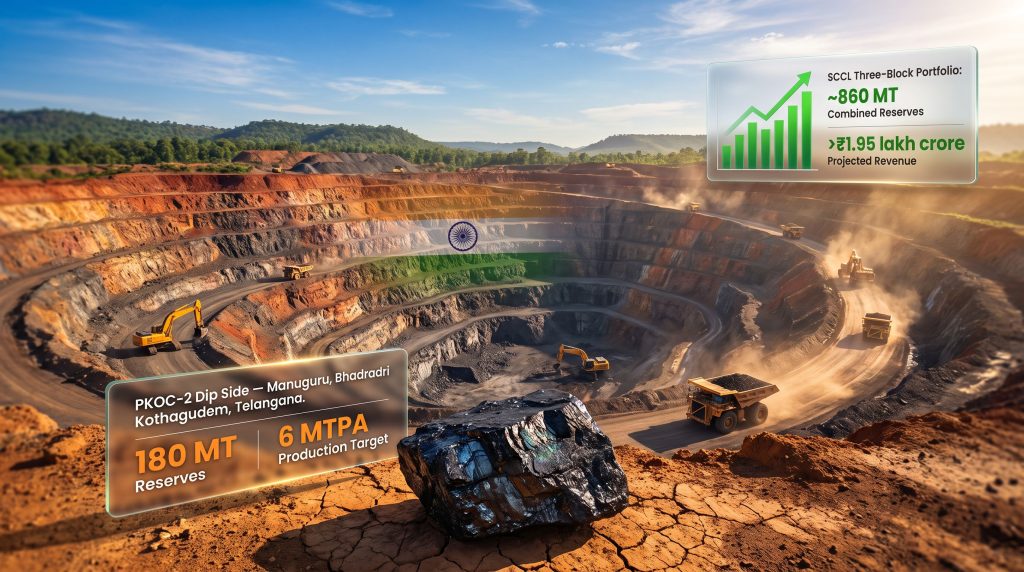
The name PKOC-2 derives from Prakasam Khani Open Cast-2, with the Dip Side designation referring to the downdip geological extension of the existing Prakasam Khani mining lease area. This naming convention is important to understand because earlier regulatory filings referenced a closely related allocation as the PKOC Dip Side Extension, citing approximately 120 million tonnes in reserves. The current authoritative figure for the Singareni PKOC-2 coal block stands at 180 million tonnes, reflecting updated geological assessments for the current allocation.
Key Reserve and Production Metrics
| Metric | PKOC-2 Dip Side Block |
|---|---|
| Estimated Coal Reserves | ~180 million tonnes (MT) |
| Annual Production Target | ~6 million tonnes per year |
| Projected Mine Life | ~25 years |
| Coal Grade | G-8 (thermal) |
| Projected SCCL Revenue | >₹43,000 crore |
| Telangana Government Revenue | >₹10,500 crore |
| Direct Employment Created | ~2,000 persons |
| Location | Manuguru, Bhadradri Kothagudem, Telangana |
The block produces G-8 grade thermal coal, which sits in the mid-range of India's grading system based on the Useful Heat Value (UHV) classification. G-8 coal carries a UHV ranging broadly between 3,361 and 4,200 kilocalories per kilogram, making it well suited to the operating parameters of most Indian thermal power plants. Critically, domestic power utilities tend to be configured specifically for lower-to-mid grade Indian coals, meaning G-8 material faces minimal offtake risk compared to imported higher-grade alternatives that require blending or boiler modifications.
The Manuguru sub-basin within the Godavari Valley coalfield has well-documented geological continuity. The dip side configuration of the block means the coal seams extend at depth from the existing mining operations, allowing SCCL to leverage existing surface infrastructure, haul roads, and washery facilities as the new mine is developed. This geological adjacency is a material cost advantage that greenfield blocks in entirely new territories cannot replicate. Furthermore, the coal supply challenges facing India's energy sector make this kind of infrastructure advantage all the more strategically valuable.
How India's Coal Block Auction System Works
Understanding why the PKOC-2 allocation matters requires familiarity with how India's coal block auction framework operates. The system underwent fundamental reform following the Supreme Court's 2014 cancellation of 204 coal block allocations on grounds of procedural irregularity. The subsequent Mines and Minerals (Development and Regulation) Amendment Act established a competitive bidding framework designed to replace discretionary allocation with transparent price discovery.
The regulatory lifecycle of a new coal block follows a defined sequence:
- Block identification by the Ministry of Coal, informed by Geological Survey of India assessments and national energy planning priorities.
- Auction notification published under the competitive bidding framework, specifying technical and financial eligibility criteria.
- Bid submission and evaluation against technical capacity benchmarks and revenue share offer to the state government.
- Block allocation and vesting order issued to the winning bidder, establishing legal title over the resource.
- Environmental and forest clearances obtained from the Ministry of Environment, Forest and Climate Change (MoEFCC), representing the most variable and potentially lengthy stage of the development pipeline.
- Mine development either through direct SCCL execution or via a Mine Developer and Operator (MDO) contractor arrangement.
- First coal dispatch marking commencement of royalty and levy payments to the state government.
A provision introduced under the 2021 commercial mining liberalisation reforms allows state government-owned entities to participate in auctions alongside private sector bidders, which is the mechanism through which SCCL secured the PKOC-2 block. The District Mineral Foundation (DMF), a statutory body established under the MMDR Act, collects a percentage of royalties from successful bidders to fund local community development in mining-affected districts.
The Three-Block Portfolio Strategy: A Structural Transformation
The PKOC-2 allocation is the third block SCCL has secured in a deliberate multi-block acquisition programme. Viewed individually, each acquisition is significant. Viewed as a portfolio, however, the strategy represents a fundamental restructuring of SCCL's long-term reserve base.
Three-Block Portfolio at a Glance
| Block Name | Location | Key Contribution |
|---|---|---|
| Naini Coal Block | Odisha | Cross-state reserve diversification |
| Tadicherla-2 Block | Telangana | Proximate to existing SCCL operations |
| PKOC-2 Dip Side | Manuguru, Telangana | 180 MT reserves; 6 MTPA production target |
| Combined Portfolio Total | Multi-state | ~860 MT reserves; ~22 MTPA production |
The aggregate numbers are striking. Combined, the three blocks are projected to add approximately 860 million tonnes of coal reserves, support ~22 million tonnes per year of production capacity across an average mine life of ~35 years, generate more than ₹1.95 lakh crore in revenue for SCCL, contribute approximately ₹48,000 crore to the Telangana state government, and create direct employment for around 6,500 people.
Portfolio Insight: The combined three-block programme shifts SCCL from a single-basin operator into a geographically diversified mining company with a multi-decade production horizon. This transition materially reduces the geological depletion risk that has quietly shadowed the company's legacy operations in the Godavari Valley.
The Naini block in Odisha deserves particular attention as a strategic signal. SCCL's operational history is entirely anchored in Telangana's Godavari coalfields. The Naini allocation marks the company's first significant cross-state resource acquisition and introduces a new dimension of operational complexity, including inter-state coal transport logistics, different state-level regulatory relationships, and a distinct geological setting. The strategic logic, however, is clear: geographic diversification reduces the risk of a single basin's depletion cascading into company-wide production shortfalls.
Economic and Fiscal Implications for Telangana
The fiscal arithmetic of the PKOC-2 allocation extends well beyond SCCL's own balance sheet. Coal royalties, surface rent, DMF contributions, and state GST receipts from mining activity collectively form a meaningful component of Telangana's mining sector revenues. In addition, the broader context of Australia's resource and energy exports demonstrates how consequential domestic coal policy decisions can be for long-term fiscal planning across the Asia-Pacific region.
The ₹10,500 crore projected state revenue from PKOC-2 alone represents a long-duration income stream extending approximately 25 years, providing the Telangana government with a degree of fiscal predictability that is difficult to replicate from more volatile revenue sources. When combined with the Naini and Tadicherla-2 blocks, the aggregate projected state revenue reaches approximately ₹48,000 crore across the portfolio's operational lifetime.
At the district level, the employment dimension is particularly relevant. Bhadradri Kothagudem district has historically been one of Telangana's most mining-dependent economies. The ~2,000 direct jobs anticipated from PKOC-2 operations would reinforce this dependency while providing formal employment at wage rates typically above local agricultural alternatives. Beyond direct employment, the indirect multiplier effects in mining-adjacent sectors such as equipment maintenance, transport, catering, and contract services typically expand the total employment impact by a factor of two to three relative to direct headcount.
Industrial Energy Security: The G-8 Grade Advantage
One dimension of the PKOC-2 allocation that receives insufficient attention is its direct relevance to Telangana's power sector cost structure. State power utilities that source coal from SCCL benefit from pricing arrangements and logistical simplicity that imported coal cannot match. G-8 grade coal's calorific value range aligns closely with the design parameters of most thermal power stations operating in Telangana, reducing the need for blending regimes or boiler modifications.
Expanding SCCL's production capacity through blocks like PKOC-2 therefore directly supports Telangana's ability to maintain affordable industrial electricity tariffs, a factor that is consequential for the state's manufacturing competitiveness.
The next major ASX story will hit our subscribers first
Competitive Benchmarking: Where Does PKOC-2 Stand?
| Dimension | PKOC-2 (SCCL) | Industry Benchmark Range |
|---|---|---|
| Reserve Size | 180 MT | 50-500 MT (typical captive blocks) |
| Annual Production Target | 6 MTPA | 2-15 MTPA |
| Mine Life | 25 years | 20-40 years |
| Coal Grade | G-8 | G-6 to G-12 (common thermal grades) |
| Revenue to Allocatee | >₹43,000 crore | Varies by grade and scale |
The PKOC-2 block's combination of substantial reserve size, well-defined production ramp-up, and proximity to existing infrastructure positions it toward the stronger end of recent captive block allocations by state-owned entities. The geological adjacency to existing SCCL operations is a differentiated advantage that reduces both the capital expenditure and the timeline risk associated with pure greenfield developments.
Long-Term Risks: What Could Disrupt the 25-Year Production Thesis?
Any honest assessment of the PKOC-2 allocation must engage with the risks that sit between announcement and realisation.
Environmental and forest clearance timelines represent the most immediate execution variable. In India's coal sector, the clearance process has historically ranged from two to seven years depending on the environmental sensitivity of the land in question. Bhadradri Kothagudem district contains significant forested terrain, and any forest land diversion requirements under the Forest Conservation Act could extend the pre-production development timeline meaningfully. The current clearance status of the Singareni PKOC-2 coal block should be verified against the latest filings with MoEFCC before any production timeline assumptions are treated as definitive.
Energy transition risk over a 25-year horizon introduces a different category of uncertainty. India's coal demand is broadly consensus-supported through the 2030s, with multiple government planning documents projecting thermal capacity additions well into that decade. The period beyond 2040, however, involves genuine uncertainty. A 25-year mine life extending potentially to 2050 or beyond raises legitimate questions about stranded asset exposure under more aggressive decarbonisation scenarios. India's current policy stance emphasises a managed transition that preserves coal for baseload reliability while scaling renewables, but the pace and political durability of that stance over a multi-decade horizon cannot be treated as fixed. Proposals such as the India coal trading exchange further illustrate how India's domestic coal market is evolving in response to these long-term structural pressures.
Operational complexity at the portfolio level is the third risk vector. Managing simultaneous mine development programmes across three geographically dispersed sites in two different states requires significant organisational bandwidth, capital allocation discipline, and MDO contractor management capability. SCCL's track record in the Godavari Valley is strong, but the cross-state dimension introduced by the Naini block in Odisha is genuinely new territory for the organisation. Furthermore, the global steel demand outlook adds another layer of complexity, as shifts in industrial coal demand can ripple through the broader energy and commodities supply chain.
Disclaimer: This article contains forward-looking projections sourced from published official announcements and industry data. Reserve estimates, revenue projections, and employment forecasts are subject to geological, regulatory, market, and operational risks. They should not be interpreted as guaranteed outcomes. Readers making financial or investment decisions should consult independent professional advice.
Frequently Asked Questions: Singareni PKOC-2 Coal Block
What does PKOC-2 stand for?
PKOC-2 refers to Prakasam Khani Open Cast-2, specifically the Dip Side extension of the coal block located near Manuguru in Bhadradri Kothagudem district, Telangana. It was secured by SCCL through the Government of India's competitive coal block auction mechanism.
How much coal can the PKOC-2 block produce annually?
The block is projected to yield approximately 6 million tonnes of G-8 grade thermal coal per year across an estimated operational life of 25 years.
What is the total reserve size of the PKOC-2 block?
Current authoritative estimates place reserves at approximately 180 million tonnes. Earlier documents referencing a related allocation cited approximately 120 million tonnes, but 180 MT represents the operative figure for the current PKOC-2 Dip Side designation.
How much revenue will PKOC-2 generate?
Over its operational lifetime, the block is projected to generate more than ₹43,000 crore for SCCL and over ₹10,500 crore for the Telangana state government through royalties and associated levies.
How many jobs will the block create?
Direct employment of approximately 2,000 people is anticipated in the Bhadradri Kothagudem region, with additional indirect employment multiplier effects across mining-adjacent industries.
What are SCCL's other recently acquired blocks?
Alongside PKOC-2, SCCL has secured the Naini coal block in Odisha and the Tadicherla-2 block in Telangana. Together, the three blocks are projected to add approximately 860 million tonnes of reserves and support combined annual production of around 22 million tonnes over an average mine life of 35 years.
Want to Stay Ahead of Major Resource Discoveries Before the Broader Market Catches On?
While India's state miners are quietly repositioning their reserve bases for the decades ahead, Discovery Alert's proprietary Discovery IQ model scans ASX announcements in real time, instantly identifying significant mineral discoveries across more than 30 commodities and turning complex geological data into actionable investment insights. Explore historic discoveries and their remarkable returns, then begin your 14-day free trial at Discovery Alert to secure your market-leading edge before the next major find is priced in.