August 5, 2026
The Stubborn Frontier: Why Diamond Drilling Still Runs on Human Muscle
Across the broader mining automation landscape, the headlines have long celebrated driverless haul trucks, autonomous blast-hole drills, and remotely piloted loaders navigating underground headings without a single operator in the cab. Yet one of the most physically punishing tasks in all of mining has remained almost entirely manual: the handling of drill rods during diamond core drilling operations. Understanding why this gap persists, and what it signals about the next wave of mining drill rig automation, requires looking beyond the machinery and into the biomechanics, labour economics, and engineering constraints that have kept human hands at the centre of exploration drilling for decades.
When big ASX news breaks, our subscribers know first
The Physical Reality of Manual Rod Handling
Diamond drilling is the primary method used to retrieve core samples during mineral exploration, and the rod string is the mechanical backbone of every hole drilled. Individual drill rods typically measure nine metres in length and can weigh up to 75 kilograms per unit. Crews must grip, align, thread, add, and retrieve these rods repeatedly across multi-hour shifts, often in confined underground environments or exposed surface sites operating in extreme climates.
The cumulative musculoskeletal load is substantial. Unlike isolated heavy lifts, rod handling involves repeated awkward-posture loading combined with rotational torque as threads are engaged, vibration exposure from proximity to active drill strings, and the psychological pressure of maintaining timing precision during the rod-change sequence. Fatigue compounds these risks across shift cycles, and the hazard profile intensifies during extended programs in remote northern Canada or high-altitude South American operations where temperature extremes add physical stress to an already demanding task.
What makes this occupational health challenge particularly acute is that it compounds with one of mining's most persistent structural problems: the difficulty of recruiting and retaining qualified drill operators. Skilled diamond drillers represent one of the hardest roles to fill across Canadian, Australian, and South American operations. The combination of remote postings, physical demands, occupational health exposure, and irregular scheduling creates a recruitment environment that has deteriorated steadily as the broader labour market has tightened.
High turnover rates mean institutional knowledge walks out the door regularly, and the cost of replacing and training experienced crews is substantial for operators running large drilling programs. This dual pressure — elevated injury rates combined with chronic labour shortages — is precisely what is now driving serious capital allocation toward mining drill rig automation solutions for the rod-handling problem.
What Mining Drill Rig Automation Actually Encompasses
The phrase automation covers a wide spectrum of technical capability, and understanding where different solutions sit on that spectrum is essential for evaluating both the technology landscape and the investment opportunity.
| Automation Level | Human Input Required | Key Tasks Automated | Deployment Maturity |
|---|---|---|---|
| Tele-remote | Continuous operator oversight | Rig control from a safe distance | Mature / Widespread |
| Semi-autonomous | Supervisory only | Auto-level, auto-collar, auto-drill | Mature / Growing |
| Fully autonomous (single rig) | Minimal / Exception-based | Full drill cycle including rod handling | Emerging / Commercial |
| Fleet autonomy (multi-rig) | One operator, multiple rigs | Tramming, drilling, pipe handling | Early Commercial |
| Cabinless autonomous rig | Remote monitoring only | All functions, battery-electric | Concept / Pilot Stage |
The industry has moved well beyond tele-remote control as a technological endpoint. Fleet-level autonomy, where a single operator supervises fifteen or more surface drill rigs from a connected operations centre, is now actively marketed and deployed by major original equipment manufacturers. The commercial reality of one person managing a fleet of rigs would have seemed implausible a decade ago; today it is a selling point in product brochures.
For exploration diamond drilling specifically, the automation frontier sits at the rod and inner tube manipulation sequence. This is not a solved problem. Unlike production blast-hole drilling, where GPS-guided positioning and automated pipe handling have been commercially deployed at scale for years, the mechanical complexity of diamond drill rod handling in variable environments has kept the task stubbornly human-dependent.
The Engineering Problem That Has Kept Rod Handling Manual
Designing an automated system capable of reliable rod handling is not an incremental engineering improvement on existing technology. It is a materials science, actuation, and control systems problem of considerable depth, which explains why this specific task has lagged behind the broader automation curve.
The operating specification required by major Canadian mine operators illustrates the challenge clearly. Any viable automated rod-handling solution must:
- Function reliably across a temperature range spanning minus 50°C to plus 40°C, demanding seal materials, hydraulic fluids, and electronic components engineered for extreme thermal cycling
- Handle rods and inner tubes weighing up to 75 kilograms, with actuator design carrying appropriate safety load margins for dynamic rather than static loads
- Complete a full rod-handling cycle in 40 seconds or less, placing significant demands on actuation speed and positional repeatability under operational conditions
- Maintain mechanical compatibility across a diverse fleet of existing drill-rig models without requiring complete rig replacement, meaning modular attachment architecture is essential
- Incorporate remote-operation capability as a designed-in architectural feature rather than a retrofit possibility
The 40-second cycle time benchmark is particularly demanding. A system that achieves reliable grip, precise thread alignment, and safe rod transit in under a minute — while operating at temperatures cold enough to affect metal contraction and lubricant viscosity — represents a genuine engineering achievement. The fact that this specification has been outstanding for years without a commercial solution demonstrates that the problem is hard enough to have defeated multiple development attempts.
Underground deployment adds a further layer of complexity. GPS-based positioning, which has enabled much of the autonomous capability in surface applications, is unavailable underground. Alternative positioning approaches including laser scanning, inertial navigation systems, and ultra-wideband network-based localisation must substitute, adding system complexity and requiring reliable high-bandwidth underground communication infrastructure to support remote supervision.
Surface vs. Underground: Comparing the Two Automation Environments
| Parameter | Surface Automation | Underground Automation |
|---|---|---|
| Positioning technology | GPS / GNSS | Laser, inertial navigation, UWB networks |
| Fleet management maturity | High (15+ rig supervision proven) | Moderate (single to small fleet scale) |
| Rod handling automation | Commercially deployed at scale | Active development frontier |
| Environmental extremes | Temperature, dust, terrain variation | Confined space, ground instability, humidity |
| Communication infrastructure | Relatively straightforward to establish | Requires dedicated underground network investment |
Surface drilling automation has benefited enormously from GPS precision. Three-dimensional hole targeting, automated tramming between collars, and centralised fleet management are all GPS-dependent capabilities that transfer cleanly from open-pit production drilling to surface exploration programs. The commercial maturity of surface automation explains why PwC analysis has documented a compound annual growth rate of approximately 74% for automated drills in open-pit operations since 2008 — a figure that reflects sustained structural transition rather than cyclical equipment purchasing.
Underground diamond drilling, however, lacks these positioning advantages and imposes spatial constraints on robotic handling systems that have no surface equivalent. Development headings and stopes provide limited room for mechanical arm articulation, and the ground instability risks inherent in underground environments raise the safety engineering bar substantially. Furthermore, downhole geophysics techniques must increasingly integrate with these automated systems to deliver meaningful subsurface intelligence.
The Commercial Scale Behind the Automation Procurement Wave
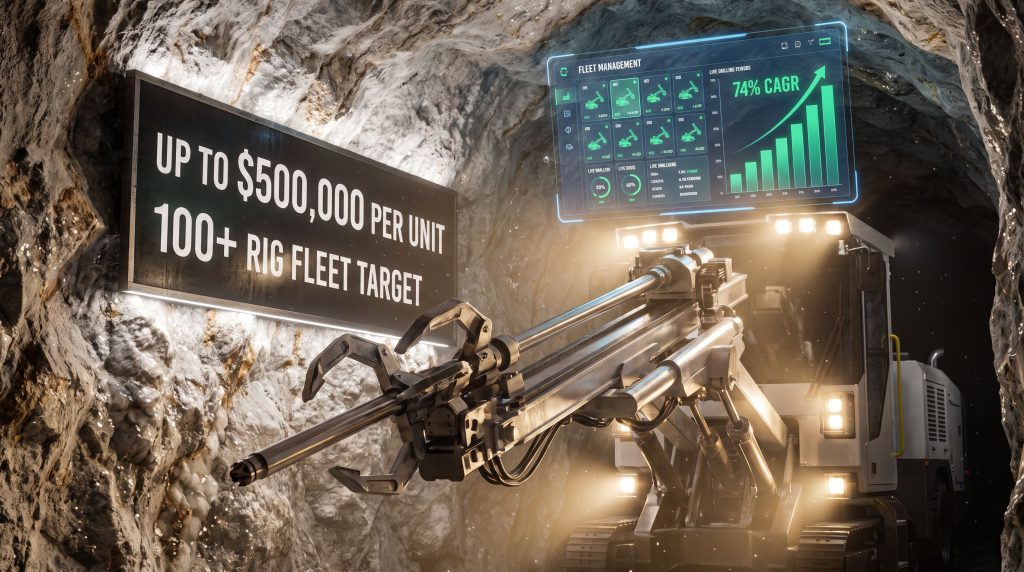
The scale of the current procurement opportunity provides important context for evaluating why technology developers are prioritising this challenge. The program under active development through the Mining Innovation Commercialization Accelerator (MICA), Canada's mining innovation intermediary, reflects specifications from a major Canadian operator targeting deployment across a fleet of more than 100 rigs at a budget of up to $500,000 per automated unit.
The arithmetic is straightforward:
- 100+ rigs targeted for fleet deployment
- $500,000 maximum budget per automated rod-handling unit
- Total potential procurement value exceeding $50 million for a single operator's program alone
- Field testing commencing in 2027, establishing a defined commercialisation timeline
Critically, the operator has signalled willingness to co-develop early-stage solutions and purchase testing units ahead of any fleet commitment. This is an unusually supportive procurement posture that materially de-risks the development pathway for technology companies with promising but pre-commercial solutions. The stage-gate pipeline moves from challenge submission through co-development, testing unit procurement, field trials against defined key performance indicators, and ultimately fleet rollout decisions.
Operators willing to participate financially in the development of pre-commercial solutions represent a structural shift from reactive procurement to collaborative innovation. For technology developers, this changes the risk calculus significantly.
The next major ASX story will hit our subscribers first
The Data Intelligence Layer: Beyond Mechanical Automation
Modern mining drill rig automation is increasingly inseparable from the data systems operating alongside mechanical functions. The sensor stack embedded in contemporary automated rigs generates continuous operational intelligence that transforms drilling from a mechanical process into a data-generating activity with direct implications for exploration decision-making.
Measurement-while-drilling (MWD) is particularly significant in this context. MWD systems capture penetration rate, torque, thrust, and rotational speed as the drill advances, creating a continuous proxy log of subsurface conditions without requiring the drill string to be withdrawn. In automated systems, this data feeds directly into control algorithms that adjust drilling parameters in real time. For exploration geologists, MWD data provides near-real-time lithological intelligence that can inform where to target the next hole before the core from the current one has even been logged.
The broader data integration stack includes:
- GPS and 3D positioning systems enabling precise spatial referencing of every drill hole in a program
- Predictive maintenance algorithms analysing vibration signatures, hydraulic pressures, and component cycle counts to anticipate failure before unplanned downtime occurs
- Digital twin platforms providing real-time operational visibility across active rig fleets
- Fleet management systems enabling centralised supervision and performance benchmarking across multi-rig programs
Predictive maintenance integration deserves particular attention as an often-underappreciated value driver. Unplanned downtime during a drill program is extraordinarily expensive in remote operations, where mobilising replacement components or technicians can take days. A system that accurately predicts component failure with sufficient lead time to schedule maintenance during planned downtime windows eliminates one of the most damaging cost variables in exploration drilling program management.
The Vendor Landscape: Where the Technology Is Coming From
Production drilling automation has been shaped primarily by two dominant OEM platforms. Sandvik's AutoMine system supports remotely operated and fully autonomous equipment across surface and underground environments, including a cabinless, battery-electric twin-boom concept rig capable of executing complete drilling cycles autonomously. Epiroc's Rig Control System provides a modular automation architecture spanning tele-remote through fully autonomous modes with integration into broader fleet management ecosystems. Both companies have made autonomy depth, rather than mechanical performance alone, their primary competitive differentiation.
The exploration diamond drilling segment presents a fundamentally different competitive structure. Major OEMs have directed the majority of their automation investment toward production applications, leaving exploration rig automation as a genuine white-space opportunity. Innovation accelerator programs like MICA are now actively soliciting solutions from non-traditional suppliers, including robotics integrators, aerospace technology companies, and industrial automation specialists who may bring transferable capability from adjacent sectors.
This openness to non-traditional entrants reflects an important industry insight: the engineering skills required to solve the rod-handling automation problem — including precision actuation in extreme environments, reliable positional control in confined spaces, and robust mechanical design for high-cycle-count applications — are not unique to mining. Companies with relevant capability in oil and gas automation, manufacturing robotics, or defence equipment may be better positioned than mining-specialist firms to crack this specific technical challenge. In addition, AI in drilling automation is reshaping how developers approach algorithm design for these systems.
From Prototype to Fleet: The Commercialisation Pathway
For technology developers evaluating this opportunity, the commercialisation pipeline follows a logical sequence:
- Challenge submission and qualification against defined operator specifications covering payload, cycle time, temperature range, and rig compatibility
- Early-stage co-development with operator financial participation, reducing the capital burden on innovators during the highest-risk development phase
- Testing unit procurement providing initial units for real-world validation ahead of fleet commitment
- Field trials and performance benchmarking against defined KPIs in live operational environments, with 2027 as the current target for initial testing
- Fleet rollout decision triggered by successful field performance, potentially covering 100-plus rig deployments
The 2027 testing timeline creates a compressed development window for solutions that are currently at early-stage or prototype readiness. Developers entering the challenge process in 2026 have roughly twelve to eighteen months to advance solutions to a testable state, which is aggressive but not unprecedented for well-capitalised teams with relevant prior technology.
What the Automation of Exploration Drilling Signals for the Industry
Zooming out from the specific technical and commercial details, the push toward mining drill rig automation in diamond drilling reflects something more fundamental: the exploration industry is being forced to industrialise a process that has operated on craft-skill and physical labour for well over a century.
The structural drivers — labour shortages, injury costs, productivity imperatives, and data quality demands — are not going away. If anything, as exploration programs push into increasingly remote and hostile environments to find the next generation of ore deposits, the case for removing human workers from the immediate drilling environment strengthens. Consequently, interpreting drill results will increasingly depend on the quality of data generated by these automated systems rather than manual logging alone.
The future drill program, managed from a surface operations centre with autonomous rigs executing hole sequences based on geologist-defined targets whilst transmitting continuous MWD data for real-time model updates, is not science fiction. It is the logical endpoint of trends already underway. The near-term milestones — 2027 field trials, 2028 to 2030 commercial fleet deployments, and progressive integration of AI-driven drilling optimisation — will determine which technology developers and OEM platforms capture the value created by this transition. The exploration drilling automation gap is closing. The question is who closes it first.
For ongoing coverage of mining automation developments and innovation programs across the Canadian mining sector, readers can explore related industry reporting through the Canadian Mining Journal, which covers equipment advances, technology innovation, and operational developments in depth.
Disclaimer: This article contains forward-looking statements, market projections, and growth rate references sourced from third-party analyses. These figures are provided for informational purposes only and should not be construed as investment advice. Mining automation market conditions, technology development timelines, and procurement outcomes are subject to change. Readers should conduct independent research before making investment or commercial decisions.
Want to Know When the Next Major Mineral Discovery Hits the ASX?
Discovery Alert's proprietary Discovery IQ model scans ASX announcements in real time, instantly identifying significant mineral discoveries and turning complex exploration data into actionable investment insights — ideal for anyone tracking the companies driving the next wave of exploration innovation. Explore historic discoveries and their market returns, then begin your 14-day free trial to position yourself ahead of the broader market.