August 21, 2026
The Physics of Power: Why Copper Demand from AI Data Centres Is Rewriting Commodity Forecasts
Few forces in modern industrial history have reshaped a commodity's demand outlook as rapidly as the convergence of artificial intelligence and hyperscale computing infrastructure. Unlike previous technology-driven demand cycles, which often substituted materials or reduced physical input requirements, the build-out of AI data centres is doing the opposite. It is consuming more copper per unit of compute, not less. Understanding why this is happening at a physics and engineering level, and what it means for supply chains stretched across decades of underinvestment, is essential context for anyone tracking copper demand from AI data centres.
When big ASX news breaks, our subscribers know first
Copper Intensity by Data Centre Type: The Numbers That Matter
The starting point for any serious analysis of copper's AI-driven demand story is understanding how dramatically different AI facilities are from conventional data infrastructure in terms of physical copper content.
| Data Centre Type | Copper per MW of Installed Capacity | Total Copper per Facility |
|---|---|---|
| Conventional Data Centre | ~15–21 tonnes/MW | 5,000–15,000 tonnes |
| Standard AI/Cloud Data Centre | 27–33 tonnes/MW | Up to 30,000 tonnes |
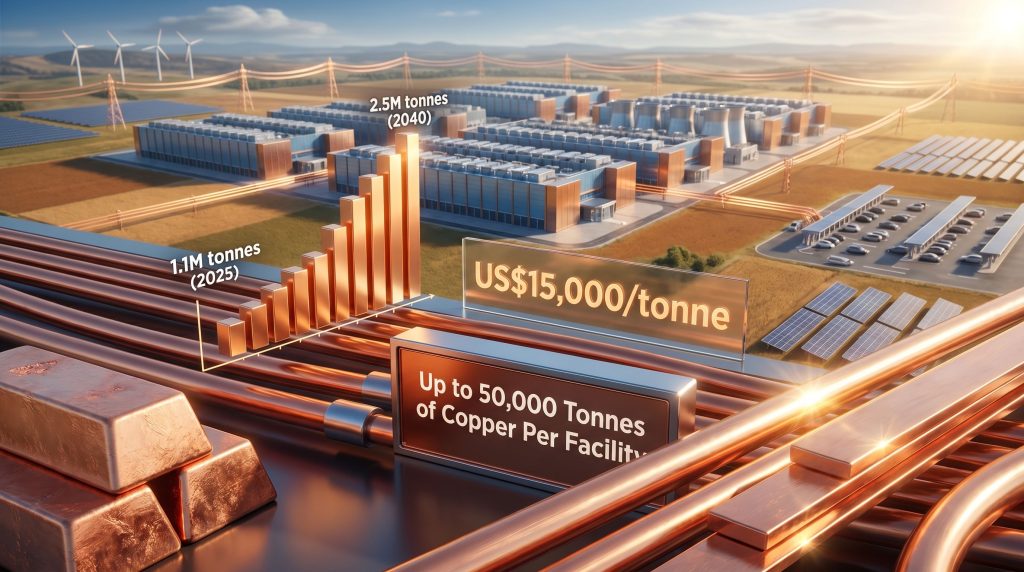
| Hyperscale AI Data Centre (Training) | Up to 47 tonnes/MW | Up to 50,000 tonnes |
These are not marginal differences. A hyperscale AI training facility can contain more than three times the copper of a conventional data centre, and the reasons are deeply embedded in the engineering requirements of large-scale machine learning workloads. Furthermore, as BHP has outlined, the scale of this shift is only beginning to register in global commodity forecasts.
Why AI Workloads Demand More Copper Per Megawatt
The elevated copper intensity of AI infrastructure is a direct consequence of thermodynamics and electrical engineering, not simply scale. Several compounding factors drive this:
- Power Distribution Architecture: GPU clusters used in AI training operate at power densities that dwarf standard server racks. This requires heavier-gauge copper busbars, more robust transformers, and denser cabling throughout the facility's power distribution network.
- Liquid Cooling Systems: Conventional data centres predominantly rely on air cooling, which requires relatively little copper. AI facilities are rapidly transitioning to direct liquid cooling (DLC) and immersion cooling, both of which depend on copper cooling plates, precision heat exchangers, and fluid-transfer piping at the chip level.
- High-Speed Interconnects: Copper remains the dominant medium for short-distance, high-bandwidth data transmission between servers, switches, and storage arrays. Its electrical conductivity and cost-performance ratio at sub-100-metre distances make aluminium substitution impractical in these applications.
- Thermal Management Infrastructure: The heat flux produced by AI accelerator clusters is substantially higher than general-purpose compute environments, requiring proportionally more copper-intensive thermal dissipation systems throughout the facility.
A detail that is rarely discussed outside specialist engineering circles is that the transition to chip-level liquid cooling is one of the single largest structural drivers of increased copper intensity per megawatt. As AI chip power envelopes continue to expand, this trend is unlikely to reverse.
Projecting the Demand Trajectory Through 2040
The aggregate picture emerging from institutional forecasters across multiple research traditions is broadly consistent: copper demand from AI data centres is transitioning from a minor end-use category to one of the primary structural pillars of global consumption. The copper demand drivers underpinning this shift are reinforcing one another across multiple sectors simultaneously.
| Forecast Metric | Data Point | Source |
|---|---|---|
| Global data centre copper demand (2025) | ~1.1 million tonnes/year | Industry consensus |
| Global data centre copper demand (2040) | ~2.5 million tonnes/year | Industry projections |
| Annual data centre copper demand (2030 projection) | ~500,000 tonnes/year | BloombergNEF/industry |
| BloombergNEF peak AI facility demand estimate | 572,000 tonnes (2028) | BloombergNEF |
| AI training centres' share of data centre copper | ~58% | Research estimates |
| Cumulative copper in data centres by 2035 | ~4.3 million tonnes | Industry projections |
| Global data centre copper needs (BHP forecast 2050) | ~3 million tonnes/year | BHP |
| Current global data centre copper needs | ~500,000 tonnes/year | BHP |
| Global copper demand (2025) | ~28 million tonnes/year | S&P Global |
| Global copper demand (2040) | ~42 million tonnes/year | S&P Global |
BHP has projected that global data centre copper requirements will expand from approximately 500,000 tonnes per year currently to around three million tonnes annually by 2050, representing a sixfold increase driven primarily by AI infrastructure growth.
The Electricity Consumption Multiplier
Data centre power demand is the underlying engine behind this copper intensity growth. The International Energy Agency projects global data centre electricity consumption will reach approximately 945 TWh by 2030, roughly doubling from current levels. This has cascading implications:
- Every additional terawatt-hour of data centre power consumption requires proportional investment in grid connections, transformers, transmission lines, and distribution equipment, all of which are copper-intensive.
- The IEA characterises this as creating highly inelastic demand for copper, meaning that facilities cannot operate without it, and there are no viable substitutes for most applications at meaningful scale.
- A projected 165% increase in data centre power demand by 2030 translates directly into accelerating copper procurement requirements across every phase of the facility lifecycle.
What makes this dynamic particularly significant from a commodity markets perspective is that inelastic demand curves do not soften during price spikes. Data centre operators cannot simply reduce copper content when prices rise; they must procure what the physics of their systems require.
The Supply-Side Collision: A Structural Deficit Building in Slow Motion
The demand trajectory described above is colliding with a supply environment characterised by structural tightness, declining ore grades, and project development timelines that are inherently incompatible with the speed of AI infrastructure build-out. Indeed, the copper supply crunch is already being felt across procurement and project planning cycles globally.
JP Morgan has noted that global mine production remains constrained by persistent supply-side disruptions even as demand signals intensify across multiple end-use sectors simultaneously. Key supply-side dynamics creating this structural tension include:
- Declining Ore Grades: Existing copper deposits globally are yielding progressively lower-grade ore, increasing the cost and energy intensity of extraction per tonne of refined copper. This is a geological reality that cannot be engineered away; it represents decades of high-grade depletion across the world's major producing regions.
- Project Development Lag: New copper mines typically require 15 to 20 years from discovery to production. This means supply responses to demand signals visible today cannot materialise in time to prevent near-term deficits, regardless of capital availability.
- Geopolitical Concentration Risk: A significant proportion of global copper production is concentrated in a small number of jurisdictions, creating systemic vulnerability to political, regulatory, or environmental disruption at the source.
Analysts forecast a potential global copper supply deficit of up to 10 million metric tonnes by 2040, driven by the simultaneous convergence of AI infrastructure build-out, renewable energy deployment, and electric vehicle adoption, all of which are copper-intensive at scale.
The Sulphur Supply Chain: A Hidden Vulnerability Few Investors Track
One of the more technically specific and least-discussed supply chain vulnerabilities affecting copper production relates to sulphuric acid availability. The Middle East is a significant global supplier of sulphur, which is a critical feedstock for sulphuric acid used in solvent extraction-electrowinning (SX-EW) copper processing operations.
SX-EW is a hydrometallurgical process used to extract copper from oxide ores and low-grade deposits. It is particularly important in regions like South America and parts of Africa, where oxide ore bodies are common. The process depends on large volumes of sulphuric acid to leach copper from the ore before electrochemical extraction.
According to S&P Global, geopolitical instability in the Middle East has:
- Elevated sulphur procurement costs, increasing operating expenses for SX-EW copper producers.
- Disrupted shipping logistics, adding lead-time uncertainty to acid supply chains.
- Introduced sustained upward cost pressure on a segment of copper production previously considered relatively stable.
This dynamic illustrates how seemingly distant geopolitical events transmit directly into copper production economics through industrial chemistry dependencies that most investors do not consider part of the copper supply thesis.
Geopolitics, Price Forecasting, and the Middle East Variable
Copper market forecasters are currently navigating an unusual analytical environment in which the structural demand case is broadly agreed upon but the near-term price path remains contested due to geopolitical uncertainty.
According to Reuters, the speculative momentum that drove copper prices to historic highs has moderated but has not reversed, with structural demand narratives continuing to attract institutional and retail capital allocation. Copper prices have risen more than 60% since April 2025, driven primarily by AI infrastructure demand signals and supply-side tightness.
Key price dynamics include:
- Institutional price targets point toward a potential move toward US$15,000 per tonne, with key technical support levels identified in the US$13,300 to US$13,400 range.
- Upward cost pressure from elevated shipping rates and sulphur supply disruption has supported copper prices above levels justified by near-term demand fundamentals alone.
- A potential peace resolution in the Middle East introduces the possibility of a near-term cost normalisation that could temporarily suppress prices even as structural demand continues to build.
Investor Note: The distinction between structural demand conviction and cyclical price risk is critical. Copper's long-term demand trajectory has never been more broadly agreed upon across institutional research. What varies is the near-term price path, which remains sensitive to geopolitical variables that have little to do with AI infrastructure fundamentals. This article does not constitute financial advice.
Beyond AI: The Multi-Vector Demand Convergence That Changes Everything
Copper demand from AI data centres does not exist in isolation. It is one component of a broader multi-sector demand convergence that is simultaneously drawing on global copper supply across several capital-intensive infrastructure megatrends. In addition, the energy transition demand for copper is amplifying pressure on an already constrained supply pipeline.
| Demand Driver | Copper Intensity | Timeline |
|---|---|---|
| AI Data Centres | Up to 47 tonnes/MW | Accelerating now through 2040 |
| Electric Vehicles | ~80–100kg per vehicle | Growing through 2035+ |
| Renewable Energy (Solar/Wind) | Substantially higher per MW than legacy generation | Policy-supported, multi-decade |
| Grid Modernisation | Large-scale upgrades across North America, Europe, Asia | Ongoing through 2040 |
Each battery electric vehicle contains approximately 80 to 100kg of copper, which is roughly four times the copper content of a conventional internal combustion engine vehicle. EV charging infrastructure adds further demand at the grid connection level.
The IEA has confirmed that the energy transition is a structurally copper-intensive undertaking. Solar, wind, and battery storage systems require substantially more copper per megawatt than legacy fossil fuel generation assets. Furthermore, as Forbes has reported, data centres alone could consume half a million tonnes of copper annually by 2030.
Strategic Implication: Copper is one of the few commodities simultaneously exposed to three of the most capital-intensive infrastructure megatrends of the coming two decades: AI, energy transition, and electrification. This multi-vector demand structure makes supply deficit scenarios increasingly difficult to avoid through incremental production increases alone.
The next major ASX story will hit our subscribers first
Structural Demand vs. Cyclical Risk: A Framework for Market Participants
A critical analytical distinction for long-term investors is separating the structural demand case for copper from the shorter-term cyclical and geopolitical price risks that can introduce significant volatility. Consequently, the future of copper mining will depend as much on navigating these complexities as on the geological availability of the metal itself.
| Dimension | Structural Case | Cyclical or Geopolitical Risk |
|---|---|---|
| AI data centre demand | Strong, multi-decade, quantified | Sensitive to AI capital expenditure cycle timing |
| Energy transition demand | Long-duration, policy-supported framework | Subject to regulatory and subsidy changes |
| EV demand | Growing but adoption pace uncertain | Dependent on consumer uptake rates |
| Supply response | Constrained by long development lead times | Geopolitical disruption can amplify tightness |
| Price trajectory | Broadly constructive long-term | Volatile near-term due to macro uncertainty |
Investors, both institutional and retail, continue to be drawn to copper's dual exposure to energy transition and artificial intelligence, two of the most capital-intensive secular themes of the current decade. However, the critical risk management consideration is not the direction of long-term demand but the timing and volatility of the price path to get there. For those considering their positioning, reviewing copper investment strategies tailored to this environment is a prudent starting point.
Frequently Asked Questions: Copper and AI Data Centre Demand
How much copper does a typical AI data centre use?
A standard AI data centre uses between 27 and 33 tonnes of copper per megawatt of installed capacity. Hyperscale AI training facilities can require up to 47 tonnes per megawatt, with total copper content per facility potentially reaching up to 50,000 tonnes across all infrastructure.
Why is copper preferred over aluminium in AI data centres?
Copper offers superior electrical conductivity, thermal performance, and reliability for high-density power distribution and precision cooling applications. While aluminium sees use in some transmission contexts, copper's physical properties make it the preferred material for the chip-level thermal management and high-speed interconnect requirements inherent to AI infrastructure.
What is projected global copper demand from data centres by 2030?
Industry projections, including estimates from BloombergNEF, suggest annual data centre copper demand could reach approximately 500,000 tonnes by 2030, with AI training centres accounting for roughly 58% of that total.
What is the risk of a global copper supply deficit?
Analysts project a potential global copper supply deficit of up to 10 million metric tonnes by 2040, driven by the convergence of AI, energy transition, and electrification demand against a supply environment constrained by long mine development timelines and progressively declining ore grades at existing operations.
What role does the Middle East play in copper supply chains?
The Middle East is a significant supplier of sulphur, a key feedstock for sulphuric acid used in SX-EW copper processing. Geopolitical instability in the region has increased production costs and disrupted acid supply logistics for a meaningful segment of global copper production, introducing near-term price support that is independent of demand fundamentals.
The material in this article is provided for informational purposes only and does not constitute investment advice. All forecasts and projections referenced are drawn from third-party institutional sources and are subject to significant uncertainty. Readers should conduct independent research and consult a qualified financial adviser before making any investment decisions.
Want to Capitalise on the Next Major ASX Copper Discovery Before the Market Moves?
Discovery Alert's proprietary Discovery IQ model delivers real-time alerts the moment significant mineral discoveries — including copper — are announced on the ASX, turning complex geological data into actionable investment insights for both short-term traders and long-term investors. Explore historic discoveries and their remarkable returns to understand what early positioning can mean, then start your 14-day free trial to ensure you never miss the next major find.