August 7, 2026
The Copper Infrastructure Beneath Every AI Breakthrough
Every time a large language model processes a query, somewhere in the world a transformer hums, a busbar carries thousands of amperes, and heat exchangers work continuously to prevent silicon from melting. None of this is possible without copper. Lots of it. The conversation around data centres and copper demand is reshaping how commodity markets think about the future of digital infrastructure.
The conversation around artificial intelligence tends to centre on semiconductors, software architectures, and the companies building them. Far less attention is paid to the physical metal that makes the entire electrical ecosystem function. Yet as these two forces become increasingly intertwined, the commodity markets that supply that metal are being asked a question they may not be able to answer quickly enough: can supply keep up?
When big ASX news breaks, our subscribers know first
A Supply Deficit That Predates the AI Era
Why Copper Was Already Running Short
Before the first hyperscale AI campus broke ground, the copper market was facing a structural challenge decades in the making. Ore grades at major producing mines have been declining for generations. The average grade of copper ore extracted globally has fallen from roughly 1.6% in the early 2000s to below 0.6% at many operations today, meaning far more rock must be moved and processed to produce the same quantity of refined metal.
Simultaneously, the pipeline of new greenfield projects capable of replacing depleting reserves has remained thin. Permitting timelines in politically stable, geologically prospective jurisdictions regularly exceed a decade. Capital expenditure cycles in the mining sector are notoriously long, and the sustained underinvestment of the 2010s is now being felt acutely.
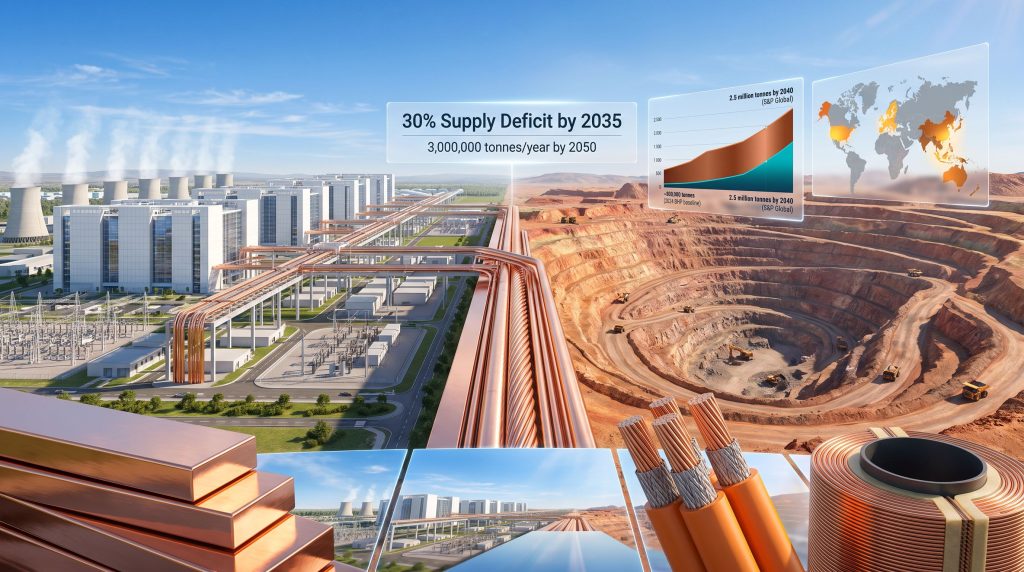
The International Energy Agency has projected a copper supply gap of approximately 30% by 2035, a figure that does not yet fully account for the explosive growth in AI infrastructure construction now reshaping demand forecasts. This deficit is being driven by the simultaneous acceleration of multiple electrification vectors, each of which is copper-intensive in its own right.
The Compounding Demand Problem
No single sector is responsible for the tightening copper balance. The pressure is coming from multiple directions at once:
- Electrification of passenger and commercial transport, including charging infrastructure networks
- Utility-scale renewable energy buildout across wind, solar, and grid-scale battery storage
- Industrial decarbonisation and the replacement of fossil fuel process heat
- National power grid modernisation programs across the United States, the European Union, and Southeast Asia
- The rapid construction of AI-era data centre infrastructure, now emerging as one of the fastest-growing new demand vectors
The critical word is simultaneous. Each of these drivers would represent a manageable demand increment in isolation. Together, however, they are converging on a supply base that cannot expand at comparable speed. Furthermore, the critical minerals demand picture adds additional complexity, as copper is far from the only resource under pressure from the energy transition.
What Makes Data Centres and Copper Demand So Structurally Linked
Copper Is Embedded at Every Layer
A common misconception is that digital infrastructure is primarily a story about rare earth elements, gallium, germanium, or exotic semiconductor inputs. In reality, copper is woven through the physical fabric of a modern data centre from the grid connection point all the way to the printed circuit board.
| Infrastructure Layer | Copper Application | Relative Intensity |
|---|---|---|
| Power delivery systems | Busbars, cables, transformers | Very High |
| Internal cabling networks | Signal and power wiring | High |
| Cooling infrastructure | Heat exchangers, piping | Medium-High |
| Grounding and earthing systems | Safety and EMI shielding | Medium |
| External grid connection | Transmission lines, switchgear | High |
| Circuit boards and components | PCB traces, connectors | Medium |
What this table obscures is the scale multiplier effect. A single hyperscale facility drawing 500 megawatts of power requires thousands of kilometres of internal cabling, hundreds of transformers, and an external grid connection infrastructure that in some cases requires dedicated substation construction. Each of those components is heavily copper-dependent.
Why AI Facilities Are a Different Proposition Entirely
Conventional cloud data centres, the kind that have been proliferating for two decades, operate at relatively modest power densities. A standard server rack in a traditional facility might draw between 5 and 10 kilowatts. An AI training cluster using the latest GPU architectures can draw 60 to 100 kilowatts per rack or more, with next-generation configurations pushing beyond that threshold.
This is not a marginal difference. It represents a fundamental change in the electrical engineering requirements of the building, which translates directly into heavier copper gauge wiring, larger busbar systems, more robust transformer infrastructure, and more extensive grounding networks. According to BHP's analysis of AI-driven copper demand, this shift in power intensity is one of the most significant demand signals the copper market has encountered in decades.
"The power density challenge in AI data centres is not simply an energy cost problem. It is a materials intensity problem. Higher throughput requires heavier electrical infrastructure at every point in the power delivery chain, and copper remains the conductor of choice across virtually all of those applications."
Cooling Architecture as a Hidden Copper Multiplier
One dimension of this relationship that receives insufficient attention is the role of cooling systems. As power density rises, air cooling alone becomes physically inadequate. The industry is transitioning through a hierarchy of increasingly copper-intensive cooling technologies:
- Conventional air cooling with computer room air conditioning units (relatively low copper content)
- Rear-door heat exchangers attached to server racks (moderate copper piping requirements)
- Direct liquid cooling with coolant distributed directly to processor components via copper manifolds
- Immersion cooling where servers are submerged in dielectric fluid within copper-pipe-connected heat transfer systems
- Two-phase immersion cooling representing the cutting edge, with substantial copper infrastructure in heat rejection circuits
Each step up this cooling hierarchy increases the copper intensity per megawatt of installed compute capacity. The AI buildout is accelerating the transition toward the upper tiers of this hierarchy faster than many commodity analysts anticipated.
Quantifying the Demand Signal: Where Forecasts Agree and Diverge
The Range of Institutional Projections
One of the more intellectually honest observations that can be made about data centres and copper demand forecasting is that the range of published estimates is genuinely wide. This is not analytical sloppiness. It reflects legitimate uncertainty about the pace of AI adoption, the trajectory of hardware efficiency improvements, and the degree to which facility construction will cluster in particular regions.
| Forecasting Institution | Demand Estimate | Time Horizon |
|---|---|---|
| BHP (current baseline) | ~500,000 tonnes/year | 2024 (present) |
| BHP (long-range projection) | ~3,000,000 tonnes/year | By 2050 |
| S&P Global | 1.1 million tonnes | 2025 |
| S&P Global | 2.5 million tonnes | By 2040 |
| Macquarie Research | 330,000-420,000 tonnes | By 2030 |
The spread between Macquarie's near-term estimate of 330,000 to 420,000 tonnes by 2030 and BHP's long-range projection of 3 million tonnes annually by 2050 is striking. However, it is important to note that these are not competing estimates for the same variable. They reflect different time horizons and different assumptions about the trajectory of AI infrastructure scaling.
The more meaningful observation is that even the most conservative institutional forecasts confirm the direction of travel: rising copper demand from the data centre sector, with the debate centred on magnitude rather than direction. For instance, S&P Global's research on copper in the age of AI reinforces this consensus view across multiple demand scenarios.
The Bull and Bear Cases in Detail
The bull case rests on several compounding assumptions:
- AI compute demand continues to double on roughly annual timescales, requiring continuous facility expansion
- Efficiency gains in chip design lag behind the growth in total compute deployment
- Grid connection requirements prove more copper-intensive than current models suggest
- Cooling system upgrades compound the demand signal beyond power delivery alone
The bear case is built on different but equally defensible logic:
- Per-megawatt copper requirements may decline as facility design standards mature and engineers optimise for material efficiency
- Advanced chip architectures (such as neuromorphic computing or optical interconnects) could reduce power density over the medium term
- Aluminium substitution in selected cabling and busbar applications remains economically viable in some configurations, though it carries trade-offs in conductivity, weight, and connection complexity
- Data centre copper consumption, even at S&P Global's 2040 estimate of 2.5 million tonnes, would represent a meaningful but not dominant share of total global copper demand, which currently runs at approximately 26 million tonnes per year
Disclaimer: The scenario projections and demand forecasts cited in this article represent institutional estimates published by named organisations and should not be construed as investment advice. Commodity market forecasts carry inherent uncertainty. Readers should conduct independent research before making investment decisions.
The Speed Mismatch: The Most Underappreciated Risk in the Copper Market
Mine Development Cannot Match Construction Timelines
The single most important and least discussed aspect of this story is not the volume of demand. It is the timing asymmetry between supply development and infrastructure construction. Understanding the copper demand drivers at play today makes this asymmetry all the more significant.
A greenfield copper mine, from initial discovery through to first production, typically requires between 10 and 20 years. That timeline encompasses:
- Geological exploration and resource definition
- Environmental and social impact assessments
- Permitting processes across multiple regulatory jurisdictions
- Engineering and feasibility studies
- Financing and construction
- Commissioning
A hyperscale data centre campus, by contrast, can move from site selection to operational status in 18 to 36 months. This structural mismatch means that even if major mining companies announce significant copper expansion programmes today, the supply response cannot materialise on a timeline that corresponds to the buildout curve.
Power Grids and Data Centres Are Competing for the Same Metal
A further complication that receives insufficient attention is the fact that AI infrastructure developers and national grid operators are drawing copper from the same constrained supply base at the same time.
| Region | Data Centre Growth Rate | Grid Upgrade Pressure | Supply Chain Vulnerability |
|---|---|---|---|
| United States | Very High (AI hyperscalers) | High (ageing infrastructure) | Moderate |
| European Union | High (regulatory-driven) | Very High (CRMA targets) | High |
| China | High (state-directed) | Moderate (domestic supply) | Low-Moderate |
| Southeast Asia | Emerging | Low-Moderate | High |
Grid modernisation in the United States alone involves replacing transmission infrastructure that in many cases dates to the mid-twentieth century. Offshore wind transmission corridors in the North Sea require submarine cable runs of hundreds of kilometres. EV charging networks across Europe and North America are expanding rapidly. Consequently, all of these programmes are simultaneously competing with data centre developers for copper supply, refined copper products, and the engineering capacity to deploy them.
Operational Realities for the Mining Sector
Can Production Scale to Meet the Challenge?
Major diversified miners including BHP and Rio Tinto have increasingly framed their copper expansion strategies in terms of digital infrastructure demand alongside energy transition requirements. This reflects a genuine shift in the demand narrative, but it does not resolve the operational constraints that govern how quickly new supply can reach the market.
The key bottlenecks include:
- Declining ore grades requiring greater energy and water consumption per tonne of copper produced
- Water availability at major copper-producing regions in Chile and Peru, where water stress is already a significant operational constraint
- Labour markets for specialised mining engineers, metallurgists, and equipment operators that are already tight globally
- Permitting complexity in jurisdictions with strengthening environmental and indigenous land rights frameworks
- Smelting and refining capacity as a separate bottleneck downstream of mine production
One dimension of the declining ore grade problem that is not widely appreciated outside the industry is its compounding effect on capital costs. When ore grades fall from 1% to 0.5% copper, the mine must process roughly twice the volume of material to produce the same output. Furthermore, that doubles the energy consumption, water consumption, and tailings volume per unit of copper, fundamentally reshaping the economics of the operation.
The copper supply crunch facing the industry is therefore not simply a matter of financing new projects. It is a multidimensional operational challenge that requires rethinking how the sector approaches resource extraction, processing efficiency, and supply chain resilience. In addition, the future of copper mining will depend heavily on how well the industry can innovate and collaborate to overcome these structural barriers.
The next major ASX story will hit our subscribers first
Frequently Asked Questions: Data Centres and Copper Demand
How much copper does a single data centre use?
Estimates vary substantially based on facility scale and design, but a large hyperscale campus in the 100 to 500 megawatt range can require between 20,000 and 75,000 tonnes of copper across all infrastructure layers, including external grid connections. Smaller colocation facilities use proportionally less, but AI-optimised builds consistently show higher copper intensity per megawatt than conventional cloud facilities.
Why do AI data centres use more copper than traditional facilities?
The primary driver is power density. AI workloads require GPU and accelerator clusters that draw far more power per rack than conventional server hardware. This higher electrical throughput requires heavier gauge conductors, larger transformer and busbar infrastructure, and more intensive cooling systems, all of which are copper-intensive. The compounding effect across all infrastructure layers results in materially higher copper consumption per megawatt of installed capacity.
What is the projected copper demand from data centres by 2040?
S&P Global has published an estimate of approximately 2.5 million tonnes attributable to data centres by 2040. BHP's long-range modelling suggests the sector could account for up to 3 million tonnes annually by 2050. These figures remain subject to significant uncertainty around AI adoption rates and hardware efficiency trajectories.
Will data centre construction cause a copper shortage?
The honest answer is that a copper supply deficit was already forming before AI infrastructure emerged as a major demand driver. Data centre construction is one of several simultaneous demand accelerants. The IEA's 30% deficit projection by 2035 reflects the aggregate of all these vectors. Whether data centres specifically cause a shortage is less meaningful than recognising that they are intensifying a supply challenge that was already structurally embedded.
Can aluminium substitute for copper in data centre applications?
Aluminium can substitute for copper in some applications, particularly in larger busbar runs and certain cabling configurations, where its lower weight and cost partially offset its inferior conductivity (roughly 61% of copper's conductivity per unit cross-section). However, aluminium connections require more careful engineering to manage thermal expansion and corrosion risks. Substitution is possible at the margins but is unlikely to fundamentally alter the copper intensity of AI-era facilities.
Key Takeaways
The relationship between data centres and copper demand represents one of the more consequential and underappreciated dynamics in commodity markets today. The key structural points are:
- The copper supply deficit was a documented concern before AI infrastructure emerged as a demand driver, with the IEA projecting a 30% shortfall by 2035
- AI-optimised facilities require materially more copper per megawatt than conventional cloud infrastructure, driven by higher power density and more intensive cooling requirements
- Institutional demand forecasts range from 330,000 tonnes by 2030 (Macquarie) to 3 million tonnes annually by 2050 (BHP), reflecting genuine scenario uncertainty rather than analytical error
- The most underappreciated risk is the timing mismatch: data centres are built in 18 to 36 months; greenfield copper mines require 10 to 20 years to develop
- Grid modernisation programmes and AI infrastructure are simultaneously drawing on the same constrained copper supply base, intensifying competition for available metal
- Declining ore grades at existing operations compound the supply challenge by increasing the energy, water, and capital required per tonne of copper produced
- The direction of travel in copper demand from the data centre sector is not meaningfully in dispute; the debate is about how large and how fast
For further technical context on copper supply dynamics and digital infrastructure development, Mining Magazine provides ongoing coverage of power infrastructure and critical minerals demand at miningmagazine.com.
Want to Know Which ASX Copper Explorers Could Benefit From the AI Infrastructure Boom?
Discovery Alert's proprietary Discovery IQ model scans ASX announcements in real time, instantly identifying significant mineral discoveries — including copper — and delivering actionable alerts before the broader market catches on. Explore why major mineral discoveries have historically generated extraordinary returns on Discovery Alert's dedicated discoveries page, and begin your 14-day free trial today to position yourself ahead of the next major find.