August 7, 2026
When Tonnage Tells the Story: Understanding What a 1.2-Billion-Tonne Copper Resource Really Means
In bulk-tonnage porphyry copper mining, the fundamental rule is deceptively simple: scale is the moat. Unlike high-grade vein systems that depend on surgical precision, large-scale porphyry deposits generate value through sheer volume processed over decades. The economics hinge not on exceptional grades but on the relationship between contained metal, processing efficiency, and infrastructure leverage. When a project crosses certain tonnage thresholds, the entire economic calculus shifts, and the project moves from speculative to strategically significant within global copper supply forecasts.
It is within this geological and economic framework that the updated Northisle North Island project mineral resource estimate, carrying an effective date of July 31, 2026, deserves careful examination. Rather than treating this as a routine resource update, investors and industry observers should read it as a structural inflection point for one of North America's most substantial undeveloped copper-gold systems.
When big ASX news breaks, our subscribers know first
The Four-Deposit Architecture Behind the North Island Project
The North Island project occupies a distinctive position along Vancouver Island's northern coast in British Columbia, a region geologically connected to the broader porphyry copper belt that extends through western Canada and into the Pacific Rim arc systems. What separates the North Island project from many peers is its multi-deposit configuration, which consolidates four individually significant mineralised bodies into a single, spatially coherent system.
The four deposits are:
- Northwest Expo – a structurally expanded deposit following aggressive conversion drilling
- West Goodspeed – the largest single contributor to the 2026 resource upgrade
- Red Dog – a prospect with growing contained metal and potential structural linkage to West Goodspeed
- Hushamu – the anchor deposit providing baseline resource continuity within the integrated estimate
This multi-deposit architecture is not cosmetic. In porphyry systems, the spatial clustering of multiple mineralised centres often reflects a shared magmatic-hydrothermal source at depth, which geologically implies the potential for a continuous mineralised corridor rather than discrete, isolated bodies. The planned drilling program targeting the possible connection between Red Dog and West Goodspeed is, therefore, a high-value exploration objective that could materially alter the project's footprint understanding. Understanding mineral deposit tiers is essential context for appreciating why this multi-deposit structure is so significant.
Full Resource Breakdown: The 2026 Integrated MRE at a Glance
The 2026 integrated Northisle North Island project mineral resource estimate consolidates all four deposits into a single technical document for the first time, providing a unified view of the system's scale.
| Resource Category | Tonnage | Cu Grade | Au Grade | Mo Grade | Re Grade | Cu Eq. (lb) | Au Eq. (oz) |
|---|---|---|---|---|---|---|---|
| Indicated | 1.2 billion tonnes | 0.14% | 0.22 g/t | 79.5 ppm | 0.44 ppm | 10.1 billion lb | 16.2 million oz |
| Inferred | 260 million tonnes | 0.12% | 0.15 g/t | 62.0 ppm | 0.37 ppm | 1.5 billion lb | 2.6 million oz |
Important Disclaimer: Mineral resources are not mineral reserves and do not have demonstrated economic viability. The figures above are estimates based on geological modelling and should not be interpreted as a guarantee of future production or profitability.
The presence of molybdenum and rare earth element (REE) reporting in this iteration of the MRE is a significant structural addition, reflecting a deliberate broadening of the project's commodity profile beyond copper and gold.
How the 2026 MRE Compares to the September 2024 Resource Estimate
Resource evolution is one of the clearest indicators of geological confidence building at a developing project. Comparing the 2024 and 2026 estimates reveals a consistent pattern of growth, with some natural grade adjustments that are characteristic of expansion-phase resource updates.
| Metric | 2024 Estimate | 2026 Estimate | Change |
|---|---|---|---|
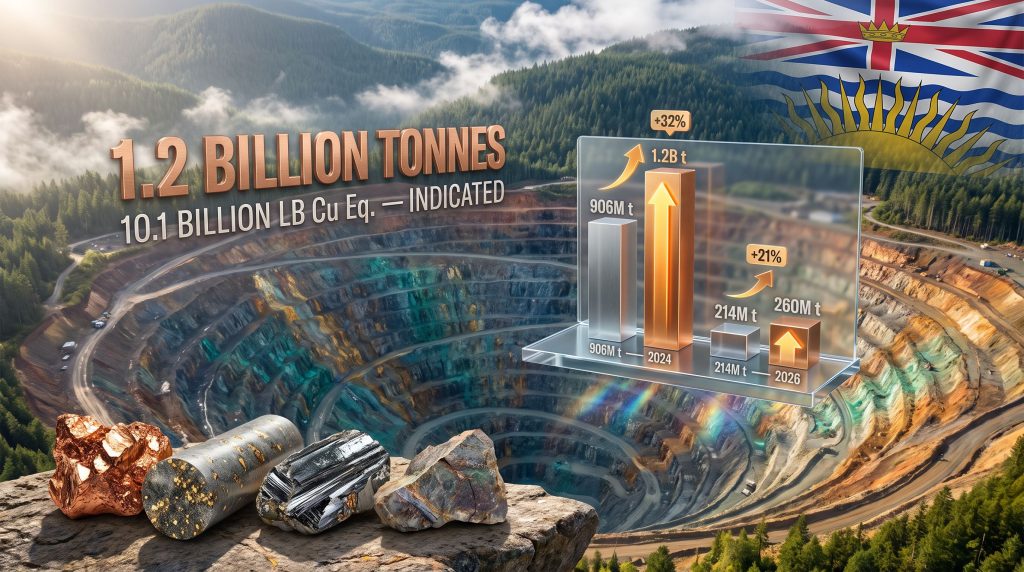
| Indicated Tonnage | 906 million tonnes | 1.2 billion tonnes | +32% |
| Indicated Cu Grade | 0.16% | 0.14% | Slight dilution |
| Indicated Au Grade | 0.24 g/t | 0.22 g/t | Slight dilution |
| Inferred Tonnage | 214 million tonnes | 260 million tonnes | +21% |
| Inferred Cu Grade | 0.12% | 0.12% | Stable |
| Inferred Au Grade | 0.22 g/t | 0.15 g/t | Reduction |
| Mo Reporting | Not previously disclosed | 79.5 ppm Indicated | New addition |
| Re Reporting | Not previously disclosed | 0.44 ppm Indicated | New addition |
Why Grade Dilution Does Not Necessarily Reduce Project Value
A common misreading among retail investors involves interpreting grade dilution as a negative signal. In porphyry copper systems developed for bulk open-pit mining, the relationship between grade and project value is non-linear. When additional lower-grade tonnes are incorporated at the margins of a deposit model, average grades compress while total contained metal often increases substantially.
In the North Island case, the indicated resource grew by 32% in tonnage while copper-equivalent contained metal reached 10.1 billion pounds. For a bulk-mining scenario processing hundreds of millions of tonnes over a multi-decade mine life, the incremental contribution of marginal-grade material remains economically meaningful, particularly when processing infrastructure costs are already deployed and amortised across a large resource base.
The key metric to watch in bulk porphyry economics is not headline grade in isolation but rather the strip ratio, processing recovery rate, and net smelter return per tonne milled, all of which will be addressed in the upcoming prefeasibility study. Furthermore, a thorough mining feasibility study will be critical in translating these resource figures into bankable economic projections.
Deposit-Level Performance: What Drove the Resource Upgrade
West Goodspeed: The Growth Engine of the 2026 Update
West Goodspeed emerged as the dominant contributor to the 2026 resource expansion. The deposit added over 113 million tonnes of new indicated resources, incorporating 873 million copper-equivalent pounds and approximately 1.2 million gold-equivalent ounces into the indicated category. This scale of single-deposit addition within one resource update cycle is unusual and suggests that prior resource models were conservative relative to the actual mineralised volume.
Northwest Expo: Confidence Building Through Conversion
Conversion from inferred to indicated classification is one of the most value-accretive activities a development-stage company can undertake. At Northwest Expo, indicated tonnage increased by 133%, a result of targeted infill drilling that demonstrated sufficient geological continuity to reclassify previously uncertain material. Strike extension drilling further enlarged the deposit's spatial boundaries, opening the possibility of additional resource growth in future estimate cycles.
Red Dog: Connectivity Potential and Metal Growth
The Red Dog prospect delivered a 30% increase in contained copper-equivalent metal within the indicated resource category. Beyond the metal addition itself, the more strategically important development is the planned drilling campaign to investigate whether Red Dog and West Goodspeed share a structural or mineralisation connection. If that connectivity is confirmed, the two deposits could be interpreted as segments of a larger, unified mineralised corridor, which would have significant implications for mine planning and extraction sequencing.
Hushamu: Structural Foundation of the Integrated System
Hushamu functions as the foundational component of the integrated resource, providing continuity and scale to the overall system. Its inclusion within the fully integrated MRE ensures that prefeasibility study modelling can draw on a cohesive, spatially connected resource rather than treating each deposit as an independent economic unit.
The Critical Minerals Dimension: Beyond Copper and Gold
Molybdenum: Strategic Value in a Technology-Metal Market
The formal addition of 68 million pounds of new molybdenum resources to the North Island indicated category represents a meaningful broadening of the project's revenue potential. Molybdenum serves as a high-performance alloying agent in specialty steels used across aerospace, energy infrastructure, and defence manufacturing. Its inclusion in the MRE is not merely additive to contained metal figures but introduces a separate commodity revenue stream that could influence processing flowsheet design and concentrate marketing strategy.
At 79.5 ppm molybdenum in the indicated resource, the North Island project sits within a grade range consistent with byproduct molybdenum recovery at established porphyry copper operations globally. Whether molybdenum is processed as a primary product or a byproduct will depend on prefeasibility-level metallurgical testing and concentrate offtake economics. In addition, the growing critical minerals demand driven by the global energy transition further reinforces the strategic relevance of this multi-commodity profile.
Rare Earth Elements as a Secondary Revenue Consideration
The 0.44 ppm rare earth element grade within the indicated resource is modest by primary REE deposit standards, but its presence within a large-tonnage porphyry system is geologically noteworthy. Rare earth elements are not commonly reported in porphyry copper MREs, and their inclusion in the 2026 estimate at North Island reflects either improved analytical coverage during the drilling program or a deliberate strategic decision to characterise the full multi-element profile of the system.
At bulk-mining scales exceeding one billion tonnes, even low-concentration REE values can yield meaningful contained quantities, though the economic recoverability of REEs from a copper-gold processing circuit requires specialised metallurgical consideration that will likely form part of the PFS scope.
Analytical Note: The deliberate expansion of commodity reporting to include molybdenum and rare earth elements in the 2026 MRE positions the North Island project within the broader critical minerals narrative that is reshaping how institutional capital evaluates undeveloped mining assets. This is a strategic repositioning that may attract different categories of investor attention than a pure copper-gold story would.
The next major ASX story will hit our subscribers first
The Prefeasibility Study Pathway: What Comes After the MRE
The integrated 2026 MRE was specifically designed to serve as the technical foundation for a prefeasibility study, with completion targeted for the first quarter of 2027. A PFS represents a materially more rigorous technical and economic assessment than a resource estimate, requiring inputs across mining method selection, processing route design, capital cost estimation, and operating cost modelling.
Key economic inputs that will shape the PFS outcome include:
- Copper and gold price assumptions across a range of scenarios reflecting supply-demand dynamics in a structurally tightening market
- Molybdenum pricing as a byproduct or co-product revenue contributor
- Rare earth element recoverability and potential concentrate value if metallurgical testing supports economic extraction
- Processing route selection for a multi-metal porphyry system, including potential bulk flotation versus selective flotation circuits
- Infrastructure cost modelling specific to the North Island's coastal British Columbia location
A successful PFS that demonstrates positive project economics at conservative commodity price assumptions would represent a significant de-risking event, potentially opening pathways toward a full feasibility study and permitting applications.
British Columbia as a Development Jurisdiction for Large-Scale Porphyry Systems
British Columbia has a well-documented history as a productive copper porphyry jurisdiction, hosting operating mines such as Highland Valley Copper, one of the largest open-pit copper operations in North America. The province's geological endowment along the Quesnel and Stikine terranes, and the coastal arc systems of Vancouver Island, reflects a long-arc magmatic history that created widespread porphyry copper mineralisation.
From a development perspective, BC operates under an established provincial environmental assessment framework and maintains detailed mineral titles administration through BC Mineral Titles Online. While the regulatory pathway for large-scale open-pit development in British Columbia involves comprehensive environmental review processes, the province's institutional familiarity with copper porphyry mine development provides a degree of procedural predictability not available in all jurisdictions.
Infrastructure considerations specific to the North Island project's coastal location include marine access potential, proximity to existing power transmission corridors, and the established industrial history of the northern Vancouver Island region — all factors that will be assessed in detail during prefeasibility work. For more detail on Northisle's project scope and corporate overview, the company's official site provides comprehensive background.
District-Scale Potential: Is the Current MRE the Ceiling or the Floor?
In porphyry copper geology, the term district-scale carries a specific meaning. It implies that multiple mineralised centres exist within a spatially coherent geological district, often controlled by a shared structural architecture or magmatic system, and that the collective resource across those centres exceeds what any single deposit could provide.
At 1.2 billion indicated tonnes across four deposits, the Northisle North Island project mineral resource estimate has crossed a threshold that places it among the upper tier of undeveloped copper-gold porphyry systems globally. However, the open nature of several deposit boundaries and the untested Red Dog to West Goodspeed corridor suggest that the current MRE may not represent the ultimate resource potential of the district.
Additional drilling beyond the current resource boundaries, particularly along strike extensions and at depth beneath known mineralised zones, could expand the resource envelope in future estimate cycles. Whether that exploration is pursued ahead of or concurrent with prefeasibility work will depend on capital allocation priorities and the geological findings from the 2026 drilling program. Consequently, those exploring copper investment strategies will find the district-scale narrative here particularly compelling.
Frequently Asked Questions: Northisle North Island Project MRE
What is the total resource size of the North Island project as of 2026?
The 2026 integrated MRE outlines 1.2 billion indicated tonnes and 260 million inferred tonnes, containing a combined copper-equivalent resource of approximately 11.6 billion pounds across both categories.
What is the difference between an indicated and inferred resource?
Indicated resources have sufficient geological sampling density and spatial continuity to support confident grade and tonnage estimation. Inferred resources reflect a lower level of geological confidence, where data spacing or quality is insufficient to establish the same degree of continuity. Only indicated and measured resources can form the basis of mineral reserves. You can review Northisle's reserves and resources page for the full technical breakdown.
What does copper-equivalent reporting mean in a multi-metal MRE?
Copper-equivalent grades and contained metal figures convert all metal values — including gold, molybdenum, and rare earths — into a single copper-denominated figure using prevailing or assumed metal prices and recovery factors. This allows direct comparison of multi-metal projects against single-commodity benchmarks.
When is the North Island prefeasibility study expected to be completed?
The PFS is targeted for completion in the first quarter of 2027, using the 2026 integrated MRE as its technical foundation.
What critical minerals does the North Island project contain beyond copper and gold?
The 2026 MRE formally reports molybdenum at 79.5 ppm indicated and rare earth elements at 0.44 ppm indicated, both of which are classified as critical minerals in multiple national frameworks. This multi-element profile is particularly relevant given the ongoing copper supply crunch shaping global commodity markets.
Are the North Island mineral resources also classified as mineral reserves?
No. Mineral resources are not mineral reserves and have not demonstrated economic viability. Resource-to-reserve conversion requires a feasibility-level study demonstrating that extraction is economically justifiable under reasonable assumptions.
Key Takeaways: Reading the 2026 MRE in Context
- Scale confirmation: At 1.2 billion indicated tonnes, the Northisle North Island project mineral resource estimate has entered the upper tier of globally significant undeveloped copper-gold porphyry systems
- Multi-commodity repositioning: Formal molybdenum and rare earth element reporting broadens the project's economic profile and strategic relevance within critical minerals supply discussions
- Conversion success: A 133% increase in indicated tonnage at Northwest Expo confirms strong geological continuity and demonstrates effective infill drilling execution
- West Goodspeed as the growth driver: The addition of over 113 million tonnes and 873 million copper-equivalent pounds at West Goodspeed represents the single largest contributor to the 2026 resource upgrade
- Red Dog connectivity as a future catalyst: Planned drilling to investigate the Red Dog to West Goodspeed structural connection represents a near-term exploration catalyst with potential to further expand the project's resource understanding
- PFS readiness: The integrated MRE provides the technical baseline required to advance toward a Q1 2027 prefeasibility study, the next major value-inflection milestone for the project
- Grade-tonnage context: Modest grade dilution relative to 2024 estimates is consistent with expansion-phase resource development in bulk-tonnage porphyry systems and does not diminish the project's long-term value proposition
Readers seeking additional geological and regulatory context on porphyry copper development in British Columbia may find value in reviewing publicly available NI 43-101 technical reports filed on SEDAR+ and the British Columbia Mineral Titles Online database. This article contains forward-looking statements regarding resource estimates and project timelines that are subject to material risks and uncertainties. It does not constitute financial or investment advice.
Want to Track the Next Major Copper Discovery the Moment It Hits the ASX?
Discovery Alert's proprietary Discovery IQ model scans ASX announcements in real time, instantly identifying significant mineral discoveries — including copper, gold, and critical minerals — and translating complex data into actionable insights for investors at every level. Explore historic examples of major mineral discoveries and their returns to understand what early positioning can mean, then begin a 14-day free trial at Discovery Alert to gain your market-leading edge.