August 7, 2026

When Supply Chains Break and Algorithms Hunger: Rethinking Copper's Role in the Modern Economy
The conventional wisdom around commodity markets rests on a deceptively simple assumption: prices rise when economies grow and fall when they contract. For decades, copper embodied this logic so reliably that traders and economists alike elevated it to the status of a leading indicator, dubbing it "Dr. Copper" for its apparent diagnostic precision. But what happens when a metal's demand profile fractures into entirely new verticals? That is precisely the question the copper record high, supply disruptions and AI demand forces investors and analysts to confront.
When big ASX news breaks, our subscribers know first
The Record That Rewrites the Rulebook
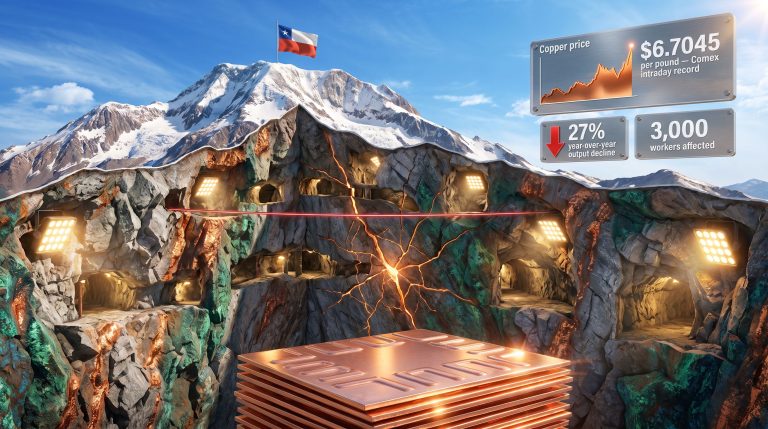
U.S. copper futures climbed to approximately $6.90 per pound in August 2026, a level never previously recorded in the metal's trading history. Simultaneously, London Metal Exchange copper broke above $14,000 per metric ton, confirming that the price breakout was not a regional arbitrage anomaly but a globally synchronised move reflecting genuine market tightness.
What makes this milestone analytically significant is the context in which it occurred. This was not a period of synchronised global economic expansion. Growth signals across major economies were mixed at best, yet copper surged regardless. That divergence between price behaviour and traditional macroeconomic conditions is not a curiosity to be footnoted — it is the central story of the copper market right now.
The copper record high, supply disruptions, and AI demand are now inseparable themes. Understanding the rally requires examining each force on its own terms before recognising how they have combined into something the market has rarely, if ever, seen before.
Supply in Crisis: A Multi-Front Compression Event
Mine Output Under Pressure From All Directions
The supply side of the copper equation is facing a confluence of disruptions that would be extraordinary even in isolation. Together, they represent what analysts are increasingly describing as a structural compression event with no near-term resolution. Furthermore, the copper supply crunch now appears to be deepening rather than easing as 2026 progresses.
Chile, which holds the title of the world's largest single copper-producing nation, experienced severe operational disruptions in 2026. Heavy snowfall, intense rainfall, and sustained high winds struck mining regions, interrupting extraction and processing activity at critical operations. Chile's copper supply gap carries disproportionate market weight given the country's outsized share of global production.
The Democratic Republic of Congo introduced an official government ban on copper and cobalt concentrate exports in 2026. The policy was designed to incentivise domestic processing, but its immediate effect was to remove a significant volume of raw concentrate from global trade flows. Indonesia's Grasberg operation also faced repeated setbacks, further thinning the supply pipeline.
The impact of these disruptions was made tangible by activity in London Metal Exchange warehouses. Industrial consumers, unable to secure adequate spot supply through normal channels, began drawing down copper inventories held in LME storage. This physical destocking is a meaningful signal because it reflects real-world scarcity rather than speculative positioning.
When buyers resort to warehouse drawdowns, the tightness is genuine. The side effect is upward pressure on treatment and refining charges — the fees smelters charge to process copper concentrate into refined metal — which rise when raw material is scarce and smelters are competing for available feed.
Michael Widmer, Bank of America's head of metals research, characterised the August 2026 price move as being driven primarily by supply constraints rather than a surge in demand, a framing that aligns with the physical evidence visible in exchange inventories and refining cost movements.
The Policy Layer: Tariffs, Bans, and Trade Distortions
Beyond operational disruptions, deliberate policy decisions have added another layer of supply restriction. The table below summarises the key policy-driven constraints active in 2026:
| Supply Constraint | Origin | Market Effect |
|---|---|---|
| U.S. Section 232 tariffs at 50% on semi-finished copper imports | U.S. Presidential Proclamation, July 2025 | Reduced import volumes; elevated domestic U.S. prices |
| DRC government ban on copper and cobalt concentrate exports | DRC government, 2026 | Removed key concentrate volumes from global trade |
| China's restrictions on scrap copper availability | Chinese domestic policy, 2026 | Tightened global refined copper supply |
| Weather-related disruptions in Chile | Operational reports, 2026 | Reduced output from the world's largest copper producer |
The U.S. Section 232 tariff regime, formalised in July 2025, placed 50% tariffs on semi-finished copper imports and copper-intensive derivative products. The relationship between copper prices and trade war dynamics has, consequently, become increasingly difficult to disentangle from broader supply fundamentals.
China's simultaneous crackdown on scrap copper availability represents a secondary supply squeeze. Scrap, or secondary copper, plays a meaningful role in global refined copper supply, particularly during periods of mine disruption. When China restricts its scrap market, the global system loses a natural buffer that would otherwise absorb some of the pressure from primary mine shortfalls.
The convergence of policy-driven and operationally-driven supply shocks occurring simultaneously across multiple major producing regions is a historically unusual event. Standard commodity pricing models, which typically assume some degree of supply elasticity, may be structurally ill-equipped to capture the full extent of this compression.
The Structural Time Lag That Cannot Be Shortcut
Perhaps the most underappreciated aspect of the copper supply story is the 10-year average development timeline from mineral discovery to first commercial production. This is not a regulatory or bureaucratic artefact that can be streamlined away. It reflects the genuine complexity of building large-scale underground or open-pit mining infrastructure, constructing concentrators and processing facilities, commissioning power and water systems, and training operational workforces in remote and often technically challenging environments.
The practical implication is stark: even if every major mining company simultaneously committed record capital to new copper projects today, meaningful volumes of new supply could not reach the market until the mid-2030s at the earliest. This reality underscores the value of copper exploration importance as a long-term strategic priority for the industry.
The Demand Revolution: AI Infrastructure and Grid Investment
Data Centers as Copper Consumers: A New Industrial Category
The emergence of artificial intelligence infrastructure as a structural copper demand driver represents a genuinely novel development in the metal's demand history. Unlike traditional cyclical demand from construction or manufacturing, hyperscaler data center investment operates on multi-year capital commitment cycles that are largely insensitive to quarterly economic fluctuations.
Copper's role within AI infrastructure is pervasive and non-substitutable in most applications:
- High-voltage power distribution systems feeding data center campuses require extensive copper cabling
- Cooling infrastructure, whether liquid or air-based, depends on copper for heat exchangers and piping
- Server rack interconnects and high-density computing environments rely on copper for low-latency data transmission
- Grid connection infrastructure linking data centers to transmission networks is copper-intensive throughout
Projections from BloombergNEF-linked research estimate that AI facilities could consume approximately 400,000 tonnes of copper per year over the next decade, with demand potentially peaking near 572,000 tonnes in 2028 as the current wave of hyperscaler construction reaches its most capital-intensive phase. According to Nikkei Asia, U.S. and China AI demand has already been a significant driver pushing copper prices toward near-record highs.
BHP estimates that global data center copper consumption could scale from approximately 0.5 million tonnes per year today to 3 million tonnes per year by 2050, representing a roughly sixfold increase over the period.
S&P Global's analysis projects that AI and data center infrastructure alone could add 2 million metric tons of incremental copper demand between 2025 and 2040, a volume roughly equivalent to the annual output of a major copper-producing nation.
As William Osnato of Barchart described in commentary to CNBC, the copper demand surge being seen now is more acute and concentrated in data center and power grid applications rather than reflecting the type of broad-based industrial growth that historically moved copper prices.
Power Grid Investment: The Parallel Demand Engine
Alongside AI infrastructure, power grid modernisation has emerged as the other major structural demand driver. Grid infrastructure is among the most copper-intensive categories of capital expenditure anywhere in the economy, requiring copper for transformers, underground and overhead cables, substations, distribution switches, and grid-scale interconnection equipment.
China's grid investment activity offers a striking illustration of the scale involved. In the first half of 2026 alone, China's power grid investment grew 13% year-over-year. The country has announced an infrastructure commitment of approximately $574 billion toward power grid upgrades, one of the largest individual infrastructure investment programmes ever announced by any government. As reported by OilPrice.com, these simultaneous demand and supply pressures have been pushing copper prices toward extraordinary new levels.
This grid investment is not occurring in isolation. Western nations are simultaneously accelerating grid modernisation programmes to support the integration of renewable generation capacity, accommodate growing EV charging infrastructure, and replace ageing transmission and distribution assets.
The Long-Term Supply-Demand Gap
The convergence of these demand forces against a structurally constrained supply outlook creates a medium-to-long-term picture of considerable concern for industrial consumers:
| Metric | Projection | Timeframe |
|---|---|---|
| Global copper demand baseline (S&P Global) | 42.4 million metric tons | By 2040 |
| Growth from 2025 levels | Approximately 50% | 2025 to 2040 |
| AI and data center incremental demand | +2 million metric tons | 2025 to 2040 |
| Potential annual supply deficit (Reuters/JPMorgan) | More than 10 million metric tons/year | By 2040 without new supply |
| AI-driven peak annual copper consumption | Approximately 572,000 tonnes | Peak around 2028 |
Is "Dr. Copper" Still a Reliable Economic Gauge?
The traditional interpretation of copper prices as a leading macroeconomic indicator rested on the metal's tight correlation with construction activity, manufacturing output, and global trade volumes. That interpretive framework is now under serious strain. The demand profile that is driving 2026's record prices is structurally disconnected from the business cycle in ways that previous copper bull markets were not.
AI infrastructure capital expenditure commitments from major technology companies are multi-year obligations that do not pause when manufacturing PMIs weaken. Grid investment programmes, once politically and fiscally committed, are similarly insulated from short-term economic volatility.
This creates a genuinely new analytical challenge. A rising copper price in the current environment does not signal that global factories are humming or that construction cranes are proliferating. Investors and economists who continue to treat copper as a simple macro barometer risk misinterpreting what the price is actually communicating.
The Bull and Bear Case: Competing Frameworks
Why the Structural Bull Case Is Compelling
- The 10-year mine development pipeline creates a multi-year floor under prices regardless of near-term demand fluctuations
- AI infrastructure capital expenditure is committed and largely non-discretionary within major technology companies' strategic plans
- Grid investment in both China and Western markets is driven by energy policy and infrastructure necessity, not economic optimism
- Simultaneous disruptions in Chile, DRC, and Indonesia have eliminated near-term supply flexibility
- The structural deficit implied by long-term demand models is too large to be addressed by incremental efficiency improvements or modest new project pipelines
Where the Bear Case Finds Traction
- A significant global economic slowdown could reduce construction and manufacturing copper demand enough to partially offset AI and grid-driven gains
- Sustained high prices historically incentivise aluminium substitution in power cables and certain construction applications, reducing copper's addressable demand
- U.S. tariff structures could create regional price dislocations rather than a clean global price premium, complicating investment theses built on uniform price exposure
- Higher prices accelerate copper scrap collection and recycling, adding secondary supply volumes that are faster to mobilise than new mining capacity
- Unexpected shifts in AI technology architecture, such as efficiency breakthroughs that reduce the hardware intensity of AI workloads, could moderate data center copper demand growth
The asymmetry between the bull and bear cases is notable. The bull case requires only the continuation of trends already underway. The bear case requires the simultaneous reversal of multiple independent forces, including economic deterioration, technological substitution, trade normalisation, and supply recovery.
The next major ASX story will hit our subscribers first
Investment and Industry Implications
How Copper's Investment Narrative Is Being Repositioned
The reframing of copper from a cyclical commodity to a structural infrastructure material has meaningful implications for how investment exposure should be evaluated and sized. Those exploring copper investment strategies in this environment are encountering a different risk-reward profile — one where the demand floor is supported by technology infrastructure spending rather than GDP growth.
Major diversified miners with substantial copper divisions, including BHP and Rio Tinto, are increasingly being discussed in the context of their exposure to AI-era infrastructure demand rather than simply their traditional cyclical characteristics. Copper-focused exchange-traded products have attracted capital from investors who might otherwise have gravitated toward semiconductor or technology sector allocations.
What the Mining Industry Needs to Do Differently
The structural nature of the supply gap demands a response that goes beyond waiting for commodity prices to incentivise a standard capex cycle. Furthermore, several priorities stand out:
- Accelerate exploration investment now: Given the 10-year development horizon, decisions about resource delineation and feasibility studies made in 2026 determine supply availability in the mid-2030s when the deficit projections suggest the market will be most acutely stretched
- Build secondary recovery capacity: Copper recycling and scrap processing can mobilise supply on timescales of two to four years rather than a decade, making investment in secondary smelting and collection infrastructure strategically valuable
- Actively manage trade and tariff risk: The 2025 to 2026 experience with U.S. Section 232 tariffs and China's scrap restrictions has demonstrated that policy interventions can be market-moving events
- Engage with off-take demand from new sectors: The emergence of technology companies and grid operators as major copper consumers opens the possibility for long-term supply agreements that reduce price volatility exposure for both producers and buyers
Frequently Asked Questions
Why did copper hit a record high in 2026?
Copper reached approximately $6.90 per pound and broke above $14,000 per metric ton in August 2026 due to simultaneous supply disruptions across Chile, the Democratic Republic of Congo, and Indonesia, combined with the impact of U.S. Section 232 tariffs, China's scrap copper restrictions, and rising structural demand from AI data center construction and power grid investment programmes.
How significant is AI infrastructure as a copper demand driver?
Projections estimate AI facilities could consume approximately 400,000 tonnes of copper annually over the next decade, peaking near 572,000 tonnes in 2028. BHP projects data center copper consumption could reach 3 million tonnes per year by 2050, compared to roughly 0.5 million tonnes today, representing a sixfold increase.
What is causing the structural copper supply shortage?
The shortage reflects both acute disruptions and structural constraints. Acute factors include weather-related mine outages in Chile, the DRC's export ban on concentrates, operational setbacks at major projects in Indonesia, and trade policy measures. The structural constraint is, however, the 10-year average mine development timeline, which prevents rapid supply responses to price signals.
How large could the copper deficit become by 2040?
Projections cited by Reuters and JPMorgan suggest the annual copper supply deficit could exceed 10 million metric tons per year by 2040 without significant acceleration of new mining investment and expanded recycling capacity. S&P Global projects total global copper demand reaching 42.4 million metric tons by 2040, roughly 50% above current levels.
Is copper still a reliable economic indicator?
Its reliability as a broad macroeconomic gauge has diminished. Because a growing share of copper demand is now driven by AI infrastructure and grid investment rather than traditional industrial activity, the copper record high, supply disruptions and AI demand together suggest that rising prices no longer necessarily reflect accelerating global growth. Analysts now recommend treating copper's price signal as a sector-specific indicator rather than a macro barometer.
Disclaimer: This article contains forward-looking projections and demand forecasts sourced from third-party research organisations. These projections are subject to significant uncertainty and should not be construed as financial advice. Commodity markets are volatile and past price behaviour is not indicative of future performance. Readers should conduct independent research and consult qualified financial advisers before making investment decisions.
Want to Position Yourself Ahead of the Next Major Copper Discovery?
Discovery Alert's proprietary Discovery IQ model delivers real-time alerts on significant ASX mineral discoveries — including copper — instantly translating complex geological data into actionable investment insights for both short-term traders and long-term investors. Explore historic examples of exceptional discovery-driven returns and begin your 14-day free trial today to secure a market-leading edge before the next major find is announced.