August 6, 2026
The Structural Case for Copper: Why Commodity Mix Determines Mining Valuations
In the global mining industry, the commodity a company produces often matters more than how efficiently it produces it. Over the long arc of a mining cycle, earnings multiples, institutional capital flows, and M&A premiums tend to cluster around a handful of metals viewed as indispensable to the next phase of economic infrastructure. Copper has occupied that position with increasing conviction since the mid-2010s, as the scale of electrification investment required for energy transition became measurable rather than theoretical. For diversified miners carrying legacy exposure to structurally declining commodities, the strategic imperative has been clear: reposition or accept a persistent valuation discount.
South32's shift to a copper strategy represents perhaps the most complete execution of that repositioning logic seen in mid-tier mining over the past decade. What began as a portfolio of assets that BHP considered non-core has been systematically dismantled and rebuilt around a thesis that prioritises copper, zinc, silver, and manganese as the metals most likely to command durable demand premiums through the 2030s.
When big ASX news breaks, our subscribers know first
From Eight Assets to Four: The Architecture of a Portfolio Transformation
What South32 Inherited and What It Chose to Become
When South32 was demerged from BHP in 2015, it carried a collection of operations spanning thermal coal in South Africa, metallurgical coal in Australia, nickel in Colombia, manganese, aluminium smelting, alumina refining, and bauxite extraction. The market's verdict on this inheritance was blunt. Industry observers labelled the newly listed company with a nickname that captured widespread scepticism about its long-term prospects, and then-CEO Graham Kerr spent the better part of a decade proving those observers wrong through one of the more disciplined portfolio reinventions in modern diversified mining.
The transformation followed a deliberate sequence rather than reactive deal-making:
| Year | Strategic Action | Financial Scale |
|---|---|---|
| 2015 | BHP demerger; inherited thermal coal, aluminium, nickel, manganese | Starting portfolio |
| 2017 | Acquired Hermosa project in Arizona, USA | Entry into US critical minerals |
| 2022 | Acquired 45% stake in Sierra Gorda copper mine, Chile | $1.4bn upfront cash |
| 2026 | Sold aluminium value chain to Alcoa | $5.6bn enterprise value |
| 2026 | Approved Sierra Gorda fourth grinding line expansion | $725m (100% basis) |
| 2026 | Hermosa receives US regulatory approval ahead of schedule | ~2 months early |
The logic threading through each transaction is consistent: exit capital-intensive, competitively exposed commodities and concentrate the balance sheet in metals where South32 can own a genuine structural position rather than fighting for margin against state-backed producers.
The Three Structural Pressures That Made Aluminium Expendable
The divestment of South32's entire aluminium chain to Alcoa for an enterprise value of $5.6 billion was the final and largest act of capital recycling in this process. The transaction comprised $4.1 billion in cash and shares alongside $750 million in asset-level debt assumed by Alcoa.
Understanding why aluminium had to go requires appreciating three compounding pressures that eroded its long-term investment case:
-
Chinese smelting dominance has systematically compressed margins for non-integrated producers operating at smaller scale. China accounts for roughly 57% of global aluminium smelting capacity, a position that has proven structurally durable rather than cyclically temporary.
-
Capital intensity at ageing smelting facilities competes directly with growth capital requirements. South32's Hillside operations in South Africa and Worsley facilities in Australia required sustained maintenance and investment to remain competitive against newer, lower-cost capacity elsewhere.
-
Valuation multiple divergence between copper and aluminium has widened over time. The same underlying earnings base generates materially higher enterprise value when attributed to a copper-weighted portfolio, creating a structural incentive to rotate exposure.
Kerr, in his final period as CEO, articulated the competitive logic clearly. His concern was that remaining in the aluminium business was ultimately not in the best interests of shareholders or the workforce at facilities like Hillside, where the scale advantages Alcoa brings were simply not available to South32 operating as a minority participant in global smelting. Alcoa's integrated position and global leverage, he indicated, gave the business a more credible path to long-term sustainability than South32 could offer as a standalone operator.
Analysts at Citi described the outcome of the Alcoa transaction as producing a structurally lower-risk, lower-cost business, with closure and rehabilitation provisions falling approximately 70% to around $500 million, according to MiningMX's reporting.
Beyond aluminium, the cleanup extended to South African thermal coal operations, Australian metallurgical coal through the Illawarra business (divestment underway), and previously sold nickel assets in Colombia. The net result is a business with four core operating assets replacing what was previously an eight-asset portfolio, with management complexity roughly halved alongside overhead cost structures.
The Pro Forma Portfolio: What South32 Actually Looks Like Now
Earnings Composition After the Transformation
The shift in commodity weighting is not marginal. Following the Alcoa transaction and the Illawarra coal exit, South32's earnings profile undergoes a near-complete transformation:
| Commodity | Approximate Pro Forma Earnings Share |
|---|---|
| Copper | ~55% |
| Lead and Silver | ~30% |
| Zinc and other base metals | Remainder |
| Base and precious metals total | ~85% |
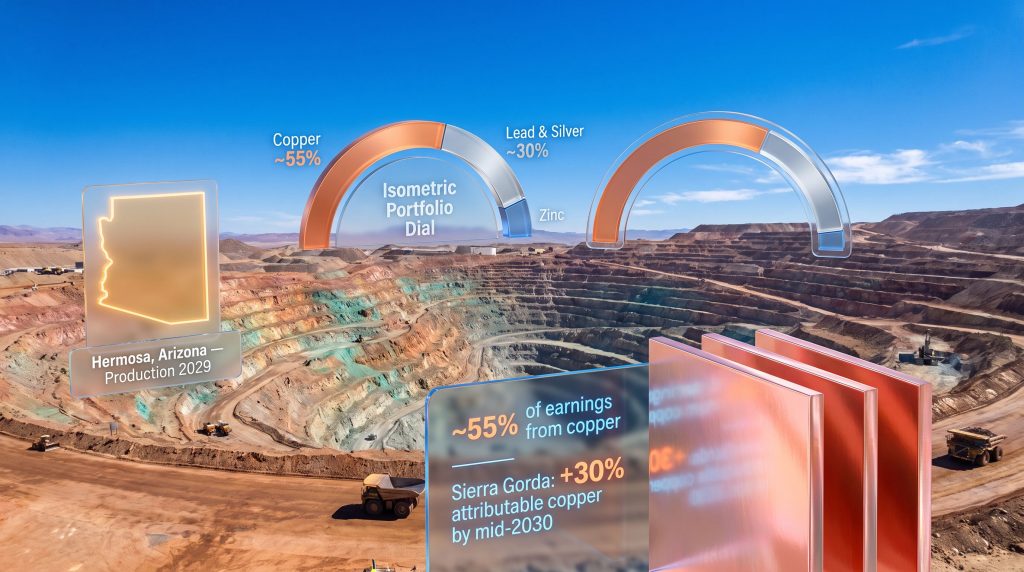
South32's incoming CEO Matt Daley, who brings direct operational experience from Anglo American and previously led Glencore's copper business in Canada, has framed the earnings trajectory with notable precision. He has indicated that approximately 55% of earnings will derive from copper, around 30% from lead and silver, with the remaining contribution from zinc and other base metals. Critically, he has identified a roughly 55% growth trajectory embedded in projects that have already received board approval and are actively in execution, according to MiningMX.
The Four Core Assets
- Sierra Gorda – 45%-owned open-pit copper mine in Chile's Atacama region, now the subject of a major capacity expansion
- Hermosa – 100%-owned zinc and manganese development project in Arizona, USA, targeting 2029 production
- Cannington – Silver, lead, and zinc operation in Queensland, Australia, generating near-term cash flow
- Cerro Matoso – Nickel laterite operation in Colombia
Sierra Gorda: Converting an Acquisition Into a Growth Engine
The Fourth Grinding Line Expansion Explained
Sierra Gorda sits at the operational centre of South32's copper growth strategy. The Chilean mine was acquired for $1.4 billion in 2022, a transaction that gave South32 its anchor copper asset but also required patience before expansion capital could be justified. That patience has now paid off with the July 2026 approval of a fourth grinding line expansion. Furthermore, the broader copper supply crunch makes this timing particularly advantageous for South32.
Key metrics for the Sierra Gorda expansion:
- Total project cost: $725 million (100% basis, South32 attributable share at 45%)
- Processing throughput increase: approximately 25%, lifting capacity to around 60 million tonnes per year
- Attributable copper production uplift: ~30% by mid-2030
- Approval date: July 2026
In copper mining, grinding circuit capacity is often the single largest constraint on throughput. Adding a fourth grinding line at Sierra Gorda is not simply an incremental upgrade. It represents a step-change in the mine's processing capability, allowing the operation to move materially more ore through the concentrator without proportional increases in mining costs. For investors, this is the mechanism that converts Sierra Gorda from a stabilising acquisition into an active production growth engine within a defined medium-term horizon.
The Atacama region context is also worth noting. The Atacama Desert hosts some of the world's highest-grade copper porphyry deposits, including Escondida, the largest copper mine globally. Sierra Gorda operates within this highly prospective geological province, though at grades typical of large-scale, lower-grade porphyry operations where economics depend heavily on throughput volumes and processing efficiency rather than ore grade alone. This is precisely why the grinding line expansion carries such financial significance. Investors seeking to understand Chile's copper supply gap will find Sierra Gorda's expansion directly relevant to the region's broader output trajectory.
Hermosa: South32's US Critical Minerals Flagship
A $2 Billion Project at the Intersection of Geology and Geopolitics
The Hermosa project in Santa Cruz County, Arizona, deserves more analytical attention than it typically receives in coverage of South32's copper pivot. While copper dominates the earnings narrative, Hermosa is the project that most clearly reveals the strategic sophistication underlying South32's repositioning. In addition, the role of critical minerals and energy transition policy has materially elevated the strategic importance of assets like Hermosa within US borders.
Hermosa centres on the Taylor deposit, which hosts zinc and manganese mineralisation. Several aspects of this project are not widely understood outside specialist mining circles:
-
Manganese's battery relevance: The Taylor deposit's manganese resource has particular strategic value because high-purity manganese sulphate is a critical input for lithium-manganese-iron-phosphate (LMFP) battery chemistry, which is gaining adoption in electric vehicle applications as a lower-cost alternative to nickel-heavy cathodes. This positions Hermosa's manganese output at the intersection of two energy transition demand curves simultaneously.
-
Underground mining methodology: Unlike Sierra Gorda's open-pit operation, Hermosa will be developed as an underground mine. Underground copper and zinc operations carry different capital profiles and operating cost structures, with higher development costs offset by lower strip ratios and greater selectivity in ore extraction.
-
Regulatory milestone significance: US approval arriving approximately two months ahead of schedule is operationally meaningful because permitting timelines in Arizona have historically been extended by environmental review processes. Early clearance reduces development timeline risk and allows construction sequencing to proceed without the buffer periods typically built into project schedules.
Hermosa Project Overview:
| Parameter | Detail |
|---|---|
| Location | Santa Cruz County, Arizona, USA |
| Primary commodities | Zinc and manganese (Taylor deposit) |
| Total development budget | ~$2 billion |
| South32 ownership | 100% |
| Acquisition year | 2017 |
| Target production start | 2029 |
| Regulatory approval | Received mid-2026, ~2 months ahead of schedule |
CEO Daley has been direct about the cash flow dynamics this project creates. South32 is navigating a period of elevated capital consumption during construction, but the post-Hermosa financial profile transforms materially once the project reaches production. The proceeds from the Alcoa transaction provide the runway to fund construction without forcing the company into dilutive equity raising, which represents a significant structural advantage compared to junior development companies attempting similar-scale projects in the current capital environment.
Is South32 Now a Copper Takeover Target?
The Acquisition Premium Thesis: Logic, Limits, and Market Signals
The structural simplification of South32's portfolio has renewed serious market commentary around whether the company now presents an attractive acquisition target for a larger diversified miner seeking copper exposure. Reuters raised this possibility explicitly in July 2026, arguing that relative valuations could make a case for a strategically motivated offer at a discount to what the growth assets might otherwise command.
The arguments in both directions deserve careful consideration. According to South32's strategy and business update, the company has articulated a clear medium-term vision centred on base and precious metals with significant growth embedded in approved projects.
Factors strengthening the takeover thesis:
- Four-asset portfolio is dramatically easier to integrate than the previous eight-asset structure
- Copper scarcity premium among major miners reflects a genuine structural deficit of development-ready, permitted copper assets at scale
- Hermosa's Arizona location offers a US-domiciled critical minerals asset that carries strategic value for any acquirer seeking domestic supply chain positioning
- Rehabilitation liabilities reduced to approximately $500 million, representing a significantly cleaner balance sheet for an acquirer to absorb
Factors complicating the takeover thesis:
- South32's share price gained approximately 9% on the Alcoa deal announcement but subsequently retraced, suggesting the market has not embedded a sustained acquisition premium into the stock
- Hermosa's $2 billion capital commitment and 2029 production timeline represent near-term cash consumption, which may deter acquirers seeking immediate production accretion
- Dividend and buyback policy review is contingent on Hermosa reaching full production, limiting near-term yield attractiveness for income-focused shareholders
The gap between a theoretically compelling takeover case and a market price that reflects that case remains wide. This divergence is itself an information signal: either the market is undervaluing the transformation thesis, or it is applying a construction execution risk discount that the theoretical sum-of-parts analysis does not fully capture.
The next major ASX story will hit our subscribers first
Competitive Positioning: How South32 Compares to Diversified Peers
| Metric | South32 (Post-Transformation) | BHP | Rio Tinto |
|---|---|---|---|
| Copper as % of earnings | ~55% target | ~25-30% | ~20-25% |
| Key copper growth asset | Sierra Gorda (Chile) | Escondida (Chile), OZ Minerals assets | Oyu Tolgoi (Mongolia) |
| US critical minerals exposure | High (Hermosa, Arizona) | Low | Low |
| Portfolio complexity | Low (4 core assets) | High (diversified) | High (diversified) |
| Rehabilitation liability | ~$500m after 70% reduction | Significantly higher | Significantly higher |
The US geographic differentiation is particularly worth isolating. Neither BHP nor the Rio Tinto copper expansion programme hold a comparable development-stage critical minerals asset within the United States at this scale. As domestic supply chain considerations become increasingly embedded in minerals policy across major consuming economies, this positioning could attract a category of strategic or institutional investor interest that purely financially-driven analysis does not fully anticipate.
Exploration Pipeline: Beyond the Two Anchor Assets
A Six-Jurisdiction Copper Discovery Platform
South32's copper ambitions extend beyond Sierra Gorda and Hermosa. The company maintains an active exploration portfolio across multiple jurisdictions that signals management's intent to pursue organic discovery-driven growth alongside the executed acquisitions:
- Alaska, USA – Early-stage copper exploration assets in a prospective but remote geological province
- Arizona, USA – Potential resource extensions within the broader Hermosa district beyond the Taylor deposit
- Nevada, USA – Exploration-stage copper targets
- Namibia – African copper belt exposure in a jurisdiction with established mining infrastructure
- Botswana – Southern African exploration, adjacent to prospective regional geology
- Argentina – South American copper province exposure in a country hosting world-class porphyry deposits
The breadth of this exploration footprint is notable for a company with only four producing assets. It signals that management views the current portfolio as a foundation rather than a ceiling, with future growth optionality embedded in a pipeline that could yield discovery-driven upside beyond the approved project timelines.
Financial Implications: Navigating the Construction Phase
Capital Allocation Through 2029 and Beyond
South32's near-term financial profile is characterised by elevated capital consumption ahead of meaningful production growth. Understanding this dynamic is essential for investors assessing entry timing. Consequently, those evaluating copper investment strategies should weigh this construction-phase discount carefully against the longer-term production growth embedded in South32's approved project pipeline.
Near-term cash flow dynamics (2026–2029):
- Alcoa transaction proceeds of $4.1 billion provide the primary construction funding runway
- Sierra Gorda expansion commitment of $725 million (100% basis) adds to near-term capital outflows
- Dividend and buyback policy under active review, with management indicating a return to higher distributions post-Hermosa completion
Post-Hermosa financial profile (projected from 2029 onwards):
- Copper and zinc production volumes materially higher across both Sierra Gorda and Hermosa
- Rehabilitation provisions structurally reduced to approximately $500 million
- Operating cost base simplified with four-asset portfolio removing complexity overhead
- Approximately 55% earnings growth trajectory embedded in approved and in-execution projects
The construction phase discount is a well-understood dynamic in mining investment. Companies executing large development projects typically trade at a discount to their post-production intrinsic value until the market can verify construction milestones and operational ramp-up. South32's challenge over the 2026-to-2029 period is to deliver Hermosa on budget and schedule while simultaneously executing the Sierra Gorda grinding line expansion, two concurrent major capital projects that will test the operational depth of an incoming CEO team.
Daley's background is directly relevant here. Experience leading copper operations at Glencore in Canada and serving as operations director at Anglo American means he has navigated large-scale mining project execution in challenging environments before. Analysts at FNArena have noted South32's growth-through-transformation thesis as a key differentiator among mid-tier diversified miners. The question the market will ultimately price is whether that experience translates into delivery confidence for South32's specific asset mix and whether the South32 shift to copper strategy ultimately commands the valuation re-rating that management's roadmap implies.
Disclaimer: This article is intended for informational purposes only and does not constitute financial advice. Forward-looking statements regarding production timelines, earnings projections, and project completion dates involve inherent uncertainty. Readers should conduct their own independent research before making any investment decisions. Past performance of mining assets and commodity prices is not indicative of future results.
Want to Know When the Next Major Copper Discovery Hits the ASX?
Discovery Alert's proprietary Discovery IQ model delivers real-time alerts on significant ASX mineral discoveries, instantly cutting through complex data to surface actionable opportunities in copper and beyond — exactly the kind of structural plays explored in this article. Start your 14-day free trial today and see why historic mineral discoveries have generated extraordinary returns for investors who moved early.