August 6, 2026
The Automation Imperative: Why Restarting a Dormant Mine Is More Complex Than Building One
Underground mining has always rewarded precision over speed. Nowhere is that principle more consequential than in a mine restart, where decades of dormancy leave behind a geological and structural reality that no amount of planning can fully anticipate. The challenge is not simply switching the lights back on. It is rebuilding operational certainty in an environment that has spent years evolving without human intervention, where ground conditions shift, infrastructure degrades, and the institutional knowledge of the original workforce has long since dispersed.
This is the operational reality confronting Gruvaktiebolaget Viscaria as it advances one of Europe's most technically demanding underground copper mine restarts, deploying a Sandvik automated fleet for the Viscaria copper mine restart as a foundational pillar of its production strategy.
When big ASX news breaks, our subscribers know first
Europe's Copper Supply Deficit and the Economics Driving Viscaria's Revival
The structural contraction of European base metals mining during the late 1990s was not incidental. It was the direct consequence of a prolonged copper price collapse that made high-cost underground operations economically unviable. The Viscaria mine in Kiruna, northern Sweden, operated from 1982 until 1997, when sustained low copper prices forced its closure. It joined a long list of European mines curtailed during that period, quietly transferring supply capacity to lower-cost jurisdictions while European demand continued to grow.
The demand equation has since shifted dramatically. The electrification of transport systems, the rapid scaling of offshore wind infrastructure, the expansion of grid-scale battery storage, and the broad push toward building electrification have collectively created a structural copper supply crunch that European domestic production is poorly positioned to satisfy. Copper consumption per electric vehicle is estimated at roughly four times that of a conventional internal combustion engine vehicle, and a single offshore wind turbine can require several tonnes of copper wiring and components. Against this backdrop, every tonne of domestically produced European copper carries genuine strategic weight.
Kiruna as a Minerals District of Enduring Significance
The Kiruna region of northern Sweden is not a peripheral mining location. It is home to the LKAB iron ore operations, which represent one of the largest underground iron ore mines on the planet. That legacy of deep, large-scale underground production provides Viscaria with a meaningful operational context: a region with existing heavy infrastructure, an established mining workforce tradition, and deep technical experience in high-latitude underground environments.
Gruvaktiebolaget Viscaria's acquisition of the asset in 2019 signalled renewed investor conviction that the project's economics had fundamentally changed. Furthermore, Europe's critical minerals supply chain increasingly depends on assets exactly like this one. At full operational capacity, targeted for 2029, the mine is projected to produce 26,000 tonnes of copper concentrate annually, a volume that represents a meaningful contribution to European domestic output at a time when import dependency on refined base metals is increasingly viewed as a strategic vulnerability.
The Engineering Complexity of a 31-Year Dormancy
Restarting a mine that has been idle since 1997 presents a category of technical challenge distinct from that of a care-and-maintenance operation. In a care-and-maintenance closure, critical infrastructure is preserved, dewatering continues, and ground support is maintained. A 31-year dormancy carries none of those assurances.
The primary technical challenges facing any long-idle underground restart include:
- Structural integrity assessment of existing tunnels, ore passes, and shaft infrastructure, where stress relaxation and water infiltration over decades can create unpredictable ground behaviour
- Geotechnical re-mapping of the orebody and surrounding rock mass, since stress fields in underground environments are dynamic and the original mine design assumptions may no longer hold
- Ventilation system recommissioning, which in a long-dormant operation may require near-complete replacement of ducting, fans, and monitoring infrastructure
- Dewatering, typically one of the most time-consuming and capital-intensive restart activities, requiring progressive management of accumulated groundwater before any other underground access is safely possible
- Regulatory re-certification of all ground support, electrical systems, and lifting equipment to contemporary Swedish mining standards, which have evolved substantially since 1997
The pre-production feasibility milestones planned for 2025 and 2026 are designed precisely to de-risk these unknowns before major capital equipment is committed to site. Securing the Sandvik fleet agreement in Q3 2026, with deliveries commencing in January 2027, reflects a sequencing logic where geotechnical confidence precedes equipment commitment.
Inside the Sandvik Automated Fleet: Equipment Selection and Technical Rationale
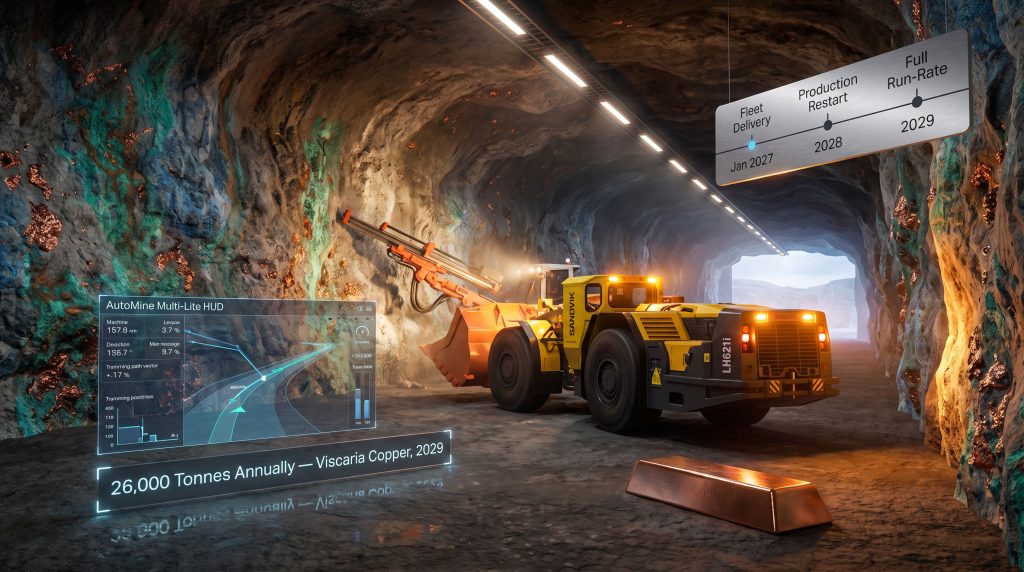
The confirmed Sandvik automated fleet for the Viscaria copper mine restart comprises four DL432i longhole drills, four Toro LH621i loaders, the AutoMine Multi-Lite fleet automation and management platform, rock tools, and a comprehensive lifecycle service contract. Fleet deliveries are programmed to run from January 2027 through to August 2027, with copper production scheduled to resume in 2028.
| Equipment | Units | Primary Function |
|---|---|---|
| Sandvik DL432i Longhole Drill | 4 | Sublevel stoping blast hole drilling |
| Sandvik Toro LH621i Loader | 4 | Underground ore tramming and loading |
| AutoMine Multi-Lite Platform | 1 (fleet-wide) | Autonomous operation and fleet management |
| Rock Tools | Fleet-wide | Drill consumables |
| On-Site Service Organisation | Dedicated | Lifecycle maintenance and support |
The DL432i: A Drill Built for Hard Rock Precision
The DL432i is a top-hammer longhole drill engineered specifically for sublevel stoping in hard rock underground environments. Sublevel stoping is the dominant mining method in high-grade underground copper and base metals operations, where ore is drilled and blasted in large vertical sections from development drives above and below the ore zone. Hole alignment precision in this method is critical: even minor angular deviations in a long drill hole compound over depth, leading to poor blast fragmentation, ore dilution, and increased mucking cycle times.
The DL432i addresses this through automated drill string management and real-time hole deviation monitoring. These capabilities are particularly valuable in a restart scenario where ground conditions may be less predictable than in a mature operation. Advances in AI in drilling and blasting have further reinforced the case for purpose-built automated drill platforms. Its native automation architecture allows integration with fleet management systems for remote monitoring and autonomous cycle execution, reducing the need for operators to work in active drilling zones.
The Toro LH621i: High-Capacity Loading with Autonomous Capability
The Toro LH621i is a 21-tonne capacity underground loader (LHD, or load-haul-dump machine), designed for large-scale ore extraction. LHDs are the workhorses of sublevel stoping operations, moving broken ore from beneath the blasted stope to ore passes or directly to underground crushers. At 21 tonnes payload capacity, the LH621i sits in the heavy end of the underground loader class, optimised for the high-tonnage requirements of a mine targeting 26,000 tonnes per annum of copper in concentrate.
Critically, the LH621i is designed for AutoMine integration. This is an important distinction. Retrofitting automation onto a loader originally designed for manual operation introduces mechanical and software compatibility compromises that purpose-built automated loaders avoid. Running four LH621i units in coordinated autonomous tramming mode under the AutoMine Multi-Lite platform allows continuous ore movement across multiple stoping areas simultaneously, improving equipment utilisation rates well beyond what a manually operated fleet of equivalent size could achieve on a single-shift basis.
AutoMine Multi-Lite: Scalable Automation Without Enterprise-Scale Infrastructure
AutoMine Multi-Lite occupies a specific position in Sandvik's automation product hierarchy: it is not the full AutoMine enterprise system designed for single-level, continuous high-volume operations, but neither is it a basic remote control solution. It is a scalable platform engineered for multi-area autonomous operation with real-time machine telemetry, fleet management integration, and a centralised control interface.
For a restart project like Viscaria, where production areas will expand progressively as ground is rehabilitated and stopes are opened, the scalable architecture of AutoMine Multi-Lite is particularly well matched to the operational reality. A full AutoMine enterprise deployment assumes a stable, fully developed mine layout, which a restart cannot guarantee in its early years.
| Feature | AutoMine Multi-Lite | Full AutoMine Deployment |
|---|---|---|
| Machine capacity | Scalable, multi-machine | Enterprise-scale full fleet |
| Infrastructure requirement | Moderate | High |
| Operational flexibility | High (multi-area) | Optimised for single-level continuous operation |
| Remote operation | Yes | Yes |
| Fleet telemetry and health monitoring | Yes | Yes |
| Ideal deployment scenario | Progressive restart, expanding mine | Mature, stable production environment |
The On-Site Service Model: Turning Reactive Support Into Embedded Partnership
One of the less-discussed but operationally significant elements of the Sandvik agreement is the commitment to establish a dedicated on-site service organisation at Viscaria. This is a meaningfully different arrangement from standard OEM service models, which typically rely on regional service centres responding to maintenance requests as they arise.
An embedded OEM service team delivers several operational advantages that are particularly consequential during the ramp-up phase of a mine restart:
- Reduced mean time to repair (MTTR): On-site technicians with deep familiarity with the specific fleet configuration can diagnose and resolve faults faster than remotely dispatched teams
- Accelerated operator competency development: Embedded OEM personnel can provide continuous on-the-job training for site operators, shortening the learning curve on complex automated systems
- Proactive maintenance planning: On-site access to machine health telemetry allows preventive interventions before failures occur, protecting equipment availability during the critical production ramp
- Parts inventory optimisation: On-site service teams can manage spare parts holdings to operational demand patterns rather than relying on standardised regional inventory buffers
The financial logic for the mine operator is equally compelling. Long-term lifecycle service agreements convert what would otherwise be unpredictable, lumpy maintenance capital expenditure into structured operational expenditure, improving cash flow predictability during the years when the operation is most financially vulnerable.
Sandvik's involvement with the Viscaria project dates to 2020, six years before first production is expected. This extended pre-production engagement allowed OEM personnel to contribute to equipment specifications, underground communications infrastructure design, and automation architecture decisions in ways that purely transactional procurement relationships cannot replicate. According to Viscaria's own announcement of the strategic supply agreement, the commercial and technical value created through that early collaboration is embedded in the fleet's design configuration before the first machine is delivered to site.
Commissioning an Automated Fleet Underground: A Step-by-Step Process
For readers less familiar with the operational mechanics of underground fleet automation, the commissioning sequence from equipment delivery to fully autonomous production follows a structured progression:
- Underground communications backbone installation establishes the Wi-Fi mesh or leaky feeder network required for machine telemetry transmission and remote control signals throughout the mine workings
- Surface acceptance testing verifies that each machine's automation system, sensor array, and control software are correctly configured before underground deployment
- Drive mapping and route programming defines the autonomous tramming routes for loaders, establishes exclusion zones around active working areas, and validates machine positioning system accuracy in the specific underground geometry of Viscaria
- Operator and control room technician training builds site personnel competency in AutoMine Multi-Lite interfaces, alarm management, and remote intervention protocols
- Supervised autonomous production cycles run initial ore-moving and drilling cycles under direct human oversight before transitioning to unattended operation
- Performance benchmarking measures actual cycle times, tonne-per-hour output, and equipment availability against design targets, informing operational optimisation decisions
This sequence is not rapid. For a mine restart of Viscaria's complexity, the transition from first equipment delivery in January 2027 to fully autonomous steady-state production could realistically require 12 to 18 months, supporting the 2028 production restart and 2029 full-output timeline.
The next major ASX story will hit our subscribers first
Automation as Operational Necessity in Nordic Underground Mining
Labour availability in remote northern Sweden is a structural constraint that elevates fleet automation from a competitive advantage to a baseline operational requirement. The Kiruna region, despite its deep mining heritage, cannot draw on the dense skilled workforce pools available to mining operations in more populous regions. Attracting and retaining underground operators for a new operation competing against the established LKAB operation for the same talent pool is a genuine challenge.
The broader mining automation trends reinforce the productivity and safety case for automated fleets. Autonomous loaders eliminate operators from active blast zones entirely, removing personnel from environments with the highest accident exposure in underground mining. Continuous operation across multiple shifts without mandatory rest periods improves effective machine utilisation from a typical manually operated rate of 55 to 65% toward the 80 to 85% range achievable with autonomous systems in mature deployments.
The decision to deploy a fully automated fleet from commissioning rather than retrofitting automation onto a manually operated operation later is a strategic choice that eliminates a disruptive and expensive technology transition during the production ramp phase. It is a design philosophy that reflects the lessons learned from earlier generation mine automation deployments across Nordic and Australian underground operations.
The Broader Market Context: Sandvik's Global Automation Pipeline
The Viscaria agreement sits within a broader period of strong underground equipment demand for Sandvik. In July 2026, the company confirmed a separate underground equipment supply contract valued at approximately SEK 340 million (roughly USD 35.2 million) with Mexican mining contractor Constructora Minera Villagomez (CoMinVi) for deployment across multiple contract mine sites in Mexico. The concurrent activity in Europe and Latin America illustrates the geographic breadth of underground automation demand currently flowing through Sandvik's order book.
For European copper development specifically, this Sandvik automated fleet for the Viscaria copper mine restart represents a proof-of-concept for the automation-intensive restart model. If the project successfully achieves its 26,000 tonne annual production target by 2029, it will establish a replicable operational template for other dormant European base metals projects. Furthermore, Rio Tinto's copper expansion strategy illustrates how majors are simultaneously scaling up, intensifying competitive pressure on emerging projects to demonstrate cost discipline through technology.
Frequently Asked Questions: Sandvik Automated Fleet and Viscaria Copper Mine Restart
When Will the Viscaria Copper Mine Restart Production?
Copper production at Viscaria is scheduled to recommence in 2028, with the operation targeting full annual output of 26,000 tonnes by 2029.
What Equipment Is Sandvik Supplying to Viscaria?
The Sandvik package comprises four DL432i longhole drills, four Toro LH621i loaders, the AutoMine Multi-Lite fleet automation and management platform, rock tools, and a comprehensive lifecycle service contract supported by a dedicated on-site service organisation.
When Will Sandvik Begin Delivering Equipment to Viscaria?
Fleet deliveries are scheduled to begin in January 2027 and are programmed to conclude by August 2027.
How Long Was the Viscaria Mine Closed Before the Restart?
The mine ceased operations in 1997 and is not expected to resume production until 2028, representing a dormancy period of approximately 31 years.
What Is the AutoMine Multi-Lite Platform?
AutoMine Multi-Lite is Sandvik's scalable underground fleet automation system, enabling multiple loaders and drills to operate autonomously from a centralised control interface, with integrated fleet management and real-time machine telemetry.
Who Owns the Viscaria Copper Mine?
The mine is owned and operated by Gruvaktiebolaget Viscaria, which acquired the asset in 2019.
What Other Major Equipment Has Been Procured for the Viscaria Restart?
In addition to the Sandvik underground fleet, Metso was contracted in January 2026 to supply two horizontal grinding mills for the processing plant.
Viscaria as a Blueprint for Technology-Intensive Mine Restarts in Europe
Three forces are converging to make projects like Viscaria commercially viable again after decades of dormancy: structurally higher copper demand driven by the energy transition, a new generation of automation technology that fundamentally changes the operating cost profile of remote underground operations, and an OEM engagement model that brings technical expertise into project development years before production begins.
The replicability of Viscaria's procurement and automation strategy for other dormant European base metals projects is significant. Europe's underground mining infrastructure is, in many cases, not gone but merely sleeping — closed during the commodity price cycle of the late 1990s and early 2000s and now approaching a point where revised economic assumptions make restart feasibility genuinely achievable.
The milestones to monitor as Viscaria moves toward first production are clear: equipment commissioning progress through 2027, automation performance benchmarks during the supervised operation phase, and ultimately whether the 26,000 tonne annual target proves achievable within the 2029 timeframe. The inherent complexity of bringing a 31-year-old underground copper operation back into production with a fully automated Sandvik fleet at its core makes this one of Europe's most consequential mining projects to watch.
Disclaimer: This article contains forward-looking statements regarding production timelines, output targets, and equipment delivery schedules. These projections are subject to technical, regulatory, and market risks. Readers should not rely on these statements as guarantees of future performance. Independent financial and technical advice should be sought before making investment decisions related to any company or project referenced in this article.
Want To Identify the Next Major Copper Discovery Before the Market Does?
Discovery Alert's proprietary Discovery IQ model instantly scans ASX announcements to deliver real-time alerts on significant mineral discoveries — including copper opportunities driven by the same energy transition dynamics reshaping European supply chains — turning complex geological data into actionable investment insights for traders and long-term investors alike. Explore historic discovery returns on Discovery Alert's discoveries page and begin your 14-day free trial at Discovery Alert to position yourself ahead of the broader market.