
August 6, 2026
The Copper Supply Gap That Makes Permitted Developers So Rare Right Now
The average timeline from discovery to first production at a copper mine now exceeds 17 years, according to industry data tracking major projects globally. That structural reality transforms the competitive landscape for investors: genuinely permitted, feasibility-complete copper projects in stable jurisdictions are not merely attractive, they are increasingly scarce. When a developer reaches the construction-readiness threshold with a clean balance sheet, the market's attention sharpens considerably.
That is precisely the context in which Marimaca Copper (TSX: MARI | ASX: MC2) sits heading into its most consequential period. The company holds a permitted, debt-free copper oxide project in Chile's Antofagasta Region alongside a high-grade discovery still being drilled. The next 18 months will determine how much of that structural advantage converts into booked value, contracted financing, and ultimately, cathode metal. Tracking the Marimaca Copper 7 key catalysts to watch is now the central analytical task for investors monitoring this name.
When big ASX news breaks, our subscribers know first
The Marimaca Oxide Deposit: What the Starting Position Actually Looks Like
A Feasibility-Complete Project in Chile's Core Copper Belt
The Marimaca Oxide Deposit (MOD) occupies a strategically compact position within Chile's premier copper-producing corridor. Located just 25 kilometres from the Port of Mejillones and 40 kilometres from the city of Antofagasta, the project benefits from proximity to established logistics infrastructure that many frontier copper projects spend a decade trying to replicate.
The project cleared its formal environmental approval, the Resolución de Calificación Ambiental (RCA), in November 2025. The definitive feasibility study (DFS), prepared alongside engineering firms Ausenco and NCL, was completed in August 2025. Together, these two milestones place the MOD in a category occupied by very few projects globally: fully permitted and fully studied, with no fundamental technical uncertainty blocking the path to a construction start.
Key Project Metrics at a Glance
| Metric | Figure |
|---|---|
| Project Location | Antofagasta Region, Chile |
| Distance to Port of Mejillones | 25 km |
| Distance to City of Antofagasta | 40 km |
| Proved and Probable Reserves | 179 Mt at 0.42% Cu |
| Contained Copper (Reserves) | 748,000 tonnes |
| Measured and Indicated Resource | 213 Mt at 0.40% Cu |
| Cash on Balance Sheet (March 2026) | US$147.2 million |
| Debt | Nil |
| Environmental Approval (RCA) Granted | November 2025 |
| DFS Completion Date | August 2025 |
Why Infrastructure and Utilities Change the Execution Equation
Two resource inputs that frequently stall copper heap-leach projects in Chile are already resolved for the MOD. Water is secured through a permitted seawater intake at the Bay of Mejillones, eliminating the freshwater dependency that complicates many Atacama-region developments. Certified renewable power sits on a grid connection just 10 kilometres from the site, avoiding the need to construct standalone energy infrastructure.
The combination of settled permits, secured utilities, and a debt-free balance sheet carrying US$147.2 million in cash as of March 2026 creates a risk profile structurally different from most pre-construction copper companies. Furthermore, the copper supply crunch facing the global market only amplifies the strategic value of assets that sit this close to a construction decision. Construction finance negotiations proceed from strength rather than necessity.
The 7 Key Catalysts Driving Marimaca Copper's Re-Rating Potential
"Each catalyst in the MOD development sequence retires a specific category of uncertainty. Permitting risk is already resolved. What remains is financing risk, execution risk, geological risk at Pampa Medina, and ultimately production risk. Investors who understand which risks each milestone eliminates can position more precisely against the de-risking curve."
Catalyst 1: Sectorial Permit Approvals Targeted for Q4 2026
Beyond the master RCA, copper projects in Chile require auxiliary sectorial permits covering specific operational elements such as water extraction, road modifications, and blast management. These are distinct from the primary environmental approval and must be obtained before construction can lawfully commence.
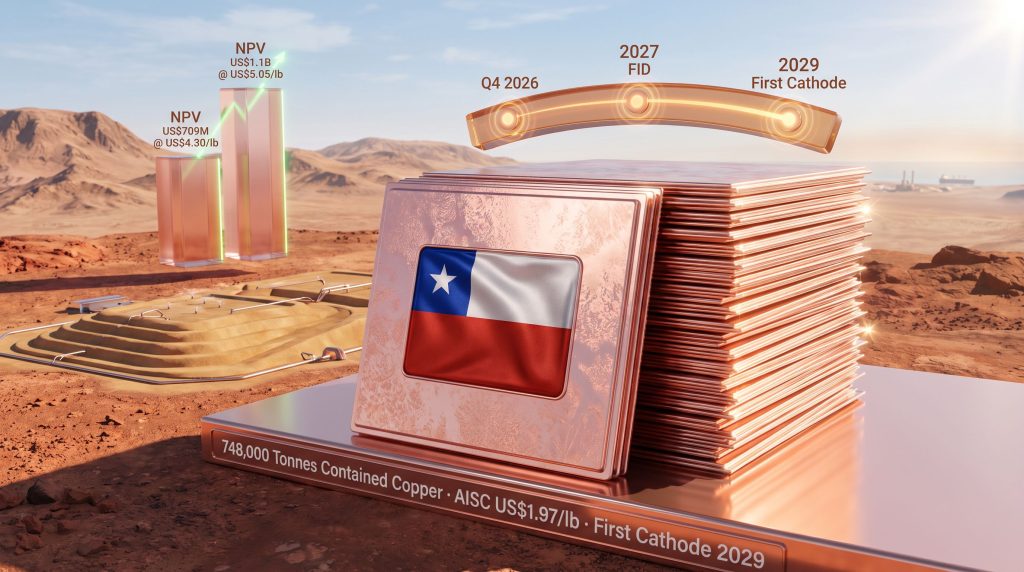
Marimaca submitted its sectorial permit applications in April 2026, and the company targets approval by Q4 2026 in line with its master project schedule. The significance of this milestone is mechanical rather than speculative: construction cannot start without these permits in hand, so the Q4 2026 approval window sits directly on the critical path to a 2027 construction commencement. A slip in sectorial approvals would cascade into the construction timeline.
Catalyst 2: Project Financing Package, Targeted Before End of 2026
The first hard external catalyst is securing third-party capital. Marimaca is targeting a full project-financing package for the MOD before the close of 2026, structured against the US$587 million initial capital cost established in the August 2025 DFS.
The company's financial modelling employs an illustrative financing split for scenario analysis purposes:
| Financing Component | Illustrative Amount |
|---|---|
| Total Initial Capital Cost (DFS) | US$587 million |
| Illustrative Equity Component | US$350 million |
| Illustrative Debt Component | US$350 million |
| DFS Capital Estimate Accuracy Range | -20% to +25% |
It is essential that investors distinguish between modelling assumptions and signed commitments. The equity-debt split above is a conservative scenario used for internal planning, not a confirmed financing structure. Hayden Locke, Chief Executive Officer of Marimaca Copper, has confirmed publicly that financing discussions are actively underway and that an announcement is expected before year-end 2026.
Risk Flag: The proportion of equity required in the final financing package is the single most consequential near-term variable for existing shareholders. If the equity component exceeds the illustrative US$350 million figure, per-share dilution will partially offset the DFS-implied NPV upside. Stress-testing entry price against a heavier equity scenario is prudent before this catalyst resolves.
Catalyst 3: Early Works and Long-Lead Equipment Commitments in 2026
Marimaca is not waiting passively for a financing close to begin spending against the schedule. Detailed engineering is already underway, road upgrades to the site have commenced, and early site preparation works are progressing ahead of any Final Investment Decision (FID). This represents a deliberate scheduling strategy rather than speculative spending.
The critical insight here relates to long-lead equipment items — those components with manufacturing and delivery lead times exceeding 50 weeks. In copper heap-leach construction, items such as crushing circuits, acid plant components, and primary conveyors fall into this category. Ordering these items before FID compresses the construction critical path significantly. For a 24-month build programme, early commitment of long-lead equipment can be the difference between a 2029 and a 2030 first cathode.
Management's willingness to commit capital in this fashion before financing is formally closed signals institutional conviction in the timeline rather than optionality-preserving caution.
Catalyst 4: Final Investment Decision and Construction Start in 2027
The FID is the decision gate that transforms a funded plan into an active construction programme. For the MOD, this requires the following sequence to be completed first:
- Sectorial permits received (target: Q4 2026)
- Project financing package announced and formally closed (target: end-2026)
- Long-lead equipment commitments placed (ongoing through 2026)
- Final Investment Decision confirmed by the board (target: 2027)
- Construction mobilisation commences (target: 2027)
- 24-month build programme initiated
The sequencing matters because each step is a gate for the next. A delay in sectorial permits or a financing close that extends into early 2027 would push the FID and therefore the construction start. Hayden Locke has been explicit that a 2027 construction start is the current plan, with first cathode targeted for 2029 but with acknowledged potential to bring that date forward depending on execution pace.
Catalyst 5: First Copper Cathode Production Targeted for 2029
The MOD is designed to produce 50,000 tonnes per annum (tpa) of copper cathode at steady state, averaging 48,000 tpa across the first ten years of a 13-year reserve life. The project operates from a low-strip open pit, moving just 0.8 tonnes of waste per tonne of ore, which keeps mining costs structurally low relative to higher-strip open pit peers.
The DFS economics across two copper price scenarios illustrate the return range investors should model:
| Economic Metric | At US$4.30/lb Cu | At US$5.05/lb Cu |
|---|---|---|
| Post-Tax NPV (8% Discount Rate) | US$709 million | US$1.1 billion |
| Internal Rate of Return (IRR) | 31% | 39% |
| Payback Period | 2.5 years | 2.2 years |
| First 5-Year AISC | US$1.97/lb | US$1.97/lb |
| Capital Intensity | US$11,700/tpa | US$11,700/tpa |
| Average Annual Production (Yr 1-10) | 48,000 tpa | 48,000 tpa |
| Reserve Life | 13 years | 13 years |
| Strip Ratio | 0.8:1 | 0.8:1 |
A first-five-year AISC of US$1.97 per pound places the MOD firmly in the lower cost quartile of global copper producers. The Chile copper price outlook remains constructive at current spot levels, and the 2.5-year payback at the conservative price case is notably short for a project of this scale and capital intensity.
Catalyst 6: Maiden Pampa Medina Mineral Resource Estimate, Targeted Early 2027
Pampa Medina sits approximately 28 kilometres east of the MOD and currently contributes nothing to the reserve or mine plan. The maiden Mineral Resource Estimate (MRE), targeted for early 2027, will be the first time this discovery carries a formal size, covering both oxide and sulphide mineralisation.
The drilling programme informing that estimate is substantial:
- Programme scale: 30,000-metre campaign across six active rigs
- Deposit style: Stacked manto-style copper-silver horizons within a sedimentary sequence
- Deepest intersection: 1,052 metres, intersecting mineralisation within basement metasediments for the first time
- Key reported drill intervals:
- 20 m at 2.65% copper from 564 m depth
- 6 m at 6.11% copper within the above interval
- 98 m at 1.21% copper
- Silver association: Silver follows copper through both oxide and sulphide zones, adding potential byproduct revenue
The manto-style deposit model is important context for non-specialist investors. Manto deposits are stratiform, sediment-hosted copper accumulations where mineralisation follows sedimentary layers rather than fracture-controlled veins. They can be geometrically predictable once the stratigraphic control is understood, but they are also susceptible to disruption by barren intrusive dykes, which have already been intersected in the deeper Pampa Medina holes.
Contextual Benchmark: Cachorro, an Antofagasta Minerals discovery in the same geological province, carries an estimated resource of approximately 300 Mt at 1.0% copper. This is a geological analogue that illustrates the scale potential of the style, not a figure already assigned to Pampa Medina. The maiden MRE will either support or distinguish from this benchmark.
For additional context on what these Pampa Medina silver assays mean for the overall resource picture, Crux Investor has published a detailed breakdown of the key implications for investors tracking the discovery.
What the maiden MRE achieves analytically is a re-categorisation of Marimaca's investment narrative. Today the company is priced as a single-deposit developer. A formally sized second copper system changes that framing entirely and introduces a new denominator for institutional valuation models.
Catalyst 7: Pampa Medina Oxide Feed and District-Scale Expansion Potential
Beyond the maiden MRE, the oxide portion of the Pampa Medina resource carries direct operational relevance. Because copper oxide mineralisation is amenable to the same copper leaching process — specifically heap-leach, solvent extraction, and electrowinning (SX-EW) — used at the MOD, Pampa Medina oxides can feed the existing plant design without requiring a separate processing facility.
| Expansion Scenario | Estimated Cathode Addition |
|---|---|
| Pampa Medina Oxides (No Further Exploration Required) | 20,000-25,000 tpa |
| MOD Base Design Capacity | 50,000 tpa |
| Combined Potential Cathode Output | Up to approximately 75,000 tpa |
The broader district picture adds further optionality layers. Marimaca has consolidated 55 concessions across approximately 14,500 hectares, with Pampa Medina's 12 concessions held under an option to acquire. Near the MOD itself, three shallow oxide targets — Mercedes, Robles, and Cindy — carry conceptual exploration estimates of 20 to 40 Mt at 0.2% to 0.4% copper, with scout drilling underway testing sediment-hosted systems beneath gravel cover.
None of these peripheral targets count toward the current mine plan. Their value is structural optionality on mine life extension and incremental cathode output, contingent on drilling confirmation.
Key Risks Investors Must Weigh Against the Catalyst Upside
Risk 1: Financing Terms and Dilution Exposure
The financing package structure remains the most consequential near-term uncertainty. If the equity component of the eventual deal exceeds the illustrative US$350 million figure, per-share value dilution could materially offset the NPV upside implied by the DFS. Consequently, copper investment strategies that account for dilution scenarios before the financing close are far better positioned to manage this specific risk.
Risk 2: Capital Cost Overrun Within the DFS Accuracy Band
The DFS carries a standard accuracy range of -20% to +25%. At the upper end, that represents approximately US$146 million of additional capital above the base case US$587 million figure. Investors should model sensitivities against this band before forming return expectations.
Risk 3: Geological Discontinuity at Pampa Medina
The deepest Pampa Medina intercepts encountered barren dyke intrusions that disrupt mineralisation continuity. In manto-style deposits, igneous intrusions can truncate economic horizons unpredictably. The maiden MRE methodology will need to account for this geological complexity in its resource classification decisions.
Risk 4: Copper Price Volatility
Marimaca's DFS return metrics are highly sensitive to copper price. At US$4.30 per pound, the post-tax IRR is 31%. A sustained price decline below the DFS base case would compress returns and potentially affect financing terms if lenders reprice project debt against lower long-term copper assumptions.
Risk 5: Sulphuric Acid Supply Chain
Heap-leach copper processing is entirely dependent on a continuous sulphuric acid supply for ore leaching. Acid pricing and availability in northern Chile can be influenced by smelter throughput rates elsewhere in the supply chain, a variable entirely outside Marimaca's operational control.
Bear Case Consideration: Investors should stress-test their entry price against a scenario in which the equity component of the financing package exceeds the illustrative figure and capital costs trend toward the upper end of the DFS accuracy band simultaneously. That combined scenario represents the most adverse near-term outcome for per-share value, independent of copper price assumptions.
Marimaca Copper Catalyst Timeline: A Roadmap for Investors
| Catalyst | Target Timing | Risk Level | Value Impact |
|---|---|---|---|
| Sectorial Permit Approvals | Q4 2026 | Medium | Enables construction start |
| Project Financing Package Close | End-2026 | High | Converts DFS to funded plan |
| Early Works and Long-Lead Equipment | 2026 (Ongoing) | Low-Medium | Shortens critical path |
| Final Investment Decision | 2027 | High | Triggers active construction |
| Maiden Pampa Medina MRE | Early 2027 | Medium | Reframes company as multi-asset |
| Construction Start | 2027 | High | Execution phase begins |
| First Copper Cathode | 2029 | Medium-High | Revenue generation commences |
| Pampa Medina Oxide Feed Decision | Post-MRE | Speculative | Potential +20,000-25,000 tpa |
How the MOD Compares Against Global Copper Development Peers
Capital Intensity and Cost Position in Context
Capital intensity of US$11,700 per tonne of annual copper capacity sits at a competitive level for a greenfield heap-leach project in South America. Many comparable projects announced over the past decade have carried capital intensities ranging from US$15,000 to above US$25,000 per annual tonne, particularly in jurisdictions with less developed infrastructure.
The first-five-year AISC of US$1.97 per pound is the figure that most directly determines margin resilience through the commodity cycle. At current copper prices, that cost position generates substantial free cash flow per tonne of cathode. Even under a significant copper price correction, the MOD's cost structure provides meaningful downside protection relative to higher-cost peers.
Why the Antofagasta Region Compresses Execution Risk
Projects in frontier copper jurisdictions must often construct access roads, power lines, water systems, and port facilities as part of the development capital budget. The MOD avoids virtually all of this. The 25-kilometre proximity to an operating port, the grid-connected renewable power, and the established regulatory environment in the Antofagasta Region remove categories of execution risk that frequently derail otherwise attractive copper projects in less developed corridors.
The next major ASX story will hit our subscribers first
Frequently Asked Questions: Marimaca Copper and the MOD
What is Marimaca Copper's ticker symbol and where does it trade?
Marimaca Copper trades on the Toronto Stock Exchange under the ticker MARI and on the Australian Securities Exchange under the ticker MC2.
When is Marimaca Copper expected to produce its first copper cathode?
First copper cathode is targeted for 2029, following a construction start in 2027 and an approximately 24-month build programme.
What is the MOD's copper reserve grade and total contained copper?
Proved and Probable reserves stand at 179 Mt at 0.42% copper, containing 748,000 tonnes of copper metal.
Why does the Pampa Medina maiden resource estimate matter?
It will formally quantify a discovery that currently sits entirely outside the MOD mine plan. A confirmed second copper system transforms Marimaca's investable narrative from a single-asset developer into a multi-system copper company with expansion optionality beyond the booked reserve.
How much cash does Marimaca hold, and does it carry debt?
As of March 2026, Marimaca holds US$147.2 million in cash with zero debt on the balance sheet.
What is the total initial capital cost for the MOD?
The DFS pegs initial capital at US$587 million, with an accuracy range of -20% to +25%. Illustrative financing splits this across approximately US$350 million in equity and US$350 million in debt, though the actual structure remains subject to negotiation.
What is the strip ratio and mine life?
The MOD operates at a 0.8:1 waste-to-ore strip ratio across a 13-year reserve life.
The Investment Case Distilled
The re-rating logic embedded in the Marimaca Copper 7 key catalysts to watch is sequential rather than event-driven. There is no single announcement that will unlock the full DFS-implied NPV in one release. Instead, value accrues milestone by milestone as each catalyst closes a specific uncertainty gap between the current market price and the project's studied economics.
The permitted status and debt-free balance sheet define the floor of the investment case. The project financing package, construction commencement, and maiden Pampa Medina MRE define the ceiling of the near-term re-rating window. Beyond that, Pampa Medina oxides and the district exploration programme represent genuine optionality that current valuations likely underweight.
"The distance between where Marimaca trades today and what the DFS implies at consensus copper price assumptions is where the investment thesis lives. Each catalyst delivered narrows that gap, and the sequence from financing close through to first cathode is the clearest de-risking roadmap available in the copper development universe right now."
For investors seeking deeper institutional analysis and management commentary on the MOD development timeline and Pampa Medina exploration programme, Crux Investor's coverage of Marimaca Copper includes interview content with company management and an in-depth look at the undervalued investment case.
This article is for informational purposes only and does not constitute financial advice. All financial projections, NPV figures, IRR estimates, production targets, and resource estimates referenced herein are drawn from company-disclosed DFS and exploration data. Actual outcomes may differ materially from modelled scenarios. Investors should conduct their own due diligence and consult a licensed financial adviser before making any investment decision.
Want to Track the Next Major Copper Discovery Before the Market Catches On?
Discovery Alert's proprietary Discovery IQ model delivers real-time alerts on significant ASX mineral discoveries — turning complex exploration data into actionable insights the moment they hit the exchange. Start your 14-day free trial today and explore Discovery Alert's discoveries page to understand how historic mineral finds have generated exceptional returns for investors who positioned early.