August 6, 2026
The Structural Argument for Copper That Most Investors Still Underestimate
The conventional narrative around copper demand focuses almost entirely on electric vehicles. Yet EVs represent only one thread in a far larger tapestry of electrification infrastructure that is reshaping global commodity requirements. Grid expansion, offshore wind interconnection, utility-scale battery storage systems, and industrial electrification collectively consume volumes of copper that dwarf passenger vehicle demand growth alone. What makes Anglo American copper growth and Kumba Iron Ore decarbonisation demand particularly significant from an investment perspective is not the demand side, which is relatively well-understood, but the supply side, which is quietly becoming one of the most constrained in any major commodity market.
Mining project development timelines have extended materially over the past decade. Permitting complexity, community engagement obligations, environmental impact assessment requirements, and the rising capital intensity of new mine construction have all compressed the pipeline of credible future copper supply. The capital required to bring a greenfield copper mine into production has risen well ahead of general inflation, making many projects economically marginal at all but the highest price assumptions. This structural backdrop, which increasingly resembles a copper supply crunch, makes brownfield expansion not merely a pragmatic choice but arguably the only rational one for a capital-disciplined mining major.
When big ASX news breaks, our subscribers know first
Why Brownfield Copper Growth Outperforms in a Capital-Constrained World
The Risk-Adjusted Case for Existing Asset Expansion
Anglo American's copper growth strategy is anchored in brownfield development and the optimisation of existing producing assets rather than large-scale greenfield construction. This is a strategically meaningful distinction that goes beyond simple cost comparisons.
Brownfield expansion benefits from established infrastructure, known geological profiles, existing community relationships, and operational workforces already in place. These factors collectively reduce the execution risk that has derailed numerous greenfield projects in recent years. More importantly for capital allocators, brownfield projects deliver production uplift on compressed timelines, which fundamentally improves the internal rate of return profile of invested capital.
| Development Type | Typical Lead Time | Capital Intensity | Permitting Risk | Production Certainty |
|---|---|---|---|---|
| Greenfield | 10-15+ years | Very High | Very High | Low |
| Brownfield Expansion | 3-7 years | Moderate | Lower | High |
| Existing Asset Optimisation | 1-3 years | Low | Minimal | Very High |
The table above makes clear why the phased ramp-up model is gaining traction among institutional investors who increasingly scrutinise the volume of production growth delivered per dollar of capital deployed rather than simply the headline tonnage ambitions. Furthermore, copper investment strategies that prioritise capital efficiency are explicitly rewarded by this model, providing operational optionality that allows production targets to be calibrated against prevailing copper prices without committing to irreversible capital expenditure upfront.
What the Production Numbers Actually Reveal
Anglo American's copper production reached approximately 695,000 tonnes in 2025, establishing the baseline from which its multi-year growth trajectory is measured. Near-term guidance for 2026 was revised to a range of 700,000 to 760,000 tonnes, a recalibration that reflects softer prior-year output and illustrates that even brownfield production can be subject to operational variability. However, this near-term adjustment does not materially alter the medium-term strategic direction.
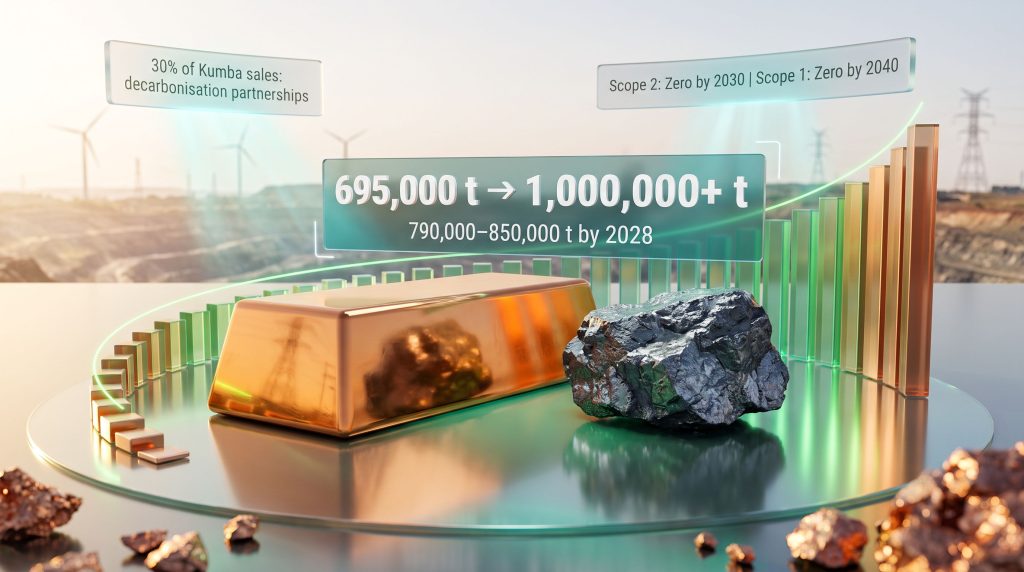
The medium-term target of 790,000 to 850,000 tonnes by 2028 represents a volume increase of approximately 14 to 22% above the 2025 baseline, achievable through a combination of existing asset optimisation and targeted brownfield development. The longer-term ambition of surpassing 1 million tonnes per annum in the early 2030s would represent a 44%+ increase over the 2025 production base, consequently positioning Anglo American among the world's largest dedicated copper producers.
| Timeframe | Target Production Volume | Growth vs. 2025 Baseline |
|---|---|---|
| 2025 (Actual) | ~695,000 t | Baseline |
| 2026 (Guidance) | 700,000-760,000 t | ~0-9% |
| 2028 (Target) | 790,000-850,000 t | ~14-22% |
| Early 2030s (Ambition) | 1,000,000+ t | ~44%+ |
Anglo American's copper production target for 2028 is between 790,000 and 850,000 tonnes per year, rising from approximately 695,000 tonnes in 2025. The company's longer-term ambition is to exceed 1 million tonnes annually in the early 2030s through a capital-efficient brownfield expansion strategy.
The Grade Premium Revolution Quietly Transforming Iron Ore Markets
Why Steel Decarbonisation Is Rewriting Iron Ore Procurement Specifications
While copper's energy transition credentials are well-publicised, the structural transformation occurring within iron ore markets is less widely understood by generalist investors, yet equally consequential for producers operating at the quality end of the product spectrum.
The decarbonisation of steel production is fundamentally altering the economics of iron ore procurement. This is particularly evident when examining China steel and iron ore dynamics, where traditional blast furnace routes dominate global production today and can accommodate a relatively wide range of iron ore grades. However, electric arc furnace technology and direct reduced iron processes, both of which are central to lower-carbon steel production pathways, are significantly more sensitive to ore quality.
This technological sensitivity creates a commercially important dynamic: as steel producers face intensifying pressure from regulators, investors, and corporate customers to reduce their Scope 1 emissions, their willingness to pay a premium for higher-grade iron ore inputs increases. The grade premium is not simply a quality metric; it is becoming a decarbonisation enabler with measurable commercial value.
The Lump Product Advantage: A Less-Discussed Structural Edge
Beyond iron grade, lump ore products carry an additional processing efficiency advantage that is not widely appreciated outside the industry. Lump ore can be charged directly into a blast furnace or DRI shaft without the energy-intensive sintering or pelletising processes required for fine ore. The elimination of these intermediate processing steps reduces the overall energy consumption and emissions intensity of steelmaking at the mill level, not merely at the mine.
For steelmakers facing carbon pricing mechanisms or operating under national decarbonisation targets, this translates into a measurable reduction in their operational emissions intensity per tonne of steel produced. As carbon costs rise and regulatory scrutiny intensifies, the financial value of this reduction is increasingly reflected in the premiums that major steel producers are prepared to pay for lump products from quality-certified, low-impurity sources. In addition, green steel pricing dynamics are accelerating this shift as market participants price in carbon risk more aggressively.
Kumba Iron Ore's product portfolio, characterised by high-grade ore and significant lump proportions from its Northern Cape operations, is structurally aligned with precisely these input requirements. This alignment reflects the inherent geological characteristics of the Sishen and Kolomela deposits, which produce ore with iron grades and physical characteristics that meet the exacting specifications of lower-carbon steelmaking processes.
Kumba Iron Ore's Decarbonisation Strategy: A Commercial Differentiator, Not a Compliance Exercise
The Commercial Scale of Decarbonisation Partnerships
Kumba CEO Mpumi Zikalala has articulated that the steel industry's decarbonisation journey is continuing to reinforce demand for the higher-grade ores and lump products that Kumba produces. What makes this particularly significant from a commercial perspective is the formalisation of these demand dynamics into structured partnerships.
Decarbonisation-linked commercial partnerships now account for approximately 30% of Kumba's iron ore sales volume. This figure is more significant than it might initially appear. It reflects the pace at which major steel producers are moving from informal interest in lower-carbon procurement to contractual commitments that carry quality specifications, emissions accounting requirements, and in some cases collaborative research obligations. These are not simple offtake agreements; they are structured commercial relationships that create switching costs for customers and pricing power for suppliers.
The scope of these partnerships extends to joint engagement with academic institutions and collaborative development of supply chain emissions accounting methodologies. Kumba's early positioning in this space creates a first-mover advantage that is difficult for competitors to replicate quickly, given the time required to establish credible emissions verification systems and customer-specific decarbonisation frameworks. According to Kumba's sustainability report, these structured partnerships are central to the company's long-term commercial resilience.
Emissions Reduction Targets: The Operational Roadmap
Kumba has established a structured emissions reduction framework with clearly defined milestones across both Scope 1 and Scope 2 categories.
| Target | Scope | Timeline |
|---|---|---|
| 30% emissions reduction | Scope 1 + 2 combined | By 2030 |
| Net-zero operational electricity | Scope 2 | By 2030 |
| Full operational decarbonisation | Scope 1 | By 2040 |
The distinction between the 2030 Scope 2 target and the 2040 Scope 1 target reflects the genuine technological complexity of decarbonising mining operations. Scope 2 emissions from purchased electricity are addressable through renewable energy procurement and power purchase agreements within a relatively near-term timeframe. The Koruson 2 renewable energy cluster represents a significant infrastructure commitment in this direction, while embedded renewable power installations at the Kolomela mine demonstrate the operational viability of on-site generation in remote mining environments.
Scope 1 emissions are structurally harder to eliminate. They originate primarily from diesel combustion in mobile mining equipment, including the large haul trucks, excavators, and support vehicles that are fundamental to open-pit iron ore operations. Furthermore, emerging technologies such as hydrogen iron ore reduction processes are still maturing at the scale required for a major iron ore operation. The 2040 timeline for zero Scope 1 emissions reflects this realistic technology transition horizon rather than a lack of strategic ambition.
Kumba's decarbonisation pathway is structured to convert what might otherwise be a compliance cost into a revenue-enhancing commercial strategy. As steelmakers face mounting pressure to demonstrate lower-carbon supply chains, the willingness to pay a grade and provenance premium is expected to compound over time, creating durable pricing power for producers that have invested early in credible decarbonisation frameworks.
The Portfolio Architecture: Two Commodity Theses Converging on One Strategic Logic
How Copper and Premium Iron Ore Construct a Unified Energy Transition Thesis
Viewed independently, Anglo American's copper growth ambitions and Kumba Iron Ore's decarbonisation-linked commercial positioning appear to be separate operational stories within a diversified mining group. Examined together, however, they reveal a coherent portfolio construction thesis built around two distinct but complementary vectors of energy transition demand.
Copper addresses the electrification infrastructure vector: every additional unit of renewable energy generation capacity, grid transmission infrastructure, and electric vehicle penetration requires significantly more copper than its fossil fuel equivalent. The International Energy Agency has noted that a typical electric car requires roughly three to four times the copper content of an internal combustion engine vehicle, while offshore wind installations can require up to nine tonnes of copper per megawatt of installed capacity. According to Anglo American's copper portfolio overview, these figures underscore why the demand-supply imbalance is not a short-term market phenomenon but a structural feature of the energy transition timeline.
Premium iron ore addresses the industrial decarbonisation vector: the steel industry, responsible for approximately 7 to 8% of global CO2 emissions according to the World Steel Association, cannot achieve its climate commitments without transitioning toward EAF and DRI production routes. Those routes require exactly the high-grade, low-impurity iron ore inputs that Kumba produces. The commercial premium for these products is therefore not cyclical; it is structural and directionally linked to the pace of steel sector decarbonisation.
Scenario Analysis: What Different Transition Pathways Mean for This Portfolio
| Scenario | Copper Demand Impact | Premium Iron Ore Demand Impact | Strategic Positioning |
|---|---|---|---|
| Accelerated energy transition | Strong upward demand pressure; supply gap widens | Significant uplift as EAF/DRI adoption accelerates | Highly advantaged across both asset classes |
| Moderate transition pace | Steady demand growth; manageable supply response | Gradual grade premium expansion | Well-positioned with optionality to scale |
| Delayed or disrupted transition | Demand growth moderated; near-term price pressure | Premium narrows if blast furnace dominance persists | Brownfield flexibility limits downside capital exposure |
The asymmetry of this scenario analysis is notable. In an accelerated transition scenario, both copper and premium iron ore benefit simultaneously, creating a compounding positive effect for Anglo American's portfolio. In a delayed transition scenario, the brownfield-focused copper strategy and Kumba's relatively low capital intensity limit the downside exposure compared to peers with large greenfield commitments.
Key Risks That Could Disrupt the Dual-Commodity Strategy
Execution and Jurisdiction Risks in Copper Growth
The 2026 guidance reset to 700,000 to 760,000 tonnes from prior expectations illustrates that near-term production can be subject to meaningful operational variability, even within established brownfield asset bases. Geological variability at depth, processing circuit bottlenecks, and inflationary pressure on labour and consumables can all constrain production ramp-up timelines in ways that are difficult to model precisely from the outside.
Additionally, the regulatory and permitting environments in key copper-producing jurisdictions, including Chile and Peru, which together account for roughly 40% of global copper mine supply according to the US Geological Survey, remain subject to resource nationalism pressures, community relations dynamics, and evolving water usage regulations. These factors can introduce unexpected delays or cost escalations that affect even well-established operators.
Market Structure Risks for Iron Ore Grade Premiums
The pace of steel industry decarbonisation is not uniform across geographies. China, which produces approximately 54% of the world's steel, has a domestic iron ore supply base that is structurally different from the high-grade imports sourced from South Africa and Australia. If China's blast furnace dominance persists beyond current policy timelines, the near-term commercial premium expansion for high-grade lump ore may materialise more slowly than Kumba's strategy anticipates.
Competing iron ore producers are also investing in product quality and emissions credentials. As more producers bring high-grade products to market and develop their own decarbonisation partnerships, the current first-mover advantage that Kumba enjoys could compress over time, particularly if premium pricing stimulates additional high-grade supply from currently marginal deposits.
The next major ASX story will hit our subscribers first
What Investors and Industry Observers Should Track
The metrics that will determine whether these interlocking strategies succeed are specific and monitorable.
- Copper production trajectory against guidance: Whether Anglo achieves the 2028 target range of 790,000 to 850,000 tonnes will be the first meaningful test of the brownfield growth thesis, with each quarterly production report providing a data point against the trajectory.
- Decarbonisation partnership coverage growth: Expansion of the proportion of Kumba's sales tied to formalised decarbonisation agreements beyond the current approximately 30% will signal whether the commercial premium thesis is gaining accelerating traction.
- Renewable energy milestone delivery: Progress against Kumba's 2030 Scope 2 zero-emissions target, particularly the operational commissioning and ramp-up of the Koruson 2 renewable energy cluster and the Kolomela embedded generation project.
- EAF and DRI capacity additions globally: The rate at which new electric arc furnace and direct reduced iron capacity comes online, particularly in Europe and emerging markets, will determine how quickly structural demand for high-grade iron ore scales up.
- Copper supply pipeline credibility: Whether greenfield project announcements convert into actual permitted, funded, and construction-ready projects will determine whether the structural supply gap widens in Anglo's favour or begins to close.
Together, these monitoring points provide a framework for assessing whether the dual-commodity energy transition thesis is tracking as intended, or whether the operational and market realities are diverging from the strategic ambition. The Anglo American copper growth and Kumba Iron Ore decarbonisation demand story is ultimately a long-duration bet on two of the most structurally significant commodity demand trends of the coming decade, and the evidence base for that bet continues to build.
Disclaimer: This article is intended for informational purposes only and does not constitute financial advice. Production targets, emissions milestones, and market forecasts referenced herein are subject to operational, regulatory, and macroeconomic risks. Readers should conduct their own due diligence before making any investment decisions. For further industry coverage and analysis, visit miningweekly.com.
Want to Identify the Next Major Mineral Discovery Before the Broader Market Does?
Discovery Alert's proprietary Discovery IQ model delivers real-time alerts on significant ASX mineral discoveries — including copper and other energy transition commodities — instantly translating complex geological data into actionable investment insights for both short-term traders and long-term investors. Explore how historic mineral discoveries have generated substantial returns and begin your 14-day free trial today to position yourself ahead of the market.