August 6, 2026
When Copper Prices Meet Production Growth, the Numbers Get Interesting
Few intersections in the mining sector are as financially consequential as the simultaneous arrival of record commodity prices and a step-change in production volume. When both forces converge in the same reporting period, the compounding effect on margins can be dramatic. That is precisely the backdrop against which Trekor Metals Q2 earnings and copper production results need to be understood, because the numbers reported for the April-to-June 2026 quarter represent something genuinely rare: a near-complete transformation of the company's financial profile within twelve months.
When big ASX news breaks, our subscribers know first
A Financial Turnaround Measured in Multiples, Not Percentages
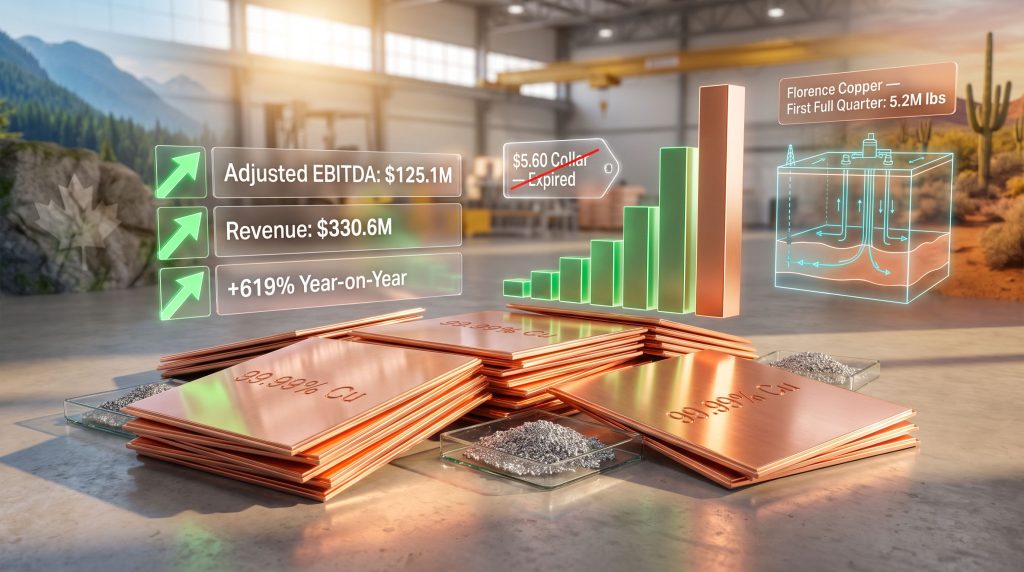
The headline figures alone tell a striking story. Adjusted EBITDA reached $125.1 million for Q2 2026, compared to just $17.4 million in the same period of 2025. That is not incremental improvement. That is a 619% year-on-year expansion in one of the most closely watched profitability metrics in the mining industry.
Net income came in at $22.2 million, or $0.06 per share, while adjusted net income reached $40 million, or $0.11 per share. In Q2 2025, the adjusted net income position was a loss of $13 million at -$0.04 per share. The swing from loss to meaningful profit in four quarters reflects more than a commodity price tailwind. It reflects structural changes across the business that have permanently altered the earnings equation.
Q2 2026 Financial Performance at a Glance
| Metric | Q2 2026 | Q2 2025 | Change |
|---|---|---|---|
| Adjusted EBITDA | $125.1M | $17.4M | +619% |
| Net Income | $22.2M ($0.06/share) | Loss | Turnaround |
| Adjusted Net Income | $40M ($0.11/share) | -$13M (-$0.04/share) | Turnaround |
| Revenue | $330.6M | N/A | N/A |
| Operating Cash Flow | $183M | N/A | N/A |
| Cash Balance (June 30) | $186M | N/A | N/A |
| Total Available Liquidity | $342M | N/A | N/A |
Revenue of $330.6 million was generated from the sale of 37.5 million pounds of copper and 575,000 pounds of molybdenum. Earnings from mining operations, before depletion, amortisation, and non-recurring items, reached $154 million. Operating cash flow of $183 million reinforces that the earnings quality is real, not a function of accounting adjustments. Furthermore, these results align with broader copper price drivers that have shaped the sector's trajectory throughout the year.
The Collar Constraint That Suppressed Two Years of Upside
One of the most important and least visible factors shaping Trekor's margin history is its use of copper price collars. These hedging instruments, which capped the company's copper revenue at $5.60 per pound, provided downside protection during periods of price uncertainty but simultaneously created a structural ceiling on earnings during one of copper's strongest multi-year price runs.
Copper price collars are common risk management tools in the mining sector. They typically involve a combination of a put option (protecting against price falls below a floor) and a sold call option (capping revenue above a ceiling). The trade-off is predictable cash flow in exchange for foregone upside during commodity bull markets.
With those collars having matured in June 2026, Trekor enters the second half of the year with full exposure to prevailing copper spot prices. For a company generating 36 million pounds of copper per quarter and targeting production growth through H2, every dollar per pound of copper price improvement now flows directly to the bottom line without a contractual ceiling limiting the benefit.
This is not a trivial change. The removal of the collar constraint is arguably as significant a financial catalyst as any production milestone, because it permanently restructures the revenue-per-pound calculation going forward. Consequently, analysts tracking the copper supply crunch will recognise how this structural shift positions Trekor advantageously heading into H2.
Gibraltar Mine: Consistency as a Competitive Advantage
The Gibraltar mine in British Columbia remains the operational backbone of Trekor's production platform. In Q2 2026, Gibraltar produced 30.3 million pounds of copper and sold 32 million pounds, with sales exceeding production due to drawdown from existing inventory. Mining was concentrated in the lower benches of the Connector Pit, where ore grades aligned with the life-of-mine average, providing consistent feed quality to the processing circuit.
Gibraltar Mine Q2 2026 Output Summary
| Commodity | Production | Sales | Unit Economics |
|---|---|---|---|
| Copper | 30.3M lbs | 32M lbs | C1 cost: US$2.41/lb |
| Molybdenum | 559,000 lbs | 575,000 lbs | ~$30/lb realised |
The C1 cash cost of US$2.41 per pound is a critical benchmark. In a copper price environment significantly above that level, the margin per pound of copper sold is substantial, and the mine's operational leverage to price movements is considerable.
Molybdenum: The Underappreciated Margin Defender
Gibraltar's molybdenum production deserves more analytical attention than it typically receives. Molybdenum is a transition metal used primarily as an alloying agent in high-strength steel, tool steel, and superalloys. It increases corrosion resistance and high-temperature strength, making it indispensable in aerospace, energy infrastructure, and defence manufacturing.
At approximately $30 per pound, Gibraltar's molybdenum output in Q2 generated meaningful revenue that directly offsets the cost inflation Gibraltar faces from diesel price movements. Because diesel is a primary operating cost driver in open-pit copper mining, the molybdenum byproduct functions as a natural, embedded hedge against energy cost volatility. This structural feature is particularly valuable in inflationary environments and is not always fully appreciated in simplified cost-per-pound analyses of copper producers.
Copper cathode output was temporarily reduced in Q2 due to planned plant downtime in April, scheduled to facilitate the integration of a second leach pad. This type of downtime, while reducing short-term output, is a capital improvement that expands the mine's future processing capacity and should not be interpreted as an operational problem.
Florence Copper: A New Production Engine Coming Online
The Florence Copper operation in Arizona represents the most significant forward-looking variable in Trekor's production growth story. Q2 2026 marked the first complete quarter of plant operations at Florence, with copper cathode production reaching 5.2 million pounds.
Florence employs in-situ recovery (ISR) technology, a method that is fundamentally different from conventional open-pit or underground mining. The in-situ leaching benefits of this approach are considerable, and the process itself involves several distinct stages rather than physically extracting ore from the ground:
-
Drilling a network of injection and recovery wells into the ore body.
-
Circulating a dilute acidic leaching solution through the ore formation underground.
-
Recovering the copper-enriched solution at surface through production wells.
-
Processing the solution through a solvent extraction and electrowinning (SX-EW) circuit to produce copper cathode directly.
The copper cathode produced through ISR is 99.99% pure, meeting London Metal Exchange Grade A specifications without requiring smelting or refining. This eliminates the treatment and refining charges that erode margins for concentrate-based producers, while also reducing surface disturbance, waste rock generation, and the associated carbon footprint of conventional mining.
ISR copper mining has a significantly smaller surface footprint than open-pit operations. Because the ore body is leached in place, there is no requirement for large tailings storage facilities or waste rock dumps, which reduces both environmental impact and long-term site rehabilitation liability.
Wellfield Expansion as the Production Growth Mechanism
At Florence, production growth is driven by expanding the wellfield, specifically by commissioning additional injection and recovery wells into the ore body. An additional 18 wells were being integrated into the Florence wellfield during and immediately after Q2 2026, with further commissioning expected in the weeks following the reporting period.
This well-by-well ramp-up model gives management granular control over production pacing. Unlike a conventional mine expansion requiring large capital commitments for equipment or infrastructure, wellfield expansion at an ISR operation is incremental, modular, and relatively capital-efficient. Each new well commissioned directly increases the volume of leach solution circulating through the ore body, which translates to higher copper recovery rates and increased cathode output. Management indicated that Q3 2026 production at Florence is expected to benefit directly from these additions.
Consolidated Production: The 80% Growth Story
Across both operations, Trekor Metals Q2 earnings and copper production figures showed the company produced a total of 36 million pounds of copper in Q2 2026 and sold 37.5 million pounds, with the difference explained by inventory drawdown at Gibraltar. Year-on-year, this represents production growth of 80%, a figure that reflects both Gibraltar's operational consistency and Florence Copper's transition from commissioning phase to its first full operational quarter.
| Commodity | Q2 2026 Volume | Source Operation |
|---|---|---|
| Total copper produced | 36M lbs | Gibraltar + Florence |
| Total copper sold | 37.5M lbs | Including inventory |
| Molybdenum produced | 559,000 lbs | Gibraltar |
| Molybdenum sold | 575,000 lbs | Gibraltar |
The next major ASX story will hit our subscribers first
Liquidity, Balance Sheet Strength, and Capital Flexibility
As at June 30, 2026, Trekor held a cash balance of $186 million and total available liquidity of $342 million, including undrawn credit facilities. With quarterly operating cash flow of $183 million and no near-term collar constraints capping revenue, the company enters H2 2026 with significant financial flexibility.
This liquidity position matters for two reasons. First, it provides a substantial buffer against any short-term copper price volatility without requiring emergency financing. Second, it funds Florence Copper's ongoing wellfield expansion without pressure on the balance sheet. Capital deployment at an ISR operation tends to be more predictable and modular than at a conventional mine, which means Trekor can calibrate spending to match actual production ramp-up progress rather than committing to large upfront infrastructure outlays.
The Copper Market Context: Why This Moment Matters
Trekor's Q2 results cannot be fully understood in isolation from the broader copper market. The global energy transition continues to create structural demand pressure on copper supply chains. Electric vehicles require roughly three to four times more copper than equivalent internal combustion engine vehicles. Grid modernisation programmes, renewable energy installations, and data centre buildouts are adding further layers of demand that were not anticipated in supply planning cycles from five to ten years ago.
Supply growth, meanwhile, has consistently underperformed demand projections due to permitting delays, grade decline at mature operations, water constraints, and community opposition at major development projects in South America and Africa. Indeed, the global copper supply gap has widened considerably as a result, with the outcome being a copper market where price strength reflects genuine physical tightness, not purely financial speculation.
For Trekor specifically, operating copper assets in Canada and the United States provides a geopolitical risk profile that is increasingly valued by institutional investors seeking exposure to copper without the jurisdiction risk associated with higher-risk producing countries. However, those considering copper investment strategies should weigh this jurisdictional advantage carefully when evaluating producer options.
Scenario Analysis: What Could Drive or Derail H2 2026 Performance
| Scenario | Key Driver | Potential Outcome |
|---|---|---|
| Bull Case | Copper sustains above $5/lb; Florence wells commissioned ahead of schedule | EBITDA well above $125M/quarter |
| Base Case | Copper stable; 18-well expansion completes on schedule | Steady production growth, margin expansion |
| Bear Case | Copper price correction; wellfield commissioning delays | Compressed margins, reduced operating cash flow |
Disclaimer: Scenario projections are based on management guidance and publicly available market data. They are not financial forecasts and should not be relied upon as investment advice. Copper prices are subject to volatility driven by macroeconomic conditions, trade policy, and supply-demand dynamics that cannot be predicted with certainty.
Frequently Asked Questions
What drove the 619% EBITDA growth in Trekor Metals Q2 earnings and copper production?
Three converging factors drove the result: record copper prices providing higher revenue per pound sold, an 80% year-on-year increase in total copper production from both Gibraltar and the newly operational Florence Copper, and the structural benefit of near-full margin capture as the $5.60 copper price collars approached their June 2026 maturity date. Analysts at Seeking Alpha noted the market responded positively to these combined factors.
What is a C1 cash cost and why does Gibraltar's $2.41/lb figure matter?
C1 cash cost is an industry-standard measure of the direct cost to produce one pound of copper, including mining, processing, and site administration, but net of byproduct credits such as molybdenum revenue. At US$2.41 per pound, Gibraltar operates with a cost structure that generates significant margin at current copper prices, making it a highly cash-generative asset.
Why did copper cathode production fall at Gibraltar in Q2?
The reduction was deliberate, not operational. Planned plant downtime in April was used to integrate a second leach pad into the processing circuit, a capital improvement that expands future cathode production capacity. The short-term output reduction is a trade-off for long-term processing upside.
What makes Florence Copper's ISR model technically distinct from conventional copper mining?
Florence uses in-situ recovery, which leaches copper directly from the ore body underground without physically mining it. The process produces 99.99% pure copper cathode at surface, bypassing the smelting and refining stages that add cost and carbon intensity to conventional copper concentrate operations. The wellfield model also allows incremental, modular production growth as additional wells are commissioned.
What is Trekor Metals' total liquidity position?
As at June 30, 2026, Trekor held $186 million in cash and $342 million in total available liquidity, inclusive of undrawn credit facilities, providing substantial runway for Florence Copper's ramp-up and general operational flexibility through H2 2026 and into 2027.
Want to Capitalise on the Next Major Copper Discovery Before the Market Does?
Discovery Alert's proprietary Discovery IQ model delivers real-time alerts on significant ASX mineral discoveries, instantly transforming complex commodity data into actionable investment insights — so subscribers are never left chasing a move. Explore how historic mineral discoveries have generated extraordinary returns on Discovery Alert's dedicated discoveries page, and begin your 14-day free trial today to position yourself ahead of the broader market.