June 20, 2026
Understanding Botswana's Copper Exploration Framework
The global mining industry stands at a pivotal moment where traditional geological methods converge with artificial intelligence to unlock previously inaccessible mineral deposits. This technological revolution has particular significance in southern Africa's copper belt, where sophisticated data processing techniques are transforming how exploration companies identify and evaluate prospective targets.
Modern copper exploration relies on integrating vast datasets spanning geological formations, geophysical surveys, and geochemical analysis through machine learning algorithms. Furthermore, this approach enables mining companies to process decades of historical data alongside real-time field measurements, creating predictive models that significantly improve the probability of discovery success.
The intersection of proven geological provinces and advanced targeting methodologies has created unprecedented opportunities for systematic exploration across underexplored terrains. Companies operating in these environments must balance traditional geological expertise with cutting-edge technological capabilities to remain competitive in today's resource sector, particularly when evaluating Botswana Minerals copper licences and similar opportunities.
When big ASX news breaks, our subscribers know first
Botswana's Mining Licence Structure and Recent Regulatory Evolution
Botswana operates a comprehensive mining licensing framework designed to attract international investment while ensuring local economic participation. The country's mineral rights system encompasses multiple licence categories, each serving distinct phases of the mining development cycle.
Prospecting Licences (PL) form the foundation of Botswana's exploration framework, granting exclusive rights to conduct geological investigations across defined geographical areas. These licences typically cover substantial territories, allowing operators to conduct comprehensive regional assessments before focusing on specific targets.
Mining Licences represent the next development phase, converting successful exploration results into production rights. The transition from prospecting to mining status requires demonstrating economic viability through detailed feasibility studies and environmental impact assessments.
Special Grant Licences accommodate large-scale operations requiring enhanced operational terms and extended development timelines. These arrangements typically involve significant capital commitments and long-term production agreements.
Retention Licences provide holding rights for proven deposits that remain economically marginal under current market conditions. This mechanism allows companies to maintain control over resources while awaiting improved commodity prices or technological advances.
Recent Regulatory Modifications Affecting New Licence Holders
The Botswana government has implemented several significant policy changes affecting future mining operations. These modifications reflect broader trends across African mining jurisdictions toward increased local participation and environmental accountability.
Local Ownership Requirements
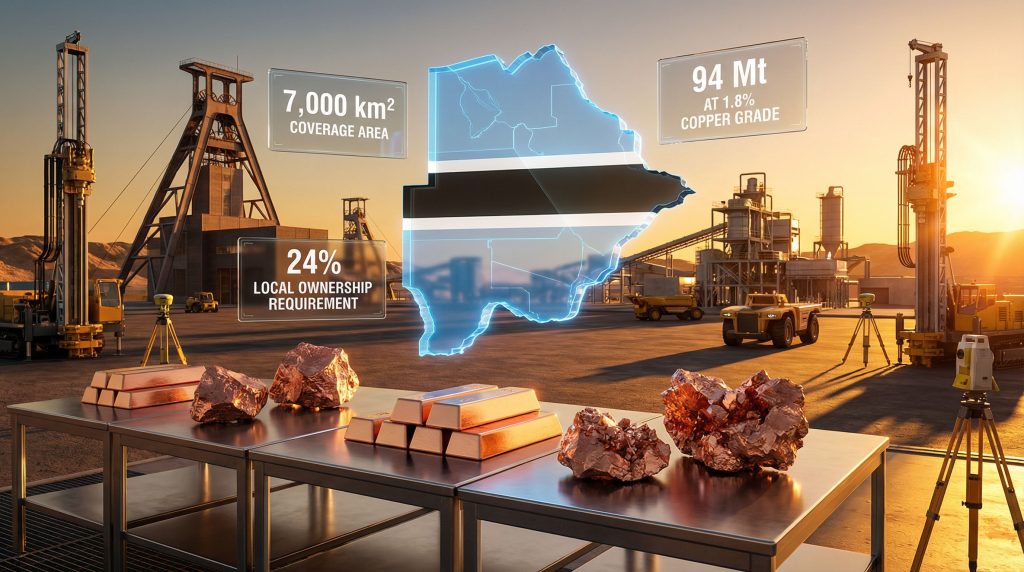
New mining licences granted after October 2025 must comply with mandatory local ownership provisions. Under this framework, 24% of project equity must be allocated to Botswana citizens or citizen-controlled entities. The government exercises a 15% participation option initially, with the remaining 9% offered to qualified local investors.
This ownership structure applies exclusively to new licence grants, preserving existing ownership arrangements for current operators. Consequently, the policy aims to enhance local economic participation while maintaining investment attractiveness for international mining companies.
Environmental Rehabilitation Fund Establishment
All new mining operations must contribute to environmental rehabilitation funds throughout project lifecycles. These mandatory contributions ensure adequate financial resources for site restoration and long-term environmental management obligations.
| Project Phase | Fund Requirement | Designated Purpose |
|---|---|---|
| Exploration Phase | Baseline Security Deposit | Site restoration guarantee for early-stage activities |
| Development Phase | Scaled Contribution Program | Infrastructure rehabilitation and impact mitigation |
| Production Phase | Annual Fund Additions | Ongoing environmental management and monitoring |
| Mine Closure | Full Fund Activation | Complete site remediation and long-term care |
Major Companies Securing Copper Licences in Botswana
Several prominent exploration and mining companies have established significant positions within Botswana's copper belt, each employing distinct strategic approaches to target identification and resource development. Understanding the mineral exploration importance helps contextualise these strategic decisions within the broader industry framework.
Botswana Minerals' AI-Driven Exploration Program
Botswana Minerals, a London and Botswana-listed exploration company, has commenced Phase 1 operations across its copper licence portfolio in the Ngamiland region of north-western Botswana. The company has positioned itself within the underexplored north-eastern section of the Damara Belt, a geological formation with demonstrated copper mineralisation potential.
The company's strategic approach emphasises integrating artificial intelligence with conventional geological methods. According to company leadership, AI transforming mining tech has enabled the identification and acquisition of highly prospective copper ground through systematic analysis of available geological data.
Technical Methodology and Work Program Structure
Phase 1 operations focus on refining and ranking promising targets across the licence package while establishing geophysical priorities for future drill target identification. The program aims to create a technically ranked portfolio of opportunities supported by a comprehensive geophysical targeting framework.
Subsequent field programs and drilling campaigns will be designed based on Phase 1 results, with data integration and target refinement expected to improve drilling success rates. In addition, the company plans to incorporate additional datasets into its AI models, enhancing target definition accuracy through iterative data processing.
Operational Experience and Strategic Positioning
Botswana Minerals brings 25 years of operational experience within Botswana's mining sector, providing institutional knowledge of local geological conditions and regulatory environments. This established presence offers significant advantages in licence acquisition, community relations, and operational execution.
The company's focus on the Damara Belt reflects recognition of this region's geological prospectivity for copper mineralisation. For instance, the north-eastern section remains relatively underexplored compared to other portions of Botswana's copper belt, presenting opportunities for significant discoveries.
Regional Competitive Landscape Analysis
Botswana's copper exploration sector features several active participants, each pursuing distinct strategic approaches and geographical focuses. This competitive environment has intensified following increased global copper demand projections and the proven success of operations like MMG Limited's Khoemacau mine.
Table: Active Copper Licence Holders in Botswana
| Company | Licence Classification | Strategic Focus Area | Operational Approach |
|---|---|---|---|
| Botswana Minerals | Prospecting Rights | Multi-target exploration across Damara Belt | AI-enhanced target identification |
| MMG Limited | Active Mining Operations | Khoemacau mine optimisation | Production and near-mine expansion |
| Regional Explorers | Various Prospecting Rights | Proximity to established operations | Traditional geological methods |
Geological Advantages of Botswana's Copper Belt
The Kalahari Copper Belt encompasses extensive geological formations demonstrating significant copper endowment across multiple operational and exploration projects. This region's mineral potential stems from favourable structural controls and widespread copper-bearing formations extending across hundreds of square kilometres.
Damara Belt Mineralisation Characteristics
The Damara Belt represents a major geological province hosting copper mineralisation across multiple structural settings. This region's geological architecture includes extensive sedimentary sequences with favourable conditions for copper precipitation and concentration.
Structural continuity across the belt provides opportunities for discovering multiple deposits within individual licence areas. Furthermore, copper-bearing formations demonstrate lateral persistence, suggesting that successful discoveries may indicate broader mineralisation zones requiring systematic exploration.
When evaluating these geological advantages, companies often utilise a mineral deposit tiers guide to classify and prioritise potential targets based on their economic significance and development potential.
Infrastructure Accessibility and Development Advantages
Botswana's copper belt benefits from established mining infrastructure and service industries developed around existing operations. The presence of producing mines like Khoemacau has created regional expertise in copper processing, logistics, and workforce development.
Transportation networks connect mining areas to international markets through established rail and road systems. However, power infrastructure provides access to reliable electricity supply, while water resources support both operational requirements and community needs.
Economic Drivers Supporting Exploration Investment
Global copper demand fundamentals provide strong support for exploration investment in proven geological provinces. The energy transition toward renewable technologies and electric vehicle adoption creates sustained demand growth expectations across multiple market segments.
This environment has created numerous opportunities for investors to develop effective copper investment strategies that capitalise on both immediate market conditions and long-term structural demand growth.
Energy Transition Impact on Copper Requirements
Electric vehicle manufacturing requires approximately four times more copper content compared to conventional internal combustion vehicles. This multiplicative effect, combined with projected EV adoption rates, suggests substantial incremental copper demand over the next decade.
Renewable energy infrastructure development demands significant copper inputs for electrical components, transmission systems, and energy storage technologies. Consequently, wind and solar installations require extensive copper wiring and electrical connections, creating additional demand sources beyond transportation applications.
Battery storage systems supporting grid stability and renewable energy integration represent emerging copper demand categories. These applications require high-quality copper for electrical components and thermal management systems.
Advanced Exploration Technologies Driving Discovery Success
Modern copper exploration increasingly relies on sophisticated technologies that integrate multiple data sources through advanced analytical frameworks. These methodologies enable exploration companies to process vast information quantities while identifying subtle geological indicators of mineralisation.
Artificial Intelligence Applications in Target Generation
Machine learning algorithms have revolutionised how exploration companies approach target identification and ranking. These systems process geological databases containing decades of exploration results, geological mapping, and geophysical surveys to identify patterns indicative of copper mineralisation.
Data Integration and Pattern Recognition
AI systems excel at recognising complex geological relationships that may not be apparent through traditional analytical methods. By processing geophysical, geochemical, and structural datasets simultaneously, these algorithms identify subtle correlations between different geological parameters.
Predictive modelling capabilities enable exploration teams to rank targets based on probability assessments derived from successful discovery analogues. For instance, this approach reduces exploration risk by focusing resources on areas with highest geological potential.
Risk Reduction Through Data-Driven Decision Making
Traditional exploration approaches often rely heavily on geological intuition and experience, which can introduce subjective biases into target selection processes. AI-enhanced methodologies provide objective analytical frameworks for evaluating exploration opportunities.
Statistical validation of target selection criteria through machine learning improves the reproducibility and consistency of exploration decisions. This systematic approach enables more efficient resource allocation across multiple target areas.
Geophysical Survey Methodologies for Copper Detection
Modern geophysical techniques provide detailed subsurface imaging capabilities essential for identifying copper mineralisation zones. These non-invasive methods enable exploration teams to map geological structures and identify anomalous zones requiring further investigation.
Electromagnetic Survey Applications
Electromagnetic methods detect conductive zones associated with sulphide mineralisation, making them particularly effective for identifying copper deposits. These surveys can penetrate significant depths while providing detailed information about subsurface conductivity variations.
Ground-based electromagnetic systems offer high-resolution imaging of near-surface conductivity structures, enabling precise targeting of anomalous zones. Furthermore, airborne electromagnetic surveys provide regional coverage for identifying large-scale structural controls on mineralisation.
Gravity and Magnetic Survey Integration
Gravity surveys identify density variations associated with different rock types and alteration zones. These measurements help define geological structures and identify areas where dense sulphide minerals may be concentrated.
Magnetic surveys map variations in magnetic susceptibility, revealing underlying geological structures and lithological boundaries. In addition, downhole geophysics integration with other geophysical methods provides comprehensive geological models for target evaluation.
Induced Polarisation for Sulphide Detection
Induced polarisation surveys specifically target sulphide minerals through their distinctive electrical properties. This method provides direct indication of potential copper mineralisation zones, making it essential for detailed target evaluation.
Time-domain and frequency-domain IP surveys offer different resolution capabilities and depth penetration characteristics. Selection of appropriate IP methodologies depends on target depth, geological conditions, and required resolution levels.
Regional Licensing Comparison and Investment Attractiveness
Botswana's mining licensing framework operates within a competitive regional environment where neighbouring countries offer alternative investment destinations for copper exploration and development. Understanding comparative advantages and disadvantages across jurisdictions helps inform investment decision-making.
Comparative Analysis of Regional Licensing Terms
Table: Copper Licensing Frameworks Across Southern Africa
| Jurisdiction | Maximum Licence Duration | Royalty Rate Range | Local Ownership Requirements | Government Equity Participation |
|---|---|---|---|---|
| Botswana | 25 years renewable | 3-5% of revenue | 24% (post-October 2025 licences) | 15% participation option |
| Zambia | 25 years renewable | 6-8% of revenue | None mandated | 20% carried interest available |
| Democratic Republic of Congo | 30 years renewable | 3.5% of revenue | None mandated | 5% free carry interest |
| Namibia | 25 years renewable | 3% of revenue | 25% local ownership required | None specified |
Political and Economic Stability Factors
Botswana maintains strong governance institutions and political stability compared to other regional mining jurisdictions. The country's democratic institutions, rule of law, and transparent regulatory processes provide significant advantages for long-term mining investments.
Regulatory Transparency and Predictability
Botswana's mining regulations provide clear guidelines for licence acquisition, operational requirements, and compliance obligations. This regulatory clarity reduces investment uncertainty and enables more accurate project planning and financial modelling.
The country's established legal framework protects mineral rights and provides effective dispute resolution mechanisms. However, foreign investors benefit from established precedents and consistent regulatory interpretation across different projects and time periods.
Currency Stability and Economic Management
The Botswana Pula maintains relative stability compared to other regional currencies, reducing foreign exchange risk for international mining investors. Sound fiscal management and diamond revenues provide economic stability supporting long-term investment planning.
Established banking and financial services infrastructure supports mining project financing and operational cash flow management. Access to international financial markets through established institutions facilitates project development funding.
The next major ASX story will hit our subscribers first
Risk Assessment Framework for Copper Licence Investments
Successful copper exploration and mining investments require comprehensive risk evaluation across technical, regulatory, and market dimensions. Understanding and mitigating these risks forms the foundation for sustainable project development.
Technical and Operational Risk Factors
Metallurgical Processing Challenges
Deep oxidation zones common in Botswana Minerals copper licences and similar deposits can complicate ore processing and recovery operations. These geological conditions may require specialised metallurgical techniques and additional capital investment in processing facilities.
Water table management in arid environments presents ongoing operational challenges requiring careful resource planning and environmental management. Consequently, access to sufficient water resources for processing and dust control may require significant infrastructure investment.
Geographic and Logistical Considerations
Remote exploration areas require substantial logistical planning and infrastructure development. Transportation costs for equipment, supplies, and personnel can significantly impact project economics, particularly during early exploration phases.
Skilled workforce availability in rural mining areas may require extensive training programmes and competitive compensation packages. Building local technical capacity requires long-term commitment and ongoing investment in human resource development.
Regulatory Evolution and Compliance Requirements
Mining regulations continue evolving as governments balance economic development objectives with environmental protection and community participation goals. Staying current with regulatory changes requires ongoing legal and compliance support.
Environmental Standards and Permitting
Environmental regulations are becoming increasingly stringent across African mining jurisdictions. New projects must demonstrate comprehensive environmental management throughout project lifecycles, requiring substantial upfront planning and ongoing monitoring.
Community consultation processes are expanding in scope and duration, extending project development timelines. Furthermore, successful projects require early engagement with local communities and sustained relationship building throughout operational phases.
Export and Trade Policy Considerations
Commodity export restrictions during periods of high prices could affect project revenue streams and international market access. Understanding potential trade policy changes helps inform long-term marketing and pricing strategies.
Currency controls and foreign exchange regulations may impact profit repatriation and international financial management. These considerations require careful structuring of project financing and revenue management systems.
Investment Evaluation Strategies for Copper Exploration Opportunities
Evaluating copper exploration investments requires systematic analysis combining geological assessment, technical evaluation, and financial modelling. Successful investment strategies balance risk and return expectations across multiple investment horizons.
Technical Due Diligence Priorities
Resource Potential Assessment
Geological prospectivity analysis forms the foundation for evaluating exploration potential. This assessment examines structural controls, mineralisation styles, and geological analogues to estimate discovery probabilities and potential resource scales.
Historical exploration results provide valuable context for understanding geological conditions and previous exploration effectiveness. Reviewing past drilling results, geophysical surveys, and geological mapping helps identify both opportunities and potential challenges.
Infrastructure and Development Feasibility
Access to transportation infrastructure significantly impacts project development costs and operational feasibility. Proximity to existing roads, railways, and ports affects both capital requirements and ongoing operational expenses.
Power supply availability and reliability influence processing options and operational costs. For instance, projects located near existing electrical infrastructure benefit from reduced capital requirements and improved operational reliability.
Financial Modelling and Economic Evaluation
Sensitivity Analysis and Scenario Planning
Copper price volatility requires comprehensive sensitivity analysis across multiple price scenarios. Understanding project economics under different commodity price assumptions helps evaluate investment risk and return potential.
Capital expenditure estimates must account for infrastructure development, processing facility construction, and working capital requirements. Accurate cost estimation requires detailed engineering studies and regional cost benchmarking.
Portfolio Diversification Strategies
Geographic diversification across multiple licence areas reduces single-project risk while providing exposure to different geological environments. This approach balances risk while maintaining upside potential from successful discoveries.
Development stage diversification enables investors to participate across the exploration-to-production spectrum. However, early-stage exploration offers high return potential but carries discovery risk, while advanced projects provide more predictable returns with lower risk profiles.
Risk Mitigation Approaches
Joint Venture Partnership Strategies
Strategic partnerships with experienced operators provide access to technical expertise, operational capabilities, and financial resources. These arrangements can reduce individual investment exposure while maintaining participation in successful projects.
Local partnership arrangements may provide advantages in community relations, regulatory compliance, and operational execution. Understanding local business practices and cultural considerations contributes to project success.
Market Risk Management
Commodity price hedging strategies can provide revenue stability during project development and early production phases. These financial instruments help manage cash flow predictability while maintaining exposure to favourable price movements.
Currency hedging may be appropriate for projects with significant foreign exchange exposure. Consequently, managing currency risk helps stabilise project returns and financial planning across multiple market cycles.
What Makes Botswana's Copper Sector Attractive to International Investors?
The convergence of advanced exploration technologies, supportive regulatory frameworks, and strong copper demand fundamentals creates compelling investment opportunities within Botswana's mining sector. When evaluating Botswana Minerals copper licences and similar opportunities, investors must consider both technical merit and broader market dynamics.
Success requires combining technical expertise with systematic risk management and strategic patience as exploration programmes advance through development phases toward potential production. The integration of AI-powered exploration techniques with traditional geological methods continues to enhance discovery potential across proven geological provinces.
Furthermore, Botswana Minerals copper licences represent one example of how systematic technological approaches can unlock value in underexplored terrains. As global copper demand continues expanding, particularly driven by renewable energy transitions and electrification trends, well-positioned exploration assets in stable jurisdictions like Botswana offer compelling risk-adjusted return profiles for patient capital.
Interested in Exploring Copper Investment Opportunities?
Discovery Alert's proprietary Discovery IQ model delivers real-time alerts on significant copper discoveries, instantly empowering subscribers to identify actionable opportunities ahead of the broader market. Understand why major mineral discoveries can generate substantial returns by exploring Discovery Alert's dedicated discoveries page, showcasing historic examples of exceptional outcomes, and begin your 14-day free trial today to position yourself ahead of the market.