June 3, 2026
The Real Cost of Digging Deeper: How Modern Mining Economics Have Been Permanently Altered
There is a structural shift underway in global metals extraction that goes far beyond commodity price cycles. For decades, the dominant assumption in mining finance was that a commodity price recovery would eventually restore margins to acceptable levels, allowing operators to ride out periods of compressed profitability. That assumption is increasingly difficult to sustain. The cost architecture of copper-gold mining technology and tougher margins has been fundamentally altered by converging geological, operational, and financial forces that do not reverse simply because spot prices improve.
Understanding why this has happened, and what it means for operators and capital allocators, requires looking beneath the surface of commodity market narratives and into the deposit-level economics that now determine which projects survive and which do not.
When big ASX news breaks, our subscribers know first
The Margin Compression Problem: Why Copper-Gold Operations Are Under Structural Pressure
How Global Mining Profitability Has Shifted Since the 2021 Supercycle Peak
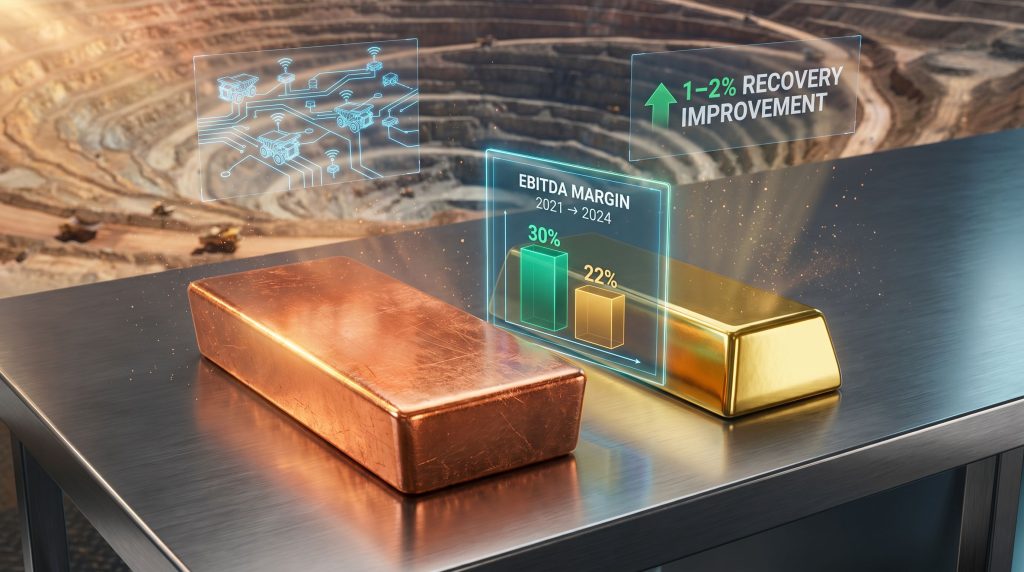
The 2021 commodity supercycle delivered extraordinary returns for mining operators, with average EBITDA margins for global mining exceeding 30% as demand recovered sharply from pandemic-era lows and supply chains struggled to keep pace. That environment has not persisted. By 2024, average EBITDA margins across the global mining sector had compressed to approximately 22%, representing a decline of nearly one-third in profitability metrics within a compressed timeframe.
What makes this contraction structurally significant is its composition. Commodity prices have normalised from their supercycle peaks, but the input costs that surged alongside them have not followed the same trajectory. The key cost drivers include:
- Energy costs, which remain elevated despite commodity price normalisation, reflecting structural shifts in energy markets and the increasing depth of operations requiring more intensive power consumption
- Labour expenses, which have increased at a rate approximately double the historical average due to acute skilled worker shortages in mining jurisdictions globally
- Sulfuric acid pricing, a critical reagent in copper leaching operations, which remains at historically elevated levels due to persistent supply chain constraints
- Explosives costs, which increased by roughly 35% since 2021 and have not retreated meaningfully despite broader commodity price softening
The result is a cost-price differential that continues to pressure net margins for public mining companies, creating an environment where operational efficiency improvements are no longer discretionary but existential.
The Ore Grade Decline Compounding the Cost Problem
Overlaid on this input cost challenge is a geological reality that the industry has been managing for decades but which is now reaching an inflection point. Average copper grades in operating mines have approximately halved since the 1990s, declining from roughly 0.8–1.0% copper to current operating averages closer to 0.4–0.5%. The consequence of this grade decline is that modern copper operations must move and process approximately twice as much material per unit of recovered metal compared to equivalent operations three decades ago.
Gold mining has tracked a similar trajectory. Average grades for new discoveries have declined substantially from the levels achieved during the exploration booms of the 1980s and 1990s, when surface-accessible, structurally simple, high-grade deposits were still being found with regularity. The deposits being developed today tend to be deeper, more mineralogically complex, and more demanding on processing infrastructure.
Furthermore, understanding cut-off grade economics is increasingly critical as operators seek to determine which ore is genuinely worth processing in this tighter-margin environment.
The combined effect of grade decline and input cost inflation creates a compounding pressure that commodity price recovery alone cannot resolve. The underlying economics of extraction have shifted structurally, not cyclically.
The New Economics of Depth and Complexity
As mining moves deeper and into more geometrically complex orebodies, the capital expenditure requirements expand significantly. Shaft sinking, ventilation systems, ground support engineering, and the logistics of maintaining large workforces in deep underground environments all carry substantial cost premiums over shallow open-pit operations.
Water constraints, which are intensifying across many of the world's most productive copper jurisdictions including Chile's Atacama region, add both operational cost and permitting complexity that extends pre-production timelines. In a higher cost of capital environment, this schedule risk is financially material. A project that requires two additional years of permitting and construction before generating cash flow faces a meaningfully different financial hurdle than the same project in a lower interest rate environment. Marginal projects that would have cleared economic thresholds during the low-rate period of the 2010s are now facing a far more demanding financial assessment.
What Makes Copper-Gold Projects Strategically Different From Single-Metal Operations?
The Built-In Hedge: How Dual-Metal Revenue Structures Stabilise Cash Flow
The strategic differentiation of copper-gold projects relative to single-metal operations rests on a fundamental economic mechanism: the two metals behave in opposite ways across commodity cycles, creating a natural internal hedge that single-metal operations cannot replicate.
| Revenue Driver | Copper | Gold |
|---|---|---|
| Primary demand lever | Industrial activity, electrification, data infrastructure | Monetary uncertainty, inflation hedging |
| Cycle behaviour | Procyclical — rises with economic growth | Counter-cyclical — rises with risk aversion |
| Mine-level benefit | Scales with global infrastructure buildout | Offsets copper margin compression |
| Sensitivity | High to industrial production indices | High to real interest rates and credit stress |
This inverse relationship operates as an automatic stabiliser at the mine level. When industrial activity slows and copper demand softens, the conditions that typically accompany such slowdowns — including monetary uncertainty and investor risk aversion — tend to strengthen gold prices. The revenue decline from copper is partially or fully offset by stronger gold revenue, maintaining cash flow stability and improving debt serviceability across the cycle.
For project operators, this means more consistent mine-level economics without requiring fundamental reconfiguration of the processing plant. Production sequencing can be adjusted toward whichever metal the current market cycle is rewarding, providing operational flexibility that is genuinely valuable in volatile commodity environments.
How Gold By-Product Credits Rescue Marginal Copper Economics
One of the less widely appreciated dynamics in copper-gold project economics is the transformative effect that a meaningful gold credit can have on the financial viability of what would otherwise be a marginal copper deposit. In mining finance, all-in sustaining cost (AISC) calculations for copper equivalent production incorporate revenue from co-products as a credit against total operating costs. A gold credit of even modest grade can shift a project's economic profile dramatically.
Consider the following illustrative scenario:
Illustrative Scenario: A copper deposit grading 0.55% Cu with an associated gold grade of 0.18 g/t Au sits below the economic viability threshold when evaluated purely on copper economics at current input costs and prevailing copper prices. When the gold co-product credit is applied at spot gold prices, the effective AISC per pound of copper equivalent drops materially, potentially moving the project from marginal to fundable. This is precisely the economic logic driving disproportionate capital attention toward porphyry copper-gold systems globally.
The reverse dynamic also applies. In environments where standalone gold economics are insufficient to justify capital deployment, copper revenue can underwrite project development, with gold providing the margin enhancement rather than the primary revenue stream. This bidirectional flexibility is a structural advantage that the market has increasingly recognised, contributing to the premium valuations applied to quality copper-gold assets relative to single-metal alternatives.
Consequently, tracking gold prices and mining equities has become an essential discipline for operators and investors seeking to understand when co-product economics are most favourable. Porphyry copper-gold systems, which are large-volume, lower-grade deposits formed by magmatic-hydrothermal processes, are particularly well-suited to this co-product economic structure. Their typical characteristics — including large, predictable ore bodies with relatively uniform grade distribution — make them amenable to the bulk mining methods and process plant configurations that maximise the efficiency benefits of dual-metal extraction.
How Is Technology Changing the Economics of Copper-Gold Mining?
The Shift From Bigger Equipment to Smarter Systems
The previous generation of mining technology investment was defined by scale. Larger trucks, larger mills, larger open pits, and larger blast patterns were the primary levers through which operators pursued cost reduction. The economic logic was straightforward: fixed costs spread across greater volumes reduced unit costs. The problem with this approach is that it requires continuously expanding capital commitments and eventually runs into the physical limits of what any individual deposit can sustain.
The current wave of copper-gold mining technology and tougher margins has made this fundamental shift in character more urgent. Rather than targeting volume expansion, the focus now targets efficiency per unit of throughput, extracting greater value from the material already being processed. The operational technologies now considered baseline requirements at competitive copper-gold operations include:
- AI-driven fleet management systems that optimise haul routes, loading sequences, and fuel consumption in real time, reducing the cycle time and energy intensity of material movement
- Real-time geometallurgical modelling that characterises ore variability as it is extracted, enabling dynamic mill feed blending that maximises metallurgical recovery for each tonne processed
- Drone-based stockpile reconciliation that provides accurate, continuous inventory assessment and grade control, reducing the discrepancy between geological models and actual recoverable material
- Predictive maintenance platforms applied to haul fleet and process equipment, reducing unplanned downtime that disproportionately inflates unit costs during high-throughput periods
- Remote operations centres that centralise oversight of distributed assets, reducing the labour intensity of on-site operations without sacrificing operational responsiveness
The Financial Case for Digital Mine Operations
The financial justification for this technology investment rests on a straightforward but powerful arithmetic: even modest improvements in mill throughput or metallurgical recovery generate outsized economic value at scale.
Operational Benchmark: A 1–2% improvement in mill throughput or metallurgical recovery at a copper-gold operation can deliver greater financial impact than a full year of conventional cost reduction programmes across the same operation. At a mine processing 50,000 tonnes per day, this margin of improvement represents thousands of additional tonnes of copper and gold equivalent recovered annually without any increase in capital deployment.
Furthermore, AI in mining operations is enabling operators to reduce dilution by improving the precision of ore-waste contact identification through drill-and-blast optimisation. IoT sensor networks also enable continuous monitoring of process variables across crushing, grinding, flotation, and leaching circuits, reducing unplanned downtime and catching process deviations before they translate into recovery losses. The cumulative effect of these technology applications is a fundamentally lower cost curve for operations that have fully adopted them, creating a competitive separation between technologically advanced operators and those still relying on conventional approaches.
Low-Grade Ore Unlocking: Bioleaching and Catalyst-Based Extraction
Beyond operational optimisation, a new generation of extraction technologies is beginning to reshape the economic boundary between viable and sub-economic resources. Bioleaching, which uses naturally occurring microorganisms to catalyse the oxidation of sulfide minerals and liberate contained copper, represents one of the most significant developments in this space.
Traditional processing of sulfide copper ores requires either smelting, which carries heavy capital and energy costs, or flotation concentration followed by smelting, which requires scale to be economic. Bioleaching can be applied at lower throughputs, with reduced capital requirements, and often with significantly lower water consumption than conventional pyrometallurgical routes. In addition, the in-situ leaching benefits of certain low-impact extraction methods are drawing increasing interest from operators seeking to reduce surface disturbance alongside operational costs.
Catalytic leaching variants are also advancing, targeting copper recovery from oxide and mixed ore types that have historically presented processing challenges. The strategic implication of these technologies is significant: resources classified as sub-economic under conventional processing assumptions may become viable production candidates as bioleaching and catalytic extraction methods continue to mature and achieve commercial scale.
Extending Mine Life Through Better Cut-Off Grade Management
Advanced geometallurgical modelling provides another lever for improving copper-gold mining economics that operates independently of commodity price: dynamic cut-off grade optimisation. Traditional mining operations establish fixed cut-off grades based on long-run price assumptions and average processing costs. This static approach inevitably results in material being sent to waste that could have been economically processed under different conditions, and vice versa.
Real-time geometallurgical data enables operators to adjust cut-off grade decisions continuously, incorporating current metal prices, actual processing costs, and measured ore characteristics to maximise the economic value extracted from each mining block. Combined with higher recovery rates from process optimisation, this approach converts marginal resources into economic production without requiring greenfield capital deployment, effectively extending mine life and improving resource conversion rates from within existing permitted boundaries.
Transparency as a Capital Cost Lever: The Reporting Revolution in Mining
Why Continuous Verification Is Replacing Annual Disclosure
The mining sector's relationship with disclosure has historically been a source of significant tension with capital markets. The gap between reported reserves and actual recoverable material has contributed to value destruction events that have damaged investor confidence in the sector's data integrity. Quarterly and annual production disclosures, while compliant with established reporting standards such as JORC and NI 43-101, provide only periodic snapshots of operational performance and leave substantial room for information asymmetry between operators and capital providers.
The investment community has responded by applying risk premiums to mining assets that reflect this uncertainty, inflating the cost of capital for the sector relative to industries with more transparent and continuous data availability. For marginal copper-gold projects, where the difference between fundable and unfundable economics can be a matter of financing cost basis points, this risk premium has real consequences.
How Immutable Ledger Reporting Works in a Mining Context
The emerging response to this credibility deficit is the application of blockchain-anchored, or immutable ledger, reporting frameworks to mine-level production data. The mechanism works as follows:
- Production data including tonnes mined, ore grades, and material classifications are recorded against a distributed ledger in real time as operations proceed
- Assay results from grade control sampling programmes are logged against the same ledger, creating an auditable chain of custody from the ore face to the processing plant
- Reserve updates and resource model revisions are documented with timestamped entries that cannot be retroactively altered
- Capital movement records are linked to specific operational activities, enabling expenditure to be validated against physical production outcomes
This framework does not replace established reporting standards. JORC-compliant resource and reserve estimates remain the foundational basis for project valuation. Immutable ledger reporting operates as a verification layer beneath these standards, enabling the underlying data inputs to be audited on a continuous basis rather than through the periodic snapshots that conventional disclosure provides.
The Cost of Capital Implication
Strategic Framing: Operators who adopt continuous, independently verifiable reporting frameworks are positioned to trade at a structural premium to peers who do not. In a higher-for-longer interest rate environment, a lower cost of capital is not a marginal advantage over a project's operating life — it is a compounding competitive moat.
The financial mechanism connecting transparency to cost of capital operates through risk perception. Capital providers, whether debt or equity, price the uncertainty embedded in the information they receive from operators. Projects with auditable, continuously verifiable production and reserve data are perceived as lower-risk, which translates directly into tighter debt spreads and higher equity valuation multiples.
For the mining sector specifically, where opacity has historically been a source of reputational damage and investor caution, the adoption of verifiable reporting frameworks represents an opportunity to structurally reduce the information risk premium that the sector carries. This is a financial engineering tool as much as a governance improvement, and the operators who recognise this distinction early will capture a first-mover advantage in accessing institutional capital on more favourable terms.
What Should Investors and Operators Prioritise in Copper-Gold Projects?
A Three-Factor Framework for Evaluating Project Quality
The complexity of copper-gold project evaluation can be structured around three primary factors that, when assessed rigorously, provide a reliable framework for distinguishing genuinely high-quality assets from projects that carry hidden risks beneath attractive headline metrics.
1. Capital Discipline Over Headline Grade
The mining industry's historical tendency to prioritise ore grade as the primary quality indicator has repeatedly led investors toward projects that appear geologically exceptional but prove economically challenging to develop. A copper deposit grading 0.6% with clean metallurgy, established regional infrastructure, a skilled local workforce, and straightforward permitting jurisdiction consistently outperforms a 1.0% deposit located in a remote, infrastructure-deficient, or jurisdictionally complex environment.
Infrastructure proximity directly affects both capital expenditure requirements and ongoing operating costs. Power, water, transport, and labour availability at competitive cost are frequently more determinative of project economics than grade alone. Metallurgical simplicity reduces both capital expenditure on process plant design and ongoing reagent and energy costs in operation. Permitting jurisdiction quality affects both timeline risk and the regulatory certainty required to attract long-term capital commitments.
The market consistently underweights these factors relative to grade in early-stage project assessment, creating mispricing opportunities for disciplined capital allocators willing to conduct thorough operational due diligence.
2. Operational Transparency as a Valuation Driver
As institutional ESG mandates tighten and regulatory disclosure requirements increase across major mining jurisdictions, the premium applied to operationally transparent projects will expand. Operators who build continuous, auditable reporting infrastructure early in the project lifecycle position themselves to access capital on more favourable terms as the institutional investment community progressively excludes operators unable to demonstrate verified operational performance.
This is not a theoretical future dynamic. The directional pressure from institutional capital toward verified, transparent operations is already visible in the premium valuations applied to operators with strong ESG credentials and robust data governance frameworks, and this trend has consistently strengthened over the past decade.
3. Jurisdictional Diversification as Margin Protection
Concentration of assets within a single country, regulatory regime, or legal system creates sovereign risk exposure that does not appear in project-level financial models but can materialise rapidly in the form of royalty changes, export restrictions, permitting reversals, or social licence challenges. These risks are not hypothetical: the past decade has seen multiple instances of significant value destruction at mining operations due to jurisdictional risk events that were inadequately priced in project valuations.
Operators with portfolios diversified across stable, mining-friendly regulatory environments carry implicit insurance against these events that single-jurisdiction operators lack. The next decade of copper-gold value creation will disproportionately accrue to operators whose asset portfolios are legible, diversified, and well-governed rather than to those holding the largest single deposits.
Comparison Table: Project Quality Indicators
| Evaluation Dimension | Lower Quality Signal | Higher Quality Signal |
|---|---|---|
| Ore grade context | High grade, remote, complex metallurgy | Moderate grade, infrastructure-proximate, clean metallurgy |
| Reporting framework | Annual JORC disclosure only | Continuous verification layer plus JORC/NI 43-101 |
| Revenue structure | Single metal dependency | Copper-gold co-product with natural cycle hedge |
| Jurisdictional exposure | Single-country concentration | Diversified across stable mining jurisdictions |
| Technology adoption | Conventional fleet and process methods | AI, IoT, autonomous systems, advanced extraction capability |
| Cut-off grade management | Static, price-assumption-fixed | Dynamic, real-time geometallurgical optimisation |
The next major ASX story will hit our subscribers first
Where Is Copper-Gold Mining Technology Headed? Forward-Looking Perspectives
The Strategic Shift From Greenfield Development to Asset Optimisation
A significant reallocation of industry capital is underway, shifting emphasis from new greenfield development toward extracting greater value from existing permitted assets. This reflects multiple converging pressures: extended permitting timelines that can stretch a decade or more for new projects in complex jurisdictions, the improving economics of technology-led brownfield optimisation, and the financing community's preference for assets with established operating track records over development-stage projects carrying construction and ramp-up risk.
For copper-gold mining technology and tougher margins, this brownfield focus creates a concentrated deployment opportunity. Existing operations with established infrastructure, permitted water access, and experienced workforces are the ideal environment for technology adoption, where improvements in recovery, throughput, and cost efficiency generate returns within a compressed timeline rather than requiring years of development capital before generating cash flow.
Emerging Technology Vectors to Watch
Several technology developments deserve particular attention from operators and investors tracking the evolution of copper-gold mining economics:
- Geometallurgical digital twins: Real-time three-dimensional models of orebody variability that enable dynamic process optimisation at the block-by-block level, reducing the gap between geological prediction and operational outcome
- In-situ recovery pilots: Early-stage trials targeting copper extraction through solution injection into unmined ore bodies, eliminating conventional excavation entirely and potentially transforming the economics of deep, low-grade resources
- Satellite-based grade estimation: Remote sensing technologies supplementing traditional drilling programmes, reducing exploration expenditure and accelerating the timeline between discovery and resource definition
- Closed-loop water systems: Critical for operations in water-stressed jurisdictions such as northern Chile and parts of Australia; increasingly becoming a permitting prerequisite rather than a voluntary environmental investment
The Electrification and Data Infrastructure Demand Multiplier
The structural demand backdrop for copper provides a significant long-term revenue support for copper-gold operators navigating near-term margin pressure. The global electrification transition — encompassing grid upgrades to accommodate renewable energy generation, EV charging infrastructure deployment, and the extraordinary copper intensity of data centre construction — creates a demand floor that is not dependent on traditional cyclical industrial growth patterns. The copper market trends emerging from these forces suggest structural support for prices well beyond current consensus forecasts.
Data centres alone are projected to consume substantially more copper per unit of computing capacity than previous-generation facilities due to the power distribution and cooling infrastructure requirements of AI processing hardware. This demand vector is additive to the electrification-driven demand from grid infrastructure and electric vehicle production. Furthermore, large-scale miners are outpacing smaller rivals in capturing these margin opportunities as copper demand accelerates. Gold's role as a monetary hedge ensures the co-product revenue stream remains relevant regardless of the industrial cycle phase, making copper-gold projects among the most structurally supported assets in the broader resources sector.
Frequently Asked Questions: Copper-Gold Mining Technology and Margins
What is causing margin compression in copper-gold mining?
Margin pressure in copper-gold mining stems from a combination of structurally declining ore grades, elevated input costs particularly in energy, labour, and reagents, deeper and more capital-intensive deposits, and a higher cost of capital environment. Average global mining EBITDA margins fell to approximately 22% in 2024 compared to above 30% during the 2021 cycle peak, driven by cost structures that have not normalised in line with commodity prices.
How does technology improve copper-gold mining economics?
Operational technologies including AI fleet management, real-time geometallurgical modelling, autonomous haulage, and predictive maintenance can improve mill throughput and metallurgical recovery by 1–2%, which at scale outweighs conventional cost reduction programmes across an equivalent period. New extraction methods such as bioleaching also unlock value from low-grade and previously stranded sulfide resources that conventional processing cannot economically treat.
Why are copper-gold projects considered more resilient than single-metal operations?
The dual-metal revenue structure creates a natural economic hedge within the asset. Copper revenue is procyclical, scaling with industrial and infrastructure demand. Gold revenue is counter-cyclical, strengthening during periods of monetary uncertainty and risk aversion. This inverse relationship stabilises mine-level cash flow across commodity cycles and improves debt serviceability compared to single-metal operations exposed to undiversified revenue risk.
What role does transparent reporting play in mining project valuation?
Continuous, independently verifiable reporting reduces information asymmetry between operators and capital providers. Projects with auditable production and reserve data are perceived as lower risk, which translates into tighter financing costs and higher equity valuations. In a higher interest rate environment, this cost of capital advantage compounds significantly over a mine's operating life, representing a structural financial advantage rather than merely a governance improvement.
What makes a copper-gold project high quality from an investment perspective?
The highest-quality copper-gold projects combine infrastructure-proximate deposits with clean metallurgy, co-product revenue structures, continuous reporting frameworks, and exposure to stable mining jurisdictions. Headline ore grade is a secondary consideration relative to the total cost and risk profile of bringing metal to market. Capital discipline, transparency infrastructure, and jurisdictional diversification are the three primary quality indicators that sophisticated capital allocators weight most heavily. Indeed, the strategic convergence of copper and gold mining as complementary disciplines has never been more relevant to investment decision-making.
Key Takeaways: Copper-Gold Mining in a Technology-Defined, Margin-Constrained Era
- Global mining EBITDA margins have declined from above 30% in 2021 to approximately 22% in 2024, intensifying the structural need for operational efficiency improvements
- Average copper grades have approximately halved since the 1990s, making technology-led recovery improvement a strategic imperative rather than an optional enhancement
- Copper-gold co-product structures provide a built-in revenue hedge against commodity cycle volatility that single-metal operations fundamentally cannot replicate
- AI, IoT, autonomous systems, and emerging extraction technologies including bioleaching are now operational requirements at competitive mines, not experimental pilots
- Transparent, continuously verifiable reporting is emerging as a direct cost of capital lever, creating measurable financial advantages for early-adopting operators
- Infrastructure proximity, metallurgical simplicity, and jurisdictional quality are consistently underweighted by the market relative to headline grade, creating mispricing opportunities for disciplined investors
- The next cycle of copper-gold value creation will be won by operators who combine capital discipline, technological sophistication, and institutional-grade transparency rather than those pursuing the highest-grade deposits regardless of operational and jurisdictional complexity
This article contains forward-looking statements and projections regarding commodity markets, technology adoption, and mining economics. These statements are based on current industry analysis and are subject to significant uncertainty. Readers should not rely on any projections herein as a basis for investment decisions. Past performance of commodity prices and mining margins is not indicative of future outcomes. Independent financial and technical advice should be sought before making any investment decision.
Want to Identify the Next Major Copper-Gold Discovery Before the Market Does?
Discovery Alert's proprietary Discovery IQ model delivers real-time alerts the moment significant mineral discoveries — including copper-gold systems — are announced on the ASX, transforming complex geological data into actionable investment insights for both short-term traders and long-term investors. Explore how historic discoveries have generated substantial returns and begin your 14-day free trial today to position yourself ahead of the broader market.