June 25, 2026
When Crude Is Plentiful but Fuel Is Scarce: Understanding the Refining Capacity Crisis
Most conversations about oil market vulnerability focus on the upstream end of the supply chain: reserves, drilling activity, production quotas, and geopolitical access to crude. Yet the most acute pressure point in today's global energy system sits further downstream, in the unglamorous but essential world of oil refining. Saudi Aramco oil refining underinvestment has brought this issue into sharp focus, warning that a barrel of crude oil extracted from the ground cannot power a vehicle, heat a home, or fuel a cargo ship without first being processed, cracked, and refined into usable products.
When refining capacity is insufficient to meet that task, crude abundance becomes functionally irrelevant to consumers facing fuel shortages. This is precisely the dynamic that has moved from theoretical risk to lived reality, and it raises urgent questions about how decades of capital misallocation in downstream oil infrastructure have left the global energy system structurally exposed.
When big ASX news breaks, our subscribers know first
The Refining Chain: Why Processing Capacity Is the Real Bottleneck
Understanding the current crisis requires clarity on how the oil supply chain actually functions. Crude oil is extracted at the wellhead and transported to refineries where it undergoes distillation and conversion into finished products including gasoline, diesel, jet fuel, naphtha, and fuel oil. The refinery is the industrial bridge between raw resource and usable energy.
This means that crude supply figures, while important, do not determine fuel availability in isolation. A region can theoretically have access to crude but still face acute product shortages if local or globally accessible refining capacity is insufficient to process that crude at the required rate. The distinction between upstream supply constraints and downstream processing bottlenecks is not merely academic. It defines entirely different policy responses, investment needs, and price transmission dynamics.
Refinery throughput capacity, typically measured in barrels per day, sets a hard ceiling on how much finished product can reach markets regardless of how much crude is available. When that ceiling is low, any upstream disruption is amplified. When spare refining capacity exists, markets can absorb supply shocks with greater resilience. Furthermore, broader crude oil market dynamics mean that refining bottlenecks can rapidly compound into wider price volatility across the energy complex.
Quantifying the Damage: Three Million Barrels Per Day Gone
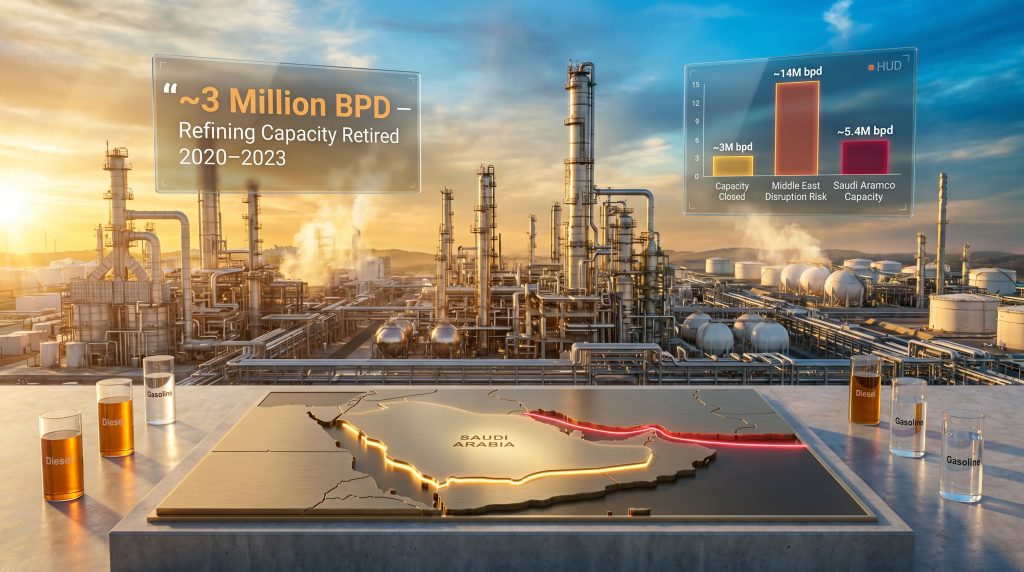
The scale of recent refining capacity destruction is significant by any historical measure. Approximately 3 million barrels per day (bpd) of global refining capacity was permanently closed between 2020 and 2023, according to remarks made by Musaab Al Mulla, Saudi Aramco's vice president of market analysis and sustainability, at the S&P Global Energy Middle East Petroleum and Gas Conference in London. Al Mulla indicated that had those refining assets been retained, the industry would have been substantially better positioned to absorb the supply shocks now affecting global petroleum product markets.
Key Data Snapshot
| Metric | Figure |
|---|---|
| Global refining capacity permanently closed (2020–2023) | ~3 million bpd |
| Middle Eastern crude supply removed by conflict and disruption | ~14 million bpd |
| Saudi Aramco refining capacity (domestic operations and joint ventures) | ~5.4 million bpd |
These closures were not the result of geological depletion or equipment failure. They were financial and strategic decisions, driven by a convergence of pandemic-era demand collapse, ESG-driven capital reallocation, and mounting investor pressure on oil companies to reduce their fossil fuel footprints. What made economic sense on a facility-by-facility basis in 2020 and 2021 has produced a systemic vulnerability at the industry level by the mid-2020s.
How the Investment Drought Developed
The underinvestment story in downstream oil did not begin with the pandemic. Its roots stretch back to the price collapse of 2014 to 2016, when oil fell from above $100 per barrel to below $30, destroying the economics of expansion projects across the value chain. Many refinery upgrade and greenfield development plans initiated in the high-price era were shelved, and capital budgets were cut across the industry.
What followed over the next decade was a fundamental shift in investor expectations. The growing influence of ESG (environmental, social, and governance) frameworks redirected institutional capital away from fossil fuel infrastructure at an accelerating pace. Simultaneously, ambitious energy transition timelines created a perception that oil demand would peak and then decline rapidly within the investment horizon of any new refinery project.
The critical flaw in this reasoning was the gap between projected and actual demand trajectories. Consumption in Asia, sub-Saharan Africa, and parts of the Middle East continued expanding on a path that bore little resemblance to the demand forecasts circulating in Western financial and policy circles. The result was a structural mismatch: investment decisions were made on the basis of demand pessimism while actual consumption remained resilient.
The Profitability Paradox in Refining
One of the more counterintuitive dynamics in the refining sector involves the relationship between margins and investment. Crack spreads, the metric used to measure refinery profitability by capturing the difference between crude input costs and refined product output prices, have periodically surged to multi-year highs in recent years. This has occurred precisely because capacity is constrained. Tighter capacity generates stronger margins for surviving refiners.
Yet these strong short-term returns have not translated into new capacity investment. However, several structural forces explain this persistent disconnect:
- Greenfield refinery projects require 5 to 10 years from final investment decision to first output, making them unattractive in an environment of policy uncertainty
- Shareholders in listed oil companies have consistently prioritised buybacks and dividend distributions over long-cycle capital expenditure
- Carbon pricing risk makes it difficult to underwrite the economics of assets with 30 to 40 year operational lifetimes
- Institutional debt markets have become increasingly reluctant to finance refinery construction at scale
The outcome is a sector generating strong short-run profitability precisely because insufficient long-run investment has destroyed the competitive supply response that would otherwise compress margins.
Downstream Investment Strategies: A Diverging Landscape
Not all actors in the oil industry have followed the same path. The retreat from downstream investment has been concentrated among international oil companies (IOCs) and independent refiners in OECD economies, while national oil companies (NOCs) in the Middle East and state-linked enterprises in Asia have maintained or expanded their downstream footprints.
| Entity Type | Investment Approach | Primary Driver |
|---|---|---|
| International Oil Companies (IOCs) | Selective asset divestment | ESG pressure, capital reallocation |
| National Oil Companies (NOCs) | Sustained downstream integration | Energy security, value-chain capture |
| Independent Refiners | Margin-driven opportunism | Short-cycle return optimisation |
| Asian and Middle Eastern New Entrants | Greenfield refinery development | Domestic demand growth, diversification |
Saudi Aramco oil refining underinvestment concerns are particularly significant given the company's downstream position. With approximately 5.4 million bpd of refining capacity across domestic facilities and international joint ventures, Aramco has maintained a substantial and growing downstream presence. Key domestic infrastructure includes the Jazan refinery complex, a major integrated facility on Saudi Arabia's Red Sea coast that forms a central pillar of Saudi Arabia's industrial diversification strategy.
Crucially, Aramco's own investment trajectory does not negate the industry-wide deficit. The fact that Saudi Aramco has continued to invest in refining capacity while simultaneously identifying a global shortage is not a contradiction. It confirms that the problem is concentrated among Western IOCs and OECD-based independent refiners, rather than distributed evenly across the global oil sector. In addition, OPEC's market influence over production decisions adds a further layer of complexity to how downstream investment signals are interpreted by the broader market.
Geopolitical Stress Testing: When Capacity Constraints Become Crises
The theoretical vulnerability created by refining underinvestment has become concrete in the context of Middle Eastern supply disruptions. War in Iran, attacks on energy infrastructure, the effective closure of the Strait of Hormuz, and a subsequent US naval blockade have collectively removed approximately 14 million bpd of Middle Eastern crude supply from global markets. Consequently, trade war oil impacts have compounded these pressures, further stressing an already stretched refining system.
This figure is not a scenario projection. It reflects actual volumes removed from the market under current conditions, and it stress-tests the global refining system with brutal efficiency.
Scenario Comparison: Capacity-Retained vs. Capacity-Constrained
Scenario A: If the 3 Million bpd Had Been Retained
- Spare refining throughput provides a partial buffer against crude supply disruptions
- Price volatility remains within historically manageable ranges
- Strategic petroleum reserve deployments function as supplementary tools rather than primary supply sources
- Refinery utilisation rates can absorb shocks without hitting operational ceilings
Scenario B: The Current Reality
- Every reduction in crude supply immediately compresses the volume of refined products entering markets
- Refinery utilisation rates across remaining capacity spike toward technical maximums, eliminating flexibility
- Price transmission from crude disruptions to consumer pump prices becomes near-instantaneous and disproportionate
- Strategic reserves are drawn down as primary supply instruments rather than as buffers
The Strait of Hormuz deserves particular attention as a chokepoint risk multiplier. Approximately 20% of global oil trade transits this narrow passage annually, and while alternative routing via Oman provides partial mitigation, it cannot substitute for Hormuz volumes at scale. When that transit route is disrupted, the already-constrained global refining system faces feedstock pressure simultaneously across multiple geographic nodes.
The next major ASX story will hit our subscribers first
The Carbon Capture Integration Pathway
One forward-looking mechanism that could partially resolve the investment impasse involves integrating carbon capture and storage (CCS) technology into refinery operations. By attaching CCS infrastructure to refinery emissions sources, operators can potentially extend the investment viability of both new and existing assets into a lower-carbon regulatory environment.
Saudi Aramco has itself invested in carbon capture-linked industrial infrastructure as part of its sustainability strategy, providing a working model for how large-scale hydrocarbon processing can be made more compatible with decarbonisation objectives. The economics of CCS-integrated refining remain challenging at current carbon prices in most jurisdictions, but as carbon pricing frameworks tighten globally, the relative attractiveness of CCS-enabled refinery investment is likely to improve.
This pathway is speculative in the sense that it depends on carbon pricing trajectories, technology cost curves, and regulatory frameworks that remain uncertain. It should therefore be treated as a directional possibility rather than a confirmed solution. For instance, the LNG supply outlook for 2025 demonstrates how similar long-cycle infrastructure decisions today are shaping energy availability across the next decade.
Frequently Asked Questions
What Does Saudi Aramco Oil Refining Underinvestment Mean in Practice?
It refers to the broader industry failure to allocate sufficient capital to refinery construction, maintenance, and expansion. Saudi Aramco itself has continued investing in downstream capacity, but the company's leadership has publicly identified the global refining sector as chronically underfunded relative to demand requirements. Notably, reporting on supply crunch risks highlights how senior Aramco executives have grown increasingly vocal about this structural gap.
Why Did So Much Refining Capacity Close Between 2020 and 2023?
The convergence of pandemic-era demand collapse, ESG-driven capital reallocation, energy transition narrative pressure, and shareholder preference for short-term returns made refinery closures financially rational at the facility level while creating a systemic vulnerability at the industry level.
What Is the Difference Between a Crude Supply Shortage and a Refining Capacity Shortage?
A crude supply shortage means insufficient raw oil is available for extraction or delivery. A refining capacity shortage means there is insufficient industrial infrastructure to convert available crude into usable petroleum products. The two are distinct bottlenecks requiring different policy and investment responses. Refining constraints can create fuel shortages even when crude is technically accessible.
How Long Does It Take to Build a New Oil Refinery?
From final investment decision to first operational output, greenfield refinery projects typically require between 5 and 10 years. This long construction timeline means capacity cannot be rapidly restored in response to sudden supply disruptions, making the case for sustained long-cycle investment planning rather than reactive capital deployment.
Does the Strait of Hormuz Closure Directly Affect Refined Product Availability?
Yes. The closure disrupts both crude feedstock flows to refineries that depend on Middle Eastern supply and the export of refined products from Gulf-based refineries. When this chokepoint is compromised alongside constrained global refining capacity, the combined effect on product availability and pricing is substantially amplified. Furthermore, any sustained oil price rally triggered by such disruptions places additional strain on downstream margins globally.
The Strategic Reckoning Ahead
The global refining capacity crisis is not a temporary disruption awaiting a market correction. It reflects a decade of decisions made rationally at the individual firm level but catastrophically at the systemic level. The retirement of ~3 million bpd of capacity between 2020 and 2023 occurred during a period when demand forecasters were consistently overestimating the pace of petroleum product displacement by renewable alternatives.
The result is an energy system that is structurally exposed to any significant supply disruption, not because crude is unavailable, but because the industrial infrastructure to convert that crude into products has been allowed to erode. Saudi Aramco oil refining underinvestment commentary from senior leadership represents one of the clearest signals from within the producing establishment that the industry has made a collective strategic error requiring deliberate correction.
Closing the gap will require a combination of long-cycle capital commitment, policy frameworks that de-risk refinery investment over 20 to 30 year horizons, and potentially CCS integration to make new downstream assets compatible with decarbonisation objectives. None of these solutions are quick, and none are cheap. The timeline for meaningful capacity recovery, measured in years rather than months, means that the vulnerability exposed by current Middle Eastern disruptions will persist well into the next decade regardless of how geopolitical conditions evolve.
This article contains forward-looking analysis and scenario projections that are subject to significant uncertainty. Nothing in this article constitutes financial or investment advice. Readers should conduct independent research before making any investment decisions related to the energy sector.
Want to Stay Ahead of the Next Major Energy and Resources Discovery?
Discovery Alert's proprietary Discovery IQ model scans ASX announcements in real time, instantly identifying significant mineral discoveries across more than 30 commodities — including those tied to the energy transition reshaping global refining and fuel markets — and delivering actionable insights directly to subscribers. Explore how historic discoveries have generated exceptional returns on Discovery Alert's dedicated discoveries page, and begin your 14-day free trial today to position yourself ahead of the broader market.